
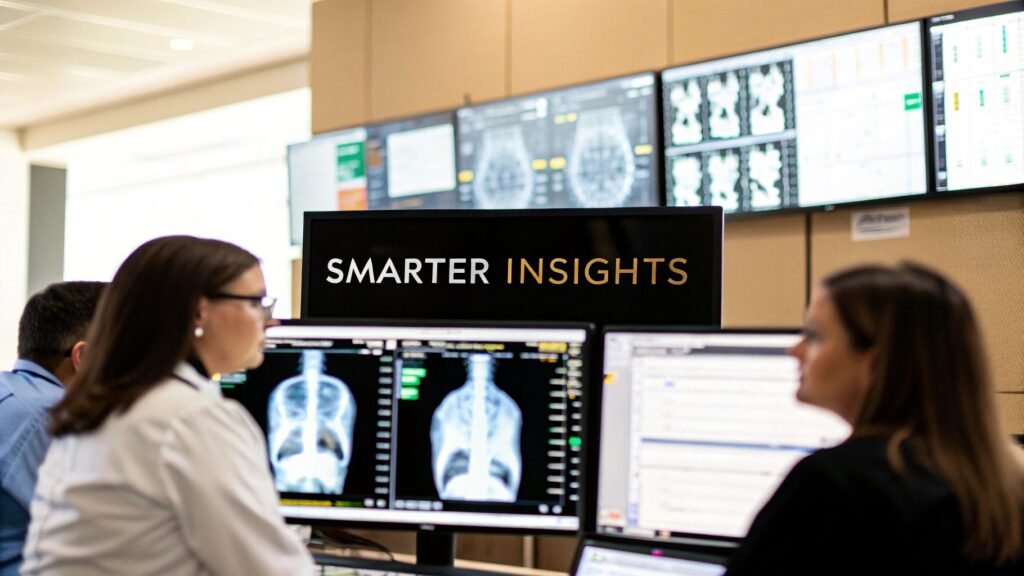
Aggregate data in healthcare is the mosaic: many anonymised sources combined into a population view — not one patient’s chart, and not the day-to-day ops of storing that chart. You step back from the tile so you can see the picture: incidence, utilisation, what happened to people like this one.
If you meant the lifecycle of running healthcare data day to day → healthcare data management. If you meant a cloud FHIR/DICOM/HL7 store → Google Cloud Healthcare API. If you meant whether the tiles themselves are trustworthy → data quality in healthcare. If you meant HIPAA transfer of a copy → HIPAA-compliant data transfer.
This page is what aggregation is, how you assemble it, and why population health cares. It is not a Google Cloud tutorial and not an HIE vendor list.
The mosaic
A visit, a lab, a claim, a scan, a wearable day — each is a tile. Aggregation is the disciplined combine: same definitions, identifiers that cannot walk back to a person, a schema you can query. The point is patterns you cannot see in one chart: an outbreak, a device that fails in a subgroup, a therapy that only works when the imaging phenotype matches.
| Source | What it adds | Why you combine it |
|---|---|---|
| EHR | Diagnoses, meds, labs, notes | Clinical course across a population |
| Imaging (DICOM) | Pixels plus study metadata | Training sets; markers too small for one reader’s memory |
| Claims | Procedures, cost, utilisation | What was billed vs what the chart said |
| Wearables / device | Continuous, between-visit signals | The week the clinic did not see |
| Trials / registries | Protocol outcomes, safety | External validity against real-world care |
Assembling the engine
- Ingest — EHR, PACS, claims, devices. Each speaks a dialect (HL7, FHIR, DICOM, X12). The engine has to speak them; this is not a CSV drop.
- Harmonise — map to a common model so “HbA1c” is one field. FHIR helps for clinical resources; DICOM stays DICOM until you extract what the study means.
- De-identify — strip or generalise direct identifiers until the set is no longer PHI for this use. Dates, rare diagnoses, and facial reconstructions on imaging are how re-identification sneaks back. Expert determination or Safe Harbor is a method, not a slogan.
- Store — a lake for raw exploration, a warehouse for the questions you already know. Most programmes use both.
Cloud healthcare APIs (FHIR / DICOM / HL7v2 stores) are one way to hold the harmonised layer. The Google Cloud product page is linked above if that is the job.
Privacy is the product constraint
Minimum necessary, purpose limitation, role-based access, encryption at rest and in transit, audit logs: the same HIPAA / GDPR grammar as everywhere else, applied to a dataset that is tempting to “just query.” A governance committee (clinical, IT, legal, ethics) decides which questions are in bounds. Aggregation without that committee is a research leak waiting for a journalist.
What it is for
- Population health — find the cohort, intervene before the admission.
- Diagnostics at scale — labelled imaging corpora so a model sees more cases than one department will ever read.
- Operations — flow, variation, cost, without waiting on a single-site extract.
- Trial feasibility — count eligible patients across sites in hours, not a year of chart review. That is feasibility, not running the trial’s EDC.
Start with one question (readmissions in one service line; one imaging phenotype) and two or three sources. Boiling the ocean is how these warehouses stall.
PYCAD implements imaging pipelines on top of DICOM / FHIR / PACS — including the viewer and training path that lets imaging into a mosaic. It is not a population-health platform. Case studies.