We built a custom dental platform that brings patient requests, clinical reporting, payments, AI segmentation, and DICOM viewing into one streamlined web-based workflow.
A specialized orthodontics and dental imaging provider needed a better way to manage requests from external dentists, produce reports, deliver outputs, and support advanced CBCT analysis. Their existing workflow relied on manual communication, email-based file exchange, and multiple disconnected tools.
The goal was to replace that fragmented process with a scalable platform where dentists could submit requests, upload files, pay online, receive reports, and analyze CBCT scans with AI-generated anatomical outputs inside a custom DICOM viewer.
Many specialized dental and orthodontic services still rely on manual workflows.
Dentists send requests by email. Files are exchanged manually. Clinical teams download, review, process, and send reports back through disconnected channels. Payments are handled separately. Outputs are scattered across inboxes, local folders, and third-party tools.
For a clinic providing specialized orthodontic reporting and CBCT-based analysis, this creates several problems:
The client already had valuable services: superimposition reporting, cranio-cephalometric reporting, and CBCT segmentation. But the workflow around these services was too manual.
The real challenge was not only to build another viewer or another upload form. The challenge was to create one platform where the full workflow could happen — from request to payment to clinical output.
The goal was to help the clinic turn its specialized dental services into a scalable digital platform.
Instead of handling each request through email and manual coordination, dentists would be able to create an account, submit a service request, upload the required files, pay through the platform, and receive the final report or segmentation outputs in one place.
For the clinic team, the platform needed to centralize incoming requests, make it easier to process cases, upload final reports, and deliver outputs back to the referring dentist.
For CBCT segmentation, the platform also needed to go beyond simple file delivery. Users needed to open the original scan and AI-generated outputs directly inside a web-based DICOM viewer with specialized 2D and 3D tools.
We built a web-based dental platform with three main modules:
Each module was designed around a real clinical service that the client already provided, but moved into a structured digital workflow.
Superimposition reporting was one of the clinic’s existing services. Before the platform, dentists could request this service manually, usually through email or direct communication.
We transformed this into a platform-based workflow. A dentist can create an account, submit a superimposition request, upload the required files, and send the case directly to the clinic team. The team can then review the request, create the report, upload the final output, and make it available to the dentist from the same platform.
This reduces back-and-forth communication and gives both sides a clearer view of the case status.
The cranio-cephalometric reporting module follows a similar workflow.
Dentists can submit a request, provide the necessary patient data and imaging files, and receive the completed report through the platform. The clinic team can manage these requests from a centralized dashboard instead of relying on email threads and manual file handling.
This makes the reporting service easier to manage, easier to scale, and easier for external dentists to use.
The segmentation module is the most advanced part of the platform.
It allows users to upload a CBCT scan and process it through AI segmentation APIs built and deployed for the client. These APIs automatically generate anatomical segmentations for key dental and maxillofacial structures, including:
Once the AI processing is complete, the platform generates the necessary output files and makes them available to the user.
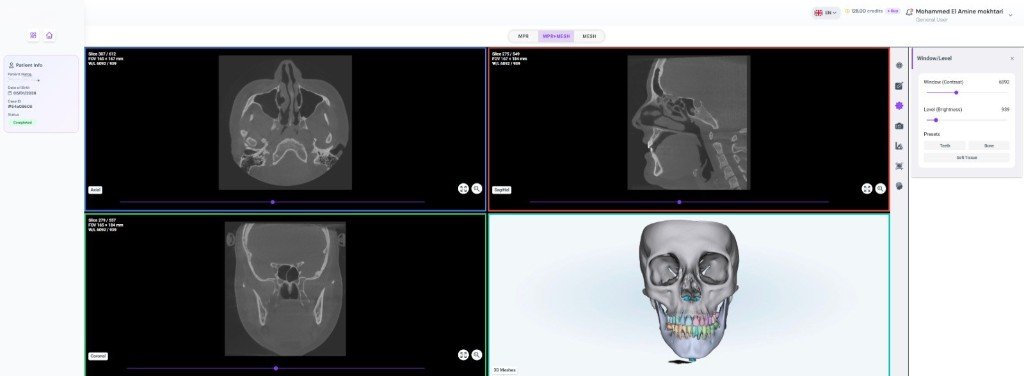
But the workflow does not stop at downloading files. The user can open the original CBCT scan and the AI-generated outputs directly inside a custom web-based DICOM viewer.
The platform includes a custom DICOM viewer designed for dental CBCT analysis.
The viewer allows dentists to inspect the original scan together with the segmentation outputs in both 2D and 3D. This gives users a more complete understanding of the patient anatomy and supports deeper analysis directly inside the browser.
The viewer was built to support dental-specific workflows, including the ability to review CBCT data, inspect segmented anatomical structures, and work with outputs generated by the AI pipeline.
This turns the platform from a simple request-management tool into a full clinical analysis environment.
A key part of the platform was streamlining the business workflow around the clinical services.
Instead of handling payments separately, the platform allows dentists to pay for services directly within the workflow. This connects the service request, uploaded files, clinical work, payment, and final delivery in one place.
For the clinic team, this creates a more organized internal process. For the referring dentist, it creates a cleaner experience: submit the case, pay, wait for processing, and receive the result.
The platform helps the clinic move from manual service delivery to a scalable digital workflow.
Before, growth was limited by operational friction: emails, file exchanges, manual tracking, separate payments, and disconnected tools.
With the new platform, the clinic can serve more dentists, process more cases, and deliver more advanced services without increasing operational complexity at the same rate.
It also creates a foundation for expanding the platform in the future with more AI tools, more reporting services, more viewer features, and more automated clinical workflows.
The result is a custom dental platform that brings together clinical service delivery, AI segmentation, payment, and imaging review into one unified workflow.
The clinic can now manage requests from external dentists more efficiently, deliver reports through a structured process, and offer advanced CBCT segmentation tools through a web-based experience.
For dentists, the platform reduces friction. They no longer need to manage scattered communication, separate payments, and disconnected files. They can request services, upload scans, pay, and access outputs from one place.
For the clinic, the platform creates the operational foundation needed to scale its specialized orthodontic and dental imaging services.
We build web-based DICOM viewers, AI segmentation workflows, reporting systems, and full medical imaging platforms for dental, orthopedic, and healthcare companies.