
We developed an on-premise forensic imaging platform that brings case management, PACS integration, advanced DICOM viewing, AI segmentation, pathology workflows, and report generation into one connected system.
Virtual autopsy is not only a technical advancement. It is also a way to preserve the dignity of the deceased.
Instead of relying only on invasive physical autopsy procedures, forensic teams can use CT imaging and digital analysis to examine the body in a non-invasive way. But for virtual autopsy to reach the level of detail required in forensic pathology, teams need more than a basic image viewer. They need advanced tools for imaging, analysis, annotation, reporting, and collaboration.
Many forensic information systems were built before modern medical imaging AI became practical. As a result, they often struggle to support advanced virtual autopsy workflows.
The imaging data may be rich, but the surrounding tools are often fragmented, outdated, or not designed for AI-assisted forensic analysis.
The client needed a system that could support the full virtual autopsy workflow: case intake, CT scan management, radiographer and pathologist collaboration, forensic DICOM review, AI-assisted analysis, snapshot capture, and structured reporting.
The goal was to help forensic teams perform deeper non-invasive analysis and generate richer reports while respecting the dignity of the deceased.
The platform had to bring several complex components together:
The difficulty was not one feature. The difficulty was making all of these components work together reliably in one controlled environment.
We built the data-management layer for handling forensic cases, users, roles, and workflow steps.
Radiographers could upload and manage imaging studies, pathologists could review cases and findings, and second-opinion pathologists could participate in the diagnostic workflow.
This gave the client a structured foundation for managing virtual autopsy cases from intake to final report.
The system was connected to a medical imaging archive so CT scans could be stored, retrieved, and reviewed directly inside the forensic workflow.
Instead of keeping imaging data separate from case data, the platform connected the imaging layer with the operational workflow of the forensic team.
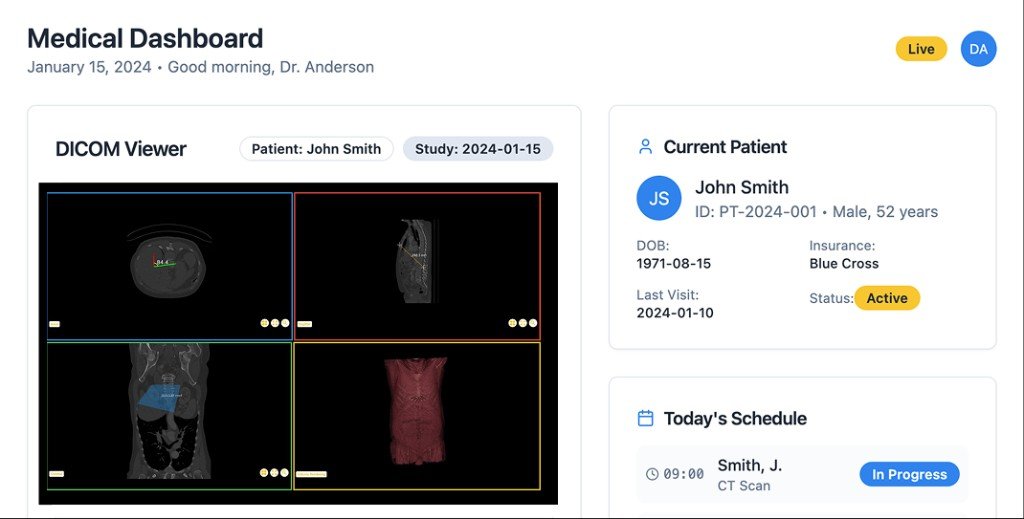
We developed a custom DICOM viewer adapted to forensic pathology use cases.
The viewer included tools for reviewing CT scans, annotating findings, pointing to anomalies, capturing regions of interest, and generating snapshots that could later be used in the final forensic report.
Specialized tools were added for forensic analysis, including support for detecting and reviewing bullet-like findings in CT scans.
The platform included AI segmentation of more than 100 anatomical structures.
This allowed the forensic team to move beyond basic image viewing and perform richer analysis of the body using automated anatomical context.
We also implemented an LLM-assisted reporting component.
The system could take structured information entered by the pathologist and generate a clear summary of the pathology report, helping transform detailed findings into a more understandable final narrative.
Because the system handled sensitive forensic data, deployment had to be on-premise.
We tested multiple hardware and machine configurations to find a setup that could run the full platform locally: case management, PACS integration, DICOM viewing, AI segmentation, and LLM-assisted reporting.
The final deployment balanced performance, cost, and operational manageability.
The result was a connected forensic information system for virtual autopsy.
Instead of using separate tools for case management, image storage, DICOM viewing, AI analysis, and report writing, the client had a unified platform designed around the actual forensic workflow.
The system helped support deeper non-invasive analysis, richer forensic reports, and a more modern approach to virtual autopsy.
If your team needs a custom imaging platform with DICOM viewing, PACS integration, AI analysis, reporting workflows, and deployment, PYCAD can help you design and build it.