
A custom medical imaging platform for an orthopedic implant manufacturing company in Asia, designed to consolidate large CT study viewing, AI-assisted segmentation, and planning into a more efficient workflow, with a foundation ready to grow into reporting.
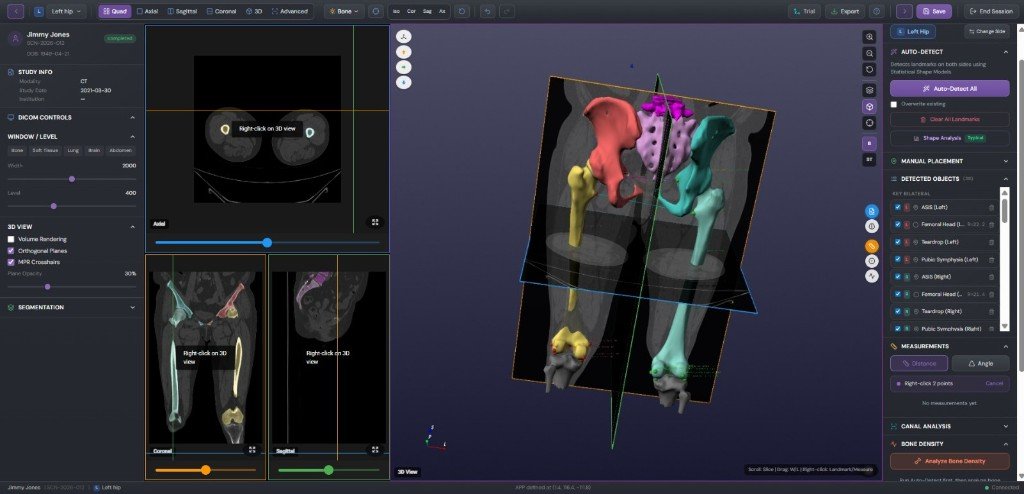
Patient-specific implant workflows depend on multiple technical steps: receiving imaging data, reviewing CT studies, segmenting anatomy, planning around the patient anatomy, preparing outputs for manufacturing, and generating reports for internal and clinical review.
For many implant manufacturers, these steps happen across separate tools. The medical images may live in one system, viewing may happen in another, segmentation in a different application, planning in a CAD-oriented workflow, and reporting in yet another tool.
This fragmentation creates operational drag. Teams lose time moving data between systems, repeating manual steps, checking whether outputs match the latest imaging context, and preparing reports from screenshots or disconnected planning data.
The challenge was not only viewing CT scans. It was helping the team move toward a consolidated workflow for patient-specific implant production.
PYCAD built a custom cloud-based medical imaging platform focused on the client’s implant planning workflow.
The platform brings together key pieces of the workflow in one controlled environment, reducing the need to jump between disconnected tools.
Large CT studies are uploaded, organized, and prepared for review.
A custom DICOM viewer supports efficient review of heavy imaging datasets.
Automatic segmentation helps convert imaging data into usable anatomical context.
Planning workflows are brought closer to the imaging data, with the foundation in place to extend into reporting later.
The client works with large CT datasets, including full-body CT studies that can exceed 1 GB per study.
For this type of workload, a normal browser-only viewer can create performance and loading challenges for users.
To address this, the platform uses a custom DICOM viewer architecture built around server-side rendering. This allows heavy imaging data to be processed on the server side while users interact with the study through a web interface.
The platform includes AI-powered automatic segmentation to reduce repetitive manual work and help the team move faster from raw imaging data toward anatomy-aware planning workflows.
We intentionally keep the exact segmentation engine and internal implementation details private, while focusing on the business value: faster preparation of imaging data for downstream implant planning.
The goal is to keep the planning context close to the imaging context.
Instead of treating viewing, segmentation, and planning as separate islands, the platform connects these steps inside one workflow — and lays the groundwork to bring reporting into the same place over time.
This helps the team reduce manual transfer work, improve consistency, and build a more scalable process for patient-specific implant cases.
For implant manufacturers, productivity is not only about faster software.
It is about helping engineering and clinical teams move from patient imaging to a manufacturable plan with fewer disconnected steps.
A consolidated platform gives the team a stronger foundation for scaling patient-specific implant workflows while keeping the experience aligned with their internal process.
Tell us about your imaging workflow and we’ll show you what a consolidated platform could look like.