
Picture this: a hospital where every department speaks a different language. The radiology team has vital scans, but they can't easily share them with cardiology. A patient’s decade-old medical images are locked away in an obsolete system from a vendor who's long gone. This isn't just a hypothetical problem—it's the frustrating reality for many healthcare providers.
This kind of fragmentation is more than just an inconvenience. It's a direct obstacle to providing the best possible care. When a doctor needs a complete picture of a patient's history, they're forced to hunt through multiple systems, wasting precious time and risking an incomplete diagnosis. This is the challenge of traditional medical imaging, where data is held hostage by proprietary Picture Archiving and Communication Systems (PACS).
This is exactly where a Vendor Neutral Archive (VNA) changes the game.
Breaking Down Healthcare Data Silos
A VNA acts as a universal translator for all that disconnected medical imaging data. It’s not just another storage drive; it’s a strategic move that gives healthcare organizations true ownership and control over their patient information, creating a single, unified, and future-proof home for every medical image.
So, What Exactly Is a VNA?
Think of a VNA as a central library for all medical images, designed from the ground up to speak a common language. It takes in images from every possible source—CT scanners, MRIs, digital pathology slides, you name it—and stores them in a standard format through a standard interface.
This simple but powerful concept creates a single source of truth, unlocking some incredible advantages:
- A Unified Patient Record: Clinicians finally get a complete, longitudinal view of a patient’s entire imaging history, no matter where or when the images were originally captured.
- True Vendor Independence: It liberates your organization from vendor lock-in. You're no longer trapped with a single PACS vendor, which means you can switch or upgrade systems without facing a nightmare of costly and complex data migrations.
- A Future-Proof Foundation: It builds a stable, scalable infrastructure that’s ready for whatever comes next, whether it’s advanced AI algorithms or brand-new imaging technologies.
The Foundation for Modern Tools
This centralized archive becomes the engine for modern tools that depend on having easy access to comprehensive data. To truly achieve interoperability and tear down those data silos for good, robust and secure healthcare data management is non-negotiable.
By separating the storage layer from the viewing applications, a VNA gives organizations the freedom to adopt the best tools for specific clinical needs. It's all about choosing the right tool for the job, without being held back by a single vendor's limited offerings.
This is the exact environment where our solutions at PYCAD come alive. We at PYCAD, build custom web DICOM viewers and integrate them into medical imaging web platforms. A well-designed VNA provides the perfect, standardized backend, allowing our viewers to pull up any patient image securely, regardless of its origin.
The industry is moving decisively in this direction. The global VNA market is expected to rocket from USD 3.3 billion in 2025 to nearly USD 11.5 billion by 2035. This massive growth underscores the shift toward a more connected and open healthcare ecosystem, a core concept we dive into on our portfolio page: https://pycad.co/portfolio.
How a Vendor Neutral Archive Really Works
Let's pull back the curtain on how a Vendor Neutral Archive actually operates. Forget the hospital setting for a moment and think about the plumbing in your house. You have a central network of pipes that can connect to any brand of faucet, showerhead, or appliance you want. A VNA is that core plumbing—a standardized, independent infrastructure for your medical images, completely separate from the applications you use to view them.
Its whole purpose is to end the painful cycle of vendor lock-in. A VNA does this by taking in medical images from all kinds of sources—CT scanners, MRI machines, digital pathology systems, you name it—and translating them into a universal format. This creates one unified, long-term home where your data lives by your rules, not a vendor's.
What this means is your organization keeps total ownership and control over its patient data. Forever.
The Core Components of a VNA
A VNA isn't just a giant hard drive; it's a sophisticated system with a few key parts working in harmony. Each piece has a specific job, and together, they turn a simple storage box into a powerful enterprise asset.
These are the foundational pillars that make a VNA tick:
- An Integration Engine: Think of this as the system's universal translator. It fluently speaks healthcare languages like HL7 for patient data and understands IHE profiles for interoperability, making sure images and their related info flow smoothly between different systems.
- A Secure, Standardized Repository: This is the heart of the VNA. It stores every image in a non-proprietary format, most often DICOM. By doing this, it guarantees that any compliant viewer or system can access the data, today and decades from now. To get a better handle on this critical format, check out our deep dive on DICOM standards.
- Intelligent Lifecycle Management: This is the automated data governor. It sets and enforces rules for how long data is kept, when it's purged, and where it's stored—automatically moving older, less-used data to cheaper storage. This ensures you stay compliant with regulations like HIPAA without lifting a finger.
This diagram shows perfectly how a VNA smashes through data silos, turning isolated pockets of information into a single, accessible asset.
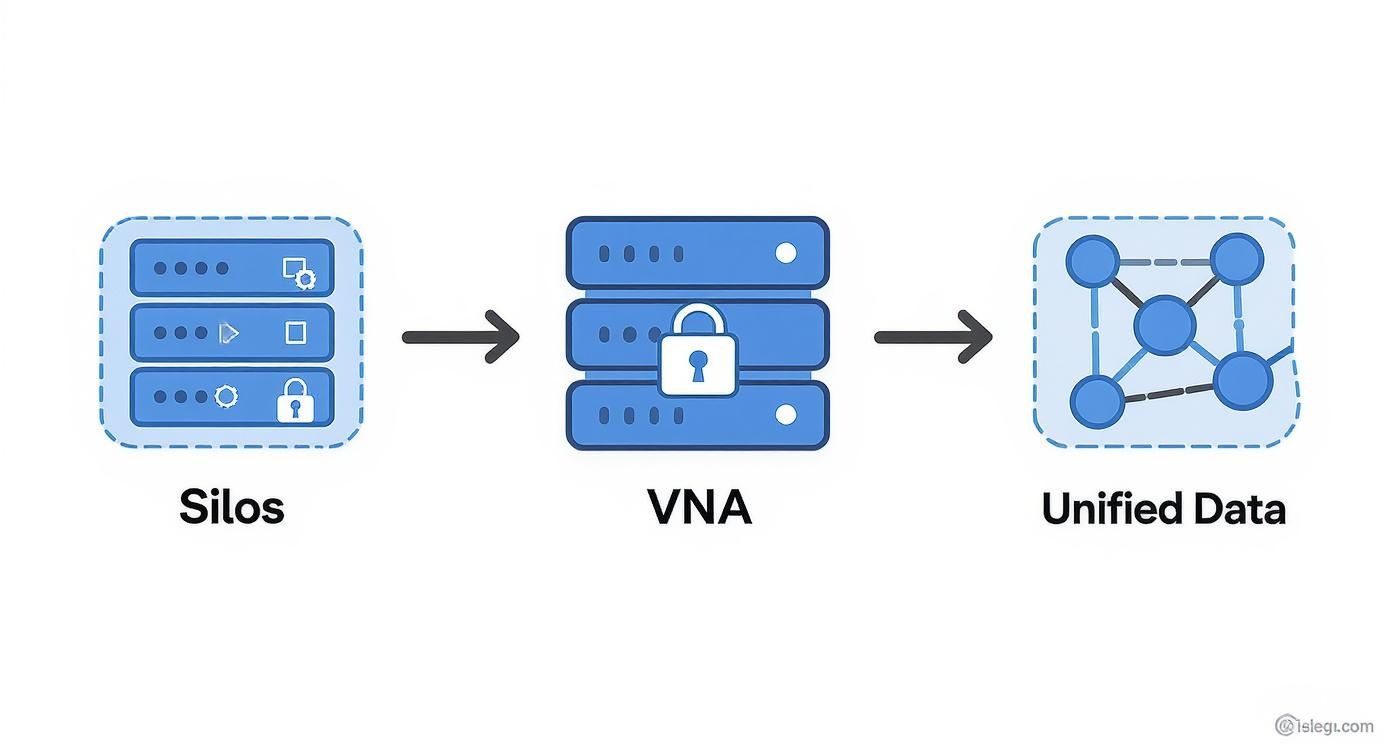
You can see the VNA acting as that central, secure hub, standardizing information from all over the place into one clean, cohesive data stream.
Data Liberation in Action
This kind of architecture is what makes advanced tools, like the ones we build at PYCAD, possible. We at PYCAD, build custom web DICOM viewers and integrate them into medical imaging web platforms, giving clinicians instant, browser-based access to patient images. The VNA is the perfect engine for this, feeding our viewers a standardized stream of data that’s always on and always complete.
The real magic of a vendor neutral archive is its ability to separate your long-term archival strategy from your short-term clinical workflow tools. You can upgrade a departmental PACS or plug in a new AI diagnostic tool without ever having to touch the underlying archive.
This separation is incredibly freeing. A hospital might choose a best-in-class viewer for its cardiology department and a completely different one for oncology, with both pulling images from the same central patient record. That freedom to pick the absolute best tool for the job is a direct result of the VNA’s vendor-agnostic design. It’s the key to building a resilient, adaptable, and forward-thinking health-tech ecosystem.
VNA vs. PACS: More Than Just Storage
It's a question I hear all the time: isn't a Vendor Neutral Archive just a giant PACS? It’s an easy mistake to make, but it misses the entire point. While both systems manage medical images, their core philosophies are worlds apart.
Think of it like this: a PACS is a speedboat. It's built for the fast, demanding, real-time work of a specific department, like radiology or cardiology. It’s all about speed and immediate diagnostic workflow within its own little world.
A Vendor Neutral Archive (VNA), however, is the cargo ship. Its grand mission is to build a single, unified, and permanent imaging record for the entire patient journey. It consolidates data from every department, every facility, and every specialty, focusing not on the immediate workflow but on the long-term health, accessibility, and control of your most valuable data.
Why This Distinction Matters
The real difference lies in their DNA. A traditional PACS is often a closed garden, tightly coupled with its vendor's technology and sometimes using proprietary data tags. This makes it powerful for its intended department, but it also creates silos and vendor lock-in.
A VNA is designed from the ground up to be open. It ingests imaging data from any source, strips away the proprietary junk, and standardizes it. This means any compliant system can access and understand the images, now and in the future. The rise of VNAs was a direct answer to the frustrations of walled-off PACS, aiming to finally separate the storage of images from the applications that view them. This seemingly simple change has profound implications for data ownership and interoperability. To really get a sense of this evolution, you can dig into the technical history of VNA technology.
To truly grasp the strategic advantage of a VNA, let’s look at how they stack up against a traditional PACS in a head-to-head comparison.
Vendor Neutral Archive vs PACS: A Strategic Comparison
This table breaks down the fundamental differences between a VNA and a traditional PACS across key strategic and operational domains.
| Attribute | Traditional PACS | Vendor Neutral Archive (VNA) |
|---|---|---|
| Primary Goal | Departmental workflow efficiency (e.g., radiology) | Enterprise-wide image data consolidation and lifecycle management |
| Data Control | Vendor-dependent; often uses proprietary data structures | Vendor-independent; standardizes data for true ownership and control |
| Scope | Siloed to a specific department or "ology" | Enterprise-wide, spanning all departments and facilities |
| Interoperability | Limited; designed to work within its own vendor ecosystem | High; designed to integrate with any standards-compliant system |
| Data Migration | Costly and complex; required when changing PACS vendors | Simplified; decouples storage from applications, minimizing migration needs |
| Scalability | Scalable within a department, but not across the enterprise | Designed for massive, long-term enterprise scalability |
| Long-Term Strategy | Tactical tool for immediate diagnostic tasks | Strategic asset for long-term data archiving and enterprise imaging |
As you can see, the choice isn't just about technology; it's about whether you want a short-term tool or a long-term, foundational asset for your entire organization.
The Home Renovation Analogy
Let's try another angle. Picture your hospital's IT as a house. A traditional, monolithic PACS is like having a kitchen where the stove, fridge, and dishwasher are all hardwired directly into the walls. If you want a new, better stove, you can't just swap it out—you have to tear out the walls, plumbing, and electrical for the entire kitchen. That’s vendor lock-in. The "renovation" is a painful and expensive data migration.
Now, imagine a VNA as the modern electrical and plumbing infrastructure of that house. It provides standardized, universal outlets in every room. You can plug in a best-in-class stove in the kitchen, a different brand of washer in the laundry room, and upgrade either one whenever you want without disturbing the foundation. The VNA is that core infrastructure.
This strategic separation of storage from application is the VNA's greatest strength. It transforms medical imaging from a series of isolated, vendor-controlled systems into a cohesive, enterprise-wide asset that your organization truly controls.
This freedom is the bedrock of what we do at PYCAD. We at PYCAD, build custom web DICOM viewers and integrate them into medical imaging web platforms. A VNA provides the stable, standardized data source our viewers need to deliver a complete patient history to clinicians, on any device, anywhere.
Better Together: The Ideal Partnership
The ultimate goal isn't necessarily to rip and replace every PACS. In fact, the most forward-thinking strategy is to let them work in harmony.
The departmental PACS can continue to be the speedboat, handling the high-speed daily grind. Meanwhile, the VNA acts as the central, long-term archive—the single source of truth for all imaging data. This two-platform approach gives you the best of both worlds: clinicians get the speed and workflow they need, while the enterprise gains the data freedom it deserves. You can see just how powerful these integrated systems can become by looking at our portfolio of work.
Unlocking Your True Return on Investment
Bringing a Vendor Neutral Archive into your health system isn't just another IT project. It's a fundamental strategic shift, a move that turns your medical imaging from a constant cost drain into a powerful asset for growth, efficiency, and ultimately, better patient care. The benefits aren't siloed; they cascade across your entire organization, creating a ripple effect that touches everything you do.
Let's dive into the four core ways a VNA delivers a powerful, measurable return on that investment.
The Financial Advantage
The most obvious win is the financial freedom you reclaim. For far too long, hospitals have been stuck paying exorbitant data migration fees—often hundreds of thousands, sometimes millions, of dollars—every time they want to switch their PACS. A VNA shatters those chains.
By centralizing and standardizing your imaging data, a VNA makes that first big data migration the last one you’ll ever have to do. It’s a one-time effort that puts an end to the endless cycle of vendor-driven migration costs.
This newfound independence is a game-changer. Suddenly, you have real negotiating power. You can pick and choose the best tools for each department based on what they actually need, not on who has your data locked away. Over time, this adds up to significant cost savings and a much more flexible, competitive tech environment.
The Clinical Breakthrough
On the clinical side, the ROI is measured in something far more valuable than dollars: diagnostic confidence and better patient outcomes. We've all seen physicians struggle to assemble a complete patient history, digging through disconnected systems to find prior studies. A VNA puts an end to that hunt by creating a single, lifelong patient imaging record.
Think about a cardiologist prepping for a complex procedure. With just a click, they can pull up not only the latest cardiac images but also a chest CT from radiology and a vascular ultrasound from an affiliated clinic—all in one place. This complete picture leads to:
- Sharper Diagnoses: Clinicians with the full story make better, more informed decisions.
- Fewer Redundant Scans: Easy access to historical images helps avoid unnecessary repeat exams, cutting costs and reducing patient radiation exposure.
- Effortless Collaboration: Specialists from different departments can finally look at the same comprehensive record, making care coordination seamless.
The Operational Empowerment
Operationally, a VNA is like oil for a rusty machine. It gets workflows moving that were once clunky and inefficient. Data starts flowing freely between departments, across facilities, and even to outside partners, tearing down the walls that slow everything down. Your IT team is finally freed from the nightmare of managing dozens of fragile, point-to-point connections between systems.
This kind of data liquidity translates directly into faster report turnaround times, smoother patient transfers, and simpler image sharing for second opinions. The entire pace of the organization picks up, letting your staff focus on what they do best—caring for patients—instead of wrestling with technology. For a deeper look at achieving this kind of smooth data flow, you can explore our detailed guide on data migration best practices.
The IT and Innovation Engine
And for your IT team? A VNA delivers a secure, scalable, and simplified architecture that’s ready for whatever comes next. Centralizing management slashes administrative overhead, while the standards-based core strengthens your security and compliance posture. It’s the solid foundation you need to build the future of your health system.
This is where we at PYCAD get really excited. We at PYCAD, build custom web DICOM viewers and integrate them into medical imaging web platforms, and a VNA is the perfect engine to power them. It feeds our advanced viewers the clean, consolidated data they need to serve up a complete patient history on any device, anywhere. A vendor neutral archive doesn't just hold your data; it gets it ready for the next wave of healthcare innovation.
Powering the Next Generation of Health Tech
Think of a Vendor Neutral Archive as less of a digital filing cabinet and more of an active launchpad for the future of medicine. This is where the true power of unified data comes alive, turning what was once a static repository into a dynamic engine for discovery and better care. By creating a single, standardized source of truth for all imaging data, a VNA provides the clean, organized fuel that the most demanding applications in health tech need to run.
This centralized data hub is the perfect partner for the tools we build at PYCAD. Our specialty is creating custom web DICOM viewers and integrating them into medical imaging web platforms, which gives clinicians browser-based access to a patient’s complete imaging history. A VNA is the ideal backend for this, allowing our viewers to securely pull any study from any source and create a completely seamless diagnostic experience.

Fueling Artificial Intelligence and Machine Learning
Artificial intelligence is set to completely reshape diagnostics, but even the most brilliant algorithms are worthless without high-quality data. To learn how to spot patterns and anomalies, AI models need to be fed massive, diverse, and well-organized datasets. A VNA is the ultimate data source for this very purpose.
It breaks down the walls between departmental silos, consolidating decades of imaging studies into one accessible pool. This gives AI developers the rich, longitudinal data they need for:
- Algorithm Training: Feeding models a huge variety of images from different modalities and patient demographics to improve their accuracy and reduce bias.
- Validation and Testing: Using historical data to rigorously test new algorithms against real-world clinical scenarios before they ever touch a live patient environment.
- Clinical Decision Support: Once in use, AI tools can analyze new studies flowing into the VNA, flagging potential issues for radiologists and offering critical insights right at the point of care.
The market’s confidence in this synergy is crystal clear. A 2024 valuation pegged the global VNA market at around USD 3.7 billion, with projections showing it will climb to roughly USD 6.1 billion by 2034. This steady growth highlights the essential role VNAs play in supporting data-hungry technologies like AI.
Creating a Truly Unified Patient Record
The ultimate goal in health IT has always been to create a single, comprehensive patient record that follows an individual throughout their entire care journey. A VNA is a cornerstone of this vision, acting as the definitive imaging library for the Electronic Medical Record (EMR).
By integrating seamlessly with your EMR, a VNA allows physicians to launch a powerful imaging viewer directly from the patient’s chart. This simple action connects textual records with rich visual data, painting a complete clinical picture.
This deep integration means clinicians no longer have to log into separate systems, which saves precious time and reduces the risk of overlooking critical information. It ensures that every provider, from a primary care physician to a specialist surgeon, has the full context needed to make the best possible decisions.
Beyond the foundational role of VNAs in unifying data, other innovations are also crucial for a modern healthcare system. For example, technologies that streamline data input are driving huge advancements in healthcare documentation automation.
Ultimately, a vendor neutral archive transforms stored images from passive historical records into active, intelligent assets. It’s the critical infrastructure that unlocks the full potential of advanced viewers, predictive AI, and integrated patient records. When you invest in this foundation, you aren't just modernizing storage—you're building the future of diagnostics and patient care.
How to Choose the Right VNA Partner
Choosing a Vendor Neutral Archive isn't like buying a new piece of software. It’s a foundational decision that will echo through your organization's data strategy for the next decade, maybe even longer. This is about forging a long-term partnership, so you have to look past the glossy brochures and slick presentations to find a partner who is genuinely committed to your data freedom.
Your mission, should you choose to accept it, is to find a partner whose technology and philosophy are perfectly in sync with your goal of true independence. It starts with a detailed, no-nonsense evaluation to ensure the solution you pick will not only secure your data but also fuel your organization’s growth without holding you back.
Is It Really Vendor Neutral?
You’ll hear the term "vendor neutral" thrown around a lot. But what does it actually mean? True neutrality isn't a feature—it's the bedrock of the entire system. The real test is digging in to see if the system uses any proprietary data formats or hidden "gotcha" tags that could trap your data down the road.
When you're talking to potential partners, don't be afraid to ask the hard questions:
- Data Standards: Does the system store every single image in a standard format like DICOM, without any proprietary wrappers?
- Interface Protocols: Are you exclusively using industry-standard interfaces like DICOM C-STORE, C-FIND, and C-MOVE for all data exchange?
- Data Tag Management: How do you handle the mess of different vendor-specific DICOM tags during ingestion? How do you make sure everything is standardized and consistent?
A genuinely neutral VNA cleans up and standardizes data the moment it comes in, making it universally available to any compliant system you might want to use in the future.
Building for the Future, Not Just for Today
Your VNA has to be more than a digital filing cabinet for today's images. It needs to be an adaptable platform ready for tomorrow's challenges, whether that's an explosion in data volume or the need to integrate entirely new types of medical information. Think about your long-term vision when you’re comparing your options.
A forward-thinking vendor neutral archive should be a launchpad for innovation, not just a digital warehouse. It must be prepared to handle non-DICOM data and serve as the backbone for advanced applications like AI and enterprise-wide viewers.
This is exactly where we at PYCAD live and breathe. We at PYCAD, build custom web DICOM viewers and integrate them into medical imaging web platforms, and a well-chosen VNA is the perfect engine to power these tools. A solid VNA ensures that our viewers can pull up a complete, standardized patient record, which is absolutely critical for better, faster diagnostics.
Your Essential Evaluation Checklist
To make a smart, strategic choice, you need to evaluate potential partners across several key areas. Getting this right means finding a partner who can support your clinical, operational, and technical goals for years to come.
Here’s a practical checklist to guide your decision-making process:
- Interoperability Standards: Confirm that they have deep support for critical healthcare standards that go beyond DICOM, including HL7 and IHE profiles. This is non-negotiable for seamless communication with your EMR and other clinical systems.
- Scalability and Deployment: Can their architecture—whether it's cloud, on-premise, or a hybrid model—scale cost-effectively as your data grows? You don't want any surprise costs later.
- Security and Compliance: Demand proof of their security measures. They must be able to demonstrate robust compliance with regulations like HIPAA to ensure your patient data is locked down tight.
- Support for Non-DICOM Data: What’s their game plan for managing and integrating non-DICOM data? Think digital pathology slides, surgical videos, and even PDFs. All of it needs a home in the patient record.
- Integration Capabilities: Ask for their track record. Have they successfully integrated with emerging technologies, especially AI and machine learning platforms?
Using this framework helps you cut through the noise and find a true partner who’s as invested in your data’s freedom as you are. To see what’s possible when you build on a strong data foundation, take a look at some of the advanced integrations we've created on our portfolio page.
Common Questions About Vendor Neutral Archives
Making the leap to a Vendor Neutral Archive is a big move, and it's totally normal to have a lot of questions. Thinking through how this kind of technology will plug into your current setup is the first step toward seeing just how much it can do for you. Let's tackle some of the most common questions we hear from teams on this journey.
Getting these answers straight can clear up a lot of the fog, lighting up the path to true data freedom and opening the door for real innovation.
How Does a VNA Impact Clinical Workflows?
This is the big one. Will this new system throw a wrench in our daily routines? The short answer is, a well-implemented vendor neutral archive should feel almost invisible to clinicians. It works quietly in the background, becoming the single source of truth for all your imaging data.
Your departmental PACS remains the go-to tool for radiologists and specialists. The difference is that it's now supercharged with instant access to a patient's entire imaging history. This actually enhances the workflow, it doesn't disrupt it. Clinicians get a much richer, more complete picture of a patient's journey without having to change the tools they already know and trust.
Are VNAs Only for Large Hospital Networks?
That's a myth we need to bust. While it's true that massive, multi-site health systems get huge benefits from a VNA, the technology is incredibly scalable. It offers game-changing value to organizations of every size, from standalone imaging centers to specialty clinics and smaller community hospitals.
The core benefit—breaking free from vendor lock-in and future-proofing your data—is universal. For a smaller organization, a VNA provides a powerful foundation for growth. It ensures that as you expand or bring in new imaging tools, your data stays secure, accessible, and completely under your control.
The biggest hurdle in adopting a VNA is usually the initial data migration. It’s a process that requires careful planning and a lot of validation, but it’s a one-time effort that puts a permanent end to the expensive, painful cycle of migrating data every single time you switch vendors.
At PYCAD, we see this transformation up close. We at PYCAD, build custom web DICOM viewers and integrate them into medical imaging web platforms, giving clinicians the tools they need to make faster, more confident decisions. That kind of seamless access is only possible when all the data lives in one unified place.
Ready to build a platform that harnesses the power of unified data? Explore our work at PYCAD and see how we create advanced medical imaging solutions. You can check out our projects on our portfolio page.