
Ever felt like your medical imaging data was trapped? Locked away in separate systems, unable to talk to each other, making a complete patient picture almost impossible to assemble? This is a common struggle in healthcare, and it's precisely the problem a Vendor Neutral Archive (VNA) was designed to solve.
Think of a VNA as the ultimate digital library for a patient's entire imaging history. It’s not just storage; it’s a smart, centralized hub that gathers, standardizes, and manages every clinical image—from X-rays and MRIs to pathology slides and dental scans—in one unified repository.
So, What Is a VNA, Really?
Imagine a hospital where radiology, cardiology, and dermatology all use different imaging systems from different manufacturers. Without a VNA, each department’s data is siloed, speaking its own proprietary language. Trying to get a holistic view of a patient's health is a logistical nightmare.
A VNA steps in to be the central nervous system for all this data. It creates a single source of truth, giving clinicians a complete, longitudinal view of a patient’s imaging journey from their first scan to their most recent.
The Universal Translator for Medical Images
At its core, a VNA acts as a powerful translator. It takes in images from countless different sources and converts them into a standardized format, most commonly DICOM (Digital Imaging and Communications in Medicine). This ensures every image, regardless of where it came from, speaks the same language.
If you're just getting started with imaging standards, our guide explaining what DICOM is is a great place to build your foundational knowledge.
This simple act of standardization is a game-changer. It gives healthcare organizations the power to:
- Bring Everything Together: Finally merge imaging data from radiology, cardiology, oncology, and other "-ologies" into a single, cohesive patient record.
- Future-Proof Your Data: Ensure that patient images taken today will still be accessible and usable 20 or 30 years from now, no matter how much technology changes.
- Connect Your Systems: Allow different platforms, like the Electronic Health Record (EHR), AI algorithms, and specialized viewers, to seamlessly pull data from one reliable source.
To put it simply, a VNA gives you freedom. Let’s take a look at the core concepts in a quick summary.
Vendor Neutral Archive (VNA) at a Glance
This table breaks down the essential components of a VNA to give you a clear, high-level overview.
| Core Attribute | Description | Primary Benefit |
|---|---|---|
| Standardization | Ingests images from multiple sources and converts them into a standard format like DICOM. | Ensures all data is universally readable and interoperable across different systems. |
| Centralization | Consolidates all enterprise imaging data into a single, unified, and secure repository. | Creates a single source of truth for a patient's complete imaging history. |
| Decoupling | Separates the image storage layer from the viewing applications (like PACS viewers). | Provides the freedom to choose best-in-class viewers and tools without vendor lock-in. |
| Interoperability | Enables seamless data sharing between the archive, EHRs, AI platforms, and other clinical applications. | Improves clinical collaboration, streamlines workflows, and enhances diagnostic accuracy. |
| Lifecycle Mgmt | Manages data from creation to archival and eventual deletion, based on defined retention policies. | Ensures data is stored efficiently, cost-effectively, and in compliance with regulations. |
| Ownership | The healthcare organization owns and controls its imaging data, independent of any single vendor. | Protects a critical asset (patient data) and avoids costly and complex data migration projects. |
By mastering these attributes, a VNA doesn't just store data—it unlocks its true potential.
The Real Power of a VNA: Freedom and Flexibility
Here’s the most important takeaway: a VNA decouples your image archive from your viewing applications. This means you are no longer locked into a single vendor's ecosystem. You gain the freedom to choose the absolute best tools for the job, whether it's a specific diagnostic viewer, an AI analysis tool, or a research platform.
This is where the magic happens for us at PYCAD. We build custom web DICOM viewers and integrate them into medical imaging web platforms to create powerful, tailored workflows. By connecting specialized applications to a unified data source, hospitals and medtech companies can drive incredible new efficiencies. It's this ability to connect any system to a central, standardized data hub that makes the VNA a true cornerstone of modern healthcare innovation. Explore our work in our portfolio.
The Architectural Blueprint of a Modern VNA
To really get what a VNA is, you have to look under the hood. Think of it like a city’s central logistics hub—a massive, humming center where packages from hundreds of different couriers arrive every second. This hub doesn't care if a package is from FedEx, UPS, or a local bike messenger. Its job is to receive everything, scan it into a universal tracking system, and make sure it gets to the right place, safely and on time.
A VNA’s architecture operates on this exact same principle, but for medical imaging data. It’s built not just for storage, but for flow, intelligence, and accessibility. Every piece works together to unlock true data freedom, creating a foundation that can support an entire hospital's clinical and research goals.
The Core Components of a VNA
A modern VNA is made up of a few key layers, and each one has a vital role. They all work in harmony to pull in, manage, and share imaging data without a hitch.
-
The Ingestion Engine: This is the loading dock of our logistics hub. It’s built to accept imaging data from any source—MRI, CT, digital pathology, you name it—no matter the vendor. It standardizes this data, making sure it conforms to the universal DICOM standard, and gets it ready for the archive.
-
The Master Patient Index (MPI): Think of this as the master ledger. The MPI is absolutely critical for data integrity because it matches up patient identities across different systems. It makes sure an image of "John Smith" from radiology is correctly linked to an image of "Jonathan Smith" from cardiology, creating one single, trustworthy patient record.
-
The Lifecycle Management Engine: Not all data needs to be kept forever. This component is the warehouse manager, applying rules for how long data should be stored, when it should be moved to cheaper long-term storage, and when it can be securely deleted—all while following legal and hospital policies.
-
The Interoperability Layer: This might be the most important part of all. It’s the dispatch center, using standard protocols to connect the VNA to everything else, like the EHR, PACS, and specialized viewers.
A huge part of a VNA's power comes from its ability to integrate with other systems. Sticking to robust API design principles is what makes this interoperability work and ensures the system is ready for the future.
This is exactly where we at PYCAD come in. We build custom web DICOM viewers and integrate them into medical imaging web platforms, plugging directly into this interoperability layer to create powerful, purpose-built workflows. You can see how this all comes together in our portfolio of projects.
Built for Scale and Unwavering Reliability
A VNA isn't just another database; it’s a high-performance engine designed to handle immense scale. Healthcare organizations generate petabytes of imaging data, and the architecture has to manage that volume without breaking a sweat. This is done through a distributed, often cloud-based, infrastructure that can grow right alongside an organization's data needs.
This architecture transforms imaging data from a siloed liability into a strategic, enterprise-wide asset. It’s the bedrock upon which future innovations in diagnostics, research, and patient care are built.
This design philosophy is actually similar to other complex measurement systems. From a technical standpoint, the architecture of a modern Vector Network Analyzer involves a signal generator, a test set, and multiple receivers. While used in a completely different field (RF engineering), the core principle of routing signals, ensuring data integrity, and enabling deep analysis mirrors the VNA's goal of managing complex data flows for reliable outcomes. You can read more about the technical architecture of these instruments.
By centralizing and standardizing data, the VNA provides the clean, organized, and accessible information needed to power everything from daily clinical reviews to groundbreaking AI research. It’s a blueprint for a future where data moves freely, empowering clinicians with the insights they need, right when they need them.
Unpacking the VNA vs PACS Relationship
One of the biggest questions in medical imaging is how a VNA and a PACS fit together. Are they rivals? Does one make the other obsolete? The truth is far more inspiring: they aren’t competitors at all. They’re essential collaborators, working together to build a modern, forward-thinking imaging strategy.
Think of it like this. A Picture Archiving and Communication System (PACS) is like a master chef’s personal kitchen station. It’s a high-performance workbench, perfectly organized with specialized tools and ingredients, all designed to help a radiologist fly through their daily diagnostic reads with maximum speed and precision. A PACS is built for workflow, for speed, and for the very specific needs of one department, like radiology or cardiology.
A Vendor Neutral Archive (VNA), on the other hand, is the massive, climate-controlled central pantry for the entire hospital. It securely stores every piece of imaging data from every department and every system, all perfectly cataloged and accessible for the long haul. It doesn’t handle the minute-to-minute diagnostic work, but it ensures that every clinician, from any department, can get the exact images they need, whenever they need them—today and for years to come.
The Power of Decoupling Storage from Viewing
The most important difference—and the source of the VNA's power—is its ability to decouple storage from viewing. Historically, a PACS was a single, monolithic system where the image archive, workflow tools, and viewing software were all bundled together from one vendor. This created what we call "vendor lock-in," making it incredibly difficult and expensive to switch to a different viewer or storage system without a painful, large-scale data migration.
A VNA shatters that old model. It takes over the long-term storage and archiving function, becoming the permanent, enterprise-wide library for all imaging data. This frees the PACS to do what it does best: manage departmental workflow and provide top-notch diagnostic viewing tools. Clinicians still use their familiar PACS interface day-to-day, but behind the scenes, the PACS is now pulling images from the VNA instead of its own limited, proprietary archive.
This separation is the key to creating a truly flexible and future-proof imaging ecosystem.
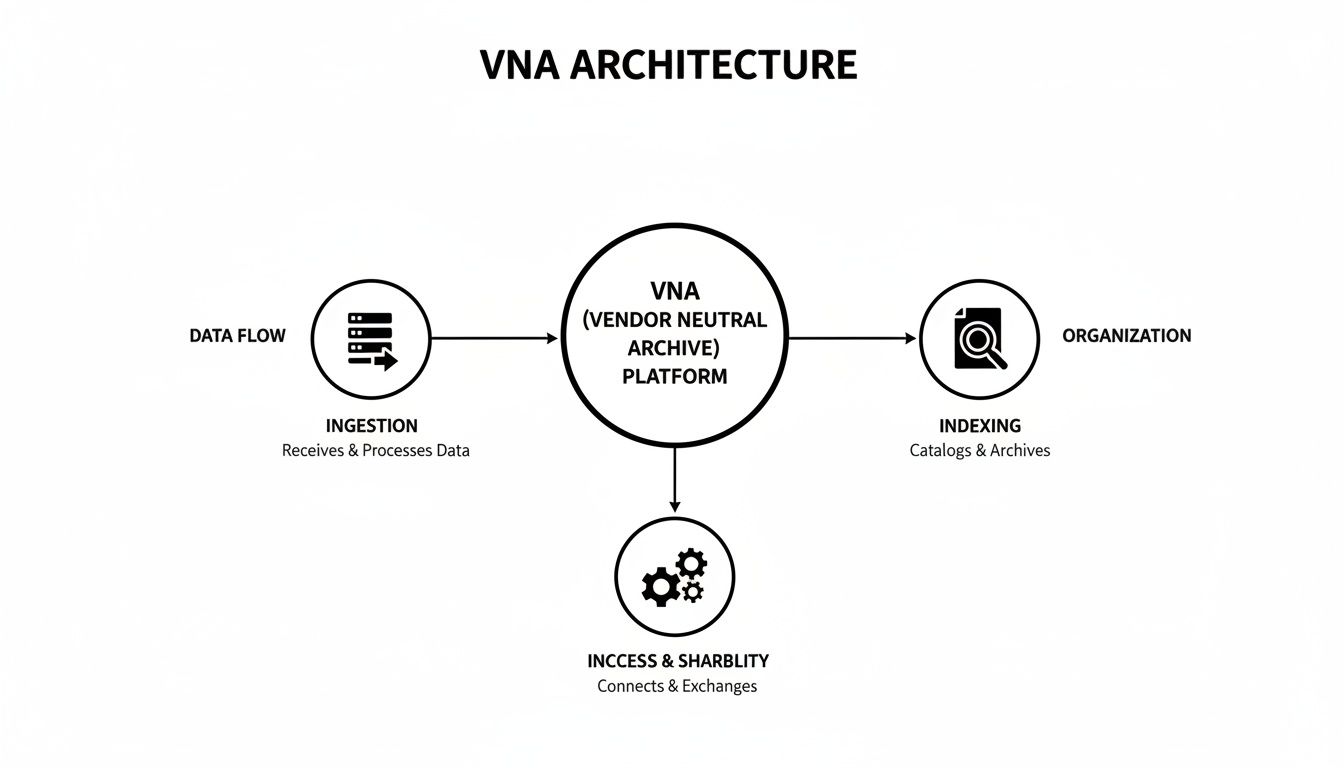
As the diagram shows, the VNA acts as a central hub, capable of connecting with and standardizing data from countless different sources.
To truly grasp their distinct roles, let's look at a direct comparison.
Comparing VNA and PACS Systems
| Aspect | Vendor Neutral Archive (VNA) | Picture Archiving & Communication System (PACS) |
|---|---|---|
| Primary Goal | Long-term, enterprise-wide image data management and archival. | Departmental workflow optimization and diagnostic viewing. |
| Data Scope | Enterprise-wide. Stores imaging from all departments (Radiology, Cardiology, Pathology, etc.). | Department-specific. Primarily manages images for a single specialty. |
| Data Format | Standardizes all data into a vendor-neutral format (e.g., DICOM). | Often uses a proprietary format tied to the vendor's system. |
| Key Function | A secure, centralized, and interoperable repository. A single source of truth. | A high-speed workflow engine for radiologists and clinicians. |
| Lifespan | Long-term (10+ years). Designed to outlive other clinical systems. | Shorter-term (5-7 years). Often replaced as technology evolves. |
| Flexibility | High. Enables "best-of-breed" choices for viewers and other systems. | Low. Tightly integrated components create vendor lock-in. |
This table makes it clear: the VNA manages the "what" (the data), while the PACS handles the "how" (the daily workflow). They are two sides of the same coin.
A Partnership for Progress
This VNA-PACS partnership creates a powerful synergy that benefits the entire organization. It allows hospitals to adopt a "best-of-breed" approach, selecting the best diagnostic viewer for radiology, a different one for cardiology, and another for digital pathology, all while connecting them back to the same central VNA.
A VNA doesn't replace a PACS; it empowers it. It transforms the PACS from a data silo into a streamlined workflow application, while the VNA serves as the strategic guardian of the organization's most valuable asset: its patient imaging data.
This strategic shift is fundamental. For a deeper dive into the specific functionalities of a PACS, you can explore our guide on what a PACS system is. Understanding both technologies clarifies why they work so much better together.
At PYCAD, we thrive in this decoupled environment. We build custom web DICOM viewers and integrate them into medical imaging web platforms, creating specialized workflows for research, AI analysis, or clinical subspecialties. By connecting our viewing platforms to an organization's central data archive, we deliver powerful, specific solutions without disrupting existing departmental systems.
Ultimately, the VNA vs. PACS discussion isn't about choosing one over the other. It’s about architecting a smarter, more flexible future for enterprise imaging.
The Strategic Gains of a VNA
Looking past the technical specs and architectural diagrams, you start to see what a Vendor Neutral Archive is really all about. Bringing a VNA into your organization isn't just an IT project; it's a strategic business decision that sends ripples of positive change through your entire healthcare ecosystem. It unlocks efficiency, control, and innovation that were simply out of reach before.
For hospital executives and administrators, the payoff is both immediate and tangible. A VNA tackles one of the most stubborn problems in medical imaging: vendor lock-in. By centralizing all your imaging data into a standard format, you take back control of your most valuable asset. This freedom turns what used to be a complex, multi-year data migration nightmare into a straightforward, predictable process.
The end game is a unified, cost-effective storage strategy that scales with your organization, not against it. It means you can finally pick the best tools for your clinicians and patients without being shackled to one vendor’s ecosystem. That flexibility alone fosters a more competitive and agile technology environment.
Empowering Clinicians with the Full Patient Story
For the doctors, specialists, and researchers on the front lines, the impact is even more profound. A VNA shatters the walls between departmental silos, giving them a complete, longitudinal view of a patient's entire imaging history. A radiologist can instantly pull up a cardiology exam from five years ago, or an oncologist can compare pathology slides side-by-side with recent CT scans.
This holistic view is a game-changer for diagnostic accuracy. It provides critical context that was often lost when images were buried in separate, incompatible systems. This leads to more informed treatment plans and cuts down on redundant scans, which is a win for both patient safety and your bottom line.
By creating a single source of truth for all imaging data, a VNA empowers clinicians to connect the dots across a patient's entire medical journey, leading to better insights and ultimately, better outcomes.
Researchers also see massive benefits. A well-structured VNA becomes a pristine, standardized data repository—perfect for training and validating AI algorithms or running large-scale clinical studies. The ability to easily query and retrieve huge volumes of high-quality imaging data puts medical discovery on the fast track.
Unlocking Data's True Potential with Custom Viewers
But here’s the thing: collecting and storing data is only half the story. The real value is unlocked when you can actually access, analyze, and interact with that data in a way that makes sense for your specific needs. This is where the powerful combination of a VNA and specialized viewing applications comes into play.
Off-the-shelf viewers are great for general diagnostics, but what about the unique workflows of a research team, a medical device manufacturer, or a specific clinical trial? That’s where a one-size-fits-all approach falls short, and custom solutions step in.
This is exactly what we do here at PYCAD. We build custom web DICOM viewers and integrate them into medical imaging web platforms. Our solutions plug directly into your VNA, allowing your teams to engage with their centralized data through interfaces and workflows built just for them. Whether you need advanced analysis tools, AI model validation environments, or collaborative research platforms, we help you turn a passive archive into an active, intelligent resource.
You can see how we bring this to life by checking out our portfolio. By creating a purpose-built window into your VNA, you can finally harness the full power of your enterprise imaging data. It’s the move that takes you from just managing images to generating real clinical and business intelligence from them.
Powering AI with VNAs and Custom Viewers
A Vendor Neutral Archive is so much more than a digital filing cabinet. It’s the very foundation for the future of medical artificial intelligence. Think of your VNA as the ultimate data reservoir for healthcare—a vast, clean, and organized collection of imaging data that spans a patient's entire history. This is exactly the kind of high-quality fuel needed to train, test, and validate AI algorithms that can spot diseases earlier and predict outcomes with stunning accuracy.
After all, an AI model is only as smart as the data it’s trained on. When researchers are forced to work with small, siloed, and inconsistent datasets, the results are often biased or unreliable. A VNA cuts through that chaos by creating a single source of truth, delivering the sheer volume and diversity of data required to build powerful and trustworthy AI.
From Raw Data to Actionable Insights
But having a brilliant algorithm and a mountain of data is only half the battle. For any AI to provide real clinical value, its insights have to be presented to clinicians in a way that feels natural and fits right into their workflow. This is where the connection between the data archive and the user experience becomes absolutely critical.
An AI might flag a suspicious nodule on a CT scan, but what happens next? How does the radiologist interact with that finding, compare it to previous scans, or see the AI’s confidence score? The answer lies in a purpose-built viewing application—a bridge that connects the VNA’s data, the AI’s intelligence, and the clinician’s expertise.
A VNA provides the fuel for medical AI, but a custom viewer is the engine that turns that fuel into clinical momentum. It transforms abstract data points into tangible, interactive, and decision-ready insights.
This is where our team at PYCAD shines. We build custom web DICOM viewers and integrate them into medical imaging web platforms. These tailored viewers connect seamlessly to your VNA, turning its massive repository into an intelligent, interactive workspace.
Building Purpose-Built AI Workflows
Any off-the-shelf viewer can display an image. A custom viewer, on the other hand, can bring an entire AI-driven workflow to life. We design solutions with your specific clinical and research goals in mind, creating an environment where your data and algorithms work together perfectly.
Our custom solutions often include:
- Integrated AI Overlays: Displaying AI-generated findings like heatmaps or bounding boxes directly on top of DICOM images for at-a-glance insights.
- Interactive Analysis Tools: Giving users the ability to measure, segment, and annotate regions of interest identified by the AI, which also provides crucial feedback to the model.
- Longitudinal Tracking Dashboards: Creating visual timelines that show how an AI-detected anomaly has changed over time by pulling all relevant prior studies from the VNA.
- Cohort Building Interfaces: Allowing researchers to easily query the VNA for specific patient groups needed to train or validate new algorithms.
To truly unlock the power of your VNA's data, especially for remote access or specialized workflows, the solution often involves developing custom mobile applications that act as intuitive, on-the-go viewers. This pushes the reach of AI-powered insights far beyond the traditional reading room.
By creating these specialized interfaces, we make sure the intelligence pulled from your VNA is not just accessible, but truly actionable. You can see how we've built these kinds of solutions for our clients in our portfolio. This is how a VNA stops being a passive archive and becomes an active, intelligent partner in shaping the future of medicine.
Your Roadmap to a Successful VNA Migration
Taking on a Vendor Neutral Archive migration can feel like preparing for a monumental expedition. It's a journey, but one that leads to true data freedom. With a clear map and a solid plan, this complex process becomes a manageable and incredibly rewarding venture. This isn't just another technical upgrade; it's a strategic move that will completely redefine your organization's relationship with its most valuable asset—its imaging data.
The first step is to simply envision your destination. What does success actually look like for your enterprise imaging strategy? Your answer to that question becomes the North Star for every decision that follows, whether you're consolidating scattered archives or building a foundation for groundbreaking AI research.
Charting Your Course
Before you can move forward, you have to know exactly where you're starting from. This means conducting a detailed inventory of your current imaging systems, data volumes, and the unique workflows in each department. This initial audit is crucial—it shines a light on potential challenges and helps you map out the most efficient path.
Once you have that clear picture, you can start making the big decisions:
- Choose Your Deployment Model: Are you leaning toward an on-premise solution for maximum control, a cloud-based model for effortless scalability, or a hybrid approach that gives you the best of both worlds?
- Plan Your Data Migration: How will you move petabytes of historical data from old, legacy systems into the new VNA? There are different ways to tackle this, like phased migrations, "lift-and-shift" approaches, or even quiet background data moves.
- Prioritize Security and Compliance: Your security framework is absolutely non-negotiable. Make sure your plan includes robust access controls, detailed audit trails, and strict adherence to regulations like HIPAA.
A successful migration is built on more than just technology. It’s a testament to meticulous planning, clear communication, and a deep understanding of the clinical and operational needs of your organization.
The Art and Science of Data Transfer
Moving all that data is a delicate dance, a balance between technical precision and strategic foresight. To get a real handle on the specifics, it's worth exploring proven data migration best practices that can help you avoid the common pitfalls. This journey often means partnering with specialists who live and breathe the intricate web of healthcare data integration.
This level of precision isn't unique to medical imaging. Consider the Vector Network Analyzer (VNA), a sophisticated instrument used to measure electrical network parameters with incredible accuracy. Its arrival in the 1980s was a massive leap forward from slow, manual methods to automated, computer-controlled measurements, setting a new standard for precision in RF engineering. You can learn more about the historical evolution of this technology.
Your Partner in Integration
Ultimately, the goal of any VNA migration is to create a single, unified, and accessible data ecosystem. A successful transition doesn't just store data; it lays the groundwork for connecting advanced tools and applications that can turn your archive into an active, intelligent resource.
At PYCAD, we specialize in this final, critical step. We build custom web DICOM viewers and seamlessly integrate them into medical imaging web platforms. By connecting our solutions to your newly migrated VNA, we help you unlock the full potential of your data for research, AI validation, and specialized clinical workflows. See examples of our work in our portfolio.
Your VNA Questions, Answered
Stepping into the world of Vendor Neutral Archives is a game-changer, but it’s completely normal to have questions. Let's tackle some of the most common ones head-on, so you can move forward with clarity and confidence.
Can a VNA Completely Replace Our PACS?
Think of it less as a replacement and more as a powerful partnership. A VNA is designed to be the rock-solid, long-term home for all your imaging data across the entire organization. Your PACS, on the other hand, is brilliant at what it does best: handling the day-to-day diagnostic workflow for specific departments.
The most forward-thinking approach is what’s often called a "deconstructed PACS." The VNA becomes your central library—the single source of truth—while the PACS acts like a specialized, high-performance workstation that pulls images when needed. This setup gives you incredible flexibility and makes you ready for whatever comes next.
What Else Can a VNA Store Besides DICOM Images?
This is where a VNA truly shines. While it’s the master of DICOM data from radiology and cardiology, a modern VNA is built to handle the full, diverse picture of a patient's journey.
It can easily manage a huge range of non-DICOM files, including:
- JPEGs from dermatology clinics
- PDFs of clinical reports
- High-definition surgical videos
- Waveform data and more
Often, the system will wrap these different file types in a lightweight DICOM header, allowing them to be stored and managed with the same standards and controls. It transforms your archive from a simple image locker into a comprehensive multimedia patient record.
How Does a VNA Make Our Data More Secure?
By bringing everything under one roof. Instead of juggling security protocols across dozens of disconnected departmental silos, a VNA gives you a single, fortified repository to protect.
By creating one point of control, a VNA allows you to apply uniform security policies, simplify audits, and better manage patient privacy across the entire enterprise.
This centralized approach is a massive win for security and compliance. With robust access controls, detailed audit trails, and the ability to enforce retention policies consistently, meeting strict standards like HIPAA becomes far simpler and more effective.
At PYCAD, we believe a well-implemented VNA is the ultimate foundation for innovation. We build custom web DICOM viewers that integrate them into medical imaging web platforms, transforming your centralized archive from a static repository into a dynamic platform for research, AI validation, and groundbreaking clinical workflows. See what's possible in our portfolio.