
In the fast-paced world of medical imaging, the systems that manage the flow of information are just as critical as the scanners themselves. This is where RIS and PACS come in—the twin pillars that support nearly every modern radiology department. A Radiology Information System (RIS) is the operational core, the department's nervous system. A Picture Archiving and Communication System (PACS) is the visual library, holding every patient scan.
When they work together, they create the digital command center for diagnostics.
The Digital Command Center of Modern Radiology
Think of a busy hospital's radiology department. It’s a place where every second counts, and accuracy is everything. Powering this high-stakes environment are two systems working in lockstep: RIS and PACS. Let's break down what they do in a way that makes sense.
A great way to think about the RIS is as the department's logistical brain. It's the system that handles everything around the image. From scheduling a patient's appointment and managing their records to tracking the exam status and handling billing, the RIS keeps the entire operation running smoothly. It makes sure the right patient gets the right scan at the right time, every time.
Then you have the PACS. This is the massive, secure digital archive for the images themselves. Every X-ray, CT scan, and MRI is stored here, ready to be pulled up in seconds. For radiologists, the PACS is their window into the patient, replacing the old, cumbersome world of physical film with instant, high-resolution digital access.
The Power of Seamless Integration
The real breakthrough isn't what these systems do alone, but what they achieve together. When a RIS and PACS are tightly integrated, they create a single, fluid workflow that’s incredibly powerful. This synergy is the digital heartbeat of diagnostics, where administrative data and clinical images flow together effortlessly.
At PYCAD, we live and breathe this stuff. We're at the forefront, building the next generation of medical imaging tools. Our passion is crafting custom web DICOM viewers and integrating them into sophisticated platforms that truly serve the needs of today's data-driven healthcare. At PYCAD, we build custom web DICOM viewers and integrate them into medical imaging web platforms.
This connected environment gives clinicians the power to make faster, more informed decisions, which directly translates to better patient care. The benefits are impossible to ignore:
- Faster Diagnosis: Imagine a radiologist pulling up a patient's CT scan from the PACS. With a single click, they can also see the full patient history and referring physician's notes from the RIS, all on one screen. That’s integration in action.
- Fewer Errors: Automating the flow of information between the two systems means no more manual data entry. This drastically cuts down on the small mistakes that can have big consequences for patient safety.
- Better Collaboration: A specialist across town or even across the country can securely view the same images and reports as the primary care team, making collaborative care a practical reality.
This is just the beginning. To see what these kinds of advanced, integrated solutions look like in the real world, feel free to browse through our extensive portfolio.
Your Guide to RIS and PACS in Modern Radiology
To really get a handle on how RIS and PACS work together, it helps to think of them not as two separate pieces of software, but as two specialists on the same team. They have distinct, equally important jobs. Think of it like a world-class orchestra: you have the conductor keeping everything in time and the musicians actually playing the notes. In radiology, the RIS and PACS perform a similar duet, one handling the logistics and the other handling the visuals.
The Radiology Information System (RIS) is the conductor. It's the operational brain of the department, managing all the text-based information that swirls around a patient's journey through imaging. It’s the system that knows who the patient is, what scan they need, and when their appointment is.
The Picture Archiving and Communication System (PACS), on the other hand, is the lead violinist—the visual heart of the whole show. This system is all about the medical images. It's the secure digital library that stores, pulls up, and displays every single high-resolution DICOM file, from a detailed MRI to a critical X-ray. For a deeper dive, check out our guide on https://pycad.co/what-is-pacs-in-healthcare/.
To make this crystal clear, let's break down their core differences.
RIS vs PACS At a Glance
The table below gives you a quick snapshot of what sets these two essential systems apart.
| Feature | Radiology Information System (RIS) | Picture Archiving & Communication System (PACS) |
|---|---|---|
| Primary Function | Manages patient workflow and data | Stores, views, and shares medical images |
| Core Data | Text-based (patient demographics, reports, billing) | Image-based (DICOM files like X-rays, CTs, MRIs) |
| Primary Users | Administrative staff, schedulers, technologists, radiologists (for reporting) | Radiologists, technologists, referring physicians |
While they handle different things, you can see how they absolutely need each other to create a complete picture of patient care.
The RIS: The Department's Nerve Center
The RIS is the engine that keeps the radiology department running smoothly. It’s the system of record for everything that isn't an image but gives that image context. It handles all the logistical and administrative heavy lifting with precision.
Here’s what the RIS is busy doing behind the scenes:
- Patient Scheduling: It’s the ultimate coordinator, juggling appointments across various machines and even different locations. This helps cut down on wait times and makes sure expensive equipment isn't just sitting idle.
- Workflow Management: From the moment a patient checks in, the RIS is tracking their progress. It gives technologists a clear to-do list and keeps the entire team on the same page.
- Reporting and Distribution: This is where radiologists type up their findings. The RIS makes sure their diagnostic reports are signed, sealed, and delivered to the right referring physician quickly and securely.
- Billing and Analytics: It collects all the data needed for billing and can crunch the numbers to create reports that help managers make smart decisions to improve how the department works.
The PACS: The Clinical Image Vault
While the RIS is busy with the "who, what, when, and why," the PACS is laser-focused on the "how it looks." It's a highly specialized environment built to handle the massive challenge of managing huge volumes of medical images.
A modern PACS does so much more than just store files. It hands radiologists a powerful set of digital tools to manipulate images, compare them to older scans, and ultimately find the clues that lead to a life-saving diagnosis. It's the digital canvas where clinical discoveries happen.
The PACS truly shines when it comes to:
- Image Storage: It safely archives terabytes of DICOM images in a way that’s organized and easy to search. No more lost films!
- Image Display: It presents images on special high-resolution screens, giving doctors tools to zoom, measure, and tweak the contrast to spot even the tiniest abnormalities.
- Data Security: Protecting patient imaging data is a top priority. The sensitive nature of this information means robust privacy controls are non-negotiable. It's crucial for professionals to have a solid grasp of understanding GDPR compliance in cloud hosting environments to ensure they meet strict regulatory standards.
Here at PYCAD, we take this a step further. We build custom web DICOM viewers and integrate them into medical imaging web platforms, giving clinicians secure access to critical images from any device, anywhere in the world. This is a game-changer for collaborative care and teleradiology. You can see our work in action by visiting our portfolio.
Mastering the Workflow: How RIS and PACS Work Together
The real magic in a modern radiology department isn't just in the RIS or the PACS—it's in how they perform a perfectly synchronized dance. When these two systems communicate seamlessly, they stop being separate tools and become a single, powerful engine for patient care. This integration eliminates frustrating delays and gets critical information where it needs to go, fast.
The secret to this harmony lies in two universal standards that act as translators, allowing different technologies to speak the same language.
First, you have Health Level Seven (HL7). Think of HL7 as the administrative messenger, handling all the text-based information. It carries things like patient demographics, doctor's orders, and final reports between systems. When a physician orders an MRI, HL7 is the protocol that delivers that request from the hospital's main system to the RIS.
Then there's Digital Imaging and Communications in Medicine (DICOM), the undisputed global standard for medical images. DICOM is what guarantees that a CT scan taken on a Siemens machine can be stored in a Fuji PACS and viewed on a Barco workstation, all without losing a single pixel of diagnostic detail.
The Integrated Workflow in Action
To truly grasp how powerful this is, let's follow the data from the moment a doctor places an order. It's a beautifully choreographed sequence designed for efficiency and patient safety.
- Step 1: The Order is Placed. A doctor orders a chest X-ray using the hospital's Electronic Health Record (EHR). That order is instantly sent to the RIS via an HL7 message. No fax machines, no phone calls.
- Step 2: Scheduling and Prep. The RIS logs the order, and the scheduling team books the appointment. All the patient's information and exam details are now neatly organized in one place.
- Step 3: The Scan. When the patient arrives, the technologist pulls up a DICOM Modality Worklist on the imaging machine. This list, fed by the RIS, automatically populates the patient’s information, which is a huge step in preventing manual entry errors. After the scan, the images are sent directly to the PACS, tagged with all the correct data.
- Step 4: Reading the Results. A radiologist gets a notification that a new study is ready. They open the images in their PACS viewer and, with a single click, can pull up the patient’s history from the RIS. Once they've interpreted the scan, their report is created in the RIS and automatically linked back to the images in the PACS.
This flow shows how the patient's journey, from the initial order to the final viewing, becomes a smooth, automated process.
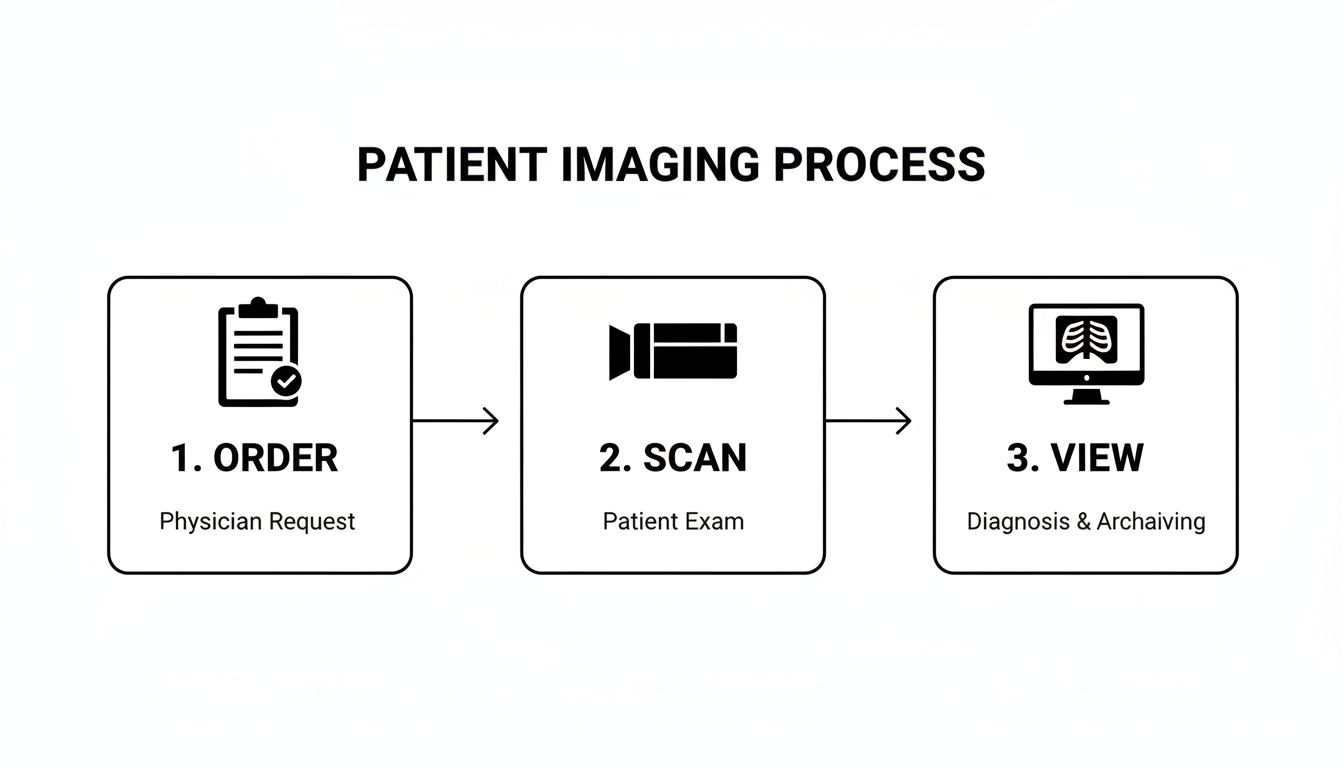
As the image shows, a well-integrated system keeps data moving automatically, cutting down on manual work and speeding up the entire diagnostic timeline.
Why a Unified System is a Game-Changer
This elegant data exchange is more than just a technical feat—it fundamentally improves how healthcare is delivered. By getting rid of manual data entry, the risk of a simple typo leading to a catastrophic patient mix-up is dramatically reduced. This tight integration is also what clears the way for more advanced technologies.
This tightly connected ecosystem is the foundation for modern medical imaging solutions. It creates the stability and data flow necessary for tools like advanced web-based viewers and AI algorithms to function effectively, pushing the boundaries of what's possible in diagnostics.
It's no surprise that the demand for these integrated radiology ris pacs systems is exploding. The global market, valued at USD 2.45 billion in 2025, is on track to hit USD 4.62 billion by 2034. This growth is fueled by huge investments in automation and the staggering volume of exams—over 3.6 billion were performed globally in 2023 alone. In the U.S., the rise of chronic diseases, like the 1,603,844 new cancer cases reported in 2020, only increases the pressure for efficient imaging and tracking that these systems provide. You can dig deeper into the numbers with this comprehensive market analysis from Precedence Research.
This level of connectivity opens the door for incredible flexibility. For example, at PYCAD, we build custom web DICOM viewers and integrate them into medical imaging web platforms. These viewers can be embedded into any medical platform, giving clinicians instant, secure access to imaging data from anywhere. To see how it's done, you can explore our detailed guide on PACS integration.
By mastering this workflow, healthcare organizations create an environment that's not just faster and more accurate, but also ready for whatever innovation comes next.
Choosing Your Deployment Model: On-Premise, Cloud, or Hybrid
Deciding where your RIS and PACS will live is one of the most critical strategic choices you'll make. This isn't just an IT decision; it's a foundational one that will ripple through your organization's performance, scalability, and security for years to come. It’s about aligning your infrastructure with your clinical mission and your bottom line.
There are really three paths you can take: on-premise, cloud, or a hybrid of the two. Each has its own distinct personality and is suited for different healthcare environments. The real question is how you balance control, accessibility, and cost. On-premise gives you ultimate command over your hardware and data, while the cloud offers incredible flexibility and frees you from massive upfront investments. For many, the sweet spot is a hybrid approach, blending the best of both to create a truly resilient imaging ecosystem.
The Fortress: On-Premise Deployment
The on-premise model is the traditional stronghold of radiology IT. Think of it as building your own fortress. All your servers, storage, and networking gear are housed right there in your facility, giving your IT team complete physical control over every last component.
This approach has long been the gold standard for large hospitals and academic medical centers. When you're managing immense volumes of sensitive data and need split-second performance for complex studies, nothing beats having the hardware in-house. Retrieval speeds are lightning-fast because you aren't at the mercy of internet bandwidth. Plus, the ability to fine-tune the system to your exact workflow needs is a huge win. To get the full picture, it's worth understanding the trade-offs between cloud computing and on-premise solutions before making a final call.
On-premise deployment puts the keys to the kingdom directly in your hands. It provides ultimate control and peak performance, making it the go-to choice for institutions where data sovereignty and speed are non-negotiable.
It’s no surprise that on-premise deployments still command a substantial market share in the radiology PACS world. This dominance is built on a reputation for rock-solid performance, deep customization, and the ability to meet strict regulations like HIPAA—a must-have for large-scale hospital environments. You can dive deeper into these market dynamics with this detailed analysis by Towards Healthcare.
The Agile Alternative: Cloud-Based Solutions
Cloud-based RIS and PACS systems are the modern, agile answer to the on-premise fortress. Instead of buying and maintaining your own servers, you partner with a provider who hosts your data and applications in highly secure, off-site data centers. This model completely changes the financial equation, slashing the initial capital investment and making it a perfect fit for smaller clinics, imaging centers, and growing teleradiology networks.
The real magic of the cloud lies in its scalability and accessibility. Need more storage? You can scale up in minutes, paying only for what you use. Need to grant a specialist access to a study from halfway across the country? The cloud makes it possible for authorized users to securely view images and reports from anywhere with an internet connection, breaking down silos and supercharging collaboration.
This is the environment where modern imaging tools truly shine. For instance, at PYCAD, we build custom web DICOM viewers and integrate them into medical imaging web platforms. These viewers are built for the cloud, giving clinicians the freedom to analyze medical images securely from anywhere, on any device.
The Strategic Middle Ground: The Hybrid Model
For many organizations, the choice isn't black and white. A hybrid model offers a powerful strategic compromise, combining the raw performance of on-premise hardware with the flexibility and cost-effectiveness of the cloud. It’s a "best of both worlds" strategy that’s rapidly gaining traction.
Here’s how it typically works: recent or frequently accessed ("hot") imaging data stays on-premise for immediate, fast access. Meanwhile, older or archival ("cold") data is pushed to the cloud for cost-effective, long-term storage.
This approach delivers some serious advantages:
- Optimized Performance: Radiologists get the blazing-fast access they need for the most relevant studies.
- Cost-Effective Archiving: You avoid the high cost of maintaining massive on-site archives by using scalable cloud infrastructure.
- Enhanced Disaster Recovery: The cloud acts as a secure, off-site backup for your most critical data, giving you peace of mind.
The hybrid model allows you to modernize your imaging infrastructure without having to rip and replace everything you've already invested in. It paves the way for a future where your data is both perfectly secure and universally accessible. Explore our portfolio to see how we build solutions for these advanced ecosystems at https://pycad.co/portfolio.
The Future of Radiology: AI-Powered Workflows
The next great leap for radiology RIS PACS systems isn't just about faster speeds or bigger storage—it's about intelligence. We're stepping into an incredible new era where Artificial Intelligence (AI) is shifting from a far-off concept to a daily reality, completely reshaping how diagnostic workflows operate. This is where the true power of integrated systems really starts to shine, creating a smarter, more predictive future for healthcare.
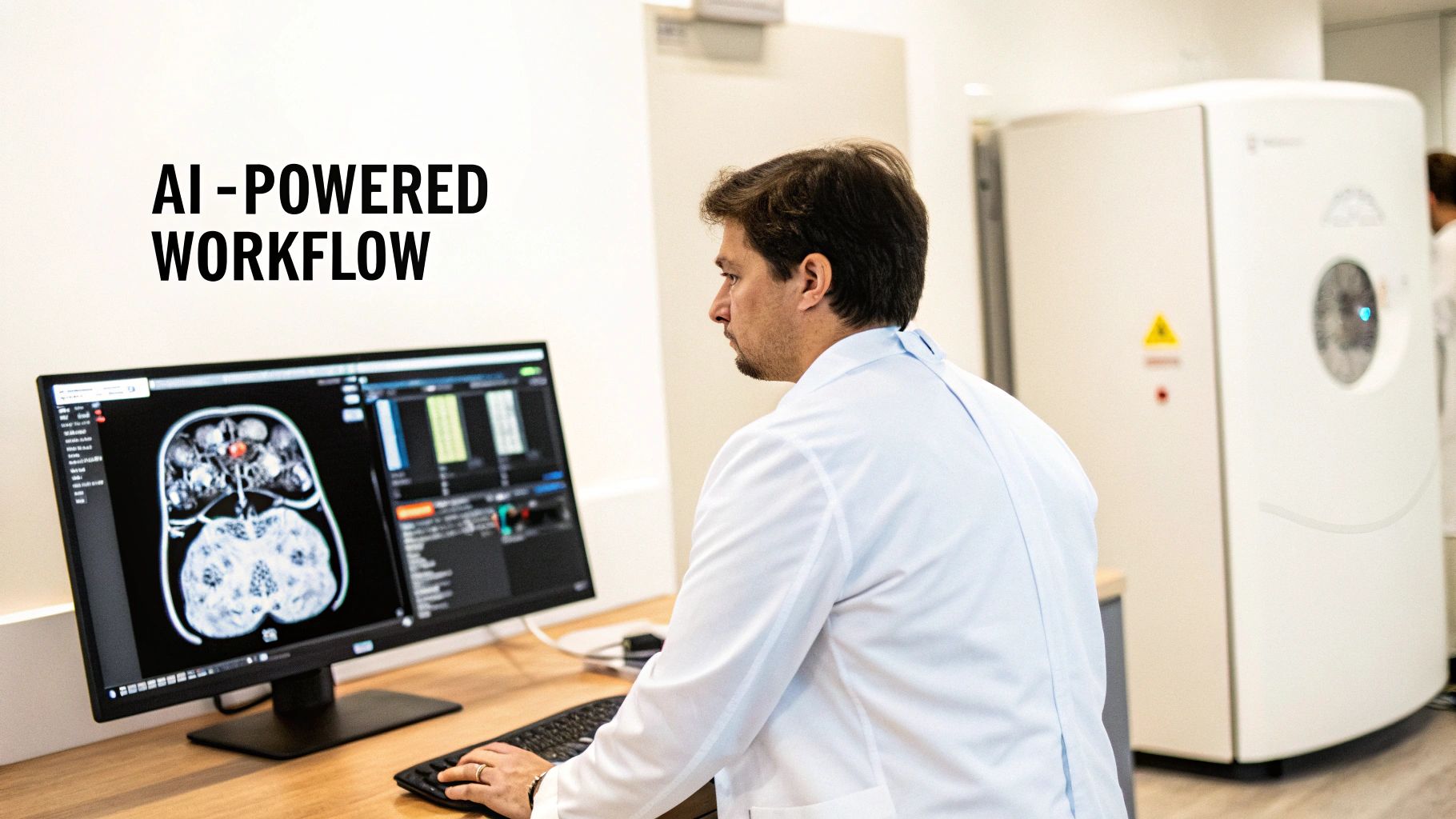
Imagine an AI algorithm working tirelessly alongside a radiologist. In mere seconds, it can scan through hundreds of images, flagging subtle anomalies that a human eye might miss after a long and demanding shift. This isn't about replacing the expert; it's about amplifying their skills. It's like giving them a powerful second set of eyes, boosting diagnostic confidence and precision.
This technology is already making a real difference. AI tools are now being used to intelligently triage the most urgent cases. For example, an algorithm can analyze an incoming CT scan from the emergency room, spot signs of a critical issue like a stroke or pulmonary embolism, and instantly bump that study to the top of the radiologist's worklist. That simple act of reordering can shave precious minutes off the clock, which can directly lead to better patient outcomes.
From Intelligent Detection to Automated Reporting
But AI’s influence doesn't stop at detection. It's also making huge waves in the reporting process, which has traditionally been one of the most time-consuming parts of a radiologist's day. AI is now capable of helping generate preliminary findings, which can slash reporting time and free up radiologists to focus their attention on the most complex parts of a case.
Think about these real-world applications:
- Automated Measurements: An AI tool can automatically segment an organ or lesion and provide precise quantitative measurements. This saves a ton of time and ensures measurements are consistent from one report to the next.
- Drafting Report Sections: Using Natural Language Processing (NLP), AI can analyze images and write initial report sections based on what it finds. The radiologist then just needs to review, edit, and finalize it.
- Ensuring Completeness: The AI can even act as a final check, scanning reports to make sure every critical finding has been addressed before the report is signed off.
AI isn't just another tool; it's a collaborative partner. It has the potential to free radiologists from repetitive tasks, reduce burnout, and allow them to operate at the absolute peak of their clinical expertise. This is the future we are building—one where technology and human skill work in perfect harmony.
This is exactly where we at PYCAD come in. We specialize in building custom AI solutions and integrating them into medical platforms. Our goal is to create a unified ecosystem where data flows intelligently between the RIS, PACS, and AI algorithms. The result is a workflow that boosts both diagnostic accuracy and operational excellence. You can learn more by exploring our in-depth article on artificial intelligence for radiology.
Connecting Diagnostics to Patient Relationships
The innovation doesn't end with diagnostics, though. The next frontier is connecting this intelligent ecosystem to the broader patient journey. This is where integrating the radiology RIS PACS system with a medical Customer Relationship Management (CRM) platform becomes a game-changer. A CRM can finally bridge the communication gap that often exists between the radiology department, referring physicians, and patients themselves.
When a critical finding is logged in the RIS, an integrated CRM can trigger automatic alerts to the referring physician, making sure that urgent information never gets lost in a cluttered inbox. It can also manage patient follow-up care, sending reminders for subsequent scans and ensuring no one falls through the cracks. It creates a closed-loop communication system that not only makes operations more efficient but also builds stronger relationships and improves the overall quality of care.
At PYCAD, we are at the forefront of this evolution. Our expertise lies in creating these deeply interconnected systems. We build custom web DICOM viewers and integrate them into medical imaging web platforms that can include both AI and CRM functionalities. This approach paves the way for a smarter, more connected future in healthcare. To see the kinds of sophisticated platforms we've built, please visit our portfolio.
Building Your Modern Radiology Ecosystem
A modern radiology RIS PACS system is more than just a piece of software. Think of it as the central nervous system of your entire practice—the core that supports a patient-first, efficient, and forward-thinking radiology department. It’s what turns diagnostic imaging into a seamless, interconnected experience.
We've walked through how the RIS acts as the operational brain, managing the workflow, while the PACS serves as the visual heart, storing and displaying every critical image. When they're properly integrated using standards like HL7 and DICOM, they work in harmony, cutting down on errors and speeding up patient care.
The foundation you choose—whether it’s the hands-on control of an on-premise server, the nimble flexibility of the cloud, or a hybrid approach—shapes what you can achieve. Now, let's turn that understanding into a concrete vision for what a truly modern ecosystem can do.
Turning Vision into Reality
Building this kind of ecosystem means creating a single, unified environment where information flows effortlessly, from the moment a study is ordered to the delivery of a final, AI-enhanced report. It’s about giving your clinical team the tools they need to be at their absolute best, which always translates into better outcomes for patients.
The future of radiology isn’t some far-off concept; it’s being built right now. It's an environment where intelligent automation and human expertise come together, pushing diagnostic accuracy to a whole new level.
Imagine a system so intuitive it seems to anticipate what clinicians need, automatically flagging urgent cases for review and delivering critical findings the moment they're needed. This isn't science fiction—it's the new standard of care, and it's completely achievable.
Getting there takes more than just good technology. It requires a partner who deeply understands the complex clinical workflows that are the heartbeat of healthcare. It demands real-world experience in building platforms that are secure, scalable, and genuinely easy for everyone—from technologists to referring physicians—to use.
Your Partner in Building the Future
At PYCAD, our entire focus is on making this vision a reality. We build custom web DICOM viewers and integrate them into medical imaging web platforms, creating the powerful, unified ecosystems your practice needs. We specialize in developing secure medical platforms that not only solve today's challenges but are designed to adapt to tomorrow's innovations.
Whether you're a hospital looking to upgrade your infrastructure, a medical device company needing deeper software integration, or a health-tech innovator with a game-changing idea, we have the expertise to help you build it.
The tools to create a smarter, more connected future for radiology are here.
See what we’ve built for our partners by taking a look at our portfolio, and let's start the conversation about building yours.
Your Top Questions About RIS PACS Systems, Answered
Diving into the world of RIS and PACS can feel like learning a new language. You're bound to have questions, especially when you're making big decisions about implementation or trying to get more out of your current setup. Let's tackle some of the most common questions we hear from folks in the field.
What's the Single Biggest Hurdle in Integrating RIS and PACS?
Honestly, it all comes down to true, seamless interoperability. Think of it this way: standards like HL7 and DICOM are supposed to be a universal language, but different vendors sometimes have their own unique "dialects."
These subtle variations can cause headaches—data might not map correctly, workflows can grind to a halt, or worse, critical information can get lost in translation between the systems. Getting it right takes careful planning, a ton of testing, and often a partner who lives and breathes this stuff. The goal is a perfect, uninterrupted conversation between your RIS, PACS, and the hospital's EMR.
Can We Use a Web-Based DICOM Viewer with Our On-Premise PACS?
You absolutely can, and it's a fantastic strategy. This hybrid approach gives you the best of both worlds and is incredibly common for good reason. Your on-premise PACS remains the fortress—the secure, high-speed local archive for all your DICOM images.
Meanwhile, a web-based DICOM viewer acts as a secure key, giving your authorized staff the freedom to access those images from anywhere, on any device. You get the raw power and control of local storage paired with the go-anywhere flexibility of the web. At PYCAD, we specialize in this; we build custom web DICOM viewers and integrate them into medical imaging web platforms that are designed to talk perfectly with any PACS, whether it's in your server room or in the cloud. You can see some of these solutions in action in our portfolio.
How Do RIS and PACS Keep Patient Data Safe and HIPAA Compliant?
Security isn't an add-on; it's baked into the very core of these systems. To meet strict HIPAA regulations, both RIS and PACS are built with multiple layers of defense. It’s a non-negotiable part of their design.
This always includes fundamental security measures like:
- Role-Based Access Control: Not everyone sees everything. Access is granted on a need-to-know basis, depending on a user's job.
- Comprehensive Audit Trails: Every click, view, and change is logged. This creates an unbreakable chain of accountability.
- End-to-End Encryption: Data is scrambled and protected, whether it's flying across the network or sitting on a server.
And if you're looking at cloud solutions, make sure your provider is fully HIPAA-compliant and ready to sign a Business Associate Agreement (BAA). In the world of radiology ris pacs, trust and security are everything.