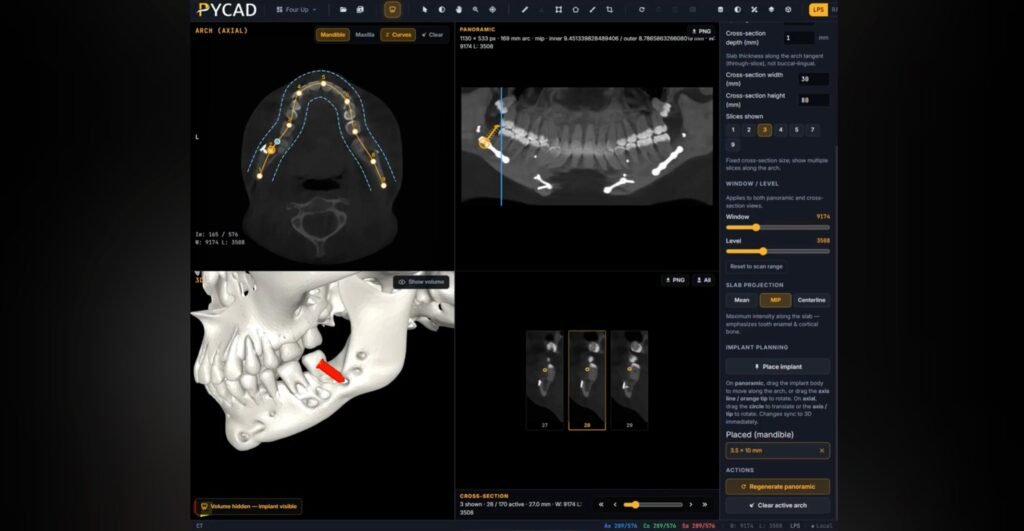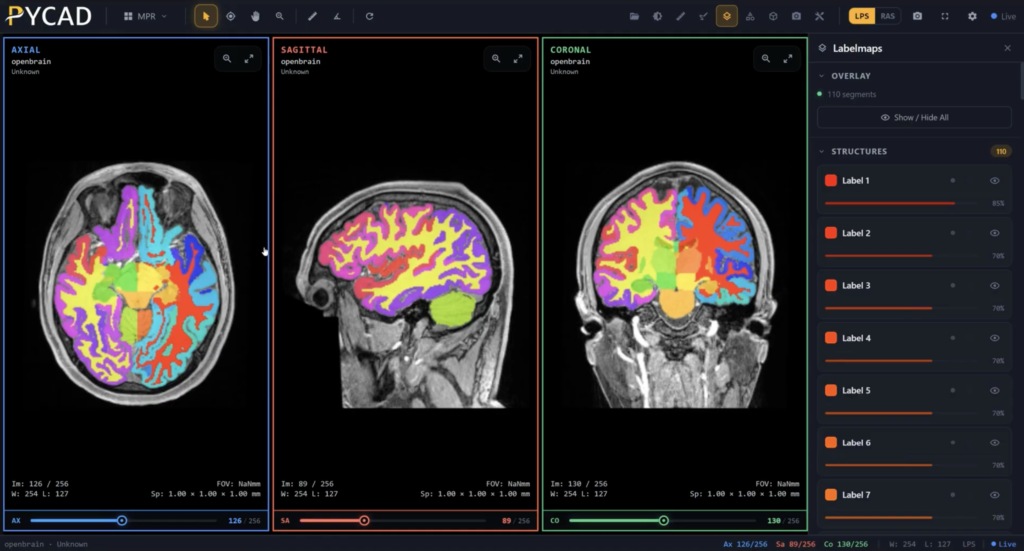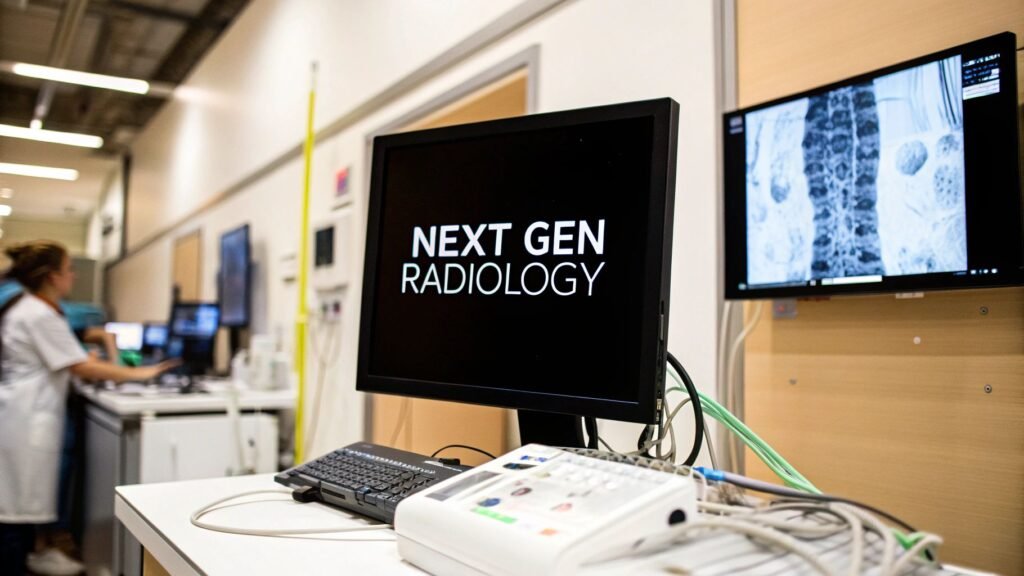
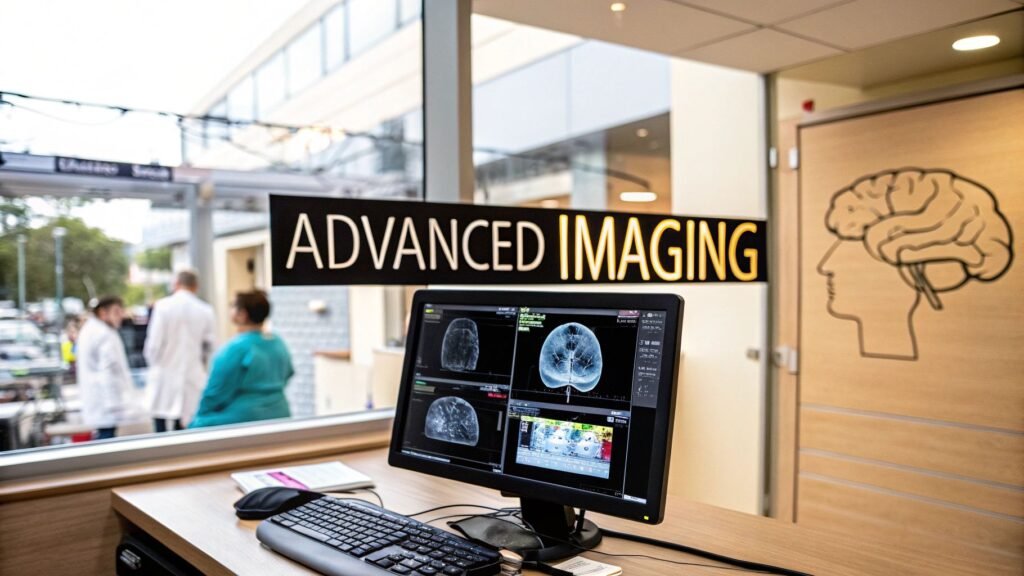
Let's be clear: advanced imaging solutions are so much more than just software for looking at clearer pictures. Think of them as the intelligent, interconnected ecosystems that breathe life into medical diagnostic data. They represent a fundamental shift, moving us away from isolated files locked away in digital cabinets and toward a living, breathing system that connects every piece of the diagnostic puzzle. At PYCAD, we build custom web DICOM viewers and integrate them into medical imaging web platforms to make this a reality for our clients.
The New Nervous System of Modern Medicine
Picture a central nervous system for healthcare. It's a system that instantly sends vital information where it needs to go, processes incredibly complex signals in a heartbeat, and allows for perfectly coordinated responses across the entire patient journey. That's not science fiction; it's the reality that advanced imaging solutions are building today.
This isn't just about one piece of technology. It's a powerful symphony of cloud infrastructure providing near-infinite scale, sophisticated software creating seamless workflows, and artificial intelligence delivering analytical insights we could only dream of a decade ago. Together, they tame the massive flood of data from modern diagnostics and transform raw images into wisdom that can save lives. This connected, intelligent approach is quickly becoming the backbone of modern medicine.
From Niche Tools to Essential Infrastructure
What started as specialized tools for radiologists and a few other experts has blossomed into a core pillar of global healthcare. This shift has built a massive technological and data foundation that hospitals, medical device OEMs, and specialized platforms now absolutely depend on for secure, accessible, and fast image viewing.
The market reflects this incredible growth. The global medical imaging services sector is on a trajectory to explode from roughly $636.8 billion in 2024 to an astonishing $1,130.17 billion by 2035. If you're interested in the financial side, you can explore more data on this market trend to see the full picture.
At the heart of this transformation is the ability to connect disparate points of data into a coherent patient story. This is where the true power of an integrated system lies—it builds bridges between departments, specialists, and even patients themselves.
At PYCAD, we see ourselves as architects of this new nervous system. We specialize in building custom web DICOM viewers and weaving them into the fabric of medical imaging web platforms. These interfaces are the critical touchpoints that make all this powerful data accessible and genuinely useful for clinicians on the front lines. They are the core of a future-ready diagnostic powerhouse, giving doctors the tools they need to make faster, more confident decisions. To see how these custom builds come to life, feel free to view our work in our dedicated portfolio.
Getting to Know the Heart of Your Imaging Ecosystem
To build a diagnostic system that truly works for you and your patients, you have to understand its moving parts. These aren't just siloed pieces of software; they're the essential gears and circuits that must work in perfect harmony to deliver fast, accurate, and patient-focused care. Let's pull back the curtain on the core building blocks of any modern advanced imaging solution.
The Web DICOM Viewer: Your Window to Diagnosis
At the very center of it all is the Web DICOM Viewer. Think of it as the universal language translator for all medical images. For years, clinicians were chained to specific, high-powered workstations to view specialized scans, stuck in one room and one location.
A web-based viewer completely shatters those old limitations. It gives authorized users the power to securely view, manipulate, and collaborate on medical images from practically anywhere—a hospital desktop, a tablet during rounds, or a laptop for a remote consult. This newfound freedom is a massive leap forward for team collaboration and making critical decisions on the fly. As specialists in this area, we at PYCAD build custom web DICOM viewers and integrate them into medical imaging web platforms to maximize this flexibility.
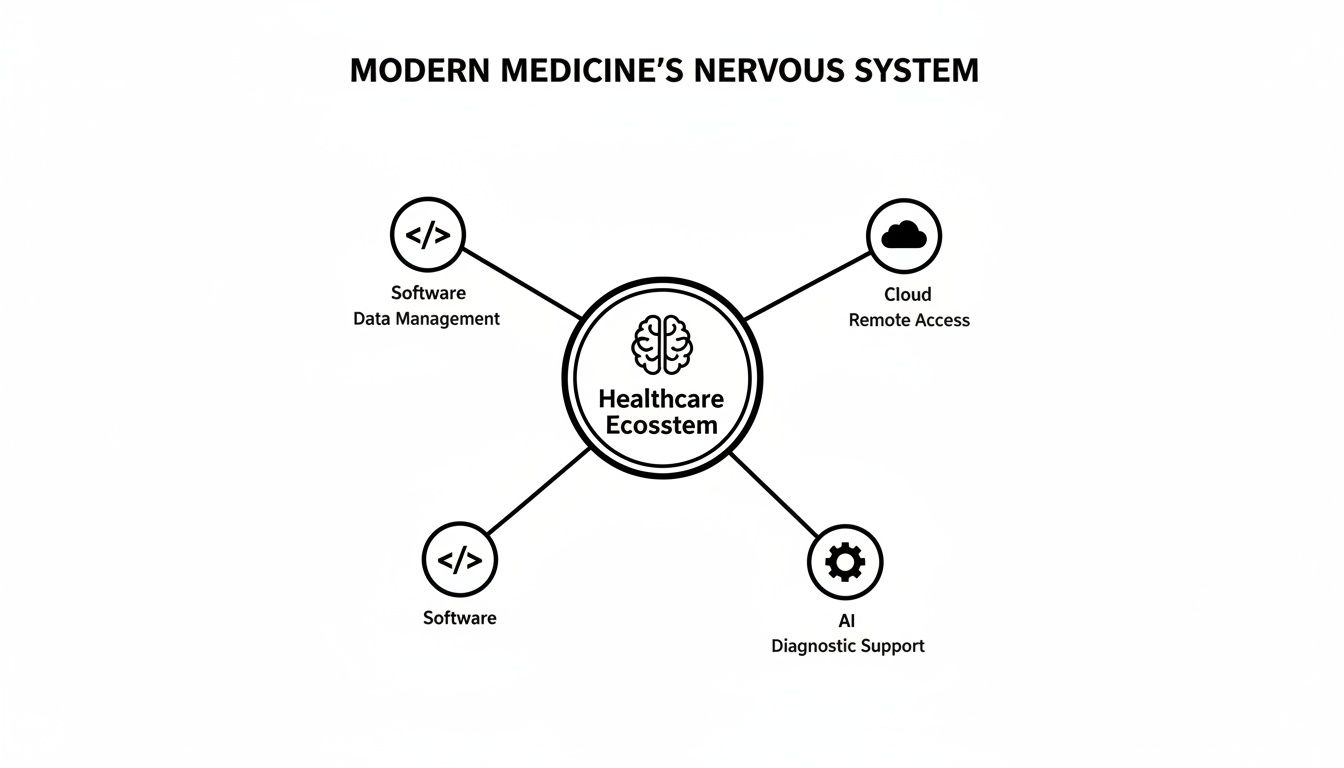
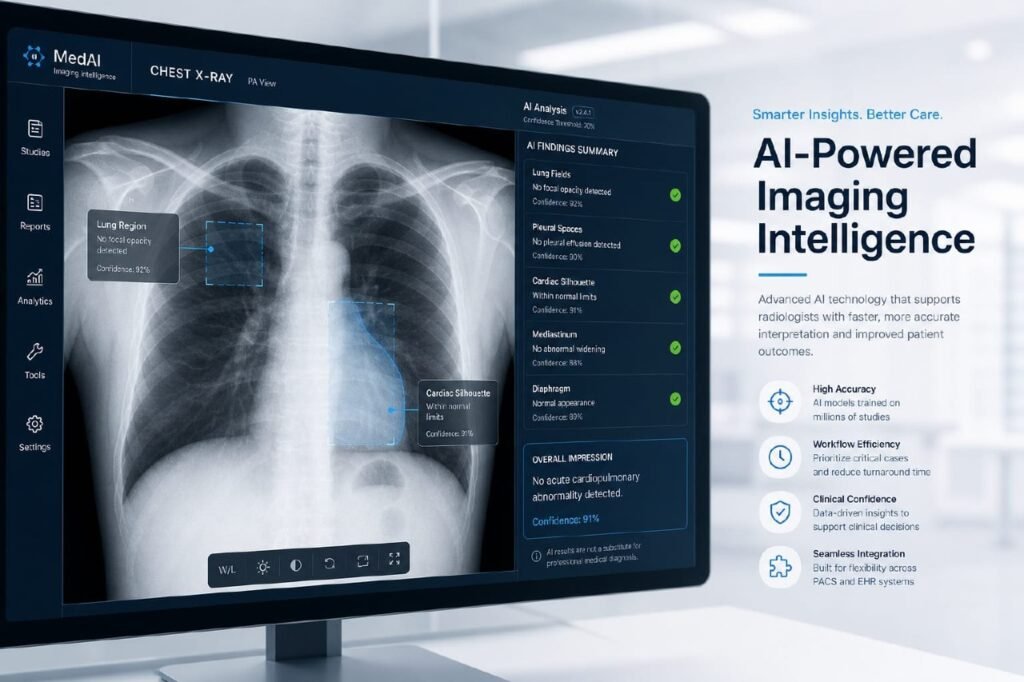
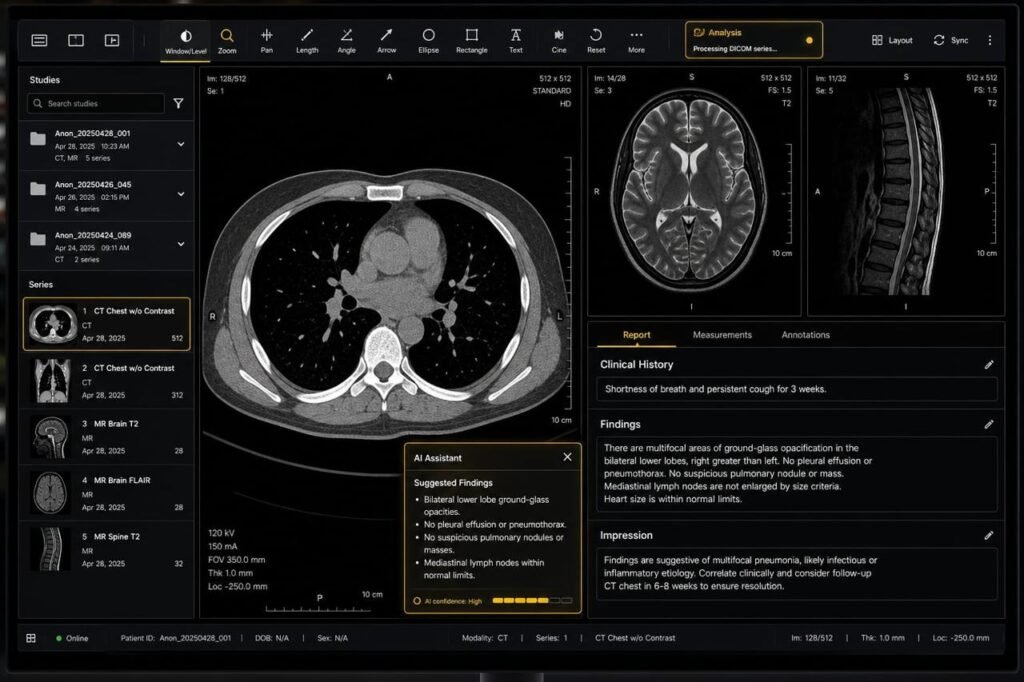
As this image shows, these technologies aren't just add-ons. They form the central nervous system of a modern healthcare operation, all deeply connected and driving the future of medicine.
PACS and VNAs: The Secure Digital Vaults
While the viewer provides the window, you need a powerful and secure place to store and manage the images themselves. That's the job of Picture Archiving and Communication Systems (PACS) and Vendor Neutral Archives (VNA).
A PACS is the workhorse of a traditional radiology department, built to store images from CT, MRI, and X-ray machines. It does its job well, but older systems can sometimes build digital walls, making it tough to share that vital imaging data with other departments.
A VNA is the next evolution. It’s a more universal, long-term archive designed to be "vendor-neutral," meaning it can handle imaging data from any manufacturer's equipment. This breaks down the silos and is absolutely key to creating one unified, enterprise-wide imaging record for every patient. To see how this all works, it helps to understand the rules of the road for medical imaging; you can learn more about DICOM standards right here.
AI and Machine Learning: The Expert in the Background
If viewers are your window and PACS are your vaults, then Artificial Intelligence (AI) and Machine Learning (ML) Modules are your brilliant analysts, working 24/7. These tools aren't about replacing clinicians. They're about augmenting their expertise, acting as an incredible second set of eyes that can catch subtle patterns the human eye might miss.
Think of it this way: an integrated AI can sift through thousands of images in minutes, flagging potential trouble spots, handling tedious measurements automatically, and pushing the most urgent cases to the top of the pile. It's about working smarter, not harder.
Imagine an AI algorithm that can:
- Pinpoint tiny, early-stage tumors on a scan that are difficult to spot during an initial review.
- Instantly calculate complex cardiac metrics from an echocardiogram, freeing up a cardiologist's valuable time.
- Help predict how a disease might progress by tracking subtle changes in imaging data over months or years.
CRM Integration: Connecting Images to the Patient's Story
Finally, the most powerful imaging solutions don't just exist in a vacuum. They must connect the diagnostic data to the complete patient story, and that’s where Customer Relationship Management (CRM) Integration comes in. While CRM sounds like a business term, in healthcare, it’s about managing the entire patient journey.
When you integrate your imaging platform with a CRM or an Electronic Health Record (EHR), you create a truly holistic view. A doctor no longer just sees a scan; they see that scan in the context of the patient’s entire medical history, their lab results, and their ongoing treatment plan. This single connection transforms scattered data points into a clear, coherent story, paving the way for better care.
7. Architecting Your Imaging Solution for the Future
Once you have a grasp of the core components, the next big question is: where does all of this live? Building your advanced imaging solution is a lot like designing a new hospital wing. You need a foundation that’s solid enough for today's needs but has the flexibility to adapt to whatever comes next.
This really boils down to two make-or-break decisions: picking the right deployment model and wrapping the entire system in an impenetrable layer of security and compliance. It’s a delicate balancing act between control, cost, and the ability to scale on demand. The choice you make here will define how your platform performs and evolves for years to come.
Finding the Right Home for Your Data
There are three main ways to set up your imaging platform, and each one changes the game for how you handle data, resources, and budgets. You can think of it as deciding whether to build a custom facility from the ground up, lease a state-of-the-art office, or do a bit of both.
-
On-Premise: This is the traditional route where you own and manage everything in-house—your servers, your software, your IT team. You get total control, which is a huge plus for some, but it comes with a hefty price tag upfront and the ongoing burden of maintenance.
-
Cloud-Based: Here, you're running your solution on servers owned by a major provider like Amazon Web Services (AWS) or Microsoft Azure. The beauty of this is the immense scalability and lower initial investment. The trade-off? You're entrusting your data to a third party.
-
Hybrid: This model gives you a strategic mix. For example, you could keep highly sensitive patient data securely on-premise while tapping into the cloud’s massive processing power for AI model training or for archiving older, less-accessed studies.
Choosing the right fit isn't always obvious. This table breaks down the key differences to help you weigh the pros and cons for your specific situation.
Comparing Imaging Solution Deployment Models
| Attribute | On-Premise | Cloud-Based | Hybrid |
|---|---|---|---|
| Initial Cost | Very High | Low | Moderate |
| Scalability | Limited & Costly | Nearly Infinite | High |
| Control | Complete | Limited | Limited |
| Maintenance | Full Responsibility | Provider Responsibility | Shared Responsibility |
| Security | Full Control & Risk | Shared Responsibility | Complex Management |
Ultimately, the best path depends on your organization's resources, risk tolerance, and growth plans. There’s no single right answer, only the right answer for you.
Building a Foundation of Trust
In medicine, nothing is more important than trust. An imaging platform, no matter how advanced, is useless if it can’t guarantee the privacy and safety of patient data. This is where security and compliance become the absolute cornerstones of your architecture.
Regulations like the Health Insurance Portability and Accountability Act (HIPAA) in the U.S. and the General Data Protection Regulation (GDPR) in Europe aren’t just red tape; they're the blueprints for building a trustworthy system. Following them is non-negotiable and sends a clear message that you take patient privacy seriously.
Security in advanced imaging isn’t just another feature on a checklist. It’s the fundamental promise you make to every patient—a commitment to protect their most sensitive health information at every point in its journey.
At PYCAD, this principle is baked into everything we do. We specialize in building custom web DICOM viewers and integrating them into secure, compliant medical imaging platforms. We know from experience that this requires a defense-in-depth strategy, not just a single firewall. You can see how we put these ideas into practice by checking out the projects in our PYCAD portfolio.
A truly secure system layers multiple defenses—from encryption and access controls to continuous monitoring—to protect against breaches and ensure data integrity is never questioned. This is how you build a platform that clinicians, and their patients, can rely on without a second thought.
Weaving Imaging Into the Fabric of Clinical Workflows
An advanced imaging solution is only as good as its ability to disappear into the background. Think about that for a moment. Its true power isn't just in the features it offers, but in how seamlessly it becomes a natural, invisible part of a clinician's day. The goal is to make the technology feel like an extension of their own expertise.
This is where smart integration comes in. It's about breaking down the digital silos that have historically kept critical patient information locked away in separate systems. By connecting your imaging platform directly with foundational tools like an Electronic Health Record (EHR) or a Radiology Information System (RIS), you create a unified, intelligent environment where data flows freely and securely to the exact point of care.

The Shared Language of Healthcare Tech
This seamless communication isn’t magic. It’s built on the back of established healthcare data standards, which act like universal translators, ensuring every piece of software speaks the same language.
Two standards are absolutely fundamental here:
- HL7 (Health Level Seven): This is the workhorse standard for exchanging clinical and administrative data. It’s what ensures an imaging order placed in the RIS is automatically communicated to the imaging modality and the PACS, all without a human having to re-enter a single piece of information.
- FHIR (Fast Healthcare Interoperability Resources): Built for the modern web, FHIR is the more flexible and nimble successor to HL7. It makes it far simpler for new applications to pull specific pieces of data from an EHR—for example, displaying a patient's latest lab results right alongside their new MRI scan.
These standards are the essential plumbing that makes true interoperability possible, transforming a collection of separate programs into a single, cohesive ecosystem.
Creating a Unified Clinical Experience
Picture this: a clinician is reviewing a complex case. With a truly integrated system, they open the patient's chart in the EHR and, with a single click, are instantly viewing the patient's entire imaging history. No separate logins. No fumbling for patient IDs. No more toggling between a dozen different windows.
This is the power of embedded technology. Instead of forcing clinicians to adapt to the software, the software adapts to them, presenting the right information in the right context, exactly when it's needed.
This is precisely the experience we build at PYCAD. Our specialty is developing custom web DICOM viewers and integrating them directly into medical imaging platforms and EHRs. By embedding the viewer right where clinicians already work, it becomes a natural part of their diagnostic process. For a deeper look, check out our guide on the nuances of this process at https://pycad.co/pacs-integration/.
Keeping Pace with Modern Medicine
The demand for this level of deep integration is exploding. The sheer volume and complexity of data coming from advanced modalities like CT, MRI, and PET/CT are overwhelming older, siloed systems. This reality has fueled a massive shift toward web-native DICOM viewers, vendor-neutral archives, and connected platforms that can bring order to the chaos. If you're curious about how AI fits into this picture, this guide on AI-powered workflows offers some great insights.
The market reflects this urgency. The global medical imaging market is projected to grow from around USD 41.6–44.9 billion in 2024 to an estimated USD 55.3 billion by 2030, a clear signal that the industry is betting big on smarter, more connected solutions.
Your Checklist for Choosing the Right Development Partner
Picking the team to build your advanced imaging solution is one of the most critical decisions you'll face. This isn't just about hiring a vendor; it’s about starting a long-term collaboration that will define your platform's success, security, and ability to grow for years to come.
To build a truly great partnership, you need a solid framework for vetting potential developers. You're not just looking for a team that can write code. You need a partner who speaks the language of healthcare, truly gets the pressures of clinical workflows, and has a proven history of building powerful, compliant systems.
The right team will feel like an extension of your own—someone just as invested in your vision as you are, but with the deep technical chops to make it real. When you're thinking about a development partner, it's also smart to understand the bigger picture of choosing the right information technology company that fits your long-term goals.

Core Technical Competencies to Verify
Before you even start talking about your project, you have to confirm a potential partner's foundational skills. Their ability to deliver a secure, high-performance solution depends entirely on this expertise.
Start with direct questions about their hands-on experience with medical imaging standards. Do they have genuine, practical knowledge of DICOM and HL7/FHIR? This is absolutely non-negotiable. If they can't speak fluently about these standards, it's a major red flag that they lack the specialized background this work demands.
Next, dig into their portfolio. Have they actually built systems like yours before? At PYCAD, for instance, this is precisely what we do—we build custom web DICOM viewers and integrate them into medical imaging web platforms. You can see clear proof of our experience by looking at the real-world projects in our PYCAD portfolio. Any serious partner should be able to show you concrete examples that back up their claims.
Evaluating Their Development Process and Security Posture
Technical skill is only half the story. The way a partner works reveals everything about their dedication to quality, security, and your ultimate success.
Ask them how they handle security and compliance. How do they guarantee their software is HIPAA and GDPR compliant from the ground up? Get specific. Ask them to walk you through their security protocols, from data encryption and access controls to how often they test for vulnerabilities. A fuzzy answer here means security is just an item on a checklist, which is a risk you simply can't afford in healthcare.
A great development partner doesn't just build what you ask for. They challenge your assumptions, anticipate future needs, and guide you toward a solution that is not only functional today but also resilient and scalable for tomorrow.
Finally, get a feel for their project management and communication style.
- How will they keep you in the loop on progress?
- What collaboration tools do they prefer?
- How do they manage scope changes or hit unexpected roadblocks?
A transparent, agile, and communicative process is the foundation of every successful project. It’s what prevents nasty surprises and ensures the final product perfectly matches your clinical needs and business goals, setting you up for future innovation.
Imagining the Future: Where Diagnostics Get Personal
Today's advanced imaging solutions are truly remarkable, but they're just the starting point. We're on the brink of a new age in healthcare—one that's more predictive, deeply personal, and truly participatory. The goal is shifting from simply finding out what's wrong today to understanding what might happen tomorrow, giving doctors and patients the power to act before a disease takes hold.
This isn't some far-off science fiction scenario; it's the next frontier we're actively exploring. Think about it: a routine scan is fed through an AI that flags a patient's hidden risk of developing a heart condition years from now. That’s the kind of power we're talking about—moving from reactive sick-care to proactive healthcare. This very vision is what gets us out of bed in the morning at PYCAD, driving us to build the tools that will bring this future to life.
From Diagnosis to Personalized Prediction
The real magic happens when an image stops being just a static picture and becomes a dynamic tool for predicting the future. Artificial intelligence is the key that unlocks this potential, allowing for personalized treatment plans that were once impossible.
- Smarter Treatment Paths: An AI could examine the unique texture of a tumor on a CT scan and predict which chemotherapy will hit it hardest, saving a patient from the grueling process of trying treatments that won't work.
- Early Warning Systems: By tracking tiny, almost invisible changes in imaging scans over time, these systems could alert doctors to the earliest signs of diseases like Alzheimer's, long before a person ever feels a symptom.
- Virtual Surgical Rehearsal: AI will take imaging data and build stunningly accurate 3D models of a patient's body. This lets surgeons practice a complex operation in a virtual space, planning for every contingency and dramatically boosting the odds of a perfect outcome.
This predictive power transforms every scan from a simple snapshot into a personal roadmap for a patient's health journey. You can dive deeper into what's coming next in our article on the future of medical imaging.
Putting Patients in the Driver's Seat
For far too long, medical images have been mysterious files locked away in a hospital server room, seen only by a handful of specialists. The future is all about transparency. It's about empowering patients to become active partners in their own health story. This means building secure, easy-to-use portals where people can not only see their scans but also get a real sense of what they're looking at.
Patient empowerment isn't just about access—it's about context. When patients can see their own progress, understand their diagnosis visually, and share their data with whomever they choose, they become more invested and engaged in their own well-being.
This is the future we're building at PYCAD. We build custom web DICOM viewers and integrate them into medical imaging web platforms that are designed for this new, collaborative reality. Our passion is to create systems that are as simple for a patient to use as they are powerful for a clinician, creating a true partnership based on shared information.
The road to truly patient-centered diagnostics is a journey we must take together. It demands a bold vision and the technical skill to build the next generation of advanced imaging solutions. We invite you to see what we've built on our portfolio page and join us in creating this inspiring future—a future where every image helps build a healthier world.
Common Questions on Advanced Imaging Solutions
Stepping into the world of advanced medical imaging can feel complex. Whether you're exploring a new system or planning an upgrade, you're bound to have questions. Let's walk through some of the most common ones to help clear the path for your next big move.
What's the Real Benefit of a Custom Web DICOM Viewer?
The biggest win is getting a tool that works exactly the way your clinicians do. Off-the-shelf viewers are a bit like a one-size-fits-all glove—they cover the basics, but they never fit just right. You end up with a cluttered interface full of features you don't need and missing the specific ones you wish you had.
A custom viewer is built for your workflow, not around it. At PYCAD, we specialize in building these custom web DICOM viewers and seamlessly integrating them into your medical imaging platform. Imagine having specialized measurement tools designed for cardiology or unique annotation features crafted for oncology. The result is a system that feels like a natural extension of your team's expertise, making the entire diagnostic process faster and far more intuitive.
How Do These Solutions Actually Help Patients?
Ultimately, this is the most important question, and the impact is profound. Advanced imaging solutions directly elevate patient care in a few key ways.
First, by connecting with systems like the EHR, they provide a full 360-degree view of a patient’s medical history. This holistic perspective is invaluable for making accurate diagnoses, especially in complex cases where every detail matters.
Second, the built-in AI modules act as a vigilant second opinion, capable of spotting subtle anomalies a human eye might miss. This can lead to much earlier disease detection, which is often the single most critical factor in successful treatment. And finally, by creating smoother workflows and enabling remote access, specialists can collaborate in real-time, drastically cutting down the time it takes to get from a scan to a solid treatment plan.
An advanced imaging solution transforms a static image archive into a dynamic, enterprise-wide clinical asset. It’s not just about better storage; it's about unlocking the intelligence within the data to elevate the standard of care.
I Already Have a PACS. Isn't That Enough?
A traditional PACS is a workhorse for what it was designed to do: store and retrieve images within a single department, like radiology. The problem is, it often becomes a digital island, completely cut off from the rest of the hospital's clinical universe. In today's interconnected healthcare world, that isolation is a major roadblock.
An advanced imaging solution takes everything great about a PACS and builds on it. It adds critical layers of intelligence, interoperability, and enterprise-wide accessibility. It shatters those departmental silos, linking imaging data directly to the patient's complete record. By using a web-based DICOM viewer, it puts those images securely in the hands of any authorized user, on any device, anywhere. It’s about empowering your entire organization to make better, faster decisions.
To see what these integrated systems look like in action, feel free to explore our PYCAD portfolio.
Here at PYCAD, we're passionate about engineering the next generation of medical imaging platforms. If you’re ready to build a solution that truly empowers your clinicians and enhances patient care, let's start the conversation. See what's possible by visiting us at https://pycad.co/portfolio.