
In the world of medical imaging, instant access to DICOM files can revolutionize diagnostics, research, and education. The challenge? Finding a powerful, secure, and intuitive online DICOM viewer free of the hefty price tags often associated with professional medical software. This guide is crafted to solve that exact problem. We've meticulously reviewed the landscape to bring you a definitive list of the 12 best free and freemium online DICOM viewers available today.
We'll dive deep into what makes each tool unique, from open-source frameworks perfect for developers to cloud-based platforms ideal for sharing and teaching. This isn't just a list; it's a comprehensive resource designed to empower your decision-making. We provide direct links, screenshots, and honest assessments of each viewer's strengths, limitations, and ideal use cases. You'll gain clarity on which platforms prioritize security, which excel at collaborative research, and which offer the most robust toolsets for clinical review.
Whether you're a clinician needing a quick second opinion, a researcher analyzing public datasets, or a developer exploring integration possibilities, this resource will inspire you to find the perfect tool to bring your medical images to life, right from your web browser.
For those in medtech seeking a more tailored solution, it's important to recognize when a free tool's limitations call for a professional approach. We at PYCAD specialize in building custom web DICOM viewers and integrating them into sophisticated medical imaging platforms. You can explore examples of our advanced solutions on our portfolio page. Now, let's unlock the potential of web-based imaging.
1. OHIF Viewer: The Gold Standard for Open-Source Web Imaging
OHIF (Open Health Imaging Foundation) Viewer is less a simple tool and more a powerful, open-source framework that represents the pinnacle of modern web-based medical imaging. It’s the definitive starting point for developers, researchers, and institutions looking to build sophisticated, zero-footprint DICOM viewing capabilities directly into their own applications. Unlike other ready-to-use viewers, OHIF is a foundational platform, offering unparalleled customizability and a direct line to cutting-edge DICOMweb standards.
The live demo available on their website serves as an excellent, full-featured online DICOM viewer free of charge, allowing anyone to drag and drop their own studies to test its capabilities. This demo showcases its fluid user experience, support for complex imaging modalities, and advanced tools like segmentation and measurements.
Key Features and Use Cases
- For Developers: OHIF is the go-to framework for building production-grade, HIPAA-compliant medical imaging applications. Companies like us at PYCAD often use frameworks like OHIF as a starting point to build custom web DICOM viewers and integrate them seamlessly into larger medical imaging platforms.
- For Researchers: It provides an extensible platform to develop and test novel imaging tools and AI-powered analysis workflows.
- Zero-Footprint: Entirely browser-based, requiring no installation on client machines, making it ideal for large-scale, enterprise-wide deployment.
- DICOMweb Native: Built from the ground up to support modern standards like WADO-RS, STOW-RS, and QIDO-RS for efficient data access.
Limitations and Considerations
While the public demo is a fantastic tool for evaluation, OHIF itself is a framework, not a turnkey commercial product. Implementing it requires significant development expertise and resources to configure, deploy, and maintain. Security and HIPAA compliance are the responsibility of the team deploying it. For those needing a pre-built, fully managed solution, exploring commercial options or partnering with development experts might be a better path. For inspiration on custom viewer integrations, check out our portfolio at https://pycad.co/portfolio.
Website: https://ohif.org
2. DICOM Library: Quick & Simple Anonymized Sharing
DICOM Library offers a streamlined and highly accessible solution for those needing to quickly view, anonymize, and share medical images. Unlike comprehensive development frameworks, this platform is a ready-to-use online DICOM viewer free of charge, designed for simplicity and immediate use. Its core value lies in its public, web-based service where users can upload DICOM files, have them automatically anonymized, and then view them using the integrated MedDream viewer.
This focus on anonymization and ease-of-use makes it a standout tool for educational purposes, case sharing among students, or for developers who need to test image rendering without handling sensitive patient data. The platform provides a straightforward drag-and-drop interface, making it one of the fastest ways to get a DICOM file from your local machine into a shareable, web-viewable format. For those new to the format, it’s a great way to understand how to open a .dcm file without any software installation.
Key Features and Use Cases
- Effortless Anonymization: The service automatically strips patient-identifying information upon upload, making it ideal for creating teaching files or public case libraries.
- Instant Sharing: Generates a unique, shareable link for each uploaded study, allowing for easy distribution to colleagues or students.
- No Installation or Setup: As a purely web-based service, it requires no software, plugins, or complex configuration, offering true zero-footprint viewing.
- Educational Tool: Perfect for medical students, residents, and educators who need a simple way to share and discuss non-clinical cases.
Limitations and Considerations
DICOM Library's greatest strength is also its most significant limitation: it is explicitly not designed for clinical use or for handling Protected Health Information (PHI). The public nature of the platform means it is unsuitable for diagnostic workflows or any scenario requiring HIPAA compliance. While excellent for quick, de-identified viewing, it lacks the advanced tooling, security, and integration capabilities required for professional medical imaging platforms. For building secure, custom viewers for clinical applications, companies like us at PYCAD often develop bespoke solutions. See examples in our portfolio.
Website: https://www.dicomlibrary.com
3. PostDICOM: Cloud-Based PACS and Viewer for Easy Sharing
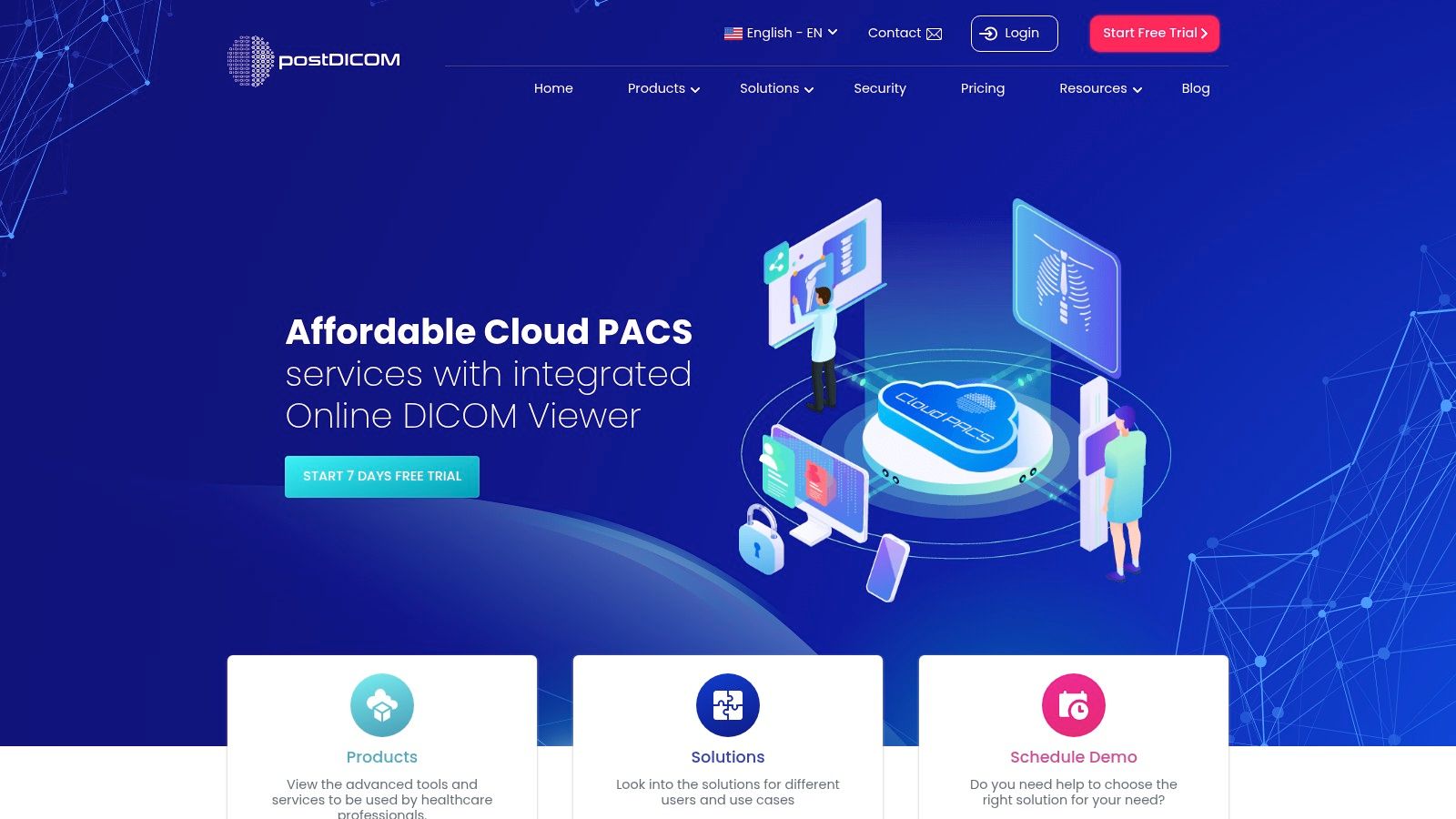
PostDICOM transitions from a simple viewing tool to a comprehensive cloud-based Picture Archiving and Communication System (PACS) with a powerful, integrated web viewer. It is designed for clinics, researchers, and educational institutions that need a turnkey solution for storing, viewing, and securely sharing medical images without the overhead of managing local servers. Its platform is built around accessibility, allowing users to upload studies and share them via secure links with patients or referring physicians from any device with a web browser.
While PostDICOM is a commercial service, it offers a time-boxed free trial that serves as a functional online DICOM viewer free for evaluation. This trial allows you to experience its full suite of features, including its HTML5 viewer, cloud storage, and intuitive sharing capabilities, making it an excellent way to test if a cloud PACS is the right fit for your workflow. To better understand how cloud solutions are changing medical imaging, you can learn more about PACS in healthcare.
Key Features and Use Cases
- Cloud PACS: Provides an all-in-one solution for storing, archiving, and viewing DICOM studies, accessible from anywhere.
- Easy Sharing: Generates secure, shareable links for studies, streamlining collaboration with colleagues and communication with patients.
- Multi-Device Access: Its HTML5 viewer is fully responsive, ensuring a consistent experience on desktops, tablets, and mobile phones.
- Scalable Tiers: Offers tiered plans that grow with your needs, from individual use to large-scale clinical and research operations with optional APIs.
Limitations and Considerations
PostDICOM's primary strength is its integrated cloud service, but the free access is limited to a trial period. For continuous use, a paid subscription is required, and advanced functionalities like the DICOMweb API are tied to higher-tier plans. While it’s an excellent out-of-the-box solution, it offers less customizability than a framework like OHIF. For organizations needing a unique viewer integrated into their own platform, a custom-built solution is often necessary. We at PYCAD specialize in building custom web DICOM viewers and integrating them into bespoke medical imaging platforms. For inspiration, check our work at https://pycad.co/portfolio.
Website: https://www.postdicom.com
4. MedDream DICOM Viewer (Softneta)
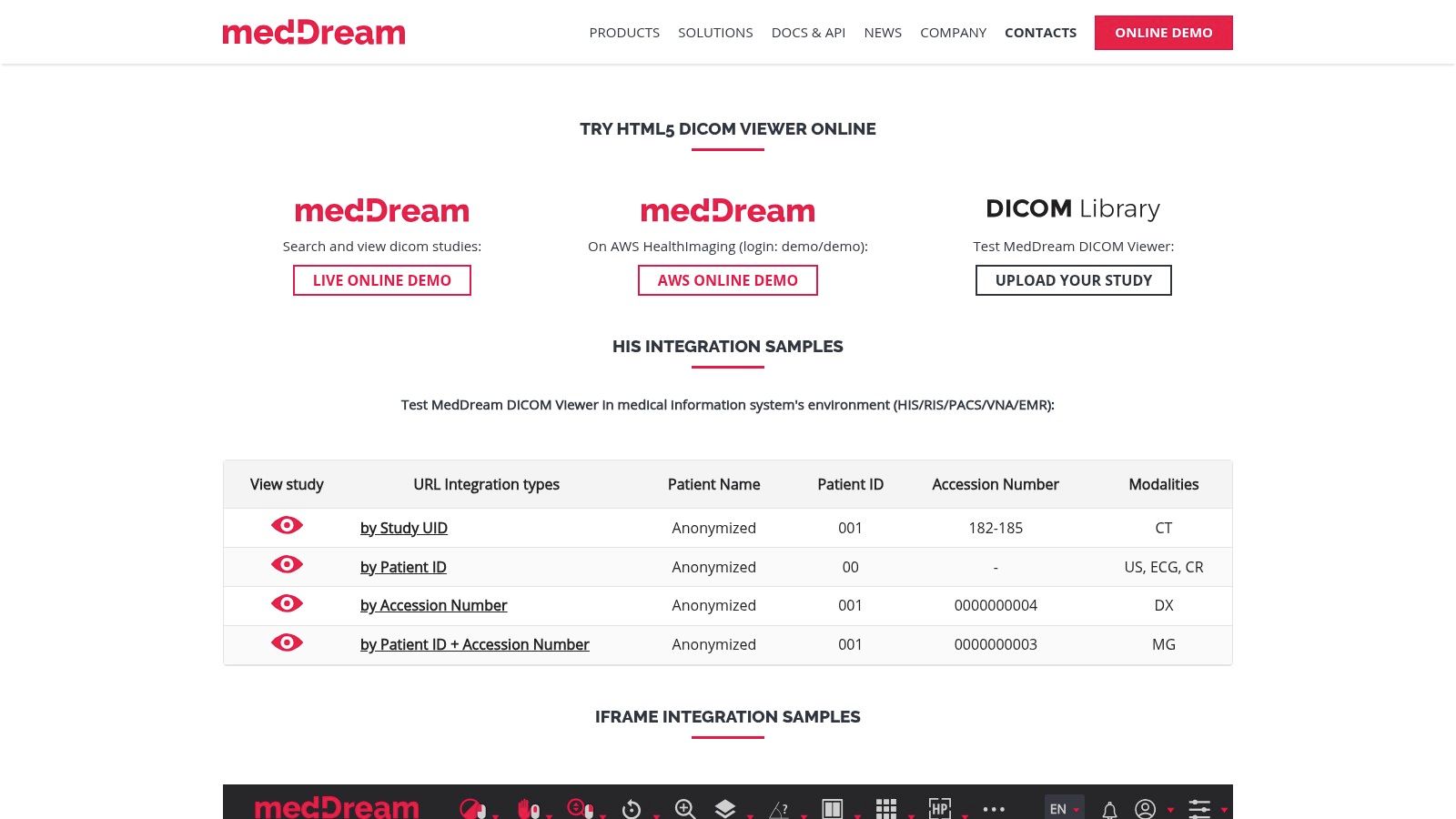
MedDream offers a glimpse into the world of enterprise-grade, diagnostic web imaging through its powerful HTML5 DICOM viewer. While it is a commercial product at its core, its publicly accessible demos function as an excellent online DICOM viewer free for evaluation purposes. This allows anyone to test a clinical-grade, zero-footprint viewer directly in their browser, providing a clear benchmark for what a production-ready system should feel like. The platform is especially useful for hospital IT departments and medtech companies evaluating potential integration partners.
The various online demos, including one featuring integration with AWS HealthImaging, allow users to test advanced functionalities without commitment. You can upload your own studies or use their samples to experience its fluid performance, broad modality support (from CT and MR to ECG and video), and extensive clinical toolset. This "try-before-you-buy" approach is invaluable for assessing diagnostic workflows in a realistic web environment.
Key Features and Use Cases
- For Enterprise Evaluation: The demos are perfect for IT managers and clinical administrators to assess the speed, tools, and user experience of a top-tier commercial viewer before investing.
- Integration Testing: Developers can explore the provided iframe and URL integration examples to understand how a commercial viewer could be embedded into their existing EMR, PACS, or VNA systems. At PYCAD, we often build similar custom integrations for our clients.
- Clinical-Grade Toolset: The viewer is FDA cleared and CE certified, and its demos showcase a rich set of tools for measurements, annotations, and multi-planar reconstructions (MPR).
- Zero-Footprint: Requires no client-side installation, making it ideal for large-scale deployments across diverse hospital networks.
Limitations and Considerations
MedDream is fundamentally a commercial product, and its free demos are for evaluation, not for sustained clinical or research use. The provided datasets are limited, and while you can upload your own studies, functionality is restricted to the demo environment. For organizations needing a tailored solution, the best path is often to partner with specialists. We at PYCAD build custom web DICOM viewers and integrate them into medical imaging web platforms, delivering functionality aligned with specific clinical needs. For examples of our work, visit our portfolio at https://pycad.co/portfolio.
Website: https://meddream.com/online-dicom-viewer/
5. Pacsbin: Streamlined DICOM Sharing for Education and Collaboration
Pacsbin stands out by focusing on a specific, critical workflow: the simple sharing and organization of DICOM cases. It’s less of a diagnostic workstation and more of an elegant, cloud-based platform for creating teaching file libraries, sharing interesting cases with colleagues, or building a professional portfolio. Its core strength lies in its seamless blend of a zero-footprint online DICOM viewer free tier with powerful, user-friendly sharing and anonymization features.
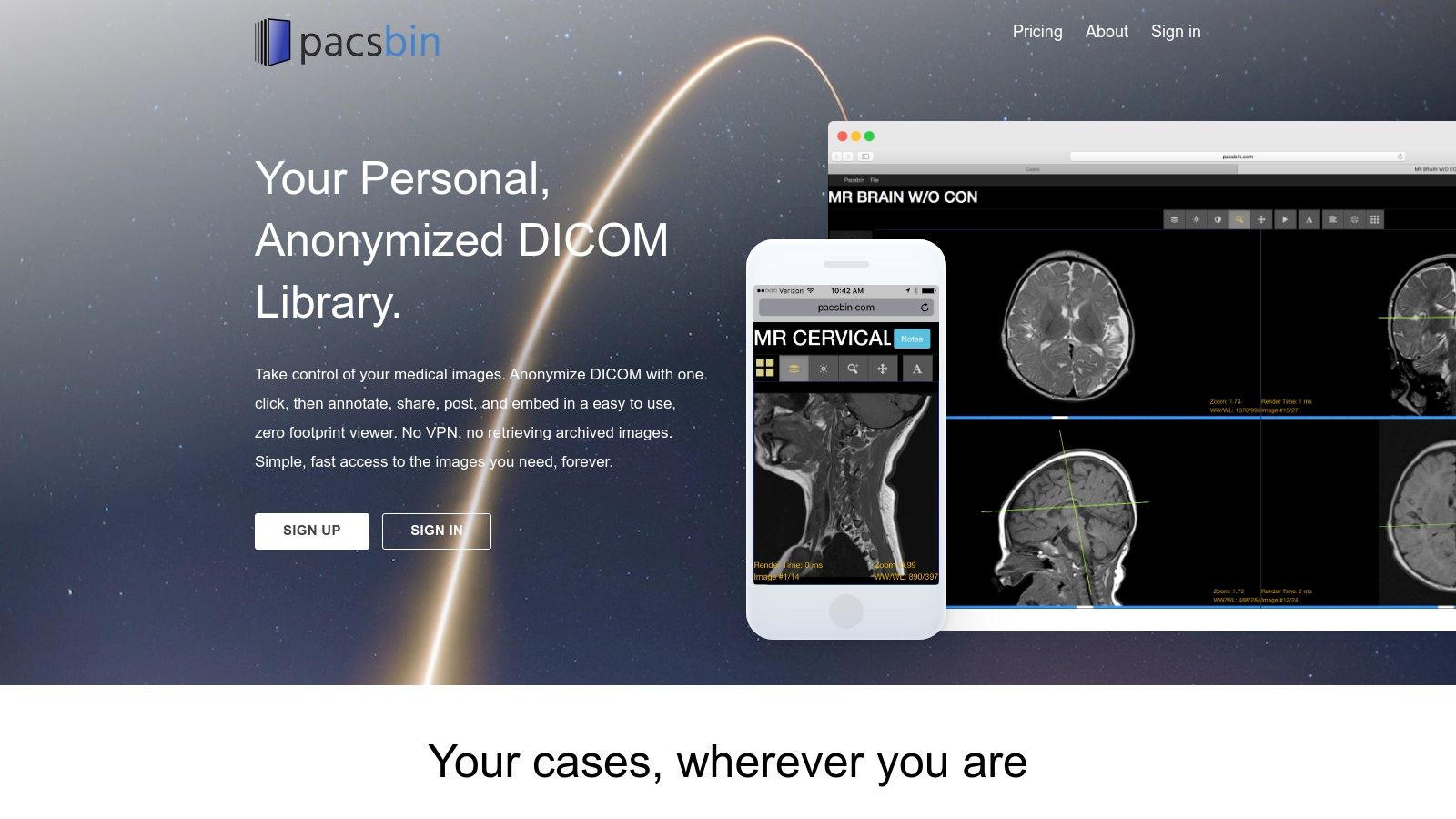
The platform makes it incredibly easy to upload a study, have it automatically anonymized, and then share it via a simple link. This focus on ease of use and presentation makes it a favorite among residents, researchers, and educators who need to communicate visual findings without the complexity of a full PACS system.
Key Features and Use Cases
- For Educators and Residents: Perfect for building teaching files and case libraries. You can organize studies into collections, add annotations, and share them with students or for conference presentations.
- For Simple Collaboration: Quickly share a case with a colleague for a second opinion. The automatic anonymization helps maintain patient privacy during informal consultations.
- Automatic Anonymization: A critical feature for educational and sharing purposes, stripping patient-identifying information upon upload to simplify compliance.
- Embeddable Viewer: Paid plans offer the ability to embed the viewer directly into websites or blogs, which is excellent for medical education sites or personal portfolios.
Limitations and Considerations
Pacsbin’s free tier is generous for casual use but comes with storage and study upload limits, making it unsuitable as a primary archive. It is not designed to be a full-fledged PACS or a diagnostic viewer for clinical decision-making. Its toolset is focused on viewing and sharing rather than advanced post-processing or AI integration. For organizations that need a fully integrated, branded viewer within their own platform, a custom solution is necessary. At PYCAD, we often build custom web DICOM viewers and integrate them into medical imaging platforms, providing a seamless user experience. You can see examples of our work at our portfolio: https://pycad.co/portfolio.
Website: https://get.pacsbin.com
6. Ambra Health (via Box integration): Enterprise-Grade Viewing in a Familiar Ecosystem
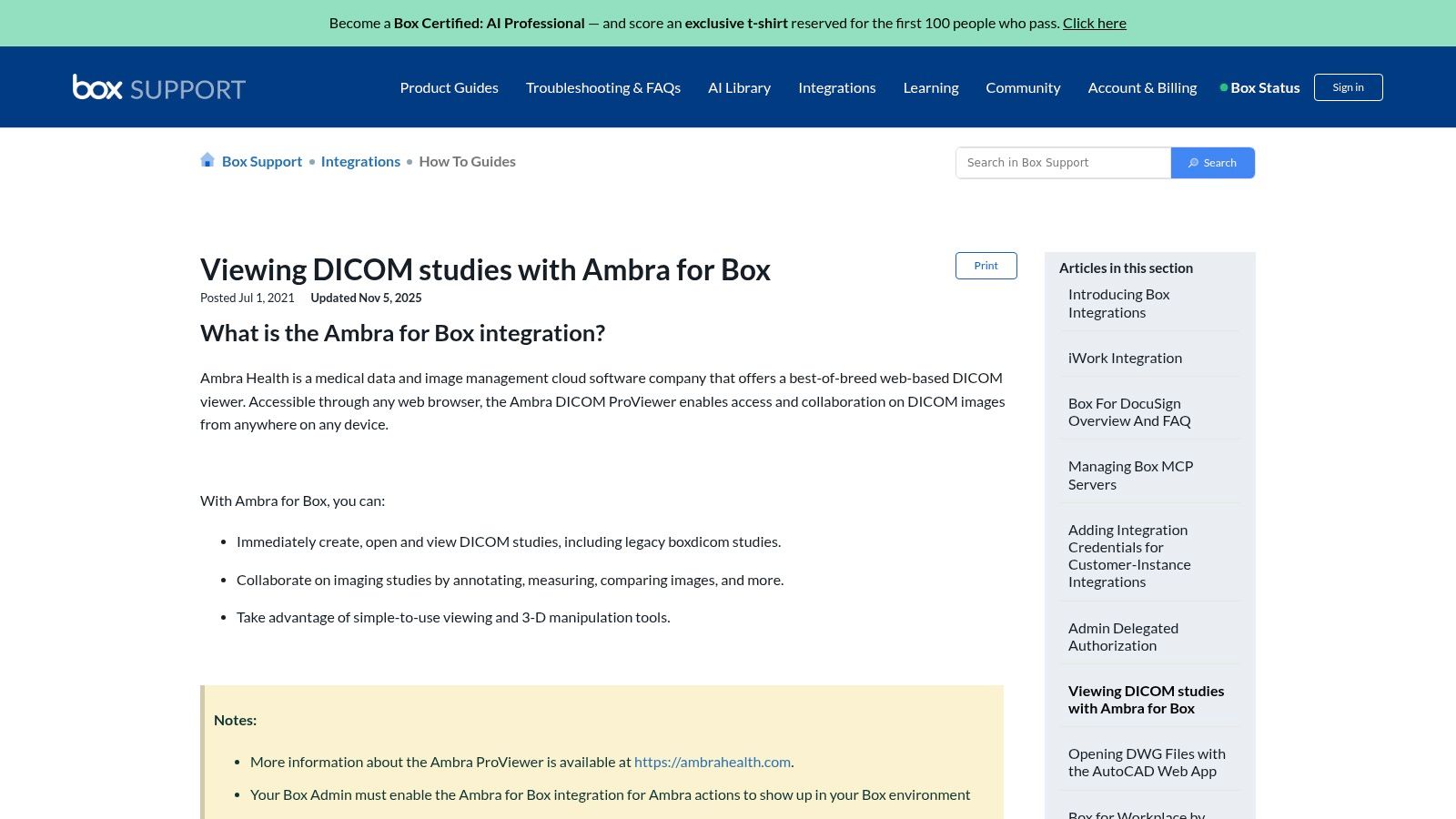
Ambra Health's ProViewer, integrated directly with the Box cloud storage platform, offers a powerful, enterprise-focused approach to medical image viewing. This integration is less of a standalone public viewer and more of a strategic solution for organizations already leveraging Box for secure file storage and collaboration. It transforms a standard Box folder into a diagnostic-capable medical imaging workspace, allowing teams to view, annotate, and collaborate on DICOM studies without ever leaving their established cloud environment.
While not a conventional online DICOM viewer free for public use, its value lies in creating a seamless workflow for existing enterprise customers. The FDA-cleared viewer brings sophisticated imaging tools directly to the point of data storage, streamlining processes for clinical trials, remote consultations, and distributed research teams that depend on Box for data management.
Key Features and Use Cases
- For Enterprise Teams: Organizations using Box can enable their users with a powerful, zero-footprint DICOM viewer without requiring a separate platform or complex data migration. This is ideal for secure, multi-site collaboration.
- Diagnostic Tools: As an FDA-cleared viewer, it includes essential tools for measurements, annotations, and 3D reconstructions, making it suitable for clinical review.
- Leverages Box Security: The integration inherits Box's robust security, compliance, and access control features, simplifying HIPAA and GDPR adherence.
- Streamlined Workflow: Eliminates the need to download studies from Box and upload them to another viewer, reducing friction and potential security risks.
Limitations and Considerations
This solution is designed for a specific niche: organizations with existing Box and Ambra subscriptions. It is not an open, free-to-use tool for the general public. Access requires enterprise-level integration and pricing, which is not publicly listed. For businesses seeking to embed a custom viewer directly into their own proprietary platform without relying on third-party integrations like Box, a tailored development approach is necessary. At PYCAD, we build custom web DICOM viewers that integrate seamlessly into unique medical imaging platforms, as shown in our portfolio at https://pycad.co/portfolio.
Website: https://support.box.com/hc/en-us/articles/4403063589395-Viewing-DICOM-studies-with-Ambra-for-Box
7. Imaging Data Commons (IDC) Viewer: A Gateway to Public Research Data
The Imaging Data Commons (IDC) Viewer offers a unique and invaluable service to the research and development community. It's not a general-purpose viewer for your private studies; instead, it provides a powerful, OHIF-based interface to a massive, cloud-hosted repository of public, de-identified cancer imaging data. This makes it an exceptional resource for researchers, data scientists, and developers who need high-quality, diverse DICOM datasets for training AI models, benchmarking algorithms, or demonstrating new imaging technologies.
This platform serves as a premier online DICOM viewer free for exploring and interacting with curated research collections without the complexities of handling protected health information (PHI). Its direct integration with the IDC portal allows users to seamlessly move from discovering a dataset to visualizing its contents with a single click, generating shareable URLs to specific studies for easy collaboration.
Key Features and Use Cases
- For Researchers: Provides immediate access to large, analysis-ready datasets (e.g., from The Cancer Imaging Archive) without needing to download terabytes of data.
- For Developers: An ideal environment for testing and validating custom-built viewers or analysis tools against real-world, complex imaging data. We at PYCAD often recommend resources like IDC to clients for benchmarking the custom web DICOM viewers we develop and integrate.
- Powered by OHIF v3: The viewer itself is modern and feature-rich, supporting both radiology (DICOM) and pathology (whole-slide imaging) modalities.
- Zero-Footprint and No Registration: Anyone can access and use the viewer and its associated public data instantly, making it perfect for educational purposes and quick demonstrations.
Limitations and Considerations
The IDC Viewer's greatest strength is also its primary limitation: it is exclusively designed for accessing the public datasets hosted by the IDC. You cannot upload your own private or clinical DICOM files. Its purpose is data exploration and research, not clinical diagnosis or private data management. For teams needing to build a viewer for their own proprietary data, a custom solution built on a framework like OHIF is the necessary path. Explore examples of such custom integrations in our portfolio at https://pycad.co/portfolio.
Website: https://viewer.imaging.datacommons.cancer.gov
8. DWV (DICOM Web Viewer): Lightweight and Embeddable Simplicity
DWV (DICOM Web Viewer) stands out for its simplicity and accessibility, offering a pure HTML5 and JavaScript-based solution that is both open-source and incredibly lightweight. It's designed for developers and educators who need a straightforward, zero-footprint viewer that can be easily embedded into web applications or used for quick, client-side analysis. DWV embodies the principle of "less is more," focusing on core functionalities without the overhead of complex server-side setups.
Its live demo serves as an excellent online DICOM viewer free for immediate use, allowing anyone to load local files or access remote DICOM studies directly in the browser. This makes it a perfect tool for testing, educational purposes, or situations where a quick, no-install viewer is paramount.
Key Features and Use Cases
- For Developers: DWV is a fantastic library for embedding basic DICOM viewing capabilities into a website or web application with minimal effort. At PYCAD, we recognize its value for projects needing a simple, fast-loading viewer for non-diagnostic previews or educational modules.
- For Education & Quick Lookups: Its ease of use makes it ideal for students learning about medical imaging or clinicians needing a quick way to view a study without logging into a full PACS.
- Zero-Footprint: Runs entirely in the browser using just HTML5 and JavaScript, ensuring broad compatibility and no client-side installation.
- Core Toolset: Provides essential tools like windowing, zooming, panning, and basic MPR (Multi-Planar Reconstruction), covering the fundamental needs of image review.
Limitations and Considerations
DWV is not certified for diagnostic use and its feature set is intentionally basic compared to comprehensive frameworks like OHIF or commercial enterprise viewers. While perfect for embedding and simple tasks, it lacks the advanced segmentation, annotation, and reporting tools required for clinical workflows. For organizations needing a robust, custom-built viewer with advanced features and integration capabilities, partnering with a development firm to build upon more powerful frameworks is the ideal path. Explore examples of such custom integrations in our portfolio at https://pycad.co/portfolio.
Website: https://ivmartel.github.io/dwv/
9. SonicDICOM: A Rapidly Deployable Server and Viewer in One
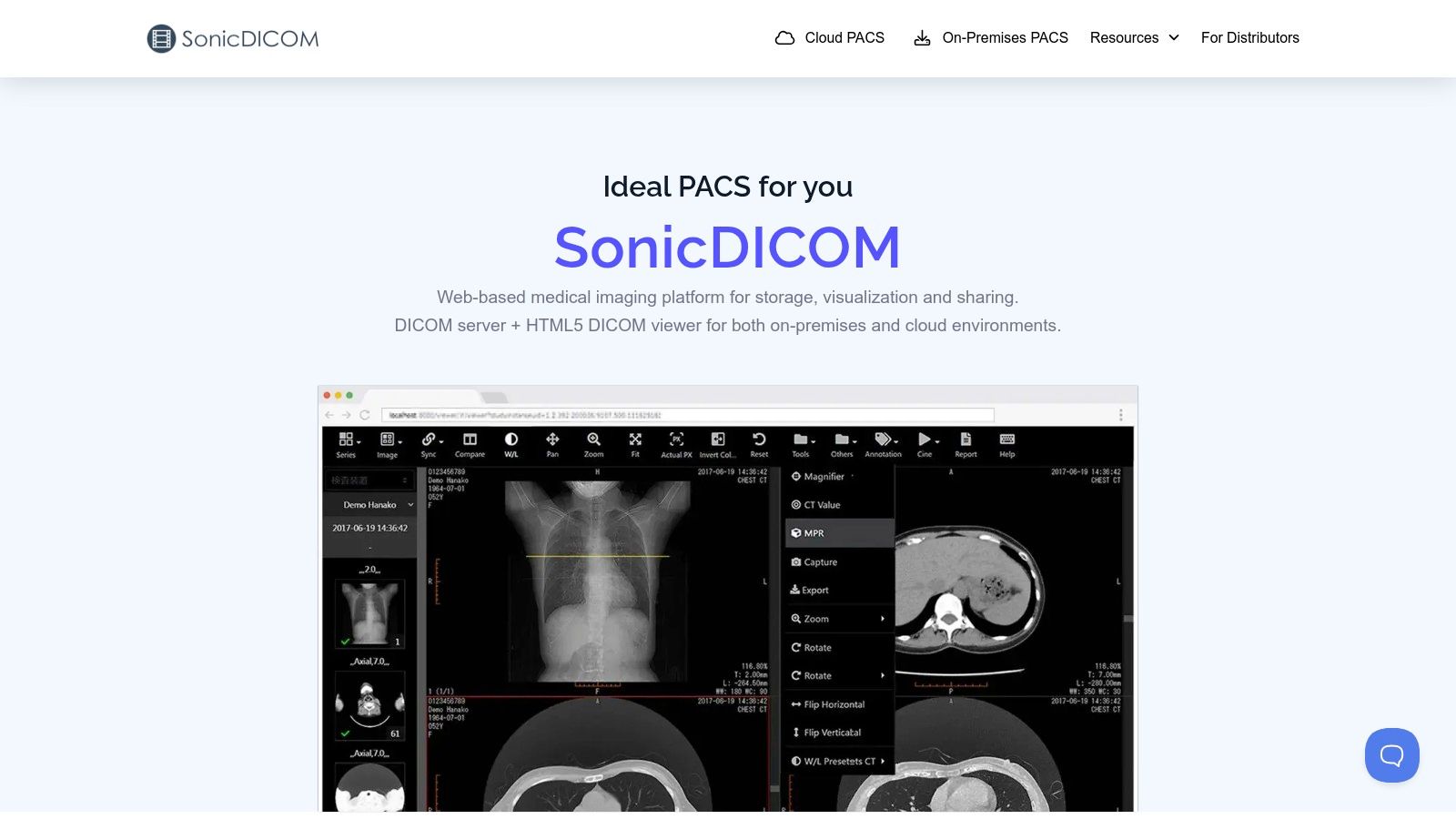
SonicDICOM offers a unique, integrated approach by combining a web-based DICOM server with a built-in HTML5 viewer. This all-in-one solution is designed for simplicity and rapid deployment, making it an excellent choice for small clinics, research projects, or anyone needing to quickly set up a self-contained DICOM environment. While primarily a commercial product, its trial version serves as a powerful online DICOM viewer free for evaluation, allowing users to experience its seamless server-viewer workflow.
Its strength lies in its simplicity. You can deploy it on a local Windows server or in the cloud, and within minutes, begin storing, viewing, and sharing studies securely via a web browser. The system generates shareable, password-protected URLs, which is a practical feature for collaborations or simple EMR integrations.
Key Features and Use Cases
- For Small Clinics: Provides a lightweight, easy-to-manage PACS and viewer without the complexity of enterprise-grade systems.
- For Pilot Projects: Ideal for testing new workflows or integrations on a small scale before committing to larger infrastructure.
- Simple Integration: Can be linked to an EMR, HIS, or RIS via a simple URL call, a feature often requested in custom projects. At PYCAD, we frequently build similar custom integrations for clients needing to connect their existing systems to a web viewer.
- Multi-Platform Access: The HTML5 viewer works on desktops, tablets, and mobile devices, offering flexibility for on-the-go image review.
Limitations and Considerations
SonicDICOM is a commercial product, and the free access is for trial purposes. Production use requires a license, the pricing for which is not immediately available on the website. While its simplicity is a major benefit, it lacks the extensive customization and extensibility found in frameworks like OHIF. Organizations needing tailored features or deeper integration into complex platforms would likely need a more flexible solution. For examples of fully customized viewers, you can explore our work at https://pycad.co/portfolio.
Website: https://sonicdicom.com
10. KHEOPS: The Open Platform for Collaborative Imaging Research
KHEOPS is more than just a viewer; it's an open-source platform engineered for secure sharing and collaboration around medical imaging data. It provides a centralized hub where research groups and multi-site projects can manage, distribute, and visualize DICOM studies through an integrated web interface. While it includes a built-in viewer, its primary strength lies in creating a controlled ecosystem for data sharing, making it a powerful tool for collaborative scientific discovery.
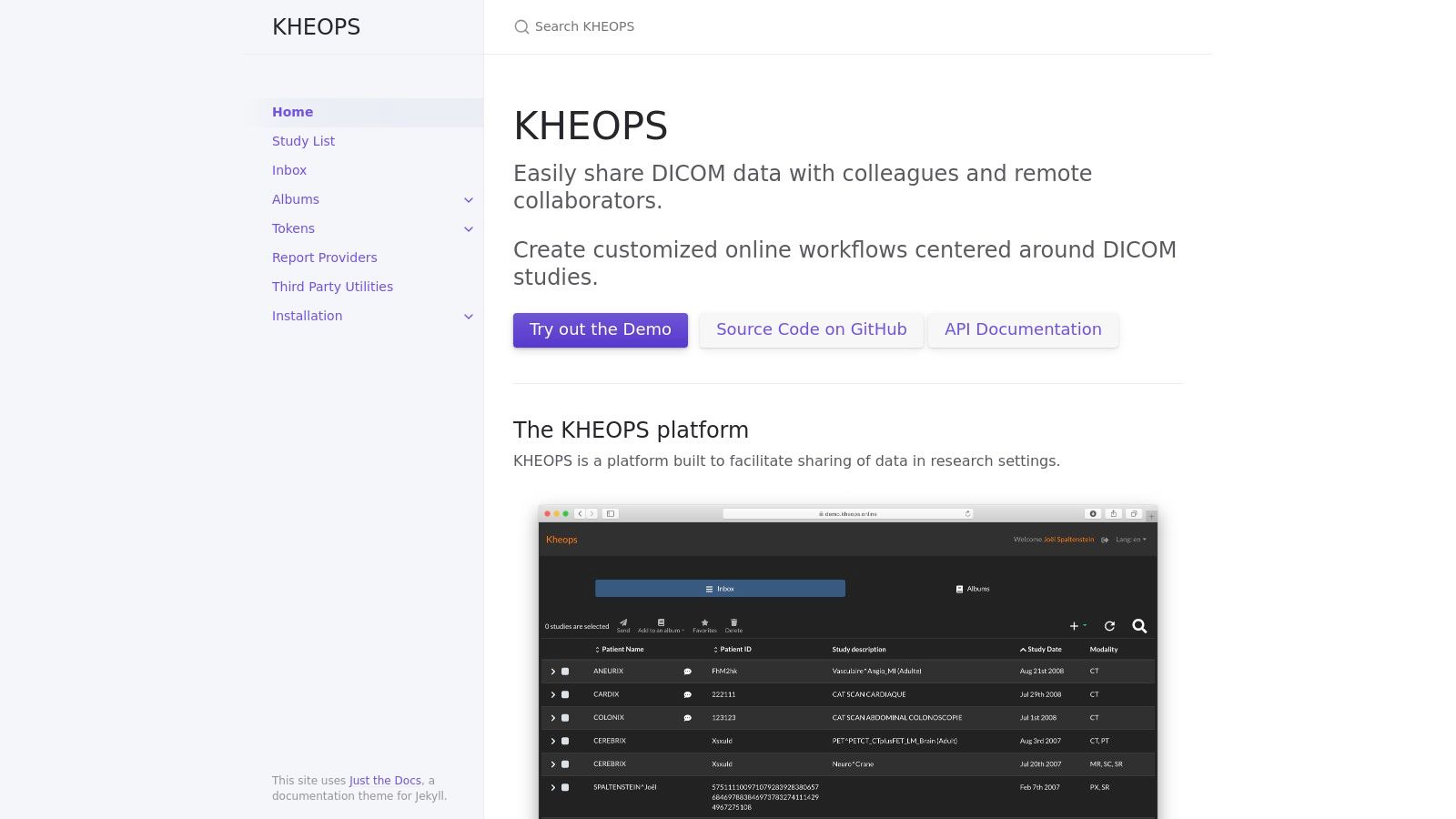
Its public demo showcases a clean study list, an inbox for receiving studies, and the core viewing capabilities, making it a great online DICOM viewer free for evaluation. This setup highlights its unique focus on workflow and data management, which is essential for projects involving multiple institutions.
Key Features and Use Cases
- For Multi-Site Research: KHEOPS excels at creating secure, token-based sharing networks, allowing researchers to distribute specific datasets to collaborators without giving them full access to the entire archive.
- For Custom Workflows: As an open and extensible platform, it allows developers to build custom research workflows on top of its core functionalities. Companies like us at PYCAD can leverage such platforms to build specialized, collaborative environments for clinical trials or research consortia.
- Centralized Study Management: It provides a user-friendly online study list and inbox, simplifying the process of organizing and accessing images for different projects.
- API-Driven: The platform offers a robust API, enabling integration with other research tools, AI models, and data analysis pipelines.
Limitations and Considerations
KHEOPS is designed as a self-hosted, collaborative platform, not a turnkey, FDA-cleared diagnostic viewer. Setting up a production instance requires technical expertise in deployment and server management. The built-in viewer is functional but may not have the advanced diagnostic tools found in dedicated clinical systems. Organizations looking for a custom, fully integrated viewing solution without the overhead of self-hosting can explore our work at https://pycad.co/portfolio for inspiration.
Website: https://docs.kheops.online
11. MiPACS HTML5 Web Viewer: Evaluating a Commercial-Grade Clinical Viewer
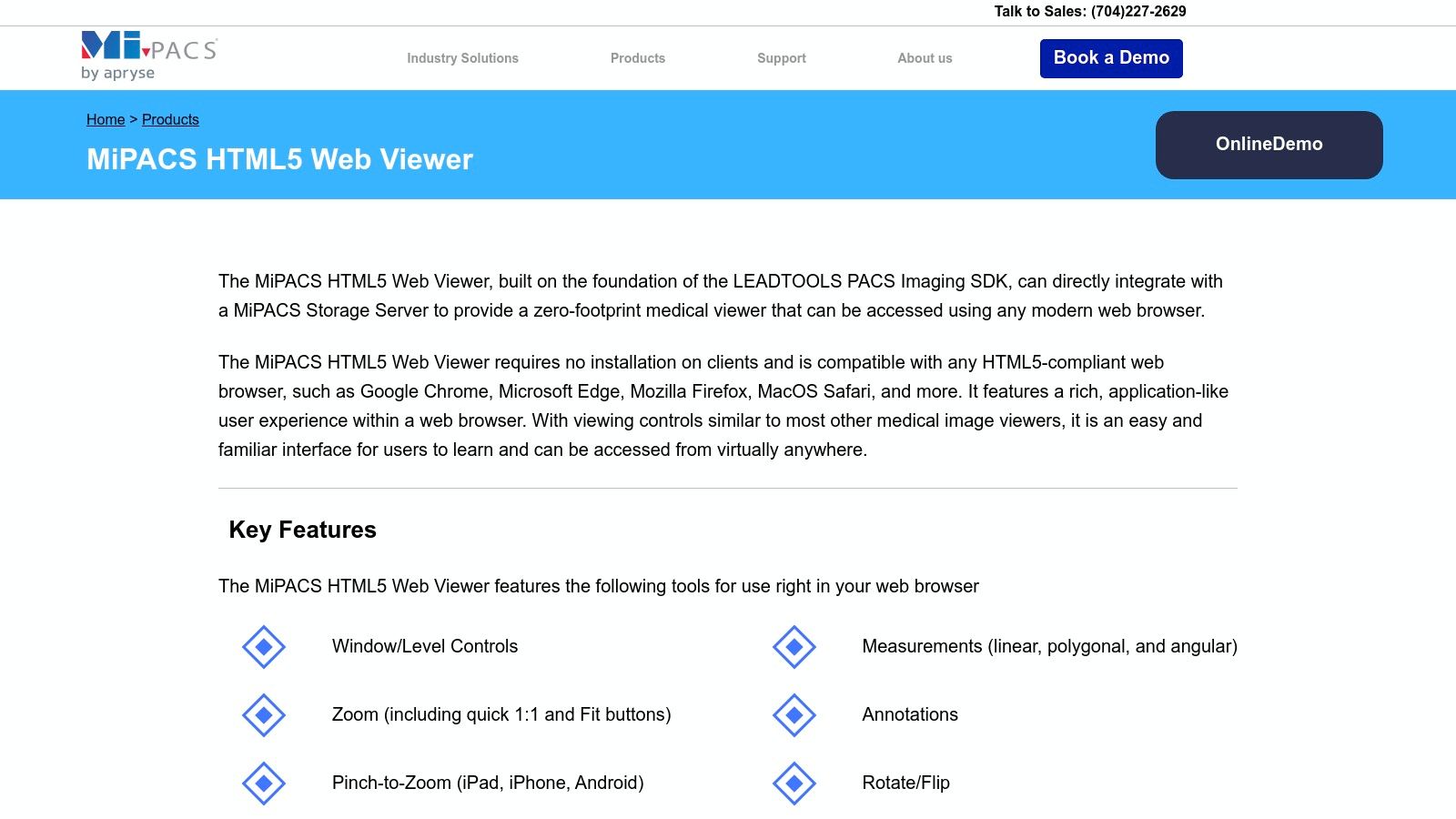
The MiPACS HTML5 Web Viewer offers a glimpse into a mature, commercial-grade diagnostic viewing environment. Built upon the robust LEADTOOLS SDK, this viewer is designed as an integrated component of the broader MiPACS Storage and VNA ecosystem. While it's a commercial product requiring a license, its public demo serves as a valuable online DICOM viewer free for evaluation purposes, allowing potential buyers to test its clinical-focused feature set in a zero-footprint environment.
This demo showcases a clean, intuitive interface that will feel familiar to many clinicians, prioritizing core diagnostic tools over experimental features. It’s a powerful preview for organizations considering a fully integrated, vendor-supported web viewing solution that connects directly to their PACS or VNA.
Key Features and Use Cases
- For Clinical Evaluation: The online demo is ideal for hospital IT departments and imaging center administrators evaluating how a commercial zero-footprint viewer would fit into their existing workflows.
- Essential Diagnostic Tools: Provides standard tools crucial for clinical review, including window/level adjustments, zoom, measurements, annotations, and a magnifier.
- Zero-Footprint: Runs in any modern browser without requiring plugins or local software installation, simplifying IT management and deployment across an organization.
- Mobile-Ready: Features responsive design with touch-based controls like pinch-to-zoom, making it suitable for viewing on tablets and other mobile devices.
Limitations and Considerations
The MiPACS viewer is fundamentally a commercial product, not a free-to-use tool for daily tasks. The demo is an evaluation gateway, and realizing its full potential requires purchasing and integrating it with the MiPACS back-end systems. For teams needing a custom-branded viewer without being locked into a specific VNA, it often makes more sense to build a bespoke solution. We at PYCAD specialize in developing custom web DICOM viewers that integrate seamlessly into unique medical imaging platforms. For a look at what's possible, view our work at https://pycad.co/portfolio.
Website: https://www.mipacs.com/products/mipacs-html5-web-viewer/
12. iQ-4VIEW: Extending PACS for Remote Diagnostic Workflows
iQ-4VIEW by IMAGE Information Systems is not a standalone viewer but a powerful, zero-footprint web extension for their iQ-WEB PACS. It is designed to bring diagnostic-quality reading and reporting capabilities to any modern browser, effectively untethering radiologists and specialists from dedicated workstations. While not an online DICOM viewer free for public use, its role within the iQ-WEB ecosystem demonstrates how sophisticated remote workflows can be seamlessly integrated into an existing PACS infrastructure.
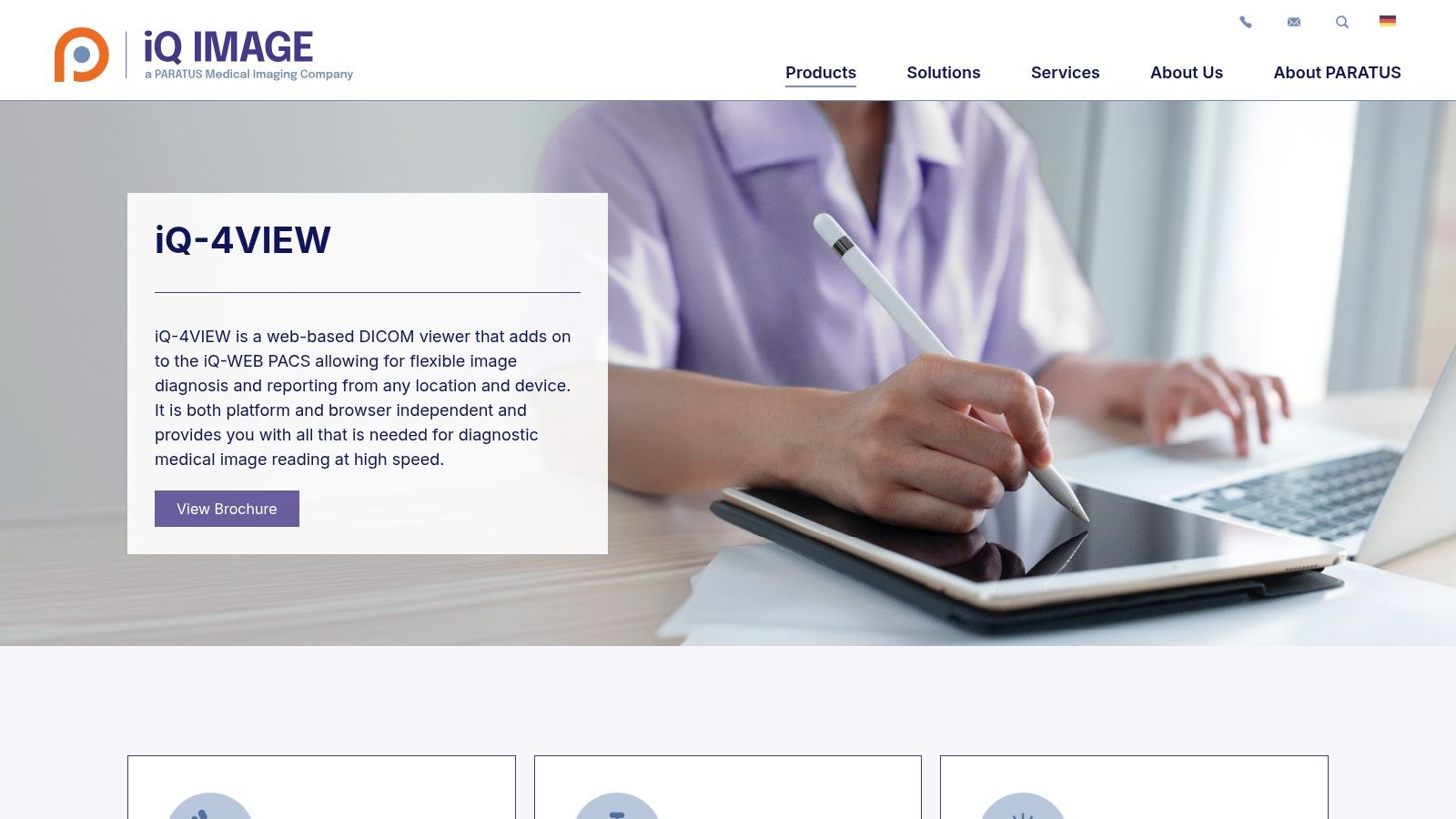
This platform is engineered for speed and enterprise reliability, allowing users to access and manipulate large imaging studies from anywhere without client-side installation. Its focus on integrated reporting directly within the browser streamlines the entire diagnostic process, from image review to final sign-off, making it a highly efficient solution for distributed healthcare environments.
Key Features and Use Cases
- Remote Diagnostics: Its primary use case is enabling radiologists to perform primary diagnostic reads and create structured reports from any location, on any device.
- Zero-Footprint: Eliminates the need for software installation and maintenance on client computers, simplifying IT management across a hospital or imaging center network.
- Integrated Structured Reporting: Offers built-in tools to create, sign, and distribute diagnostic reports directly from the viewing interface, creating a cohesive workflow.
- Cross-Platform Compatibility: Delivers a consistent user experience across different operating systems (Windows, macOS, Linux) and web browsers.
Limitations and Considerations
The biggest limitation is its dependency; iQ-4VIEW is exclusively an add-on for the iQ-WEB PACS and cannot be used as a standalone product. There is no free public version, and pricing is only available through a direct sales inquiry, making it unsuitable for individuals or institutions not already invested in or planning to adopt the iQ-WEB ecosystem. For organizations needing a more flexible or custom solution, building a bespoke viewer is often the better route. We at PYCAD specialize in creating such custom web DICOM viewers and integrating them into medical imaging platforms to meet specific workflow demands.
Website: https://www.iq-image.com/product/iq-4view/
12 Free Online DICOM Viewers Comparison
| Product | Core features | UX/Quality (★) | 👥 Target audience | 💰 Price / Value | ✨ / 🏆 USP |
|---|---|---|---|---|---|
| OHIF Viewer (Open Health Imaging Foundation) | Browser DICOMweb, 2D/3D, MPR, segmentation, plugin system | ★★★★☆ | 👥 Devs, integrators, healthcare IT | 💰 Free (open-source, MIT) | ✨ Extensible plugins; AI integration ready |
| DICOM Library | In-browser upload/view, auto-anonymize, shareable links | ★★★☆☆ | 👥 Educators, students, quick sharers | 💰 Free (non-clinical) | ✨ Fast anonymize & share for teaching |
| PostDICOM | Cloud PACS, HTML5 viewer, mobile, DICOMweb/FHIR add‑ons, tiered storage | ★★★★☆ | 👥 Clinics, research groups, universities | 💰 Trial → paid tiers (100GB–2TB+) | 🏆 Turnkey cloud PACS; scalable storage |
| MedDream DICOM Viewer (Softneta) | Enterprise HTML5 viewer, broad modalities, PACS/VNA integration | ★★★★★ | 👥 Hospitals, imaging centers, vendors | 💰 Commercial licensing | 🏆 Diagnostic-grade (FDA/CE demos) |
| Pacsbin | Auto-anonymize/compress, web viewer, annotations, shared collections | ★★★☆☆ | 👥 Educators, clinicians building portfolios | 💰 Free basic plan (limits) | ✨ Simple case sharing & teaching files |
| Ambra Health (via Box) | ProViewer in Box, annotations, 3D tools, mobile, cloud mgmt | ★★★★★ | 👥 Enterprises using Box, distributed teams | 💰 Enterprise pricing (integration req'd) | 🏆 FDA-cleared viewer + Box security |
| Imaging Data Commons (IDC) Viewer | OHIF v3 viewer, public CC-BY datasets, click-to-view URLs | ★★★★☆ | 👥 Researchers, benchmarkers, demo users | 💰 Free (public data access) | ✨ Large public corpus ideal for research |
| DWV (DICOM Web Viewer) | Pure HTML5/JS, local/remote DICOM load, basic tools, MPR | ★★★☆☆ | 👥 Developers, educators, quick embeds | 💰 Free (open-source) | ✨ Lightweight, easy to embed and test |
| SonicDICOM | Web DICOM server + HTML5 viewer, HTTPS, shareable URLs, EMR links | ★★★★☆ | 👥 Small facilities, pilots, IT teams | 💰 Commercial (contact sales) | ✨ Combined server+viewer for rapid trials |
| KHEOPS | Online study list, token-based secure sharing, API, demo | ★★★★☆ | 👥 Research groups, multi-site projects | 💰 Open / self-host (deployment req'd) | ✨ Secure multi-site sharing & API focus |
| MiPACS HTML5 Web Viewer | Window/level, zoom, measurements, DICOM tags, mobile support | ★★★★☆ | 👥 Buyers evaluating MiPACS clinical viewing | 💰 Commercial (requires MiPACS backend) | 🏆 Mature SDK lineage for clinical use |
| iQ-4VIEW (IMAGE Info Sys) | Zero-footprint high-speed viewer, structured reporting, cross‑device | ★★★★★ | 👥 PACS users, remote readers, hospitals | 💰 Commercial (requires iQ‑WEB) | 🏆 Integrated reporting + diagnostic workflows |
Beyond Free Viewers: When to Build Your Custom Solution
Our journey through the landscape of free online DICOM viewers has revealed a powerful and diverse ecosystem. From the research-centric, open-source framework of OHIF to the user-friendly accessibility of PostDICOM and the specialized platform of Imaging Data Commons, these tools are more than just utilities. They are catalysts for innovation, enabling students, researchers, and small clinics to access and interact with complex medical imaging data without prohibitive upfront costs.
We've seen how each online dicom viewer free tool carves out its niche. Some excel at anonymous, rapid sharing for educational purposes, while others offer modest, cloud-based storage for personal case libraries. The key takeaway is that "free" is not a one-size-fits-all category. The right free tool can be a game-changer for specific, contained tasks, such as validating a dataset, collaborating on a non-clinical research project, or teaching a medical student the fundamentals of image interpretation.
However, this exploration also illuminates a critical inflection point: the moment when your needs outgrow the inherent limitations of off-the-shelf solutions. This is where strategic thinking must supersede the convenience of free software.
From Evaluation to Enterprise: Recognizing the Tipping Point
The transition from a free viewer to a custom-built solution is not a sign of failure but a mark of maturity. It signals that your project, platform, or clinical workflow is scaling to a level where generic tools are no longer sufficient. You've moved beyond simple viewing and into the realm of integrated, mission-critical operations.
Consider these critical questions to determine if you've reached this point:
- Workflow Integration: Does your viewer need to seamlessly communicate with your EMR, RIS, or a proprietary patient management system? Free tools rarely offer the deep, bidirectional integration required for clinical efficiency.
- User Experience & Branding: Is a cohesive, branded user experience essential for your patient portal or teleradiology platform? A custom solution allows you to control every pixel, ensuring the viewer feels like an integral part of your application, not a third-party add-on.
- Specialized Functionality: Does your research require novel measurement tools, specific annotation types, or the integration of a custom AI diagnostic model? When your needs are unique, a purpose-built viewer is the only way to achieve the required functionality without compromise.
- Data Sovereignty and Security: Do you have strict requirements for where data is stored, how it is accessed, and the specific security protocols that must be in place? A custom solution gives you complete control over the entire data lifecycle, ensuring compliance with institutional or regional mandates.
The Power of a Purpose-Built Foundation
Choosing to build a custom web DICOM viewer is an investment in your platform's future. It's about creating a foundational asset that is not just a feature but a core component of your value proposition. A custom viewer becomes your proprietary engine for medical image interaction, one that is perfectly tuned to your users' needs and your organization's strategic goals.
This path allows you to architect a solution that is performant, scalable, and secure by design. You can optimize loading times for massive datasets, build collaborative features that mirror real-world clinical workflows, and embed intelligence directly into the viewing experience. It is the definitive step from being a user of technology to becoming a creator of a unique, competitive advantage in the medical imaging space.
The world of free online DICOM viewers is an incredible starting point, a launchpad for ideas and a powerful resource for many. But when your vision is bigger than what a free tool can offer, it’s time to build the precise instrument your work demands.
At PYCAD, we specialize in this exact transition. We build custom, high-performance web DICOM viewers and seamlessly integrate them into sophisticated medical imaging platforms. If you're ready to move beyond the limitations of free tools and create a powerful, proprietary imaging experience, explore our portfolio of work and see how we can help bring your vision to life.
Keep Reading
Related Articles
Explore the full DICOM HubAll services, tools, and guides on this topic — in one place.
Visit Hub →