
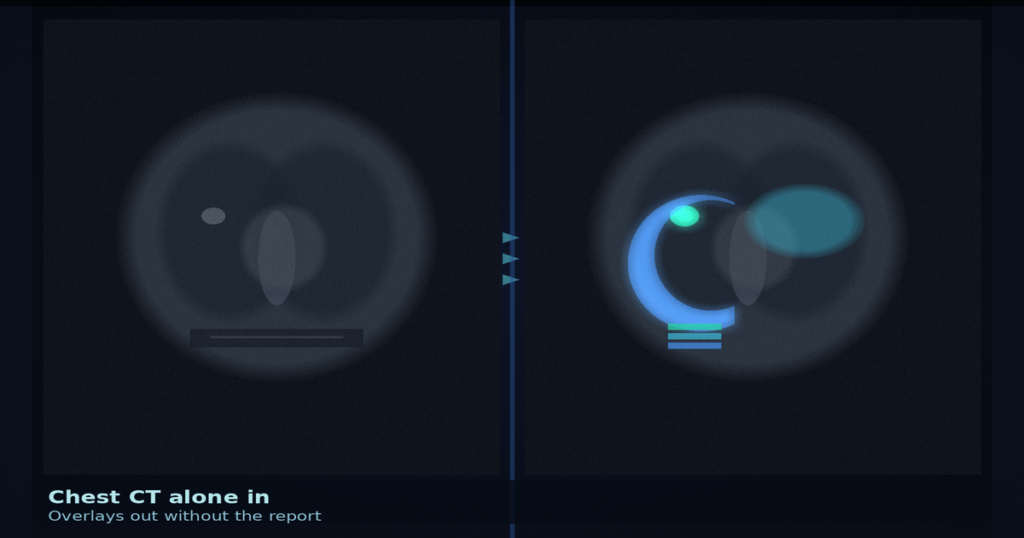
Hang a non-contrast chest CT and most report-guided segmenters still want the finding sentence in the same forward pass, one queried abnormality at a time. Instance-Guided Report Anchoring (IGRA) keeps those report sentences for training only, then throws away every text pathway so inference is a plain CT-to-mask map across fourteen abnormality categories. Zhenyu Bu, Haoyan Ding, Chushu Shen, Xinyuan Zheng, Peiyu Duan, Xueqi Guo, Sepehr Farhand, Yoshihisa Shinagawa, Gerardo Hermosillo Valadez, and Chaowei Wu (Siemens Medical Solutions USA, with OSU, UCLA / Cedars-Sinai, and Yale) posted arXiv:2609.00447 around 31 August 2026. The paper is Instance-Guided Report Anchoring for Text-Free 3D Abnormality Segmentation in Chest CT. No public code repository is linked in the preprint (checked 8 September 2026).
Viewer shops already hang chest CT fine. The annoying part is when the overlay service expects paired report text at runtime, or when you can only ask for one finding sentence per pass while the worklist needs every category on the stack.
Reports train the features, not the inference call
ReXGroundingCT pairs each abnormality instance with the report sentence that describes that region. Text-conditioned methods take the CT plus one sentence and return that one mask. IGRA instead merges same-category instances into fourteen multi-label channels, then during training pools the full-resolution decoder features inside each instance and anchors them to a frozen BiomedCLIP embedding of the matching finding sentence with a cosine-distance loss. The segmentation loss stays Dice plus binary cross-entropy with deep supervision. After training, the projector, finding-assignment maps, and all text components are discarded. What ships is the original image-only network: one CT volume in, fourteen sigmoid channels out.
The encoder starts from VoxTell pretrained ResEnc-L weights. The decoder is a fresh U-Net-style stack, so the text-conditioned VoxTell decoder path never rides along into deployment. Patches are 96 by 160 by 128 at nnU-Net spacing near 1.0 by 0.70 by 0.70 mm. Anchoring weight lambda is 0.1. Inference uses sliding windows. Everything runs on a single A100 in the paper’s setup.
Where it was measured
ReXGroundingCT contributes 3,142 non-contrast chest CT volumes from CT-RATE with 8,028 text-to-segmentation pairs across fourteen lung and pleura categories (eight focal, six non-focal; about 79% of findings are focal). The official split is 2,992 train and 200 validation, with exhaustive radiologist masks on validation. On the all-findings validation setting (341 case-category targets after merge), IGRA reaches 30.93 Dice and 74.49 hit rate, against 25.25 Dice for the strongest image-only baseline (TransUNet), a 22.5% relative Dice lift. On the single-finding subset it sits at 30.29 Dice, essentially tied with text-conditioned VoxTell at 30.43, while still needing no text at test time.
Zero-shot, with no adaptation: LIDC-IDRI nodules (class 2d) hit 51.53 Dice versus 42.34 for TransUNet; PleThora pleural effusion (class 2e) hits 36.88 Dice versus 22.96 for ProLearn; an in-house COVID ground-glass set (class 2c, 240 subjects) hits 50.27 Dice. Those external sets have no paired finding text, so text-conditioned baselines cannot even be scored there. Dropping IGRA onto nnU-Net, SwinUNETR, TransUNet, and SegResNet without changing their inference graphs also raises Dice on each backbone.
How this lands in a viewer
If you already hang chest CT in a DICOM viewer, treat IGRA as a training recipe for the overlay service, not a new report parser in the reading room. Wire the series as image-only input, hang the fourteen category masks as editable overlays, and leave the radiology report on the side panel for the human. Fail closed when the finding sits outside the ReXGroundingCT ontology, when you need open-vocabulary free-text localization at runtime, when training data has reports but no instance masks to anchor against, or when a single scan needs instance-level separation of three same-category nodules rather than one merged channel. Absolute Dice on this benchmark is still modest in the thirties; the practical win is text-free multi-label hang plus zero-shot carry to nodule, effusion, and ground-glass cohorts.
CoMLP keeps the report in the forward pass for head-and-neck PET/CT tumor overlays. This paper is the opposite trade: report sentences coach the features during training, then chest CT alone drives the abnormality overlay list.
Rebuild from arXiv:2609.00447. As of 8 September 2026 the abstract and PDF respond (HTTP 200). The preprint is the source of record until a camera-ready version exists. No public weights or repo are listed yet.
Sources
- Zhenyu Bu, Haoyan Ding, Chushu Shen, Xinyuan Zheng, Peiyu Duan, Xueqi Guo, Sepehr Farhand, Yoshihisa Shinagawa, Gerardo Hermosillo Valadez, Chaowei Wu. Instance-Guided Report Anchoring for Text-Free 3D Abnormality Segmentation in Chest CT. arXiv:2609.00447, posted ~31 August 2026. https://arxiv.org/abs/2609.00447 (HTTP 200 on 8 September 2026). PDF: https://arxiv.org/pdf/2609.00447 (HTTP 200 on 8 September 2026). No public code linked in the preprint as of 8 September 2026.