
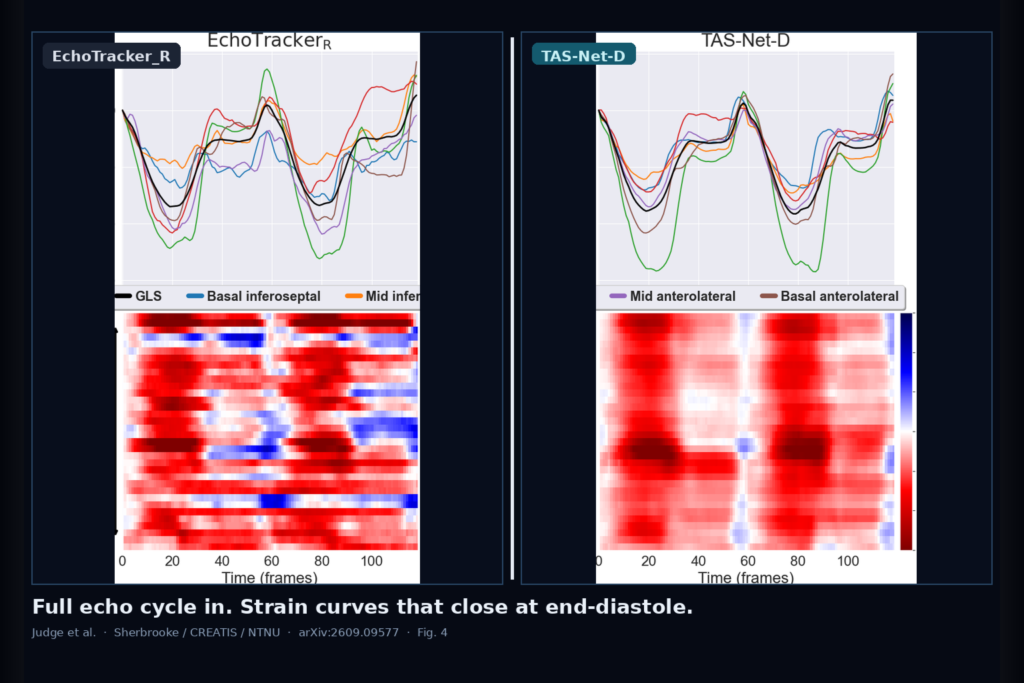
Hang a multi-beat apical echo loop for myocardial strain and watch a deep learning tracker walk the wall. On a cyclic sequence, GLS and regional longitudinal strain should come back near zero at the next end-diastole. Many DL trackers do not. Errors stack across frames, strain curves walk off the baseline, and regional maps look noisier from beat to beat. Commercial STE packages often paper over that with a posteriori drift correction that never touched the tracking itself. Thierry Judge, Nicolas Duchateau, Andreas Østvik, Havard Dalen, Bjørnar Grenne, Pierre-Yves Courand, Lasse Lovstakken, Pierre-Marc Jodoin, and Olivier Bernard (Sherbrooke, CREATIS / Lyon, NTNU / St. Olavs and collaborators) posted arXiv:2609.09577 on 9 September 2026. The paper is Myocardial Strain Drift Correction in Deep Learning Based Ultrasound Tracking. Code: https://github.com/ThierryJudge/cardiac-motion.
Their answer is TAS-Net-D. It starts from TAS-Net, keeps a sliding-window tracker, and adds persistent memory tokens plus a teacher-student fine-tune so the model sees full cycles and learns to keep mesh edge lengths consistent from one ED to the next.
What TAS-Net-D changes in the tracker
Plain TAS-Net refines each window to completion before sliding. That keeps temporal context inside the window and blocks information from traveling across the full sequence. TAS-Net-D flips the schedule: a few inner refinements per window, then outer passes over the whole video, so refinement is interleaved across windows instead of finished per window in isolation. On top of that, a set of window-persistent tokens rides between windows. At each window the transformer reads those tokens with cross-attention between spatial and temporal attention; after the window they update through gated cross-attention. Same total refinement budget as TAS-Net in the paper’s settings (Ii = 2, Io = 2 train / 3 infer), but the tokens carry state across the cycle.
Fine-tuning is teacher-student on real CAMUS and CARDINAL echo, not on simulated motion labels. A pretrained TAS-Net is both the weight init (token ops start as no-ops) and the teacher. The student gets a drift loss on mesh edge lengths between ED frames, shape and point-to-point anchors to the teacher (Chamfer on the contour, visibility-weighted point loss), and a temporal regularizer on the third derivative of edge length so the model cannot cheat by only editing the ED frames. The CNN encoder stays frozen so full videos fit in memory. Inference still wants a mesh init at end-systole.
What the HUNT and CAMUS checks show
On the HUNT test-retest set (30 patients, paired A2C/A3C/A4C acquisitions, EchoPac-derived centerline reference), TAS-Net-D is competitive with the better simulated-supervised peers on mean trajectory error and drift. Table 1 lists GLS drift around 0.98% for TAS-Net-D, with the best test-retest MAE and variance among the compared trackers, and it beats the reference’s own test-retest MAE and variance on those columns. Linear a posteriori correction on TAS-Net drives drift to zero by construction but raises MTE and does not help reference agreement or test-retest. EchoTracker_R, trained on STE-derived labels, still wins reference GLS MAE because it was supervised toward EchoPac-style outputs.
For multi-cycle behavior they run 120 CAMUS A4C validation videos with at least two cycles (none used in training). Bland-Altman on cycle-1 vs cycle-2 GLS/RLS (Fig. 3) puts TAS-Net-D closest to zero mean with the tightest spread. Fig. 4 is the figure you hang side by side: EchoTracker_R, TAS-Net, and TAS-Net-D strain curves plus centerline strain maps over two beats. TAS-Net-D is the column where the curves close nearer ED and the maps stay coherent beat to beat, even though spatial map consistency was not an explicit loss.
Where it still fails
You still need a mesh initialization, manual or semi-automatic; the authors flag automatic segmentation as future work. Out-of-plane motion still warps projected distances even though the edge-length drift metric is invariant to in-plane rotation and translation. Zero drift is not always desirable: acquisition variability can create real geometric change between cycles, so forcing a perfect close can erase signal. EchoTracker_R remains closer to EchoPac-derived GLS on reference MAE because of its STE-label training. None of the compared methods trained on multi-cycle sequences, so the CAMUS multi-cycle results are transfer, not in-distribution. Ablations that chase lower drift by dropping loss terms trade away GLS agreement with the reference.
For a viewer or echo-AI shop
Treat TAS-Net-D as a tracking rail on apical cine: full loop in, myocardial mesh tracked with cycle-aware memory, GLS and six-segment RLS curves plus centerline strain maps out. Hang the curves with an ED-return check, hang regional maps beside the B-mode, and overlay cycle-to-cycle strain so a reader can see whether beat 2 still matches beat 1. Fail closed when the mesh init is missing or wrong, when the loop is not approximately cyclic, when out-of-plane motion dominates the view, when you need vendor GLS that matches EchoPac labels out of the box (EchoTracker_R may sit closer there), and when you only have a single short window with no way to run the persistent-token path over a full cycle. If your product already exposes strain curves for QC, learned drift handling beats silent linear redistribution of the residual.
Rebuild from arXiv:2609.09577 and https://github.com/ThierryJudge/cardiac-motion. As of 14 September 2026 the abstract, PDF, and GitHub repo respond.
Sources
- Judge, T., Duchateau, N., Østvik, A., Dalen, H., Grenne, B., Courand, P.-Y., Lovstakken, L., Jodoin, P.-M., Bernard, O. Myocardial Strain Drift Correction in Deep Learning Based Ultrasound Tracking. arXiv:2609.09577, posted 9 September 2026. https://arxiv.org/abs/2609.09577. PDF: https://arxiv.org/pdf/2609.09577. Code: https://github.com/ThierryJudge/cardiac-motion.
- Judge et al. TAS-Net / TAS-1K echocardiographic tracking baseline (cited prior work).
- Azad et al. EchoTracker myocardial point tracking (cited baseline; EchoTracker_R uses STE-derived labels).
- Leclerc et al. CAMUS; CARDINAL and HUNT test-retest cohorts as used in the paper.