
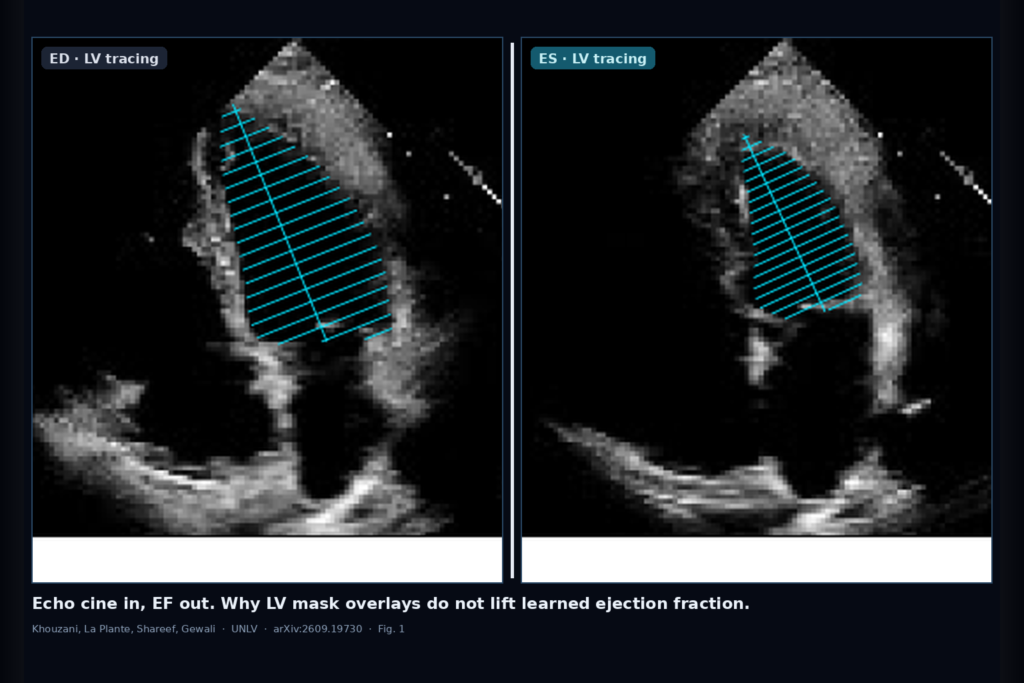
Hang an apical four-chamber echo cine and ask the viewer for one number: left-ventricular ejection fraction. The clinical recipe is clear. Find end-diastole and end-systole, trace the LV endocardium, convert areas to volumes, then take the normalized difference. So the natural product instinct is to feed those LV masks (or area auxiliaries) into a learned regressor and expect a better EF. Farshid Farhadi Khouzani, Paul La Plante, Bryar Mustafa Shareef, and Laxmi Gewali (University of Nevada, Las Vegas) posted arXiv:2609.19730 on 17 September 2026. The paper is The segmentation ceiling: why explicit left-ventricular masks do not improve learned ejection-fraction regression.
On EchoNet-Dynamic (10,030 Stanford A4C videos) with a UniFormer-S video backbone, they show that intuition fails once you account for how per-frame area error propagates into EF. A representative DeepLabV3 segmenter sits at about 13.8% per-frame area error (Dice near 0.92). Their closed-form break-even, after measured ED/ES error correlation, is about 10.5%. That is the segmentation ceiling. Four ways of injecting predicted masks or area consistency never beat a raw-video baseline. Ground-truth masks only look better because the EF labels come from those same traces (label leakage). The practical lever that does move the needle is EMA of weights plus strong spatiotemporal augmentation (test all-clips R^2 0.806, MAE 4.08 EF points under a matched dense-clip protocol). Heteroscedastic beta-NLL then gives calibrated per-prediction uncertainty that grows on harder low-EF cases.
What hangs on the viewer
Upstream, A4C cine clips enter UniFormer-S as raw video. No mandatory LV SEG channel. Downstream for a DICOM shop is a single EF scalar you can hang next to the study, optionally with a predicted uncertainty band from the beta-NLL head. Fig. 1 in the paper is the clinical picture everyone already knows: ED and ES frames with cyan expert LV tracings and volumes that compute EF the classical way. The research question is whether that overlay language should become a required intermediate for a learned EF product.
Their answer is quantitative. Because EF is a normalized difference of ED and ES volumes, area errors amplify rather than cancel. Below roughly 10.5% per-frame area error, a perfect-enough mask could help. Above it, the mask channel is noisier EF signal than the pixels the video backbone already sees. DeepLabV3 on this data lands above that line, so mask injection is expected to fail. Empirically it does: predicted-mask input channel, ED/ES clip sampling, per-bin area-consistency loss, and amplitude-consistency loss all fail to beat the zero-mask EMA baseline.
What works instead of more mask channels
Once input representation is not the bottleneck, generalization is. An exponential moving average of weights (decay 0.999) plus strong spatiotemporal augmentation tightens the validation-to-test gap and reaches test all-clips R^2 0.806 with MAE 4.08 under their matched dense multi-clip protocol, statistically comparable to a convolutional R(2+1)D baseline they matched carefully. For clinics that need a confidence cue, post-hoc Monte-Carlo dropout uncertainty did not track actual error. The heteroscedastic beta-NLL formulation, where the network predicts EF and variance together, produced informative, input-dependent uncertainty that is larger on clinically harder low-EF cases, at a modest cost in point accuracy.
For a viewer or clinic AI shop, that is a concrete product pattern: hang A4C cine, return EF from raw video, keep LV SEG as a separate assistive overlay if readers want it, and do not assume the SEG rail will lift the EF number. Spend engineering budget on EMA, augmentation, and calibrated uncertainty rather than on force-fitting mask channels into the regressor.
Where it still fails
Everything here is EchoNet-Dynamic A4C from one hospital era. Other views, vendors, and acquisition protocols are out of scope. The ceiling number moves with ED/ES error correlation and with segmenter quality; a future echo segmenter well below 10% area error could reopen the mask-injection case. Evaluation uses a matched dense-clip protocol, so apples-to-apples comparisons need the same protocol. Ground-truth mask experiments are diagnostic only; shipping GT masks as inputs would leak the label. Fail closed when the hanging is not A4C, when image quality collapses endocardial borders, when someone insists the EF path must wait on a SEG model that still sits above the ceiling, or when uncertainty is taken from MC dropout that the paper found uncorrelated with error.
For a viewer or clinic AI shop
Treat this as an EF rail design note, not a SEG bake-off. A4C cine in, EF out from raw video. Keep expert or model LV overlays for reader audit and Simpson-style teaching views if your product already shows them. Do not block EF on a mask channel that the segmentation ceiling says cannot help at current echo SEG error. Prefer EMA plus spatiotemporal aug for the point estimate, and prefer a heteroscedastic uncertainty head over post-hoc dropout if you surface confidence next to the number. Rebuild and audit against EchoNet-Dynamic splits before claiming clinic numbers.
Rebuild from arXiv:2609.19730. As of 18 September 2026 the abstract and PDF respond. EchoNet-Dynamic is at echonet.github.io/dynamic.
Sources
- Khouzani, F. F., La Plante, P., Shareef, B. M., Gewali, L. The segmentation ceiling: why explicit left-ventricular masks do not improve learned ejection-fraction regression. arXiv:2609.19730, posted 17 September 2026. https://arxiv.org/abs/2609.19730. PDF: https://arxiv.org/pdf/2609.19730.
- Ouyang et al. EchoNet-Dynamic (cited dataset): https://echonet.github.io/dynamic/.
- Li et al. UniFormer (cited video backbone); Chen et al. DeepLabV3 (cited segmenter); Seitzer et al. beta-NLL (cited uncertainty objective).