
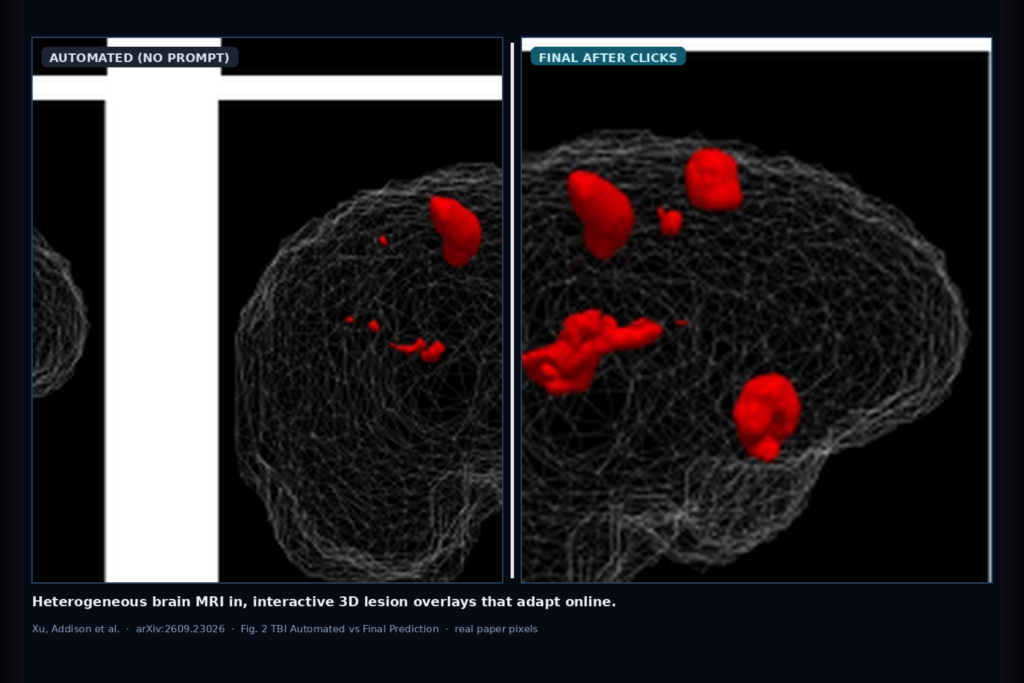
Heterogeneous brain MRI volumes in, click-correctable 3D lesion overlays out, with the network updating from those corrections so the next case on the same site starts closer to usable. That is the clinic ask Xu, Addison, Liang, Anthony, Yang, and Kamnitsas take on in arXiv:2609.23026, posted around mid-September 2026. The paper is BrainIAC: Interactive 3D Brain Lesion Segmentation across Heterogeneous MRI Modalities with Online Adaptation. Planned code and a 3D Slicer plug-in are listed at github.com/WenTXuL/BrainIAC.
Brain lesion masks still break when the scanner mix, the modality set, or the pathology differs from training. Auto models miss components, paint artifacts, or under/over call lesions. Editing a 3D mask by hand is slow. BrainIAC keeps a single Multi-Unet-style backbone that can run with no prompts, accept a bounding box and corrective clicks, handle missing or previously unseen modalities through zero-fill and a modality-agnostic channel, and adapt online from the clinician’s own corrections.
What hangs on the viewer
Upstream is a multi-sequence brain MRI study. Available channels may be any subset of FLAIR, T1, T1c, T2, PD, SWI, DWI, and similar. Absent modalities are zero-filled so the same network can ingest whatever arrived. The hangable pieces for a DICOM or Slicer-style viewer are: an automatic binary lesion overlay when nobody has prompted yet; an optional 2D/3D bounding box seed; foreground and background click maps that update the overlay after each correction; and a session that can continue learning across cases as Mid-Interaction and Post-Interaction adaptation steps fire.
Unlike SAM-style tools that expect a prompt before they draw anything, BrainIAC fills prompt channels with zeros and still returns a full-volume prediction. That matches a reading room where some studies get a quick auto pass and only the hard ones get clicks.
How it works in plain words
The backbone is a 3D Residual Encoder U-Net in the nnU-Net family. Input shape is (C + 3) × H × W × D: C modality channels plus three prompt channels for the bounding-box mask, foreground clicks, and background clicks. Output is a single-channel lesion map at the same resolution. Training mixes Dice and cross-entropy with a Click-Centered Gaussian (CCG) loss that weights errors near each click more heavily so the network actually reacts to local corrections.
Modalities are joined with the Multi-Unet recipe from the authors’ prior work: the channel set is the union across training databases, missing channels are zero-filled, and random modality dropping during training stops the model from latching onto one dominant sequence. A modality-agnostic channel, from their related MICCAI ML-CDS work, receives sequences never seen in training (SWI on TBI is the running example) so interactive updates can teach the network to use that new contrast without a full retrain.
Prompt sampling during training covers box+clicks (about 49%), box only (21%), clicks only (21%), and no prompts (9%). At inference the default loop is: auto prediction, optional box on the largest component, then one corrective click per iteration until the reader stops. Mid-Interaction adaptation takes a gradient step after each new click using the updated prediction as a pseudo label plus CCG. Post-Interaction adaptation runs two short fine-tunes after the case is accepted: one against the final mask from the initial setting, and one against freshly sampled correction clicks on false-positive and false-negative components. Updates use Adam at 5×10⁻⁵ with a single step, so they stay light.
What the numbers say
Training draws on up to five databases (BraTS 2016, ATLAS, MSSEG, WMH, TBI) with held-out and out-of-distribution tests on MSSEG, TBI, VES-SEG, and ISLES. On held-out MSSEG with FLAIR+T1, BrainIAC with online adaptation reaches Dice 66.1 with no prompt, 66.9 with a box, 68.7 with box+1 click, and 73.3 with box+6 clicks. The same backbone without online adaptation sits at 55.0 / 59.1 / 62.0 / 69.6. Top-5 box initialization plus online adaptation hits 75.2 at box+6. nnInteractive and MedSAM2 stay well below on the same protocol (nnInteractive FLAIR box+6 is 52.0; MedSAM2 box-only is 40.9).
On held-out TBI FLAIR-visible lesions with FLAIR+T1+T2, online BrainIAC reaches 62.7 Dice at box+6 versus 47.9 without online adaptation on FLAIR-only box+6. Feeding unseen SWI through the modality-agnostic channel plus online adaptation lifts the all-lesion setting to 61.0 at box+6. On previously unseen VES-SEG, online adaptation is the difference between a weak start and a usable mask (the paper reports dramatic jumps once adaptation is on). Click-efficiency numbers matter for the reading room: online adaptation cuts mean clicks to a target Dice from 12.81 to 2.67 on VES-SEG and from 6.66 to 3.81 on MSSEG. Mid-interaction latency is about 1.2 s per click update; post-interaction is a few seconds per case.
Where it fails and what not to trust
Evaluation uses simulated boxes and clicks, not a radiologist user study, so real click habits may differ. The framework is binary lesion segmentation; tumour sub-regions, multi-class components, and longitudinal tracking are left for later. Full 192³ volumes fit brain work but will need sliding-window or similar tricks on other anatomies. On TBI without online adaptation, the backbone can trail large foundation models until clicks and adaptation catch up. Scattered MS lesions still punish a single-box start; multi-box or click-only modes help, but a clinic that only ever draws one box will leave small components behind. Treat this as research software with a planned Slicer plug-in, not a cleared device.
For a viewer or clinic AI shop
Wire multi-sequence brain MRI in (whatever subset arrived), lesion overlay out, with optional box and FG/BG click tools that rewrite the mask after each prompt. Keep a no-prompt path so the first hang on the study list is free. Persist Mid- and Post-Interaction weight updates per site or per queue if you want the next case to inherit corrections, and log provenance that separates auto output from click-refined masks. If SWI or another odd sequence shows up, route it into an agnostic channel and let interactive sessions teach it rather than averaging single-modality logits after the fact.
If you already ship a DICOM viewer or Slicer extension, the natural hang points are the auto overlay, the box seed, click layers, and a badge for whether online adaptation is live. Rebuild thresholds on your own vendor mix. Audit click counts and time-to-usable-mask with your readers before you advertise hand-off. Rebuild from arXiv:2609.23026. PDF: https://arxiv.org/pdf/2609.23026. Code (planned): https://github.com/WenTXuL/BrainIAC.
Sources
- Xu, W., Addison, A. P., Liang, Z., Anthony, H., Yang, G., Kamnitsas, K. BrainIAC: Interactive 3D Brain Lesion Segmentation across Heterogeneous MRI Modalities with Online Adaptation. arXiv:2609.23026, 2026. https://arxiv.org/abs/2609.23026. PDF: https://arxiv.org/pdf/2609.23026. Planned code / 3D Slicer plug-in: https://github.com/WenTXuL/BrainIAC.
- Prior Multi-Unet and OAIMS work by the same group (MIDL 2024; ICLR 2026). Modality-agnostic channel: Addison et al., MICCAI ML-CDS 2025.
- Baselines and public sets cited in the paper: nnInteractive (Isensee et al., 2025); MedSAM2 (Ma et al., 2025); BraTS 2016; ATLAS; MSSEG; WMH; ISLES; VES-SEG; in-house TBI (Cambridge).