
Clinic brain-tumor overlays often look sharp even when T1ce or FLAIR never made it into the study. Sol Lee, Hyunji Kim, Sungrae Hong, Donghee Han and Mun Yi (KAIST) posted arXiv:2610.11419 on 8 October 2026 with MMA-LTS (Missing Modality-Aware Local Temperature Scaling), a post-hoc voxel-wise calibrator that rescales a frozen segmentation model’s logits when the MRI stack is incomplete. No public code was released with the paper; we cite arXiv only.
What goes in and what comes out
Inputs are a multimodal MRI volume (T1, T2, T1ce, FLAIR in any availability pattern), a frozen missing-modality segmentation backbone that already emits logits, and a binary modality mask saying which sequences are present. MMA-LTS does not retrain that backbone.
The output is a spatially varying temperature field used to rescale the logits into calibrated class probabilities. Overlay geometry (and therefore Dice) stays the same as the uncalibrated model; what changes is how much you should trust the confidence at each voxel. The method also exposes a voxel-wise difficulty score (VDS) that highlights where calibration pressure is highest.
How it works
MMA-LTS is trained only on the validation split. A spatial encoder reads the backbone’s joint features. Modality availability is encoded as a learnable token (separate embeddings for present vs missing for each of the four sequences). A voxel-wise difficulty score is computed from feature Mahalanobis distances against class-conditional statistics, so hard boundary voxels get flagged even when average Dice looks fine.
Those signals feed a temperature estimator with spatial-difficulty gating and FiLM conditioning on the modality token. The resulting temperature map divides the frozen logits before softmax. Temperatures above 1 cool overconfident voxels; temperatures below 1 lift underconfident ones. Class ordering is preserved. Training uses ModDrop-style random modality dropout and a voxel NLL objective so the calibrator recovers better probabilities without touching the segmentation weights.
What the numbers say
On BraTS 2020 with a DC-Seg backbone, MMA-LTS cuts average ECE for whole tumor / tumor core / enhancing tumor to about 10.2 / 14.5 / 15.1, ahead of plain local temperature scaling at about 13.1 / 16.8 / 16.5, while Dice stays at the uncalibrated level (about 86.7 / 80.2 / 66.8). On FeTS 2024 the same pattern holds, with best ECE around 9.5 / 12.0 / 11.6 across those regions. The paper also shows gains when the same calibrator is plugged into RobustSeg and mmFormer, so the plug-in is not tied to one architecture.
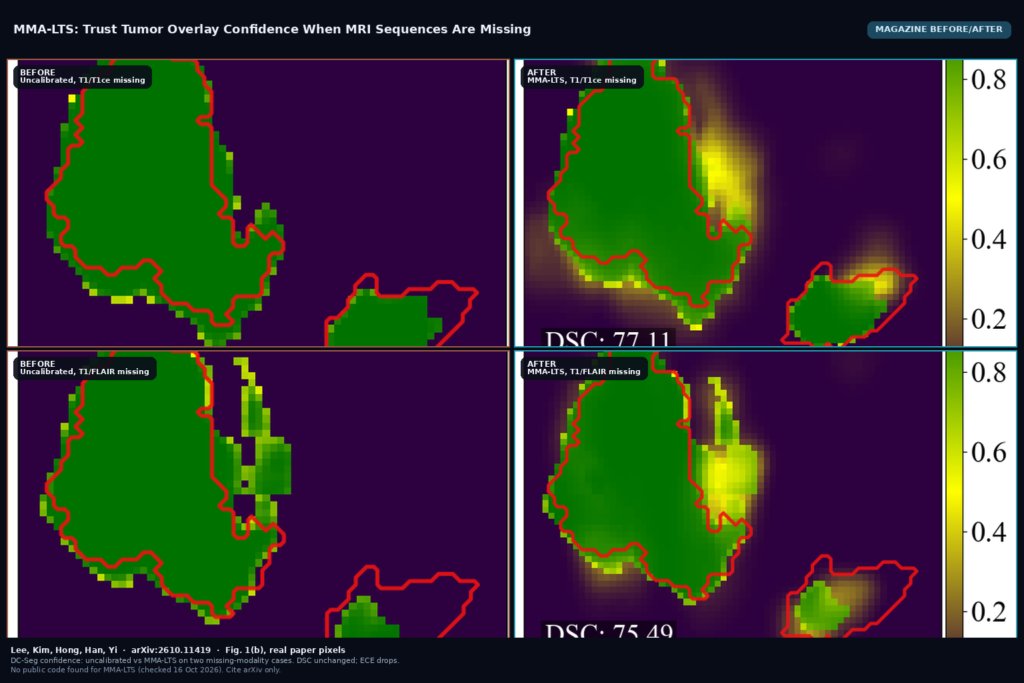
The featured figure’s two cases make the clinical point concrete: same Dice before and after, lower ECE after (for example ECE 9.81 to 5.64 on one missing-FLAIR case), even though both cases are missing two of four sequences.
What the pictures show
The featured image is a magazine before/after from Fig. 1(b). Top row: T1 and T1ce missing, uncalibrated DC-Seg confidence versus MMA-LTS. Bottom row: T1 and FLAIR missing, same pair. Red contours are ground truth. Green/yellow maps are confidence. Dice stays put; the confidence field is what MMA-LTS rewrites. The paper also shows VDS and calibration-strength maps for the same slices; those are useful debug layers in a viewer, not the hero story here.
Where it falls short
MMA-LTS is post-hoc. It cannot rescue a backbone that already missed the tumor; it only recalibrates confidence on the logits you already have. It expects a validation set with ground truth to fit the temperature network (about 40 epochs in the paper). Results are reported on BraTS-style four-modality brain MRI after skull-stripping and 1 mm resampling, so scanner quirks outside that protocol are untested. Absolute ECE is still not zero. There is no public repository, weights, or training script to drop into a pipeline today.
Code, weights, and data
As of 16 October 2026 we found no public GitHub, weights, or installable package for MMA-LTS. Use the paper as the reference: arXiv:2610.11419 and PDF arxiv.org/pdf/2610.11419. Evaluation uses BraTS 2020 (369 cases) and FeTS 2024 (1,251 cases). Backbones cited are RobustSeg, mmFormer, and DC-Seg. Calibration baselines include temperature scaling, Dirichlet scaling, LTS, selective scaling, MC dropout, mL1-ACE, and SDC.
How we would wire it into a viewer
Treat MMA-LTS as a confidence layer beside the tumor overlay, never as a rewrite of original DICOM pixels. Keep the frozen segmenter as-is. On studies with a partial MRI stack, pass the modality mask into the calibrator, store the calibrated probability volume and optional VDS as derived series or overlay channels, and surface a study-level ECE-style summary only when you have labels for a QA cohort.
UI cues that help: mute or hatch voxels where VDS is high or calibrated confidence is low; warn when T1ce is missing on an enhancing-tumor review; never pretend Dice improved when only ECE did. Until code is public, prototype from the paper equations on a small labeled holdout before any clinical display. For related posts on this site, see MID batch segmentation scores and BrainNet cortical surfaces from any MRI.
Sources
- Lee, S., Kim, H., Hong, S., Han, D., Yi, M. Missing Modality-Aware Calibration for Trustworthy Brain Tumor Segmentation. arXiv:2610.11419, 2026. https://arxiv.org/abs/2610.11419. PDF: https://arxiv.org/pdf/2610.11419.
- No public code or weights found as of 16 October 2026.
- Datasets: BraTS 2020; FeTS 2024. Backbones cited: RobustSeg, mmFormer, DC-Seg.
- Featured image: Fig. 1(b) of arXiv:2610.11419 (uncalibrated vs MMA-LTS confidence on two missing-modality cases), as published.