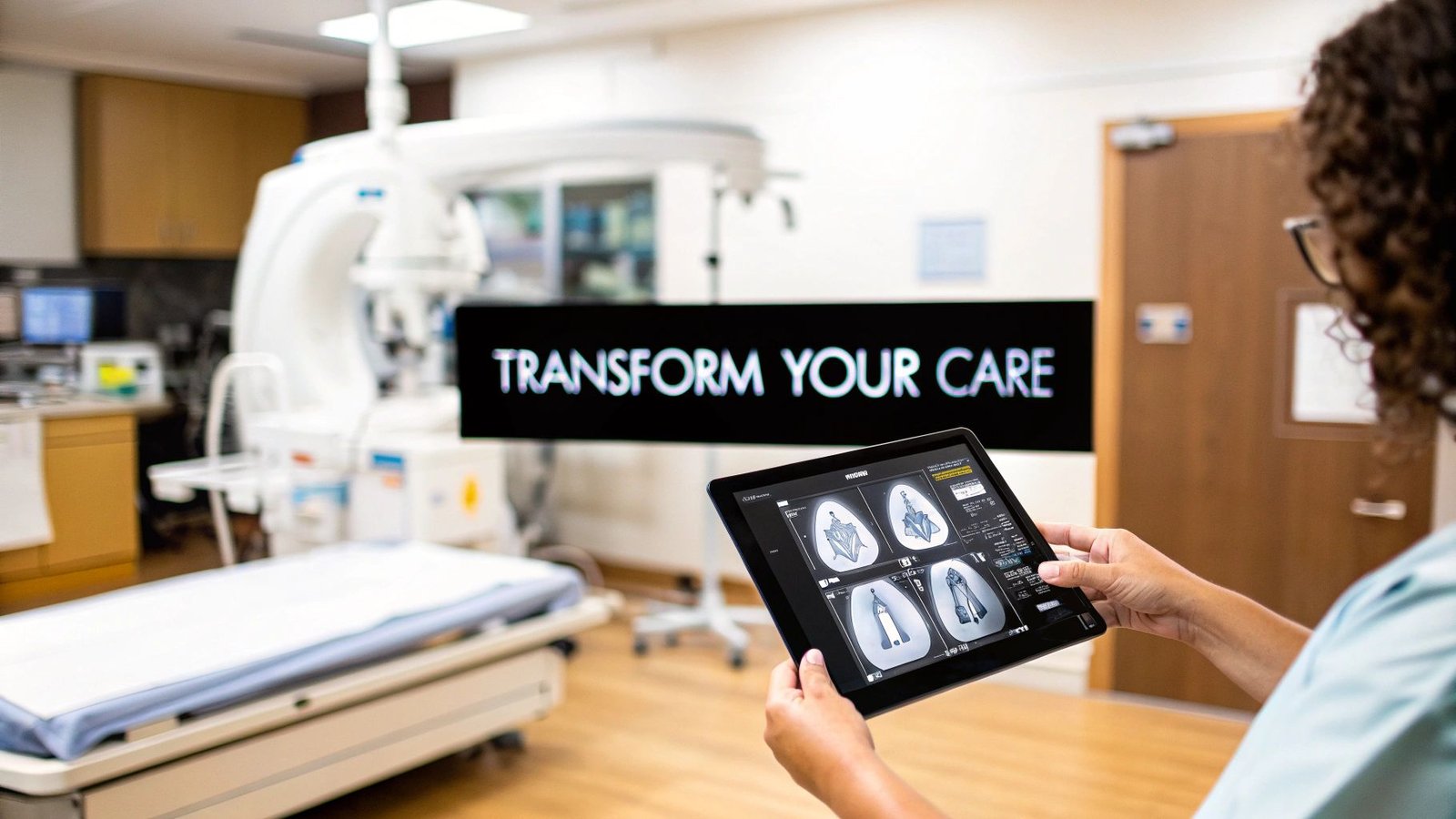
An advanced radiology patient portal is so much more than a login screen. Think of it as your personal, secure window into your own medical imaging and reports—a digital space that puts you in the driver's seat of your healthcare journey. It represents a fundamental shift from passively waiting for results to actively participating in your own care.
The Shift to Empowered Patient Care in Radiology
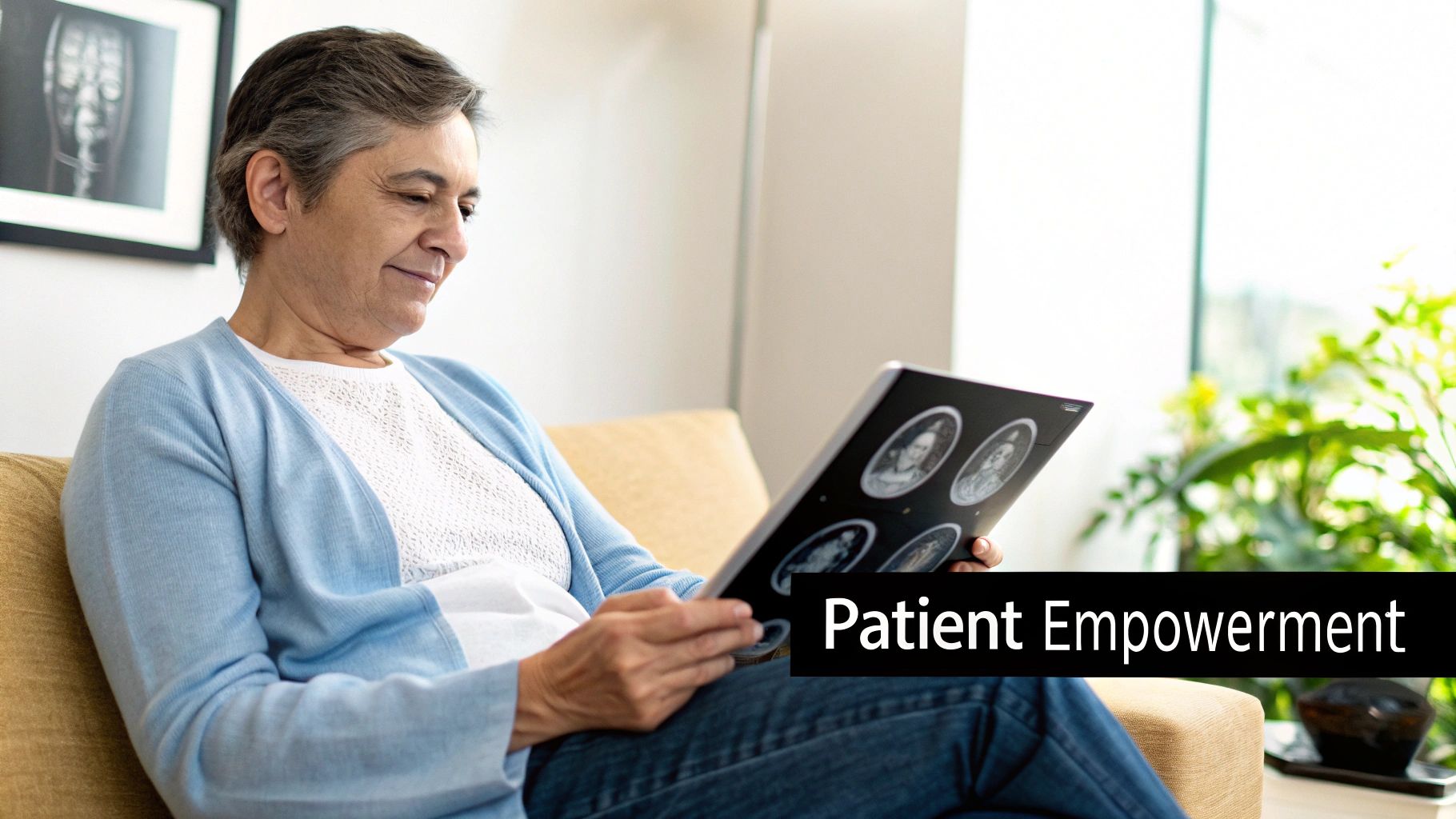
Remember the traditional radiology experience? It often involved days, sometimes weeks, of anxiously waiting by the phone for a call about your imaging results. The whole process felt impersonal, leaving you feeling powerless and completely disconnected from your own health information.
Now, imagine a new reality. With an advanced radiology patient portal, that waiting game is over. You get instant, secure access to your medical images—whether it's an X-ray or an MRI—and can read clear, understandable reports from any device, anywhere in the world. This isn’t just a tech upgrade; it’s a complete transformation of the patient experience.
Moving From Passive Recipient to Active Partner
At the heart of this change is a simple but powerful idea: moving you from being a passive recipient of information to an active, informed partner in your healthcare. This evolution is fueled by new tools that foster transparency and build a stronger foundation of trust between you and your providers.
A modern portal is built around you, the patient. It’s designed to provide not just raw data, but meaningful context and control. This entire movement is part of the larger digital transformation in healthcare, a trend focused on making health information more accessible and engaging.
This new model brings several incredible advantages:
- Immediate Access: See your imaging studies and reports the moment they become available, which helps eliminate those stressful delays.
- Enhanced Understanding: Many portals include tools to help translate complex medical jargon into plain language, empowering you with real knowledge.
- Greater Control: Securely share your results with other specialists or family members with just a few clicks, putting you at the center of your own care team.
This shift empowers patients to ask smarter questions, make better-informed decisions, and work more closely with their clinical teams, ultimately leading to better health outcomes.
At PYCAD, we’re on the front lines of this movement. We specialize in building custom web DICOM viewers and integrating them into medical imaging platforms, creating the kind of seamless and secure experience that patients now expect. You can see examples of our work in our portfolio page, where we bring these state-of-the-art platforms to life.
The journey toward a better patient portal is about creating a future where every patient is an engaged, confident participant in their own health story. It’s about replacing anxiety with access and turning uncertainty into understanding.
The Core Components of a Modern Radiology Portal
So, what truly separates a next-generation portal from a simple login page? Think of it like a high-performance engine. Every single component is engineered for power, safety, and an exceptional user experience. An advanced radiology patient portal is built on four distinct pillars that work in harmony to create a world-class platform.
These aren't just features; they're the very foundation of a system designed to empower patients and give clinical teams the support they need. Each pillar plays a unique and vital role in reimagining how we access, understand, and manage our health information.
The Secure Web DICOM Viewer
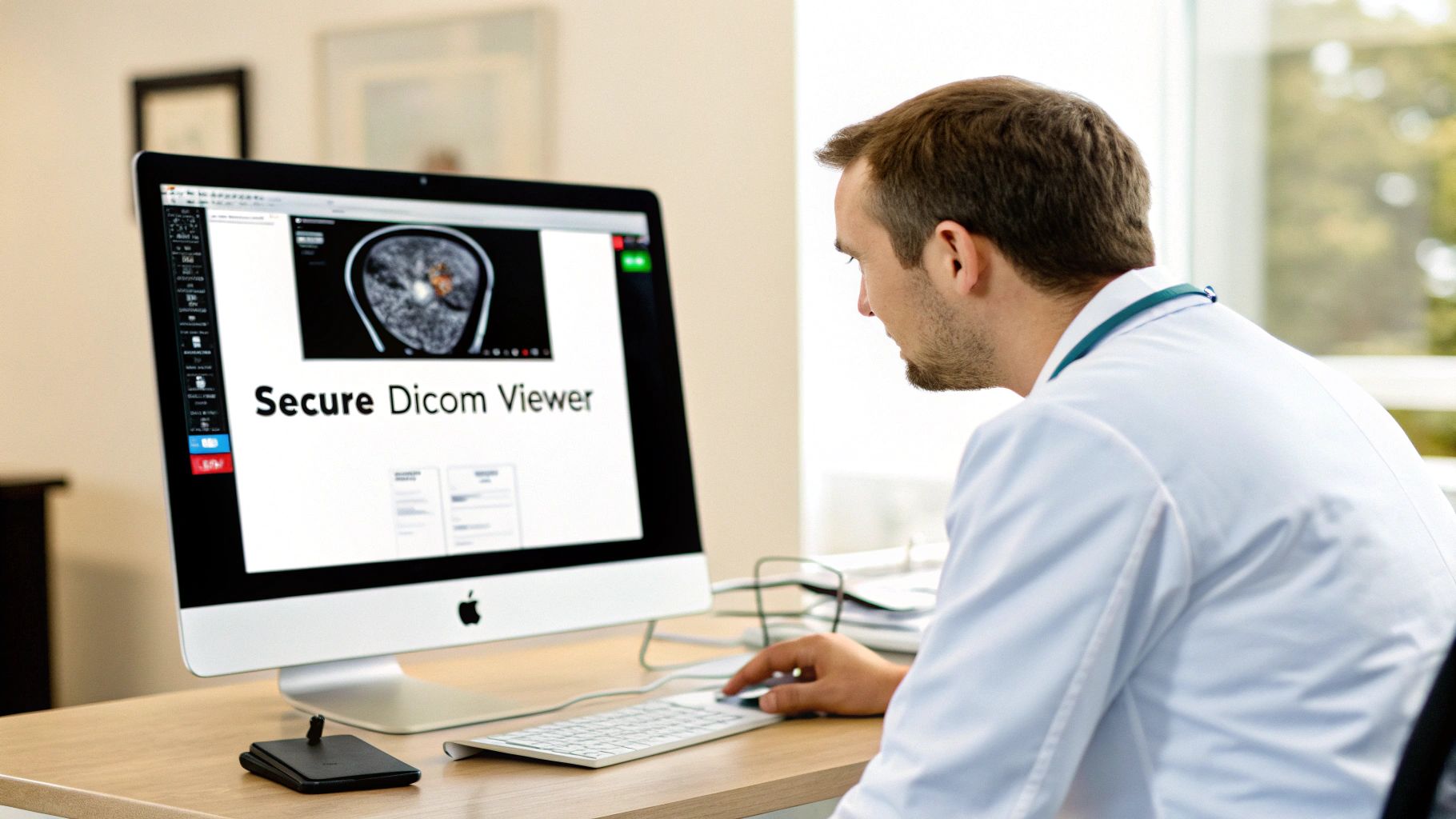
At the heart of any modern radiology portal is its secure web DICOM viewer. This is the specialized tool that lets patients see their own medical images—like MRIs, CT scans, and X-rays—right in their web browser. No special software, no complicated downloads. It’s like giving them a simplified version of a radiologist's viewing station.
This component is absolutely critical. It demystifies complex medical data and makes it accessible, replacing the outdated and insecure practice of burning images onto CDs. It gives patients immediate, interactive access to their own studies. Here at PYCAD, this is precisely our area of expertise. We build custom web DICOM viewers and integrate them into medical imaging web platforms, ensuring a crystal-clear and intuitive viewing experience. Our work, which you can see in our PYCAD portfolio, shows just how powerful and patient-friendly these viewers can be.
The Intuitive Patient Dashboard
Viewing images is just the beginning. A top-tier portal needs a central hub where patients can manage their entire healthcare journey. This is where the intuitive patient dashboard comes in—a command center designed with absolute simplicity and clarity in mind. It provides a clean, easy-to-navigate interface for all the essential tasks.
The dashboard should make life easier, not more complicated. Key functions typically include:
- Simplified Appointment Scheduling: Let patients see available slots, book new appointments, or reschedule existing ones without ever picking up the phone.
- Understandable Report Summaries: Translate dense medical jargon into plain-language summaries that highlight the key findings from radiology reports.
- Secure Provider Messaging: Offer a direct and secure line of communication to the clinical team, so patients can ask questions and get timely answers.
A well-designed dashboard removes friction from the healthcare process. It anticipates patient needs and provides the tools to meet them efficiently, fostering a sense of control and confidence.
This focus on the patient experience is driving massive growth in the market. The global patient portal market is projected to hit USD 6.56 billion in 2025 and is expected to surge to USD 15.52 billion by 2030. It's no surprise that integrated solutions, which connect seamlessly with other health systems, are already dominating, capturing over 63% of the market as providers seek more unified workflows. You can dive deeper into this explosive growth on Mordor Intelligence.
To understand how these components come together, let's look at their individual roles and the value they bring to both sides of the care equation.
Core Components of a Modern Radiology Portal
| Component | Key Function | Benefit for Patient | Benefit for Provider |
|---|---|---|---|
| Secure Web DICOM Viewer | Renders medical images (MRI, CT) in a browser. | Direct, interactive access to their own scans; feels empowered. | Reduces staff time spent on burning CDs and handling image requests. |
| Intuitive Patient Dashboard | Central hub for appointments, reports, and messages. | Manages their healthcare in one place; clear and easy to use. | Fewer administrative phone calls; improved patient engagement. |
| Scalable Cloud Architecture | The secure, cloud-based infrastructure running the portal. | Fast, reliable access to their data anytime; trust in data security. | Ensures high uptime, performance, and HIPAA compliance without heavy IT overhead. |
| Intelligent System Integrations | Connects the portal to EMR, RIS, and PACS systems. | Sees a complete, accurate, and up-to-date health record. | Automates data flow, reduces manual entry errors, and creates a unified workflow. |
Each piece is essential. When they work together seamlessly, they create a platform that feels less like a tool and more like a trusted partner in a patient's health journey.
The Scalable Cloud Architecture
Behind the scenes, the engine powering the portal has to be robust, secure, and utterly reliable. A scalable cloud architecture ensures the platform can handle thousands of users and massive data files without ever slowing down. Think of it as the unshakable foundation of a skyscraper—invisible but absolutely critical for stability and growth.
This kind of architecture delivers several key benefits:
- Reliability: It ensures the portal is always available, with minimal downtime.
- Data Security: Advanced encryption and built-in compliance with standards like HIPAA are non-negotiable for protecting sensitive patient information.
- Performance: Fast load times for large image files and reports create a smooth, frustration-free experience for everyone.
Intelligent System Integrations
Finally, an advanced portal can't operate in a silo. It has to connect intelligently with the wider healthcare ecosystem. Intelligent system integrations are the bridges that link the portal to a facility’s core systems, like the Electronic Medical Record (EMR), Radiology Information System (RIS), and Picture Archiving and Communication System (PACS).
These connections create a single, unified health hub where data flows seamlessly. For example, when a radiologist finalizes a report in the RIS, it can automatically and securely appear in the patient portal moments later. This automation not only boosts efficiency but also ensures data is always accurate and up-to-date. To get a better handle on how these systems fit together, you might find our guide on what PACS is in healthcare helpful. By connecting these vital systems, the portal becomes the single source of truth for the patient.
Integrating AI for a Smarter Patient Experience
An advanced radiology patient portal shouldn't just be a digital filing cabinet for your images and reports. It needs to be a dynamic health partner. This is where Artificial Intelligence (AI) comes into play, transforming a static portal into a proactive, intelligent, and deeply personal resource that can actually anticipate a patient's needs and make sense of complex information.
When you weave AI into the fabric of a patient portal, it becomes a digital health advocate, working around the clock to make the healthcare journey clearer and a whole lot less stressful. This isn't just about automating tasks; it’s about adding a layer of intelligence that builds genuine understanding and offers real support. It finally bridges that frustrating gap between clinical data and what a patient can actually comprehend.
From Medical Jargon to Clear Insights
Let's be honest: one of the biggest hurdles for patients is trying to decipher the dense, intimidating language in a radiology report. AI is changing that reality completely. Imagine seeing terms like "hypodense lesion" or "parenchymal calcification" in your results. Before AI, that meant a frantic, often terrifying, trip to a search engine. Now, AI can provide simple, plain-language explanations right inside the portal.
By translating complex radiological terminology into understandable summaries, AI demystifies the results. This empowers patients with knowledge, reduces anxiety, and helps them prepare for more meaningful conversations with their doctors.
This isn't about replacing the radiologist's expert diagnosis. It’s about supplementing it with educational context. For instance, an AI tool could explain that a particular finding is common and often benign, offering immediate reassurance while still stressing the importance of a follow-up discussion with their physician.
Intelligent Assistance and Predictive Care
Beyond just explaining terms, AI brings a new level of interactive support to the modern radiology patient portal. Intelligent chatbots are a fantastic example. They can act as the first line of support for common questions, which frees up your administrative staff to focus on more complex patient issues.
These AI-powered assistants can handle a ton of different tasks:
- Answering FAQs: Instantly respond to questions about appointment prep, billing inquiries, or how to share images.
- Guiding Users: Help patients navigate the portal to find a specific report or schedule their next visit without any friction.
- Proactive Reminders: Send smart, personalized reminders for upcoming appointments or necessary follow-up scans based on their actual medical history.
On top of that, AI analytics can work behind the scenes to predict what a patient might need next. By analyzing data trends, the system can identify patients who are due for a routine screening, like a mammogram, and proactively suggest they schedule an appointment. This helps shift the entire model from reactive to preventive care. The impact is already huge; AI chatbots can slash front-office workload by up to 50% and cut down response times from hours to mere seconds. You can explore more about these trends and their impact on radiology billing and patient engagement.
The PYCAD Approach to AI Integration
At PYCAD, we see AI not as a feature, but as an essential part of any modern medical platform. We build custom AI solutions and integrate them into medical imaging web platforms, turning raw health data into real, actionable insights that benefit both patients and providers. Our whole goal is to create a seamless experience where the technology feels completely intuitive and supportive. If you're curious about how these systems function, we offer a deeper look into the world of artificial intelligence for radiology on our blog.
We also specialize in creating the foundational pieces, like the custom web DICOM viewers that allow patients to see their own images clearly and securely. We firmly believe that combining a powerful, intuitive viewer with intelligent AI features is the key to building the next generation of patient-centric tools. Our work, which you can explore on our portfolio page, really showcases our commitment to this vision. By integrating AI, we help our partners build an advanced radiology patient portal that doesn't just deliver information—it offers guidance, support, and genuine peace of mind.
Making Sense of Healthcare Integration Standards
So, how do all the different, complex systems inside a hospital or clinic actually talk to each other? An advanced radiology patient portal is just an island unless it can securely pull information from the right sources. This seamless communication is all thanks to a set of universal healthcare integration standards, which act like a shared language for medical technology.
Think of these standards as the invisible threads that weave a patient's entire health journey together. They are what guarantee that data from one system can be perfectly understood by another. Without them, we’d just have digital silos, and true interoperability would be a pipe dream.
Comparing Healthcare Data Standards DICOM vs HL7 vs FHIR
To really get a handle on how this all works, it helps to see these standards side-by-side. Each has a specific job, but they all work toward the same goal: making sure healthcare data can move freely and securely where it’s needed most.
| Standard | Primary Use Case | Analogy | Key Advantage |
|---|---|---|---|
| DICOM | Medical imaging (MRIs, CTs, X-rays) | The "JPEG for medical images" | Universally packages images with critical patient metadata, ensuring context. |
| HL7 | Clinical & administrative data (demographics, orders) | A traditional, reliable translator | A long-established workhorse for connecting core hospital systems like EMR and RIS. |
| FHIR | Modern, web-based data exchange | The agile, web-native successor to HL7 | Flexible, fast, and easy for developers to use, powering modern apps and portals. |
Each of these "languages" plays a vital role in building a complete picture of a patient's health, from the visual evidence in an MRI to the text-based notes in their electronic record.
DICOM: The Universal Language for Medical Images
Let’s start with the images. DICOM (Digital Imaging and Communications in Medicine) is essentially the universal "JPEG for medical images." Just like you can open a JPEG on any computer or phone, a DICOM file ensures an MRI, CT scan, or X-ray can be viewed on any compliant device, no matter who made the scanner.
This standard is the absolute bedrock of modern radiology. It’s more than just a picture file; it also packages crucial metadata right alongside the image, like patient ID, the date of the scan, and equipment settings. This guarantees the image and its context are never separated.
At PYCAD, this is our native language. We build custom web DICOM viewers and integrate them into medical imaging web platforms, giving patients direct, browser-based access to their studies. It’s this deep expertise, which you can see in our PYCAD portfolio, that ensures image data flows from the hospital's PACS to the patient's screen flawlessly and securely.
HL7 and FHIR: Translating Clinical and Administrative Data
While DICOM has the images covered, we still need a way to manage the enormous amount of text-based health information. For decades, HL7 (Health Level Seven) has been the workhorse for this job. Think of it as a traditional, reliable translator for clinical and administrative data. It's the reason an Electronic Medical Record (EMR) and a Radiology Information System (RIS) can exchange things like patient demographics, orders, and results.
But as technology sprinted towards the web, a more modern standard became necessary. That’s where FHIR (Fast Healthcare Interoperability Resources) enters the scene. If HL7 is the classic, established translator, FHIR is its nimble, web-native successor.
FHIR is built on the same modern web technologies that power today's leading apps and websites. This makes it faster, more flexible, and far easier for developers to work with, accelerating the creation of new patient-facing tools.
This is where the magic really starts to happen. When you combine these integrated data streams, you can power a much more supportive patient experience.
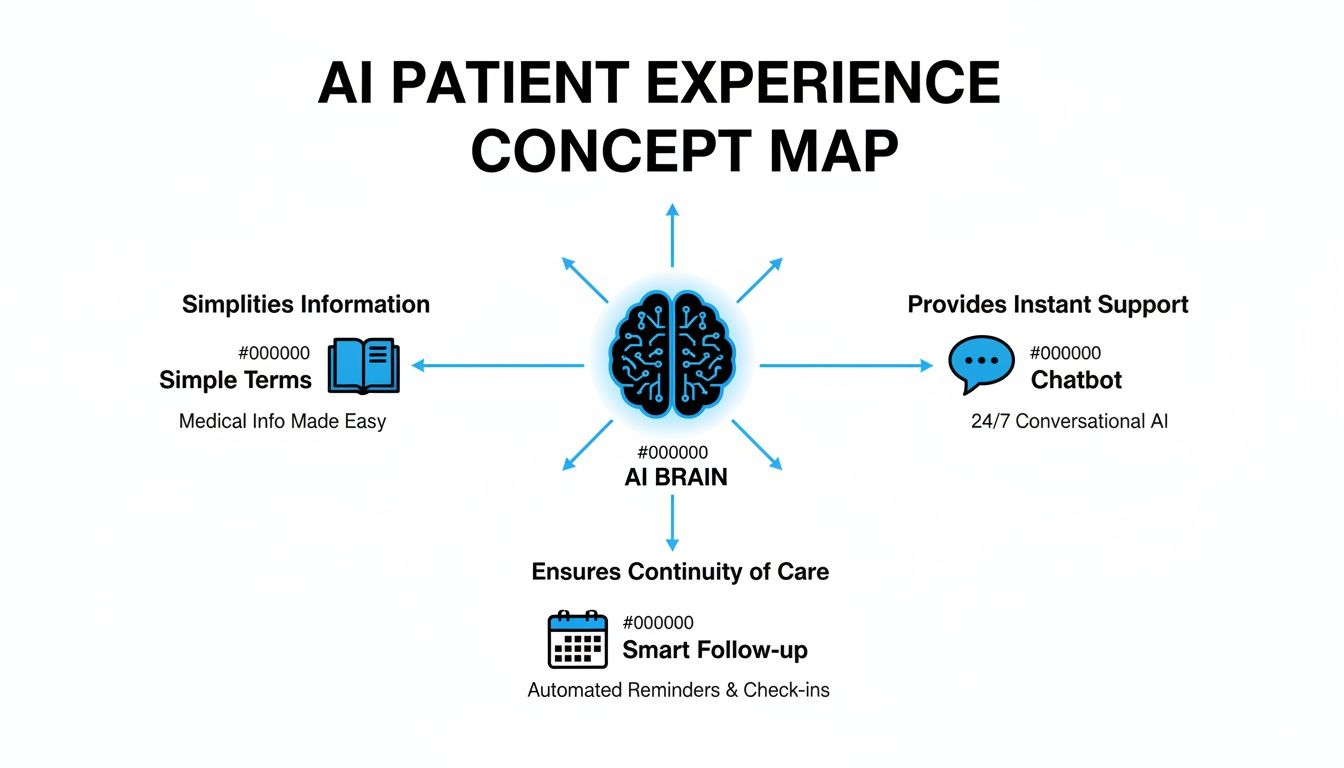
By weaving together data from different systems, a portal can offer intelligent features like simplified report explanations, instant chatbot support, and smart follow-up reminders. It moves from being a simple data repository to a true partner in the patient's care.
Bringing It All Together for a Unified View
These standards are designed to work in concert, creating a cohesive and powerful ecosystem. DICOM moves the images, while HL7 and FHIR handle the associated clinical data. This is what allows an advanced radiology patient portal to connect with a hospital's EMR, RIS, and PACS, creating a single, unified view for the patient. You can dive deeper into how these connections are so vital by exploring the interoperability of electronic health records in our detailed guide.
Getting this right is non-negotiable. To ensure seamless data flow and functionality, engaging with professional software integration services is often a critical step. This ensures all parts of the system communicate effectively, delivering a reliable and powerful experience for every user.
Your Practical Implementation Roadmap
Starting the journey to build or upgrade an advanced radiology patient portal is more than just a tech project. It's a fundamental commitment to a better standard of patient care, one that reshapes how patients engage with their health and how your team operates. For this vision to become a reality, you need a clear, actionable plan.
This roadmap is designed to walk you through the essential steps, from sketching out your initial goals all the way to getting your team and patients excited to use the new system. Following a structured path makes sure every decision you make serves your ultimate purpose, whether that's delighting patients or freeing up your staff from administrative headaches.
Phase 1: Define Your Core Objectives
Before you even think about code or vendors, you have to know what winning looks like. What are the specific pain points you're trying to solve? Setting clear, measurable goals right from the start becomes your North Star for the entire project, giving you a way to measure your success down the road.
Think about what's really driving this change. Are you trying to:
- Reduce Staff Workload? Imagine cutting down on the endless phone calls for appointment reminders and results. Automating these tasks can give your team back precious time.
- Boost Patient Engagement? When patients can see their own images and read their reports, they become active partners in their own healthcare journey. It’s empowering.
- Improve Data Security? Let's be honest, using email or burning CDs to share medical images isn't just clunky; it's a risk. A secure, HIPAA-compliant portal is a non-negotiable for modern risk management.
These objectives will guide every single decision you make, from which features to build first to the partner you choose. This clarity is your best defense against scope creep and ensures the final product actually makes a difference.
Phase 2: Key Technical and Compliance Considerations
With your goals in hand, it’s time to tackle the technical and regulatory hurdles. This phase is all about two big decisions: how you'll deploy the portal and how you'll guarantee it meets every single healthcare regulation. These choices are the foundation your entire portal will be built on.
First up is the big deployment question: Cloud vs. On-Premise. A cloud-based platform often means more flexibility, lower initial costs, and less work for your internal IT crew, which is why it's so popular. On the other hand, an on-premise setup gives you absolute control over your data and hardware, but it comes with a much bigger price tag and maintenance workload.
No matter which path you choose, strict HIPAA compliance is the one thing you can't compromise on. Your portal has to be a fortress for patient health information, armed with end-to-end encryption, tight access controls, and detailed audit trails. This isn't just a good idea—it's the law.
Phase 3: Choosing the Right Technology Partner
This might just be the most important decision you'll make. The right partner won't just sell you a piece of software; they'll work alongside you as a co-creator, bringing their deep industry knowledge and technical chops to the table. The quality of your portal will be a direct reflection of their capabilities.
As you look at potential partners, dig into their track record. At PYCAD, for example, we don't do one-size-fits-all. We build custom web DICOM viewers and integrate them into medical imaging web platforms, shaping every detail around what our clients actually need. You can see what this looks like in practice by checking out our PYCAD portfolio.
Here’s a simple checklist to guide you:
- Specialized Expertise: Do they live and breathe medical imaging and standards like DICOM?
- Custom Development Capabilities: Can they build a solution that fits your unique workflow like a glove?
- Proven Track Record: Ask to see real-world examples of platforms they've successfully launched.
- Commitment to Security: Is HIPAA compliance baked into their process from day one?
Finding a partner with focused skills, especially in complex areas like web DICOM viewers, is what separates a good portal from a great one. It’s the key to making sure that core patient experience—viewing their images—is simple, secure, and incredibly effective.
It’s Time to Build a New Kind of Patient Experience
Moving to an advanced radiology patient portal isn't just a simple tech upgrade. It’s a fundamental change in how we think about healthcare—a shift toward a more open, collaborative, and ultimately more effective partnership between patients and providers. We're moving away from a model where patients are just passive recipients of care and stepping into one where they are active, informed partners in their own health. The impact of this change is huge, improving nearly every part of the healthcare journey.
The financial upside is clear, as it slashes administrative busywork like endless phone calls and manual record chasing. But the real value? That comes from earning patient loyalty and seeing better health outcomes. When patients feel truly informed and in control, their trust in their providers grows, creating a rock-solid foundation for lasting health.
A Call for Healthcare Pioneers
The time to build this future is now. If you're a hospital administrator, this is your chance to elevate both operational efficiency and patient happiness. If you're a medtech innovator, it’s an opportunity to create tools that genuinely change lives. For clinical researchers, it unlocks incredible new avenues for engaging with patients and gathering meaningful data.
The future of medicine is built on partnership. It's a future where technology does more than just crunch numbers—it builds bridges, connecting patients and caregivers with clarity and trust.
This is exactly what we live and breathe at PYCAD. We’re the engineers behind the heart of these platforms. Specifically, we at PYCAD, build custom web DICOM viewers and integrate them into medical imaging web platforms. Our entire focus is on creating solutions that are not just technically sound but deeply human, putting the patient's needs at the very center of every decision. We'd love for you to see what we're capable of on our PYCAD portfolio.
Let's work together to build the next generation of medical imaging. We can create a future where every single patient feels confident, informed, and truly in charge of their own health story.
Have Questions? Let's Get Them Answered
It's completely normal to have a few questions when exploring a powerful tool like an advanced radiology patient portal. This whole concept is about putting you in the driver's seat of your own health journey, so let's clear up some of the most common points of curiosity.
How Can We Be Sure Our Health Data is Truly Secure?
Security isn't just a feature; it's the absolute foundation of any modern patient portal. Think of it like a digital bank vault. These platforms employ multiple, overlapping layers of protection, starting with end-to-end encryption for all data in transit and at rest.
Everything is hosted on HIPAA-compliant servers, and strict, role-based access controls mean that only the right people can see the right information. On top of that, you'll find standard features like two-factor authentication (2FA) and detailed audit trails that log every single action. It’s all designed to build a fortress of digital trust around your most sensitive information.
Can a Custom DICOM Viewer Actually Work With Our Existing Systems?
Absolutely. The goal here is to enhance what you already have, not rip and replace it. A well-designed portal is built for connection, designed to slide right into a facility's existing infrastructure, whether that's your PACS, EMR, or RIS.
It works by speaking the universal languages of healthcare data—standards like DICOM, HL7, and the more modern FHIR APIs. This allows a custom portal to securely fetch images and records, creating a single, unified experience for the patient. For instance, we at PYCAD, build custom web DICOM viewers and integrate them into medical imaging web platforms, so you get the upgrade you need without disrupting your core operations.
What's the Real Return on Investment for This Kind of Technology?
The ROI shows up in two major ways: in your bottom line and in your reputation.
First, the financial benefits are undeniable. By automating tasks like appointment reminders and giving patients instant access to their reports, you dramatically cut down on administrative busywork. This means:
- Fewer staff hours tied up on the phone.
- Significant savings on printing, mailing, and physical record management.
- A real drop in costly patient no-shows.
But the biggest return? That comes from the surge in patient satisfaction and loyalty. When you provide a transparent, empowering experience, you’re not just offering a service—you’re building a relationship. And in today’s healthcare world, that is the ultimate competitive advantage.
Ready to build a platform that truly connects with your patients? At PYCAD, we don't just build software; we create the secure, intuitive experiences that are shaping the future of radiology.
Let's see what we can build together. Explore our portfolio to see what's possible.