
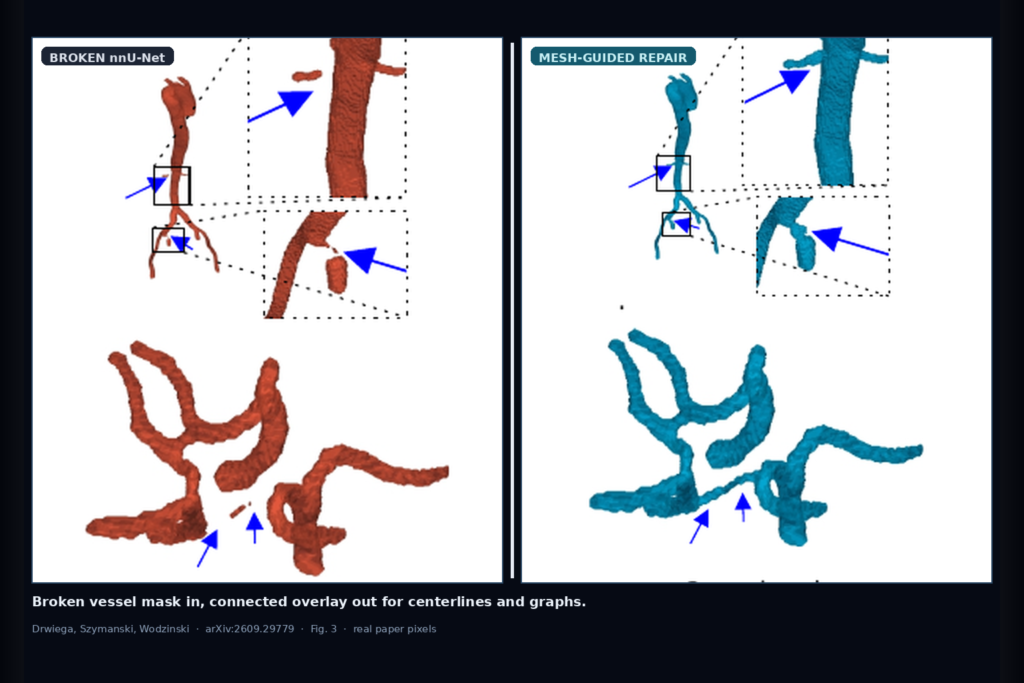
Hang an nnU-Net vessel mask into a DICOM viewer and the overlay can look clean on a volume Dice score while the centerline, branch graph, or flow mesh quietly falls apart. A missing one-voxel bridge splits an aorta branch, a Circle of Willis communicating artery, or a pulmonary tree into pieces that no longer support diameter work, labeling, or CFD. Gniewosz Drwiega, Wojciech Szymanski, and Marek Wodzinski (Sano Centre for Computational Personalised Medicine and AGH University of Krakow) treat that gap as a post-process problem in arXiv:2609.29779, posted 24 September 2026. They fit a deformable template mesh to each predicted mask surface, then use that mesh as a case-specific scaffold to reconnect components with thin bridges under foreground-growth limits. Dice stays nearly flat. Connected-component Dice (ccDice) jumps: aorta 0.596 to 0.992, TopCoW 0.722 to 0.835, PARSE 0.028 to 0.862.
The method does not retrain nnU-Net and does not replace the mask with a voxelized mesh. It starts from the hard binary prediction, fits anatomy-specific templates (cylinder for aorta, torus-like for Circle of Willis, sphere for pulmonary arteries), and only accepts bridges that merge components while keeping added voxels below a per-bridge budget. Optional filtering drops distant false-positive islands before fitting. FOMAML meta-initialization shortens the per-case fit so the repair stage stays in the same time band as the original inference.
What hangs on the viewer
Upstream is a binary vessel mask from a 3D full-resolution nnU-Net, already trained out-of-fold on AortaSeg24 and SEGA (aorta), TopCoW (Circle of Willis CTA/MRA), or PARSE (pulmonary arteries). Downstream is the same mask with local reconnections: thin tubes where the fitted mesh supports a bridge, original voxels everywhere else. For a DICOM or angio viewer rail, the hangable pieces are a repaired vessel overlay scrubber, a centerline or graph extract that no longer breaks on tiny gaps, and a QC view that can still show the raw nnU-Net mask beside the repaired one.
The practical claim for a clinic AI shop is a post-process, not a new segmenter. Keep your nnU-Net weights. Run mesh fit plus bridge acceptance on the binary mask. Hang the repaired mask for topology-sensitive tools (centerlines, branch labels, CFD prep) while logging that Dice barely moved and ccDice / Betti-0 did.
How it works in plain words
For each case, the pipeline reads the NIfTI geometry (spacing, origin, direction), extracts the mask surface with marching cubes, and normalizes that surface by its physical bounding box. A graph-based mesh decoder then deforms an anatomy-specific template toward the surface with Chamfer distance plus edge-length, Laplacian, normal-consistency, and face-area regularizers. Fitting is per-case, not a single mesh model shared across patients. The best Chamfer iterate is mapped back to image space and kept only as a geometric prior.
Connectivity repair then identifies disconnected components and proposes thin bridges in one of two ways. Mesh-graph repair anchors components to nearby mesh vertices and takes shortest paths on the mesh graph (used for aorta and TopCoW). Endpoint repair proposes short local endpoint-to-endpoint bridges and asks the mesh only to validate them (used for PARSE). A candidate is rasterized as a thin tube and accepted only if it merges the target components and stays under a max added-foreground fraction (0.03 aorta, 0.15 TopCoW, 0.06 PARSE in Table 2). Mesh-supported cleanup can remove small leftover islands that the mesh does not support. The repair stage does not read image intensities or nnU-Net probability maps.
FOMAML learns a warm-start initialization so case-wise fitting needs fewer steps. On 25 held-out TopCoW cases, FOMAML beat standard init at every Chamfer checkpoint. In the aortic timing note, nnU-Net inference took about 44 s per case, while FOMAML-initialized fit (~300 steps) plus repair took about 30 s, so the extra stage is comparable to the segmenter itself.
What the numbers say
Table 3 reports five-fold out-of-fold means on raw nnU-Net masks versus the same masks after mesh-guided repair (Filtered is an intermediate artifact-filter row). On the aortic cohort (SEGA + AortaSeg, n=145), Dice stayed at 0.934 for raw and repaired (Table 3 SEM ±0.007; text also quotes ±0.043 as the case-level spread). ccDice rose from 0.596 ± 0.045 to 0.992 ± 0.009, and Betti-0 fell from 3.35 ± 0.43 to 1.01 ± 0.02. False-branch fraction stayed near 0.056 to 0.055.
On TopCoW (n=125), Dice moved only from 0.870 ± 0.010 to 0.867 ± 0.010, while ccDice improved from 0.722 ± 0.043 to 0.835 ± 0.034 and Betti-0 from 2.58 ± 0.20 to 1.02 ± 0.02. False-branch fraction rose from 0.040 ± 0.006 to 0.063 ± 0.007, the paper’s clearest dataset-specific trade-off. On PARSE (n=100), Dice stayed near 0.877 to 0.876, ccDice jumped from 0.028 ± 0.002 to 0.862 ± 0.041, and Betti-0 collapsed from 87.46 ± 9.00 to 1.56 ± 0.21. Qualitatively, Fig. 3 shows aortic branch gaps, Circle of Willis communicating-artery breaks, and fragmented pulmonary trees reconnected with localized bridges rather than a full mesh voxelization.
Where it fails and what not to trust
This is research software on public vessel sets, not a cleared medical device. Rebuild and validate on your own CTA/MRA protocol, labeling rules, and lesion mix before you hang repaired overlays next to reportable diameters or flow prep. The fitted mesh can still endorse a wrong bridge if false-positive islands sit close to true vessels or if deformation takes an anatomically implausible shortcut. Filtering and cleanup help with distant junk; they do not fix near-vessel false positives. Hard binary masks only: intensities and probability maps are unused, so ambiguous peripheral gaps stay hard.
TopCoW ground truth sometimes encodes anatomically incomplete Circles of Willis (for example missing both posterior communicating arteries), so a residual disconnection can be correct anatomy rather than a repair failure. PARSE’s dense peripheral tree is the hardest geometry. Templates and hyperparameters are dataset-specific (Tables 1–2); expect retuning for a new territory. Do not treat the abstract’s ccDice bands as a guarantee on a different vendor stack or on a model that is not nnU-Net 3D full-res.
For a viewer or clinic AI shop
Wire the binary nnU-Net vessel mask in; hang a topology-repaired overlay out for centerline, graph, and CFD-prep rails. Keep the raw mask available for QC. Prefer mesh-graph bridges on aorta and Circle of Willis style trees, and endpoint-plus-mesh validation on dense pulmonary trees, matching the paper’s Table 2 choices. Log template type, repair variant, max foreground-growth fraction, whether FOMAML init was used, and before/after ccDice and Betti-0 on a local holdout.
Validate with senior review of bridge sites, especially near communicating arteries and thin pulmonary branches, before claiming connected vessel hang in production. Rebuild from arXiv:2609.29779. PDF: https://arxiv.org/pdf/2609.29779.
Sources
- Drwiega, G., Szymanski, W., Wodzinski, M. Mind the Gap: Mesh-Guided Repair of Broken Vessels. arXiv:2609.29779, 2026. https://arxiv.org/abs/2609.29779. PDF: https://arxiv.org/pdf/2609.29779.
- Abstract headline: Dice nearly unchanged; ccDice 0.596→0.992 (aorta), 0.722→0.835 (TopCoW), 0.028→0.862 (PARSE).
- Table 3 (five-fold OOF): Aorta n=145 Dice 0.934 raw/repaired, ccDice 0.596→0.992, β0 3.35→1.01. TopCoW n=125 Dice 0.870→0.867, ccDice 0.722→0.835, β0 2.58→1.02 (FB 0.040→0.063). PARSE n=100 Dice 0.877→0.876, ccDice 0.028→0.862, β0 87.46→1.56.
- Fig. 3 qualitative: broken nnU-Net (red) vs overfitted mesh vs repaired nnU-Net (light blue) vs ground truth across aorta, Circle of Willis, and pulmonary artery; blue arrows mark reconnected gaps.