
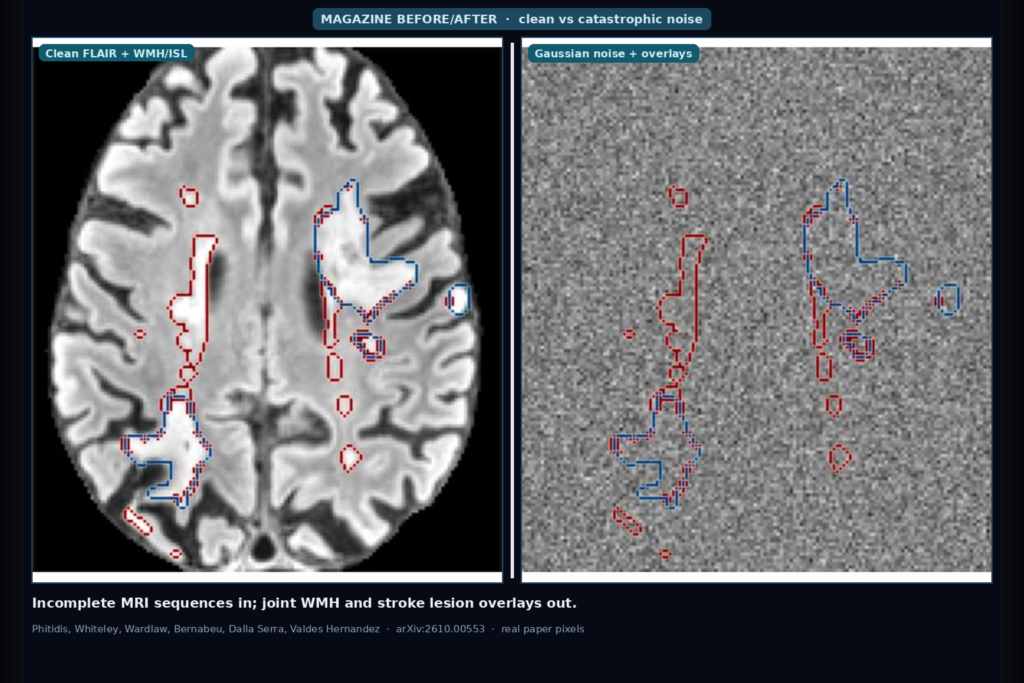
Hang an incomplete brain MRI stack into a vascular-lesion queue and the shop question is not whether another U-Net can paint bright spots on FLAIR. It is whether you still get separate white matter hyperintensity (WMH) and ischaemic stroke lesion (ISL) overlays when T2w or DWI never arrived, when FLAIR is the only usable channel, or when a sequence is present in the DICOM folder but silently filled with noise or a near-empty volume. Jesse Phitidis, William N. Whiteley, Joanna M. Wardlaw, Miguel O. Bernabeu, Francesco Dalla Serra, and Maria del C. Valdés Hernández (Centre for Clinical Brain Sciences and UK Dementia Research Institute at the University of Edinburgh, Canon Medical Research Europe, and Usher Institute) take that hang seriously in arXiv:2610.00553, posted 30 September 2026. They study hetero-modal learning on 206 Mild Stroke Study 3 patients with joint expert WMH and ISL labels across T1w, T2w, FLAIR, and DWI, and they add a Multimodal Attention Router (MMAR) plus corruption augmentation so inference still holds when modalities are missing or catastrophically degraded.
What hangs on the viewer
Upstream is a multi-sequence brain MRI from a small-vessel / mild-stroke workup: T1w, T2w, FLAIR, and DWI when the protocol is complete, but often only a subset when the case lands in PACS. WMH and ISL look alike on T1w and T2w/FLAIR; DWI helps mainly for acute ISL and is not a reliable separator on its own. Downstream hangables for a DICOM viewer or clinic AI shop include color overlays that keep WMH and ISL as separate classes, tolerance for any available subset of the four sequences, and a path that does not collapse when a channel is present but unusable.
The shop claim is that you train on heterogeneous modality subsets so incomplete cases stay in the pool, and you add a router that can down-weight a silently corrupted encoder instead of assuming every non-missing channel is clean.
How it works in plain words
They start from Mild Stroke Study 3 (3T Siemens Prisma): skull-strip with SynthStrip, N4 bias correction, resample to 1 mm isotropic, then a 103 / 41 / 62 train / val / test split. Three training distributions stress different clinical realities. Split 1 keeps all four sequences for every training subject (the clean multi-modal upper bound). Split 2 keeps a full four-sequence set for only about 10% of training subjects (11 of 103), with the rest strictly uni-modal. Split 3 uses T1w as a shared anchor for all subjects while T2w, FLAIR, and DWI never overlap with each other, so the model must later infer on combinations it never saw together in training.
Baselines are modality-specialist U-Nets (fixed input combinations), a large multi-channel U-Net with zero-imputation for missing channels, and U-HeMIS with independent encoders fused by mean/variance. Their MMAR block replaces that statistical fuse with a learnable spatial-and-channel router over the available modality features, with modality and positional embeddings, then softmax routing across modalities before the shared decoder. Corruption augmentation randomly replaces modality dropout with extreme transforms (catastrophic noise, bias field, k-space spike, Rician noise, partial masking) so the router learns to treat ruined regions as missing. Code is public at github.com/Jesse-Phitidis/MultiModal.
What the numbers say
On complete-data split 1 (Table 1), specialists still win on mean macro DSC (51.54%) versus multi-channel U-Net (50.07%), U-HeMIS (50.58%), and MMAR (50.62%). The best single specialist setup is T1w + T2w + FLAIR at 58.01% macro DSC; adding DWI as a fourth channel does not help on this small cohort. FLAIR alone is the strongest uni-modal specialist (53.46% macro).
On highly uni-modal split 2 (Table 2), hetero-modal learning pulls ahead: mean macro DSC rises to 47.93% (U-Net), 45.28% (U-HeMIS), and 46.08% (MMAR) versus 42.29% for specialists. Multi-channel U-Net leads ISL; MMAR posts the best mean WMH DSC (59.28%). Every multi-sequence inference setup shows a statistically significant lift over the matching specialist.
On anchor-modality split 3 (Table 3), models trained with only T1w-overlapping pairs still segment novel combinations. The highest test macro DSC is 54.52% (U-HeMIS on T1w + FLAIR). MMAR takes second and third on novel stacks: 54.33% (T1w + FLAIR + DWI) and 54.04% (T1w + T2w + FLAIR). Without FLAIR, MMAR peaks at 48.89% on the novel T1w + T2w + DWI trio.
Corruption tests (Tables 4 to 7, split 1 with corruption augmentation) are where MMAR separates. Under explicitly missing channels, U-HeMIS and MMAR stay close. Under false-present channels (a single non-zero voxel pretending the series exists), catastrophic Gaussian noise, or severe bias fields, MMAR keeps higher mean macro DSC than multi-channel U-Net and U-HeMIS (false-present means: MMAR 50.03, U-Net 48.66, U-HeMIS 47.41; Gaussian-noise means: MMAR 50.00, U-HeMIS 48.47, U-Net 47.38). The router loss drops quickly in training, which the authors read as the model learning to starve gradients into corrupted encoders.
Where it fails and what not to trust
This is research software on a private Mild Stroke Study 3 subset, not a cleared device for every SVD protocol. Results are from one train/val/test split with one run per model, so absolute DSC should not travel to your scanners without re-validation. Evaluation is DSC-only. Test-time corruption is synthetic; they did not have truly corrupted clinical series in the set, though train and test corruption parameters differ. They did not benchmark the full BraTS-style hetero-modal literature on this joint WMH/ISL task. Absolute DSC sits in the mid-50s macro on this hard joint task; ISL remains harder than WMH. Re-check class definitions, skull-strip, and sequence naming before you hang overlays next to a clinical read.
For a viewer or clinic AI shop
Wire whatever subset of T1w / T2w / FLAIR / DWI you actually have; hang separate WMH and ISL overlays out, including on novel sequence combinations and when a channel is present but ruined. Prefer this pattern when your vascular MRI queue already drops incomplete studies, when you need joint labels rather than a single merged “lesion” class, and when silent zero-filled or artefact-heavy series reach the model before QC flags them. Keep a human edit loop, log which modalities the router trusted, and rebuild from the public code rather than treating Table 2 lifts as a substitute for site QA.
Start from the preprint. Rebuild from arXiv:2610.00553. PDF: https://arxiv.org/pdf/2610.00553.
Sources
- Phitidis, J., Whiteley, W.N., Wardlaw, J.M., Bernabeu, M.O., Dalla Serra, F., Valdés Hernández, M.del C. Hetero-modal learning and corruption-resistant hetero-modal inference for joint segmentation of white matter hyperintensities and ischaemic stroke lesions in MRI. arXiv:2610.00553, 2026. https://arxiv.org/abs/2610.00553. PDF: https://arxiv.org/pdf/2610.00553.
- Data: Mild Stroke Study 3 subset, n=206 (103/41/62); T1w, T2w, FLAIR, DWI; joint WMH and ISL labels. Code: https://github.com/Jesse-Phitidis/MultiModal.
- Split 1 mean macro DSC: Spec 51.54, U-Net 50.07, U-HeMIS 50.58, MMAR 50.62 (Table 1). Split 2: Spec 42.29 vs U-Net 47.93 / U-HeMIS 45.28 / MMAR 46.08 (Table 2). Split 3 peak 54.52 U-HeMIS T1w+FLAIR; MMAR novel 54.33 / 54.04 (Table 3).
- Corruption (false present / Gaussian noise): MMAR mean macro 50.03 / 50.00 vs U-Net 48.66 / 47.38 and U-HeMIS 47.41 / 48.47 (Tables 5 to 6).