
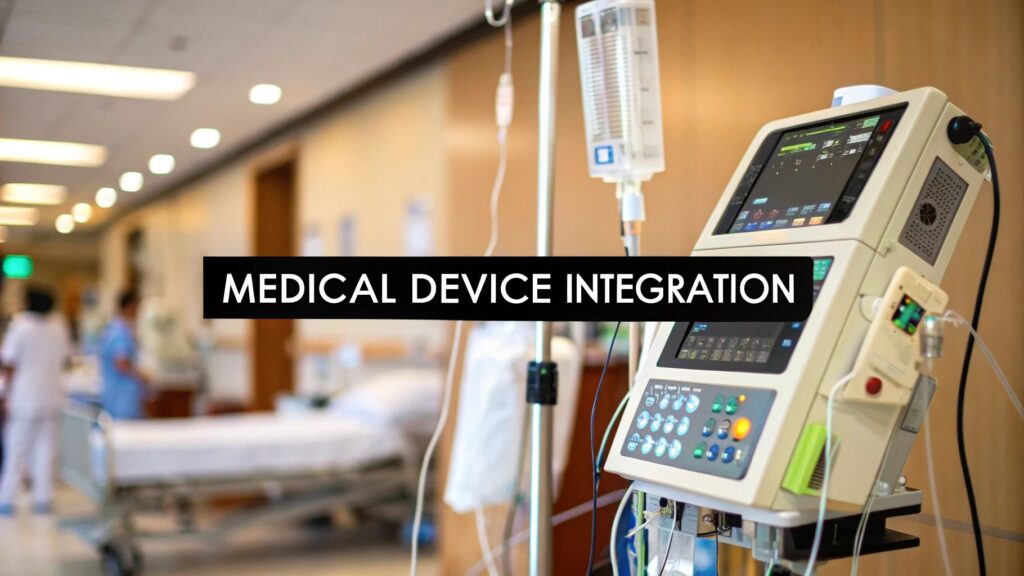
Medical device integration is the job of getting a bedside device — pump, vent, monitor — to write into the EHR without a nurse re-keying the number. Device → gateway → middleware → HL7 / FHIR → chart. It is interoperability for that path. It is not a PACS handshake, not a healthcare-API product page, and not how you pick an interop vendor.
If you meant PACS / RIS / DICOMweb handshake → PACS integration. If you meant healthcare APIs / FHIR as an API → API for healthcare. If you meant interop vendor list → healthcare interoperability solutions. If you meant device software / IEC 62304 → medical device software development. If you meant device development process → medical device development process.
If the device is imaging software, PYCAD is the imaging stack (viewer / model), not the device-connectivity middleware / interface-engine house.
What it is
A monitor, a pump, and a ventilator each speak a vendor dialect. The hospital’s EHR does not. Integration is the translation: capture the reading, prove the device is allowed on the network, normalize the payload, and file it on the right patient. “Connectivity” and “integration software” are stamps of this same job — not a second article.
The common language is HL7 (the hospital bus: ADT, ORU, observations) and FHIR (the same clinical facts as resources a web client can ask for). Interoperability here means those two sides can use the number, not that a vendor list exists. Manual charting is the failure mode: the reading exists on the device and dies there.
Heart rate, device to chart
Follow one number. That is the architecture. The names change; the hops do not.
- Capture. The cardiac monitor records the heart rate as a continuous digital stream.
- Gateway. A medical-grade gateway (wired or a locked-down Wi-Fi SSID) accepts the packet only from a trusted device.
- Middleware. A translator recognizes the device type and the shape of its payload. This is the interface engine — not a PYCAD product.
- Normalize. Proprietary reading → HL7 v2 observation or a FHIR
Observation. - Chart. The EHR files the value on the right encounter. Seconds, not a clipboard round.
Do that for vents, pumps, and bedsides and you have a live chart instead of hourly snapshots. The nurse is not the interface.
DICOM vs HL7 vs FHIR
Three languages, three jobs. Mixing them is how projects stall. DICOM is the image. HL7 v2 is the hospital’s text-and-numbers bus. FHIR is the same facts, cut into resources a modern app can request. None of this is a PACS/RIS/worklist chapter — that handshake lives on PACS integration. FHIR-as-an-API (REST, resources, Cures) lives on API for healthcare.
| Standard | Primary use | Payload | Strength |
|---|---|---|---|
| DICOM | Medical images (CT, MR, XR, US) plus the study metadata | Binary object with a header | Any compliant viewer can open any compliant study |
| HL7 v2 | Admissions, labs, orders, device observations | Pipe-delimited messages | Already running in almost every hospital |
| FHIR | Web / mobile / RPM clients that need one resource, not a dump | JSON or XML over REST | Ask for Observation without parsing a whole v2 batch |
A bedside heart-rate write is HL7 or FHIR. A CT that must land in the archive is DICOM — and getting that study into the PACS/RIS loop is 6094, not this page.
Who actually benefits
| Stakeholder | What changes | What does not |
|---|---|---|
| Patient | The chart matches the device. Fewer copy errors. Faster catch on a trend. | The device itself. Integration is not a new therapy. |
| Clinician | No clipboard round. One view instead of three screens. Alarms can be ranked. | Clinical judgment. A live number still needs a person. |
| Administrator | Less re-work, cleaner audit, a chart that can actually bill what happened. | A guaranteed length-of-stay cut. That number is a study, not a slogan. |
The point is the chart is true and timely. ROI stories that quote a connectivity-market CAGR or a 63% smart-pump drop without a paper are costume — they are not on this page.
Settings — examples, not a second article
ICU. Vent, pumps, and the monitor on one patient. The charge nurse sees the dip when it happens, not on the next hourly round.
OR. Anesthesia machine and vitals in one stream so the record is the case, not a reconstruction after close.
RPM / hospital-at-home. A home glucose or wearable reading that has to land on a care-team dashboard the same way a bedside number lands on a chart. Same hops: device → gateway → translate → record. The living room is just a longer wire.
What usually breaks it
Legacy ports. A ten-year-old pump still talks serial. A gateway or adapter is how it joins; ripping the fleet is not the first move.
Dialects. Two monitors, two payloads, one EHR field. Middleware exists to normalize. FHIR helps the modern side; HL7 v2 is still what most bedsides emit.
Security. Every new hop is ePHI in motion. Encrypt in transit and at rest, authenticate the device, segment the clinical VLAN off guest Wi-Fi, patch firmware. HIPAA applies because the reading is PHI, not because a vendor said “compliant.”
Workflow. A live feed that dumps 200 alarms an hour is worse than a clipboard. Train the unit, phase the rollout, and let the people who take the page pick the thresholds.
FAQ
Is “connectivity” a different job from “integration”?
No. Both names are this page: device → EHR. The “solutions” and “software” stamps redirected here. Do not keep a second URL for the adjective.
Is this PACS integration?
No. PACS / RIS / worklist / DICOMweb is PACS integration. DICOM appears above only as one of three healthcare languages.
Do you need to replace old devices?
Usually not. Gateways read serial and vendor dialects. Start with one unit (ICU is the usual pilot), prove the chart is right, then expand.
Where does PYCAD sit?
If the device is imaging software, the imaging stack (viewer / model). Not Capsule-style connectivity middleware, not an interface engine, not a “leading medical imaging integration company” in the HIS/HL7 sense.