
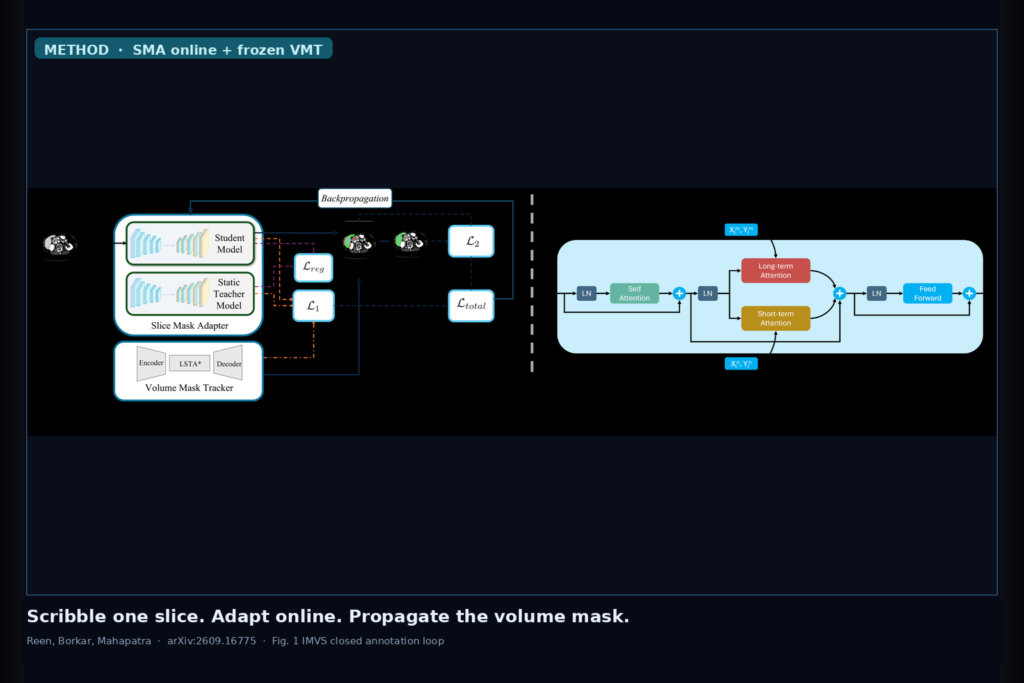
You seed a CT or MRI volume with a few scribbles on the first clear slice of a target, then ask the viewer to carry that mask through the rest of the stack. Slice-wise tools (including many foundation models) force you to re-prompt almost every slice. Fixed 3D or video propagators such as MedSAM2 carry the prompt, but they never adapt to the volume in front of you, so low-contrast or pathological targets drift and you burn clicks correcting the same failure mode. Abhilaksh Singh Reen, Kushal Borkar, and Ritvik Mahapatra posted arXiv:2609.16775 on 15 September 2026. The paper is IMVS: Interactive Medical Volume Segmentation with Test-Time Adaptation.
IMVS is not a new segmentation primitive. It is a closed human-in-the-loop annotation loop: a lightweight 2D Slice Mask Adapter (SMA) fine-tuned online from user scribbles, a frozen Volume Mask Tracker (VMT) that propagates the accepted mask to adjacent slices, and a soft teacher-student alignment that limits forgetting. For a DICOM viewer or clinic AI shop building annotation rails, the hook is interaction efficiency on hard targets, not another Dice leaderboard.
How the IMVS loop works
The annotator starts at the slice where the target first becomes clear. Foreground and background scribbles are rasterized into two guidance channels and concatenated with the grayscale slice, so early fusion stays backbone-agnostic. The SMA (UNet++ by default; DeepLabV3 and TransUNet also validated) runs as a frozen teacher plus an adaptive student. Only the student updates online. The VMT is a ViT-B propagator pretrained on YouTube-VOS and fine-tuned for medical mask propagation, then frozen at inference. It uses long/short-term attention over a memory bank of recent slice-mask pairs and pushes the accepted mask forward for up to K slices (they use K=17).
When a propagated mask is unacceptable, the user scribbles again. The student minimizes a consistency term against the VMT and teacher, an interactive cross-entropy against the corrected mask, and a soft batch-norm alignment that anchors the student to the teacher. SGD updates fire only when the total loss clears a small threshold, which suppresses noisy edits. The adapted student then warm-starts the next volume in the session.
What hangs on the scan
Downstream for a viewer shop is a familiar pattern: seed scribbles on one slice, hang the accepted 2D mask, then hang the propagated volume mask as the VMT walks the stack. Failures surface as slices that need a re-scribble rather than a silent wrong contour. Fig. 1 in the paper shows the closed loop with the SMA teacher-student path above the frozen VMT path, plus the long/short-term attention block that keeps frame-to-frame smoothness without adapting the tracker itself.
They evaluate on 8 public CT/MRI datasets (BraTS, LiTS, MSD Pancreas for training splits; CHAOS-CT/MRI, AMOS-CT, MSD Prostate, and MSD HepaticVessel held out zero-shot). A 9-resident user study set a shared acceptance stop near DSC 0.885. Against that protocol, IMVS was about 14.4× faster than a proficient copy-and-edit manual workflow and needed the fewest interactions to reach DSC ≥ 0.90 across every dataset they reported (mean 7.1 vs 10.1 for MedSAM2). MedSAM2 and nnInteractive stay competitive or faster on well-delineated healthy organs. IMVS’s edge shows up on challenging targets and on overall interaction count.
Where it still fails
Tortuous or discontinuous structures remain hard. On hepatic vessels every method needed many interactions; IMVS still sat around 20 prompts there, close to MedSAM2. The VMT tracks reliably for only about 4–6 slices on those cases versus up to 17 on well-defined organs. IMVS segments one target per pass. Multi-label volumes mean sequential single-label sessions that share the adaptation context. Native multi-object propagation is future work. Training used simulated scribbles for the SMA, so real stroke style still matters in a production tool. Fail closed when the structure is discontinuous, when the user needs sub-second latency that online SGD will not beat, when the hanging expects simultaneous multi-organ labels, or when a foundation-model box prompt on a clean organ already finishes the volume with fewer steps.
For a viewer or clinic AI shop
Treat IMVS as an annotation control plane: scribbles in, online-adapted slice mask, frozen volume propagation out, with the student carried across volumes as a warm start. Hang the current accepted mask beside the source series so a reader can see which slices were corrected versus auto-propagated. Hang interaction count and time-to-accept as QC, not as a marketing Dice claim. Compared with MedSAM2 or ScribblePrompt, keep the framing honest: foundation models stay strong on clean organs; IMVS is the pattern when you want each correction to change the model for the slices ahead instead of re-prompting a fixed tracker. If your platform already stores SEG overlays and can drive a scribble UI on CT/MRI stacks, this paper is a practical blueprint for amortizing annotations across a volume without freezing a propagator that never learns the case.
Rebuild from arXiv:2609.16775. As of 17 September 2026 the abstract and PDF respond. Code and a demo video are linked at github.com/AbhilakshSinghReen/imvs.
Sources
- Reen, A. S., Borkar, K., Mahapatra, R. IMVS: Interactive Medical Volume Segmentation with Test-Time Adaptation. arXiv:2609.16775, posted 15 September 2026 (HAIC workshop, MICCAI 2026 submitted manuscript). https://arxiv.org/abs/2609.16775. PDF: https://arxiv.org/pdf/2609.16775.
- Code / demo: https://github.com/AbhilakshSinghReen/imvs.
- Baselines cited for interaction efficiency: MedSAM2, ScribblePrompt, nnInteractive, PRISM, iSegFormer, f-BRS, MedSAM.
- Eight public CT/MRI sets used in the paper: BraTS, LiTS, MSD Pancreas, CHAOS-CT/MRI, AMOS-CT, MSD Prostate, MSD HepaticVessel.