
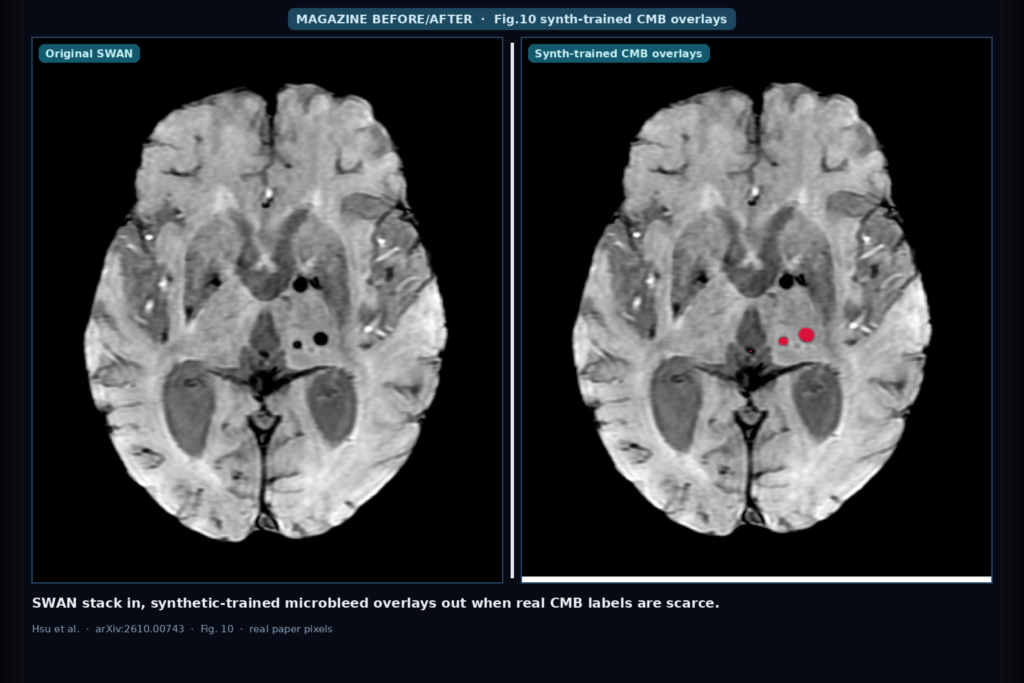
Hang a SWAN (susceptibility-weighted angiography) stack into a neuro MRI or DICOM-viewer workflow and the clinic question is whether cerebral microbleeds (CMBs) can be flagged without burning a neurologist on every MARS or BOMBS rating pass. CMBs are rare, small (2–10 mm), and easy to confuse with vessel cross-sections, calcifications, and susceptibility voids. Positive voxel labels are expensive. To-Liang Hsu, Ting-Yu Lai, Ching-Ting Lin, Chun-Hao Huang, and Wei-Chun Wang (China Medical University Hospital / CMU, Taichung) take that hang seriously in arXiv:2610.00743, submitted 30 September 2026 to eess.IV. They build a synthetic CMB generator on real CMB-negative SWAN hosts, train a lightweight MONAI 3D U-Net on synth-only data, and ask how far that gets you toward real lesion overlays and a case-level positive flag when real CMB labels are scarce.
What hangs on the viewer
Upstream input is a SWAN DICOM or NIfTI volume from routine GE multi-scanner practice (1.5T and 3T). Downstream hangables for a viewer plugin or clinic AI shop are voxel-wise CMB lesion overlays plus a case-level positive flag (any surviving predicted component counts as CMB-positive). Inference uses sliding-window prediction, mirror test-time augmentation, and a majority vote across five cross-validation folds, then drops connected components smaller than 15 voxels so tiny noise blobs do not fire the case flag.
The dataset behind the experiments is 205 CMUH exams under IRB (CMUH110-REC2-245): train 78 CMB-positive / 75 CMB-negative hosts, hold-out 26 / 26, with 687 train lesions and 171 test lesions. Only 2–10 mm lesions are labeled. That is a realistic clinic scarcity setup, not a synthetic toy cohort.
How it works in plain words
Preprocessing is SWAN-specific: DICOM to NIfTI with spatial metadata kept, brain extraction with an nnU-Net trained on 20 delineated SWAN volumes (no pretrained SWAN skull-stripper was available), then 8-bit normalize to 0–255.
The synthetic pipeline never touches the hold-out set for generator parameters. It inserts parameterized soft ellipsoids into the 75 real CMB-negative SWAN hosts. Equivalent diameter, elongation, and contrast are sampled from truncated Gaussians informed by real training CMBs (diameter about 3.6 ± 0.8 mm, elongation about 1.6, contrast about 160). Five lesions per scan match the median burden of the real-positive train set. Local background intensity is the median in a 3–6 mm shell; lesion intensity is background minus contrast; a soft alpha mask with sampled blending strength pastes the hypointense void into the host. Binary training masks threshold alpha above 0.5. Insertion sites are uniform inside an eroded brain mask so lesions stay fully intraparenchymal without a hard anatomic prior.
Primary detector is a lightweight MONAI 3D U-Net (channels 16/32/64, patches 96×96×48, Dice loss, Adam, cosine annealing, 150 epochs). nnU-Net v2 full-resolution is the comparison framework with defaults left intact. Training paradigms cover pure real (R20/R40/R78), pure synth (S20/S40/S75), synth-train with real validation (S75+ReVal), and mixed real+synth (R40+S40, R78+S75).
What the numbers say
On the hold-out set, MONAI S75 (synth-only, no real CMB annotations in train or val) retained about 83.7% of the mean Dice and about 87.7% of the lesion sensitivity of MONAI R78 (real): Dice 0.576 vs 0.688, lesion sensitivity 0.749 vs 0.854, FP/case 1.423 vs 1.135. Case sensitivity stayed 1.0 for both; case specificity dropped from 0.577 to 0.308, so the synth-trained model over-calls more cases as positive. Case F1 moved from 0.825 to 0.743.
Twenty real positive exams already beat every synth-only config: MONAI R20 reached Dice 0.660 and lesion sensitivity 0.807, above S75. Mixing synth into real raised lesion sensitivity (R78+S75: 0.877 vs R78 0.854) but also raised FP/case (1.788 vs 1.135) and did not lift Dice. Using real data only for validation on S75 gave modest, overlapping changes.
Architecture matters more than the abstract suggests. nnU-Net R78 was the strongest real-data run (Dice 0.777, lesion sensitivity 0.860, FP/case 0.500), yet nnU-Net S75 collapsed (Dice 0.240, sensitivity 0.269). Same synthetic hosts, very different transfer. Do not assume a generator that works under MONAI will transfer under nnU-Net without re-checking.
Where it fails and what not to trust
This is a research pipeline on one hospital SWAN fleet, not a cleared screening device. Case specificity is the hang you feel first: synth-only MONAI fires more false-positive cases, so a radiologist still has to clear negatives. Twenty real labels beat seventy-five synthetic hosts here; treat synth as a complement when positives are scarce, not as a full substitute. The generator is intentionally simple (soft ellipsoids, no vessel/calcification mimics like CenSynCMB), and KS gaps remain on elongation and background-to-lesion contrast. CMBs are unusually good candidates for insert-and-blend synthesis; do not export the same recipe to large, anatomy-warping lesions without new validation.
The paper says implementation details live on GitHub and a project website, but the arXiv HTML only carries broken placeholder link text (“GitHub”; “Website”). Do not invent a repo URL. Start from the arXiv abstract and PDF until the authors publish working links.
For a viewer or clinic AI shop
Wire SWAN stack in; hang CMB lesion overlays and a case-level positive flag out. Prefer the MONAI lightweight U-Net pattern when you can generate synthetic positives on confirmed CMB-negative hosts and you need a first-pass overlay under label scarcity. Keep a human confirm on the case flag, especially on synth-only or mixed models where FP/case climbs. If your shop standardizes on nnU-Net, re-run the synth-to-real check before you trust the same hosts: transfer is framework-dependent in this paper.
Rebuild from arXiv:2610.00743. PDF: https://arxiv.org/pdf/2610.00743. Code links in the preprint are placeholders; watch the arXiv page for a real GitHub URL.
Sources
- Hsu, T.-L., Lai, T.-Y., Lin, C.-T., Huang, C.-H., Wang, W.-C. Synthetic-to-Real Transfer in Cerebral Microbleed Generation and Segmentation. arXiv:2610.00743, 2026. https://arxiv.org/abs/2610.00743. PDF: https://arxiv.org/pdf/2610.00743.
- Data: 205 CMUH SWAN exams (IRB); train 78+/75– (687 lesions), hold-out 26+/26– (171 lesions); GE multi-scanner 1.5T/3T. Synth: 5 soft ellipsoids/scan into CMB-negative hosts.
- MONAI S75 vs R78: Dice 0.576/0.688 (~83.7%), lesion sens 0.749/0.854 (~87.7%), FP/case 1.423/1.135; case sens 1.0 both; case spec 0.308/0.577. R20 Dice 0.660 sens 0.807 > all synth-only. nnU-Net R78 Dice 0.777 sens 0.860 FP 0.500; nnU-Net S75 Dice 0.240 sens 0.269. Inference: sliding window + TTA + 5-fold majority vote; drop <15 voxels. Code: arXiv placeholders only; start from arXiv.