
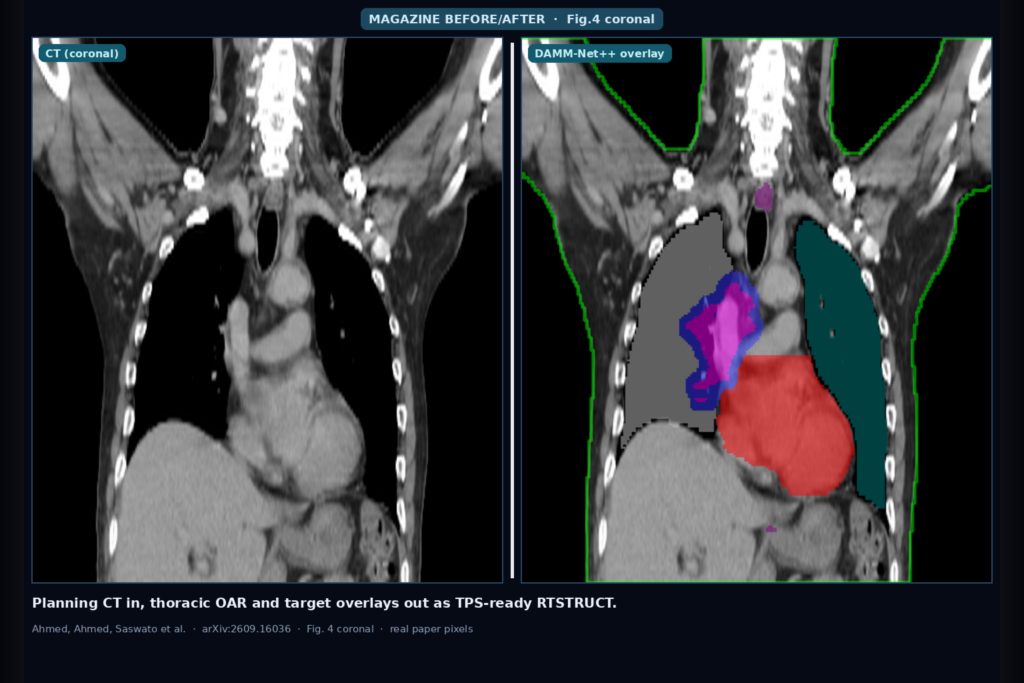
Hang a thoracic planning CT into a radiotherapy contouring workflow and the shop question is not whether another U-Net can paint lungs. It is whether the overlays stay coherent when you scroll through-plane, whether small low-contrast targets (esophagus, trachea, GTV, CTV) still land, and whether the case ships as a TPS-ready RTSTRUCT with a reliability signal the oncologist can triage. Galib Ahmed, Istiak Ahmed, Aritra Islam Saswato, and colleagues (North South University Big-Matrix Lab with Square, Labaid, Bangladesh Specialized, BMU, NICRH, and partners) take that hang seriously in arXiv:2609.16036, posted 19 September 2026 (v2). They call the system DAMM-Net++: a 2.5D auto-contourer with anatomy-change-aware bidirectional selective state-space memory, a boundary-aware decoder, and a calibrated uncertainty head. End-to-end path is DICOM ingest to TPS-compatible RTSTRUCT export, already integrated at a partner hospital.
What hangs on the viewer
Upstream is a planning CT for thoracic radiotherapy, typically 100 to 350+ axial slices at about 1 mm in-plane and ~2.5 mm through-plane. Contours come as RTSTRUCT: body, spinal cord, esophagus, heart, right and left lung, trachea, GTV, and CTV under ESTRO/RTOG-style nomenclature (TG-263 names retained on export). Manual contouring still runs 2 to 4 hours per case in the sites they describe. Downstream hangables for a DICOM viewer or planning shop include color overlays on axial/coronal/sagittal, per-structure visibility toggles, a per-voxel uncertainty map for triage, and an RTSTRUCT the TPS will accept without renaming gymnastics.
DAMM-Net++’s shop claim is that through-plane memory conditioned on observed anatomy change, plus boundary and uncertainty heads, is what you need when slice-independent 2D nets flicker and full 3D transformers blow latency on long thorax stacks.
How it works in plain words
Each step takes a short axial window (five slices in their setup) centered on the current slice. A weight-shared ConvNeXt encoder runs per slice. A multi-scale inter-slice transition branch computes feature differences between adjacent slices, attends them, and adds an anatomy-change feature into the bottleneck. Bidirectional selective state-space memory (Mamba-style) then propagates context superior-to-inferior and inferior-to-superior with a gated fusion, so the model sees how anatomy actually changes along the stack rather than assuming a fixed transition. A memory-guided boundary-aware decoder pulls that fused memory into the decode path via cross-attention, with skip connections from the encoder. Per-slice heads emit segmentation, boundary, signed distance, presence/confidence, and log-variance uncertainty.
Training uses Dice + focal + boundary losses with an uncertainty-attenuated term for calibration. At inference, slice predictions assemble into a volume; RTSTRUCT export keeps clinical structure names. Latency on an NVIDIA T4 is about 22.4 ms per axial slice, inside their ≤25 ms target and roughly 3× faster than the transformer baselines they compare.
Ablations in the paper matter for a shop that is deciding what to port. Turning on selective SSM memory and feeding it a real inter-slice transition signal, not a randomized or ablated one, is where most of the Dice and surface-metric lift appear. Boundary-aware refinement helps HD95 and NSD more than bulk Dice. The uncertainty head is there for triage: flagging a small high-uncertainty fraction of voxels raises Dice on the retained region, which is the behavior you want when an editor queues hard cases first.
What the numbers say
Data: 2,146 patients across four Bangladeshi centers, institution-stratified into train 1,424 / val 305 / test 305, plus 112 United Hospital cases held out as external validation. Reader study: 17 radiation oncologists (juniors, seniors, experts) on 305 cases. Macro-average Dice on the internal test set is 0.955 with HD95 about 3.78 mm; macro IoU 0.914. Largest gains sit on CTV/GTV and small tubular OARs where through-plane context matters. Against nnU-Net, nnMamba, UNETR++, and SwinUNETR, DAMM-Net++ leads on eight of nine structures on Dice (heart is the exception in their violin summary). In the reader study, AI assistance cut contouring time by about 75–80% across experience levels, and junior-reader IoU rose from 0.861 to 0.925, matching the unedited model. External drop stayed under 5%, with calibrated uncertainty transferring without recalibration.
Where it fails and what not to trust
This is research plus a partner-hospital pilot, not a cleared medical device for every thorax protocol. The dataset is institutional and not public. Heart is the structure where they do not claim a clean win over every baseline. Truncated FOV cases and very atypical anatomy still need human edit. Uncertainty is calibrated for triage, not a license to skip review on GTV/CTV. Re-validate RTSTRUCT naming, windowing, and dose impact on your TPS and contouring guidelines before you trust overlays for planning. Start from the preprint; there is no public code release in the paper.
For a viewer or clinic AI shop
Wire thoracic planning CT in; hang multi-structure OAR/target overlays, a per-voxel uncertainty map, and a TPS-ready RTSTRUCT out. Prefer this pattern when you already ship auto-contour overlays but see through-plane flicker on esophagus/trachea/targets, when junior editors burn hours on edits, and when you need a case-level reliability signal next to the masks. Their review UI shows synchronized orthogonal planes with predicted contours as color overlays and per-structure opacity controls, which is the same hang a DICOM viewer shop already knows how to build.
If you integrate, keep the human edit loop: AI draft, uncertainty-sorted review, oncologist sign-off, then C-STORE or file export into the TPS. Do not treat macro Dice 0.955 as a substitute for dose-aware QA on GTV/CTV. Rebuild from arXiv:2609.16036. PDF: https://arxiv.org/pdf/2609.16036.
Sources
- Ahmed, G., Ahmed, I., Saswato, A.I., et al. Anatomy-Change-Aware Bidirectional Selective State-Space Memory for Clinically Deployed Thoracic Radiotherapy Auto-Contouring. arXiv:2609.16036, 2026. https://arxiv.org/abs/2609.16036. PDF: https://arxiv.org/pdf/2609.16036.
- Internal test: macro Dice 0.955, HD95 ~3.78 mm, IoU 0.914 (2,146 pts / four centers; external n=112). Reader study: 17 oncologists, 305 cases; ~75–80% less contouring time; junior IoU 0.861 to 0.925.
- Pipeline: DICOM ingest to TPS-compatible RTSTRUCT; ~22.4 ms/slice on NVIDIA T4. Dataset not public.