
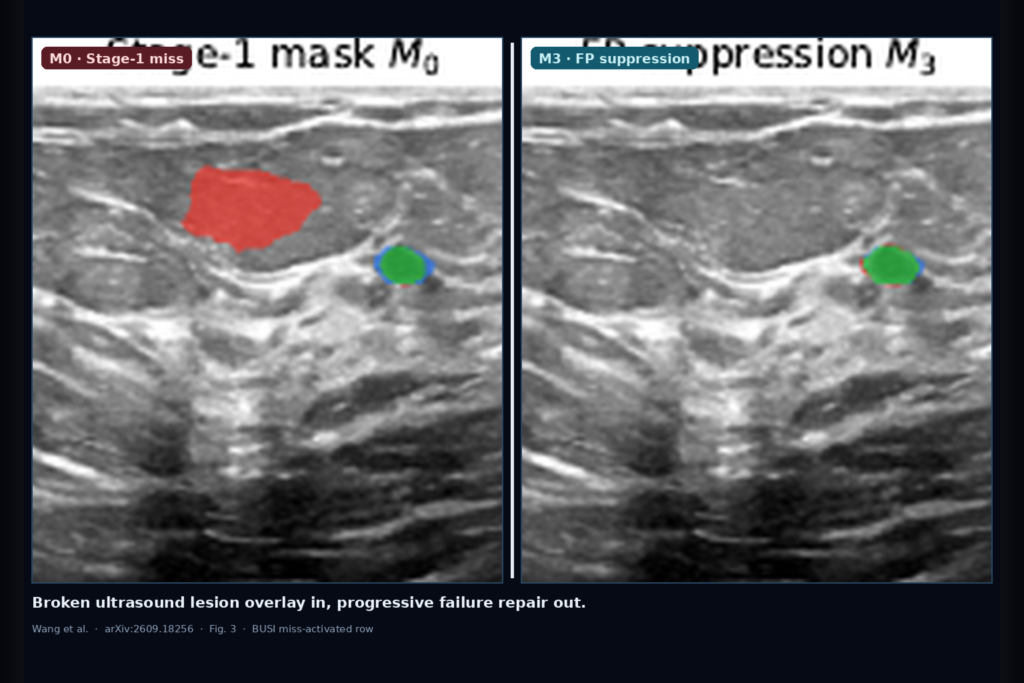
Breast and thyroid ultrasound overlays fail in a few ugly ways that mean Dice rarely tells you about. The mask can miss the nodule entirely, cover only half of it, or paint a bright blob on the wrong tissue. High average scores still leave a long tail of those misses. Ziliang Wang, XuJiang Tang, Lu Yuting, Weixin Xu, Yongqiang Zhao, Ying Fu, and Kehua Guo (Central South University with Yangtze University, Chongqing University, Peking University, and Southwest Jiaotong University) posted arXiv:2609.18256 on 16 September 2026. The paper is Evolving Error States: Failure-Aware Progressive Repair for Ultrasound Lesion Segmentation.
Their fix is Failure-Aware Progressive Repair (FAPR). Keep the base segmentor frozen. Treat the current mask as a failure state. Repair gross misses, then false negatives, then false positives in order, so each stage sees the mask the previous stage just changed. Across BUSI, BUSIS, and TN3K they report about 1.5 points mean DSC overall, and about 13.8 points average gain on the very-hard BUSI and TN3K subsets.
What hangs on the viewer
Input is a B-mode breast or thyroid ultrasound frame. Output is a lesion overlay you hang in a DICOM viewer or ultrasound workstation: green for agreement with the reference, with the usual red and blue leftovers when the prediction still overshoots or undershoots. Stage 1 is whatever frozen U-Net, U-KAN, or similar encoder-decoder you already trust. FAPR never retrains that backbone. It only consumes the initial mask M0 plus the multi-scale features the backbone already computed.
What you hang after FAPR is the repaired mask M3, unless a small rollback controller decides the repair trajectory looked harmful and restores M0. For a clinic AI shop that already ships a lesion contour rail, that is an optional post-hoc repair stage on top of an existing checkpoint, not a second full segmentation product.
Ordered repair instead of one-shot correction
Most post-hoc correctors estimate false-positive and false-negative fixes from the same fixed prediction. FAPR argues that order matters. Once a gross miss is recovered, the spatial support for the next completion step changes. Once that completion lands, the regions a suppressor should trim change again. Parallel FP/FN heads on a frozen prior miss that chain.
FAPR therefore runs three specialists in sequence. A strict-miss router decides whether M0 lacks reliable lesion support and, if so, a gross-miss expert rebuilds a plausible candidate into M1. A tail-sample router then activates false-negative expansion into M2, then false-positive suppression into M3. Sample-level scores and pixel gates decide whether and where each overlay is accepted. Failure replay feeds the specialists rare Stage-1 error states and controlled corruptions so the long tail is not invisible during training. A lightweight harm-risk controller can roll M3 back to M0 when the repair looks worse than the base mask.
Fig. 3 makes the viewer story concrete on two BUSI cases. In the miss-activated row, Stage-1 paints a large false-positive blob while the true nodule is almost empty. After gross-miss repair, FN expansion, and FP suppression, the overlay collapses onto the nodule. In the miss-bypassed row the first stage is skipped, and later stages still cut a huge over-segment down toward the true focus.
Where it still fails
Gains sit in the hard tail. On easy cases the paper shows only small DSC moves, which is what you want if you fear a refiner that rewrites already-good overlays. BUSIS is nearly saturated, so FAPR mostly preserves Stage-1 there. The strict-miss route is rare (3 of 129 BUSI test cases in their report) but those cases move a lot after M1. Ablations that drop a specialist or drop failure replay hurt very-hard DSC far more than easy DSC.
This is still research code on public ultrasound lesion sets, not a cleared device. Labels, ROI crops, and intensity prep have to match how your site draws ground truth. Fail closed when the repaired overlay still looks topologically wrong on a quick sonographer glance, when the study is not breast or thyroid B-mode in the style of BUSI/TN3K, or when someone wants silent auto-contours for biopsy planning without a human review of M3 against the cine.
For a viewer or clinic AI shop
Hang FAPR as a gated repair rail behind your existing lesion segmentor: frame in, frozen Stage-1 mask out, ordered miss/FN/FP repair, optional rollback, human edit in, contour out. Prefer it when your mean Dice board looks fine but QA still catches gross misses and wild false positives on a minority of studies. Keep Stage-1 as the source of truth for easy cases, and treat Table 2 style failure-conditioned splits as the go-live metric, not mean DSC alone.
Rebuild from arXiv:2609.18256. As of 19 September 2026 the abstract and PDF respond. The authors say code and weights will be released upon acceptance, with supplementary training scripts and splits.
Sources
- Wang, Z., Tang, X., Lu, Y., Xu, W., Zhao, Y., Fu, Y., Guo, K. Evolving Error States: Failure-Aware Progressive Repair for Ultrasound Lesion Segmentation. arXiv:2609.18256, posted 16 September 2026. https://arxiv.org/abs/2609.18256. PDF: https://arxiv.org/pdf/2609.18256.
- BUSI, BUSIS, and TN3K public ultrasound lesion benchmarks (as used in the paper).
- U-Net, U-KAN, CausalBridgeNet, SegRefiner, MSAGHNet (cited baselines and related correctors).