Welcome to the new era of medical data management. Let's be honest, data archiving solutions used to conjure images of digital basements—dusty, forgotten, and slow. But that's a thing of the past. Today, a smart archiving strategy is the bedrock for the future of healthcare, turning the relentless flood of medical data into your most powerful, accessible asset.
Unlocking The Power Of Your Healthcare Data
In healthcare, data isn't just data. It's the lifeblood of everything we do, from patient care and breakthrough research to simple operational efficiency. But with medical imaging and electronic health records producing information at a breathtaking pace, just keeping up can feel like an impossible task. This is where a modern data archive comes in—not as a simple storage closet, but as an intelligent system built for the long haul.
Think of it less as a static repository and more like a dynamic, living library for your most valuable clinical assets. It's a system designed to free up your expensive, high-performance primary storage, slash operational costs, and ensure you can pull up a patient's decade-old scan for a longitudinal study in seconds, not hours. For hospital IT leaders, medtech visionaries, and dedicated researchers, this is your roadmap to mastering the critical demands of compliance, cost, and retrieval.
Why Strategic Archiving Matters Now More Than Ever
Moving towards proactive data management isn’t just a trend; it's a financial and operational imperative. The proof is in the numbers. The global enterprise information archiving market was valued at a staggering USD 8.544 billion in 2024 and is on track to hit USD 18.889 billion by 2030.
That growth—a compound annual growth rate of 14.4%—is a clear signal that the industry sees archiving as a core business function, not an afterthought. You can dive deeper into the full market analysis and its implications for the healthcare sector.
This guide is all about showing you how a modern approach can unlock that hidden potential. We'll walk through how to:
- Turn archived data into a queryable goldmine for research and analytics.
- Elevate patient care by giving clinicians a complete, historical view of medical data.
- Achieve operational excellence by optimizing your storage costs and system performance.
- Confidently navigate the complex world of compliance, from HIPAA to GDPR.
At PYCAD, we believe archived data should be active, not dormant. Our expertise lies in bringing these archives to life. We at PYCAD, build custom web DICOM viewers and integrate them into medical imaging web platforms, turning stored data into actionable insights right at your fingertips.
This is where healthcare data management is heading—a future where your archives don't just sit there, but actively empower discovery and elevate care. As you start to imagine the possibilities, remember that the right partner can make all the difference in turning that strategic vision into a clinical reality. Take a look at the innovative solutions we've already built by visiting our portfolio page.
Let's build a future where data truly works for you.
Choosing Your Archiving Foundation
Picking the right data archiving solution is a lot like choosing the foundation for a new hospital wing. Get it right, and you’ve built a strong, flexible, and future-proof home for your data. Get it wrong, and you could be dealing with cracks in your infrastructure for years. The choice you make between on-premise, cloud, and hybrid models will ripple through everything from retrieval speeds to your long-term budget.
On-Premise: Your In-House Data Fortress
Think of an on-premise solution as your own secure, in-house vault. You own the hardware, you manage the software, and your team oversees every single security protocol. This is the classic approach, perfect for institutions with non-negotiable security mandates or a robust IT team already in place. It gives you absolute, hands-on control—a true fortress for your most sensitive patient information.
Cloud: The Scalable, Expert-Managed Library
On the other end of the spectrum is a cloud-based archive. This is less like a vault you build yourself and more like having access to a vast, specialized medical library managed by world-class experts. The biggest win here is near-infinite scalability. As your data volumes explode—and they will—you can expand your storage without the massive capital expense of buying and installing new servers. It beautifully shifts storage from a huge upfront investment to a predictable operational cost.
Hybrid: The Best of Both Worlds
For many healthcare organizations, the smartest path isn't one extreme or the other, but a blend of the two. A hybrid approach lets you create a balanced, high-performance ecosystem for your data.
Here’s how it works in practice: you keep the critical, frequently needed files right where you can get them fastest. Think recent DICOM studies for active patients, which you’d keep on-site for instant, low-latency access. Meanwhile, older data that you need for compliance but don't touch every day gets moved to the cloud, where you can take advantage of its cost-efficiency and long-term durability. It’s a strategic move that optimizes both performance and your budget.
This fundamental decision between cloud vs on-premises solutions is all about weighing those trade-offs—cost, security, and performance—to find what truly fits your institution's needs.
This decision tree helps visualize how your core priorities can point you to the right model.
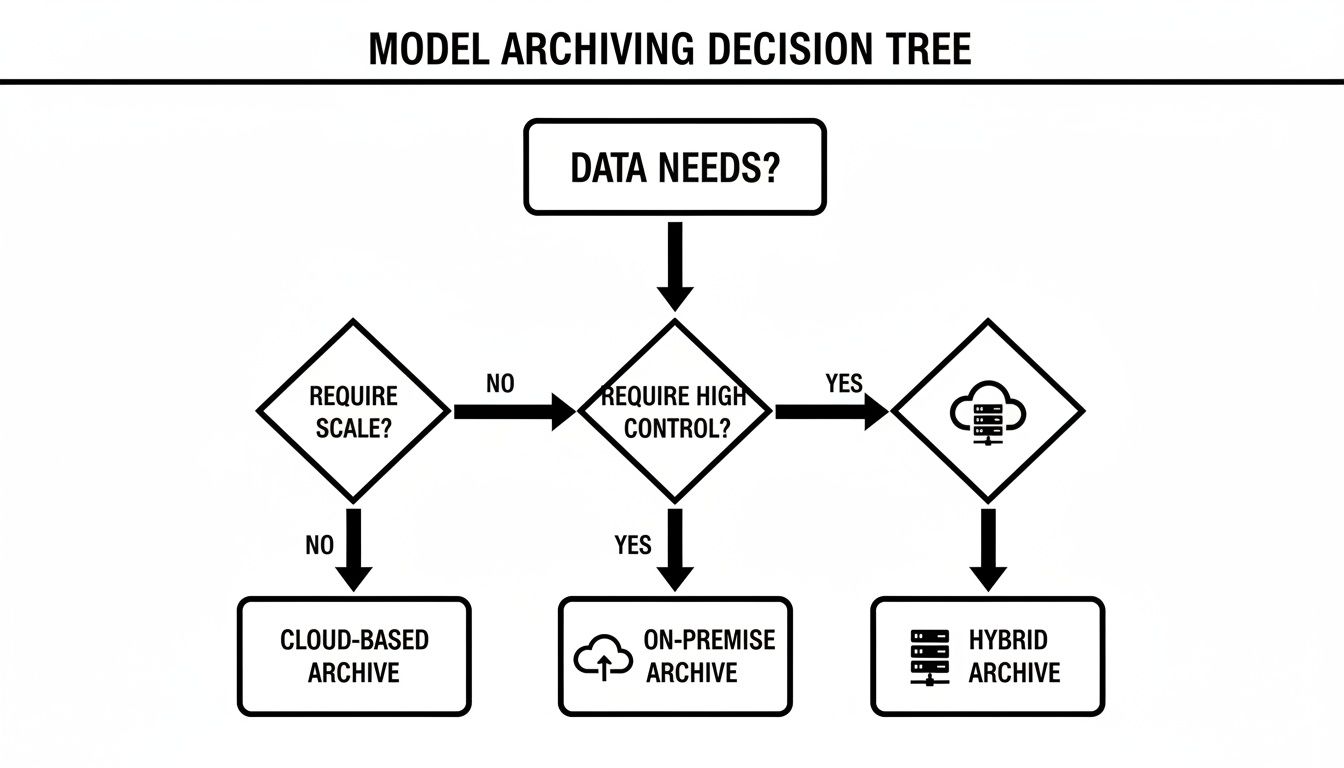
As you can see, if total control is the name of the game, on-premise is your answer. If your biggest challenge is managing massive, unpredictable growth, the cloud is built for that.
Comparing The Core Models
So, how do these three models stack up when you get into the details? Every organization has different priorities, so it’s crucial to understand the distinct advantages and trade-offs of each. Let's lay it all out.
Comparing On-Premise, Cloud, And Hybrid Archiving
This table breaks down the key differences to help you see which model aligns best with your organization's goals, from budget constraints to security posture.
| Feature | On-Premise | Cloud | Hybrid |
|---|---|---|---|
| Cost Model | High upfront capital (CapEx) for hardware, software, and personnel. | Predictable operational (OpEx) subscription model. No hardware costs. | Mixed model with CapEx for local hardware and OpEx for cloud services. |
| Scalability | Limited and slow. Requires purchasing and provisioning new hardware. | Virtually limitless and on-demand. Scale up or down instantly. | Balanced. Local tier has fixed capacity; cloud tier offers unlimited expansion. |
| Control & Security | Maximum control. Your team manages all security protocols directly. | Shared responsibility. Provider manages infrastructure security; you manage access. | Granular control. You decide which data stays on-site and which goes to the cloud. |
| Accessibility | Fast local access, but remote access can be complex and slower. | Globally accessible from any location with an internet connection. | Optimized access. Fast for on-site data, flexible for cloud-stored data. |
| Maintenance | Your responsibility. IT team handles all updates, patches, and repairs. | Provider's responsibility. No need to worry about hardware maintenance. | Shared. Your team manages on-site gear; the provider handles the cloud part. |
| Best For | Organizations with strict data sovereignty rules or existing infrastructure. | Organizations prioritizing flexibility, rapid growth, and lower upfront costs. | Organizations needing a mix of high-speed local access and cost-effective long-term storage. |
Each path has its merits. The key is to look not just at your needs today, but where you see your organization in five or ten years. An archive isn’t just a data tomb; it’s a living library that needs to support your long-term vision.
The best foundation isn’t just about storing data; it’s about making it fluid and accessible. That’s why a Vendor Neutral Archive (VNA) is such a powerful strategy—it frees your data from the silos of proprietary systems. Learn more about VNAs here: https://pycad.co/vendor-neutral-archives/
No matter which foundation you choose, the end goal is to build a system that empowers your teams. At PYCAD, we get that this choice is a big one. It's why we at PYCAD, build custom web DICOM viewers and integrate them into medical imaging web platforms to work seamlessly into any of these architectures. Whether your data lives on-premise, in the cloud, or in a hybrid environment, our tools ensure clinicians and researchers get the instant access they need. Your archive’s foundation determines its future, and we’re here to help you unlock that potential.
Taming the Tidal Wave of Medical Imaging Data
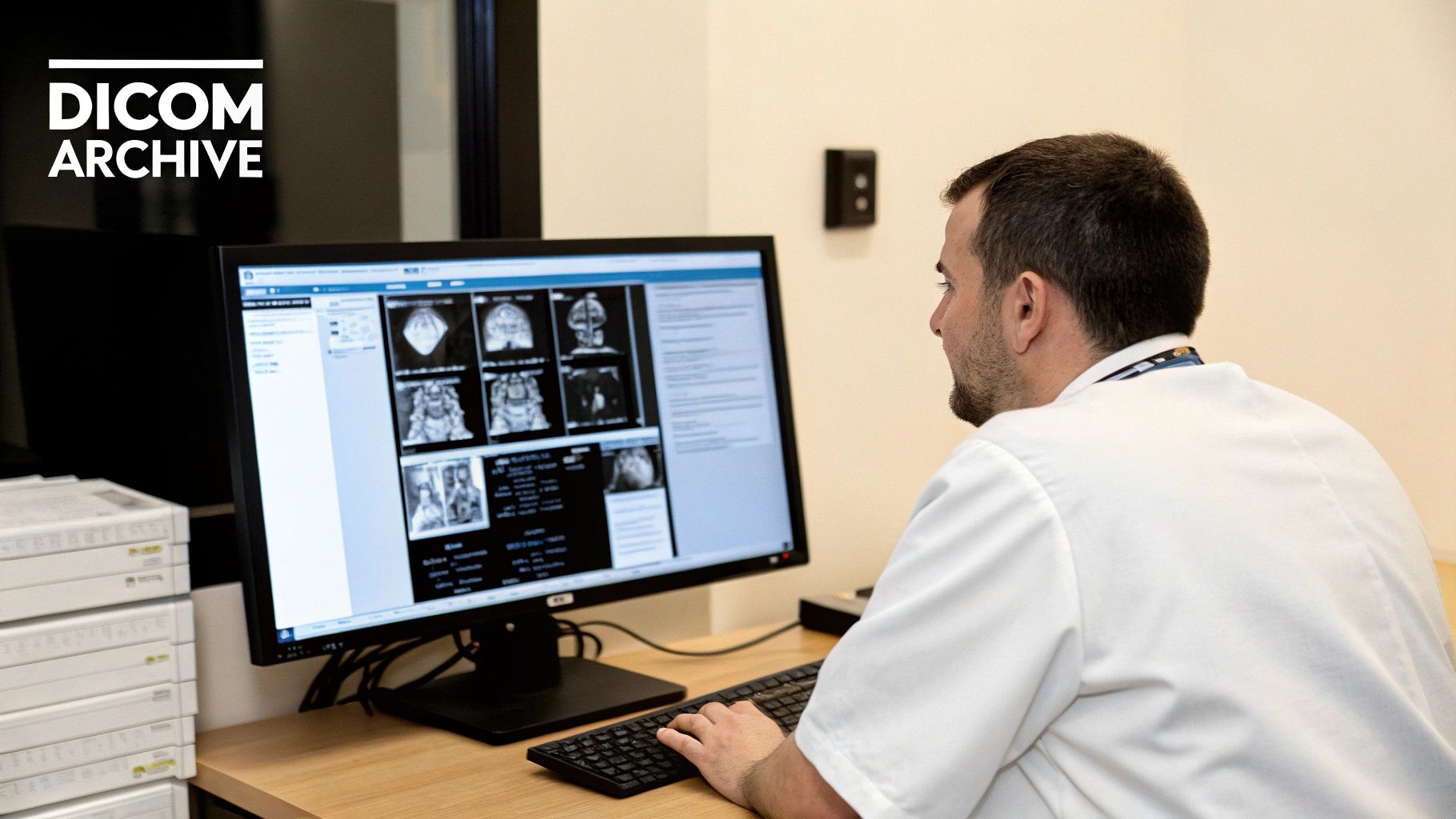
Medical images aren't just pixels on a screen. They are incredibly detailed stories—a patient's clinical journey told in the language of DICOM. Learning how to properly archive these complex files is one of the most critical tasks in modern healthcare. It’s not about just socking data away; it’s about creating a living, breathing history of patient care that’s ready when you need it.
Think about it: a standard file server sees a CT scan as just another file. It has no idea about the patient context, the imaging modality, or the vital diagnostic notes tucked away in the DICOM header. That’s why a true data archiving solution for healthcare has to be built for this world, ensuring every last bit of that story is preserved and can be recalled in an instant.
Breaking Free with a Vendor Neutral Archive
For years, one of the biggest headaches in medical imaging has been vendor lock-in. A PACS from one company often traps your images in a proprietary format, making it a nightmare to switch systems or even share data with a neighboring hospital. The answer to breaking these digital chains is a Vendor Neutral Archive (VNA).
A VNA is essentially a universal translator and storage vault for your imaging data. It’s a centralized, standards-based hub that doesn't care if an image came from a GE scanner, a Siemens PACS, or a Philips workstation. This approach puts you back in control of your data, giving you the freedom to choose the best tools for the job without worrying about compatibility. It's a strategic play for long-term flexibility.
By separating the storage of images from the systems that create and view them, a VNA essentially future-proofs your entire imaging operation. It means a patient's complete imaging history, collected over decades from different facilities, can finally live together in one accessible, unified record.
This doesn't just make the IT team's life easier; it gives clinicians the full picture they need to make the best possible decisions.
Keeping Every Pixel Perfect and Compliant
When it comes to a medical image, there is zero room for error. The slightest data loss could completely change a diagnosis. That’s why lossless compression is an absolute must-have for any serious medical image archiving strategy. It shrinks file sizes to make storage more manageable but does so without sacrificing a single pixel of diagnostic quality. The image you retrieve is identical to the one you saved.
Just as important are your retention policies. Healthcare is bound by a web of regulations, and different records need to be kept for specific lengths of time—sometimes for the patient's entire life. A modern archive automates this, applying rules to make sure you’re always in compliance with legal and institutional mandates without anyone having to think about it.
Turning Your Archive into an Active Resource
What good is an archive if you can't get to the data when it matters most? At PYCAD, we believe archived data should be just as accessible as current studies. That's why we at PYCAD, build custom web DICOM viewers and integrate them into medical imaging web platforms. This gives clinicians the power to pull up a patient's entire imaging history—from last week or last decade—right inside their existing workflow, on any device with a web browser.
This need for smart, accessible archiving is exploding globally. While North America has led the charge, the Asia-Pacific market is catching up fast, projected to grow at a CAGR of around 12.5%. This worldwide push is all about making healthcare data work smarter, not just sit idle.
By bringing together a VNA, intelligent retention rules, and powerful viewing tools, you transform your archive from a digital graveyard into a dynamic, searchable resource—one that supports today’s patient care and fuels tomorrow's breakthroughs. If you're starting this journey, our guide on moving your PACS to the cloud is a great place to explore what’s possible.
Building A Fortress Around Patient Data
In healthcare, data security isn't just a best practice—it's the very foundation of patient trust. When we talk about data archiving solutions, we’re not just talking about storing old files. We're talking about building an impenetrable digital vault to protect the most sensitive information imaginable. This vault has to stand strong against threats from the outside and mistakes on the inside, year after year.
Your archive is where patient histories are preserved for decades. The walls of that vault are constructed with layers of sophisticated security measures, each designed to guard against a different kind of risk. The real goal isn't just to check a box for HIPAA or GDPR compliance; it's to create a true sanctuary for patient privacy.
The stakes couldn't be higher. A data breach leads to more than just massive fines—it can shatter a hospital's reputation and erode the trust it has spent years building. That's why every compliant archive needs to be engineered with multiple layers of defense from the ground up.
The Essential Layers Of Protection
A truly secure data archiving solution doesn't rely on a single lock. Instead, it’s built on a strategy of defense-in-depth, where multiple layers work together to create a tough, resilient security posture. Let’s break down the absolute must-haves.
-
Robust Encryption: This is the bedrock. Data must be encrypted both at rest (while sitting on a server or disk) and in transit (as it moves across the network). This means that even if someone managed to steal the physical data, all they would have is a useless, scrambled jumble of characters.
-
Granular Access Controls: Not everyone in your organization should see every piece of patient data. Think of strong access controls as the digital gatekeepers, ensuring only specific, authorized personnel—like a particular oncologist or a clinical researcher—can view the information relevant to their job.
-
Comprehensive Audit Trails: This is your always-on surveillance system. A detailed audit trail logs every single interaction with archived data: who accessed it, what they looked at, and precisely when it happened. This creates an unchangeable record that is absolutely critical for accountability and for tracing any potential security incident back to its source.
A truly secure system provides end-to-end protection, from the moment data is created to the day it is retired. This holistic approach is essential for modern healthcare organizations. For a deeper dive, explore our guide on comprehensive healthcare data security solutions.
Beyond Digital Defenses
Your security strategy can't stop at the software level. It has to extend to the physical lifecycle of the hardware holding all this precious data. When it’s time to retire old servers or storage arrays that once housed patient information, you can't just toss them out. It is absolutely vital to work with certified and compliant secure medical equipment recycling services to guarantee the data is permanently destroyed and the hardware is disposed of responsibly.
At PYCAD, we know that security must be woven into every line of code we write and every system we design. We at PYCAD, build custom web DICOM viewers and integrate them into medical imaging web platforms with these principles at their very core. Our approach ensures that while we make historical data instantly accessible to clinicians, we do so within a rigorously controlled and secure environment.
Unlocking Efficiency With Smart Archiving
A modern archive isn't just a digital warehouse for old files; it's an active system that can save you a fortune and unlock incredible new opportunities. We need to move past the old idea of a static, one-size-fits-all storage pool. The best data archiving solutions today are dynamic, intelligent, and designed to optimize your costs and supercharge your data strategy, all without constant manual oversight.
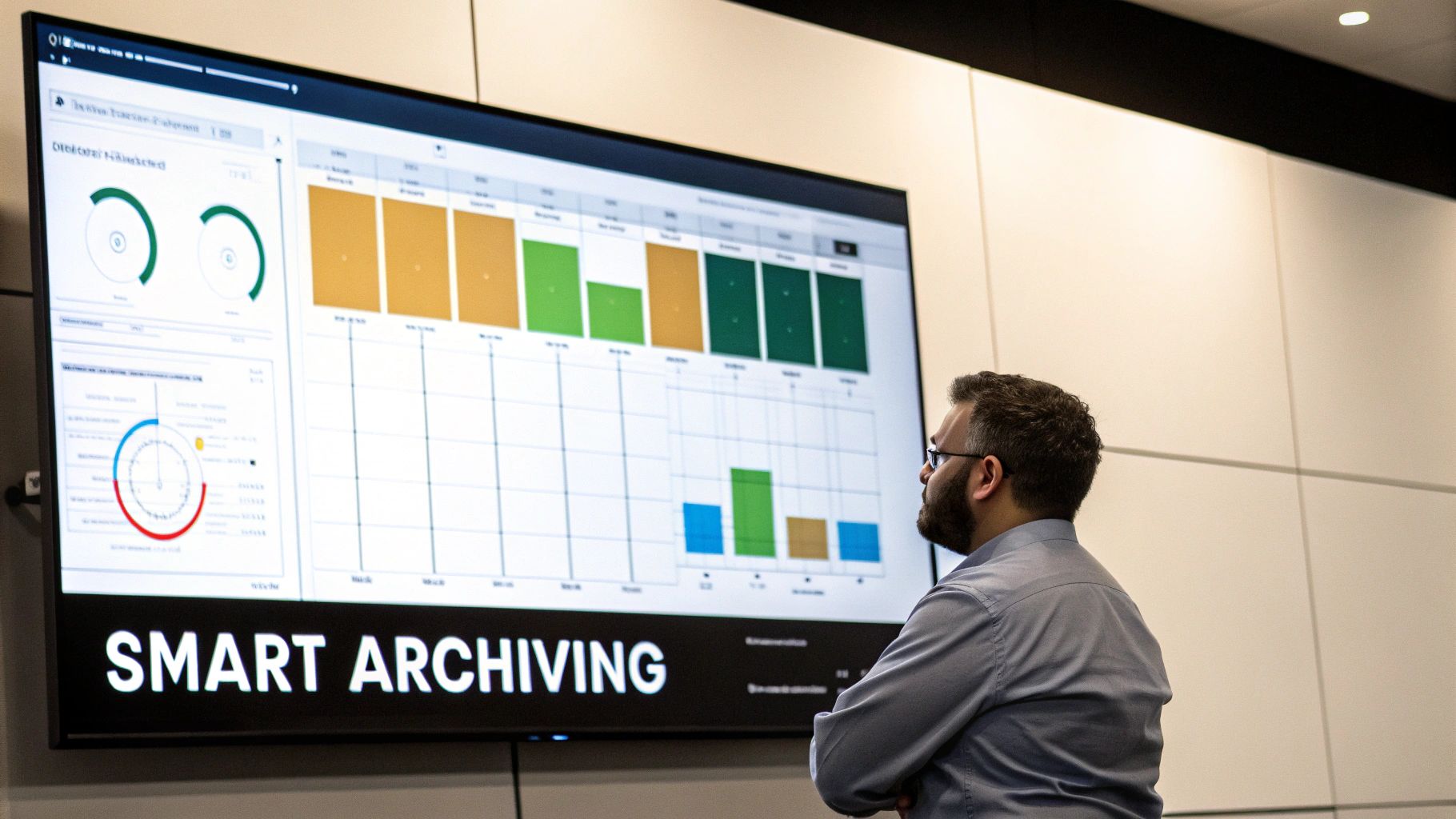
The first step in this evolution is to embrace intelligent storage tiering. Think of it like a hospital’s pharmacy. The most frequently needed medications are right up front for instant access—that’s your “hot” storage. Less common prescriptions are kept in a secure, organized back room—your “cold” storage.
An intelligent tiering system does exactly this for your data, but automatically. It identifies frequently accessed files, like a patient's recent MRI, and keeps them in high-speed, high-cost "hot" storage for immediate retrieval. As that data ages and is needed less often, the system seamlessly migrates it to low-cost, long-term "cold" storage. This simple, automated shift can slash storage costs by as much as 50% or more without ever slowing down clinical workflows.
The Game-Changing Power of AI in Archiving
While storage tiering is about saving money, Artificial Intelligence is about what your archive can actually do. AI is the engine that transforms your archive from a passive vault into an active, intelligent asset. It’s the difference between having a library and having a team of brilliant librarians who anticipate your every need before you even ask.
Imagine an AI-powered workflow that can instantly analyze incoming DICOM studies. It could classify them by modality, anatomy, or even a suspected pathology, then automatically apply the correct, complex retention policies without a human ever touching it. That alone eliminates a massive source of potential error and administrative headaches.
AI doesn't just manage data; it enriches it. By intelligently analyzing and indexing DICOM metadata, AI can make historical images instantly searchable for specific research cohorts, turning decades of stored data into a goldmine for clinical trials and academic studies.
This is the point where archiving stops being just an IT function and starts becoming a core driver of medical innovation.
Activating Your Archive for Advanced Insights
The true power of an AI-driven archive is its ability to become a launchpad for advanced analytics and predictive modeling. When your historical data is properly classified, indexed, and enriched, it becomes a clean, reliable dataset ready for machine learning. This is precisely where we at PYCAD shine.
We don’t just build software; we build intelligent ecosystems. We at PYCAD, build custom web DICOM viewers and integrate them into medical imaging web platforms, embedding AI-driven workflows directly into the user experience. This approach turns your archive into a dynamic foundation for:
- Predictive Analytics: Identifying patient populations at risk for certain conditions by spotting trends in historical imaging.
- Research Acceleration: Quickly assembling large, anonymized datasets to develop and validate new algorithms.
- Operational Efficiency: Analyzing access patterns to further fine-tune storage performance and costs.
This is the future of data management—a system where your archive doesn't just hold the past but actively informs the future of patient care. To see how we've put these principles into practice, we invite you to explore our work by visiting our portfolio page. By making your archive smarter, you empower your entire organization to be more innovative, efficient, and forward-thinking.
Finding the Right Partner to Build Your Data Future
Choosing a data archiving solution isn't just a technical purchase; it's a strategic alliance. You’ve journeyed through the architecture, security, and smart features that define a modern archive. Now, it's time to put that knowledge to work by finding a technology partner who not only gets your vision but can help you make it a clinical reality.
This isn’t about picking a product from a catalog. It’s about finding a collaborator who understands the unique rhythm of healthcare—the life-or-death need for speed, the uncompromising demands of compliance, and the incredible potential locked away in your data. The right partner helps you see past the marketing hype and make a choice that will support your organization for a decade or more.
Core Technical Competencies
The first place to look is under the hood. A sleek dashboard is worthless if the engine can't handle the intense, specific demands of medical data. Any potential partner needs to prove they have a deep, practical expertise in the healthcare tech stack.
Start with integration. How smoothly can their solution plug into your existing PACS, VNA, and EMR systems? A real partner offers more than a basic API; they give you a clear, well-documented roadmap for interoperability that avoids workflow chaos and keeps your data flowing freely.
Key Takeaway: A partner’s real worth lies not just in what they offer today, but in how well they can adapt and integrate with the tools you’ll need tomorrow. This kind of forward-thinking is what separates a true technology leader from the rest of the pack.
Next, you need to grill them on performance. Ask for hard numbers and real-world case studies on retrieval speeds for massive DICOM studies pulled from cold storage. In a clinic, every second counts. Your archiving partner has to prove their system can perform when the pressure is on.
A Checklist for Evaluating Potential Partners
To bring some structure to your search, use this checklist to compare vendors head-to-head. It’s a simple tool to make sure you cover all your bases and ground your decision in facts, not just promises.
-
Security and Compliance Chops: Do they have the right credentials, like HITRUST or SOC 2 Type II certifications? Can they show you exactly how they adhere to HIPAA and GDPR? Don't be afraid to ask for audit reports.
-
Deep DICOM and VNA Expertise: Have they been in the trenches with complex medical imaging data before? Ask them about their experience migrating huge archives from legacy systems to a modern VNA.
-
Scalable and Flexible Architecture: Can they show you a clear plan for how the solution will grow as your data volumes explode? Their architecture needs to be nimble enough to handle on-prem, cloud, or hybrid setups without forcing a complete rebuild down the line.
-
Honest Costs and Ironclad SLAs: Is the pricing model straightforward and predictable? Watch out for hidden data retrieval fees (egress costs). Make sure the Service Level Agreement (SLA) guarantees uptime and support response times that match the urgency of clinical care.
Beyond the Tech: A Partner in Your Vision
When all is said and done, the best partner is one who is just as committed to innovation and patient care as you are. They need to be more than just a vendor—they should be a strategic guide, someone who brings fresh ideas to the table and helps you see around the next corner.
At PYCAD, this is the standard we hold ourselves to every single day. We don’t just write code; we architect solutions that solve real-world clinical headaches. We at PYCAD, build custom web DICOM viewers and integrate them into medical imaging web platforms, transforming a powerful archiving strategy into a simple, effective tool for your clinicians and researchers.
Our work is a direct reflection of our belief that the right technology, built with the right partner, can genuinely change healthcare for the better. We invite you to see the care and expertise we pour into our projects. Take a look at our completed work and see how we turn daunting challenges into elegant, intuitive solutions by visiting our portfolio page. Your journey to a smarter data future begins with the right guide.
Your Questions, Answered
Let's tackle some of the most common questions that come up when healthcare organizations start thinking seriously about their data archiving strategy. Getting these fundamentals right is the key to building a system that serves you well for years to come.
We’ll clear up the confusion and give you the confidence to move forward.
What’s the Real Difference Between a Backup and an Archive?
It's a common point of confusion, but the distinction is crucial. Think of a backup as your emergency kit—it’s a copy of your current, active data, designed to get you back up and running quickly after a system failure or data loss event. Its job is to restore operations, fast.
An archive, on the other hand, is like a secure, long-term library for your inactive data. Its purpose isn't immediate recovery but long-term preservation for legal, compliance, and historical reference.
- Backups are all about rapid, short-term recovery.
- Archives are built for organized, long-term retention and retrieval.
- The Bottom Line: You need backups for business continuity, but you need archives to meet decades-long data retention rules and support research.
An effective strategy doesn’t choose one over the other; it intelligently integrates both, balancing cost, access speed, and compliance.
How Can an Archiving Solution Guarantee HIPAA Compliance?
Modern archiving solutions don't just store data; they actively enforce compliance. They act as a digital guardian for your Protected Health Information (PHI) by building security in from the ground up.
This is achieved through a multi-layered approach: end-to-end encryption scrambles the data, making it unreadable both when it's stored (at rest) and when it's being moved (in transit). Strict, role-based access controls mean only authorized personnel can ever view specific records. Finally, detailed audit logs create an unchangeable record of every single interaction, giving you a complete, traceable history for any compliance audit.
Key Insight: A well-designed archive transforms compliance from a headache of manual checklists into an automated, always-on process.
Is It Possible to Migrate Data from an Old PACS to a New Archive?
Absolutely, but it’s a mission-critical project that demands precision. Moving decades of patient imaging data from a legacy PACS to a modern Vendor Neutral Archive (VNA) is far more than a simple copy-and-paste job.
The process requires meticulous planning to ensure every DICOM file, every piece of metadata, and every study is transferred perfectly without corruption or loss. This is where specialized expertise becomes invaluable. A partner like PYCAD can navigate the complexities to ensure the integrity of your historical medical data remains completely intact.
At PYCAD, we don’t just move the data; we make it accessible. We at PYCAD, build custom web DICOM viewers and integrate them into medical imaging web platforms, empowering your clinicians to access migrated data just as easily as new studies. You can see examples of our work in our portfolio.
Ready to bring your data archiving strategy into the modern era? Visit PYCAD at https://pycad.co to start the conversation.