Think of a DICOM PACS system as the digital heart of a modern hospital's imaging department. It’s far more than just a high-tech filing cabinet; it's the entire ecosystem that breathes life into medical images like CT scans and MRIs. This system securely stores, organizes, and distributes this vital visual information, putting it at the fingertips of clinicians when it matters most.
This technology is the very backbone of modern medical imaging, enabling faster, more confident diagnoses and better patient outcomes.
The Command Center for Medical Imaging
At the core of modern diagnostics, you'll find the DICOM PACS system. It's the central command center for a facility's entire imaging operation, the place where everything comes together. This isn't just about storage; it's the dynamic environment that receives, manages, and moves critical visual data across the entire healthcare network.
For any medtech leader or hospital IT professional, a deep understanding of DICOM PACS isn't just beneficial—it's essential. This technology isn't a static piece of infrastructure. It's the foundation upon which future innovations in patient care will be built.
Fueling a New Era of Growth
The incredible value of this technology is clear when you look at the market. As healthcare goes digital across the globe, the global PACS market is expanding at an impressive pace. The market hit USD 5.59 billion in 2025 and is on track to reach USD 9.73 billion by 2035, climbing at a solid 5.7% compound annual growth rate.
What’s driving this? A surge in imaging procedures, a massive push toward digitization, and the undeniable need for seamless patient care. You can dive deeper into these trends in the latest market analysis. This growth highlights a major shift in healthcare: a world where instant data access and operational efficiency are king. A well-designed DICOM PACS system delivers on both fronts.
A DICOM PACS system transforms isolated images into a connected, accessible web of clinical knowledge, empowering every decision-maker in the patient care journey.
More Than Storage: A Gateway to Innovation
Here’s where things get really interesting. The true power of a modern PACS isn't just in what it holds, but in what it connects to. When you start integrating advanced tools, this foundational system evolves into something far more interactive and powerful. The magic happens when you link that deep well of archived data with front-end applications that clinicians can access from anywhere.
This is where specialized tools change the game entirely. For example, at PYCAD, we build custom web DICOM viewers and integrate them into medical imaging web platforms. This creates a seamless bridge between the stored data and the clinician, turning a passive archive into an active, dynamic diagnostic powerhouse.
By enabling secure, browser-based access, these viewers open up a world of possibilities for remote consultations, teleradiology, and real-time collaboration. See for yourself how these integrations come to life in our portfolio of projects.
Peeling Back the Layers of a DICOM PACS System Architecture
To get the most out of any medical imaging setup, you first have to understand what makes a DICOM PACS system tick. It’s not just one piece of software; think of it more like a digital ecosystem. This system is the central nervous system for all things imaging, making sure patient scans are captured, archived, and moved to the right people with total accuracy.
At its core, this architecture is all about the seamless flow of information. Each part has a specific job, but they all have to work together perfectly to support the life-and-death decisions made every day in diagnostics. Getting a handle on how these pieces connect is the key to building an imaging infrastructure that’s not just powerful, but also rock-solid reliable.
The diagram below breaks down the system’s main jobs into three simple actions: receiving, organizing, and sending data.
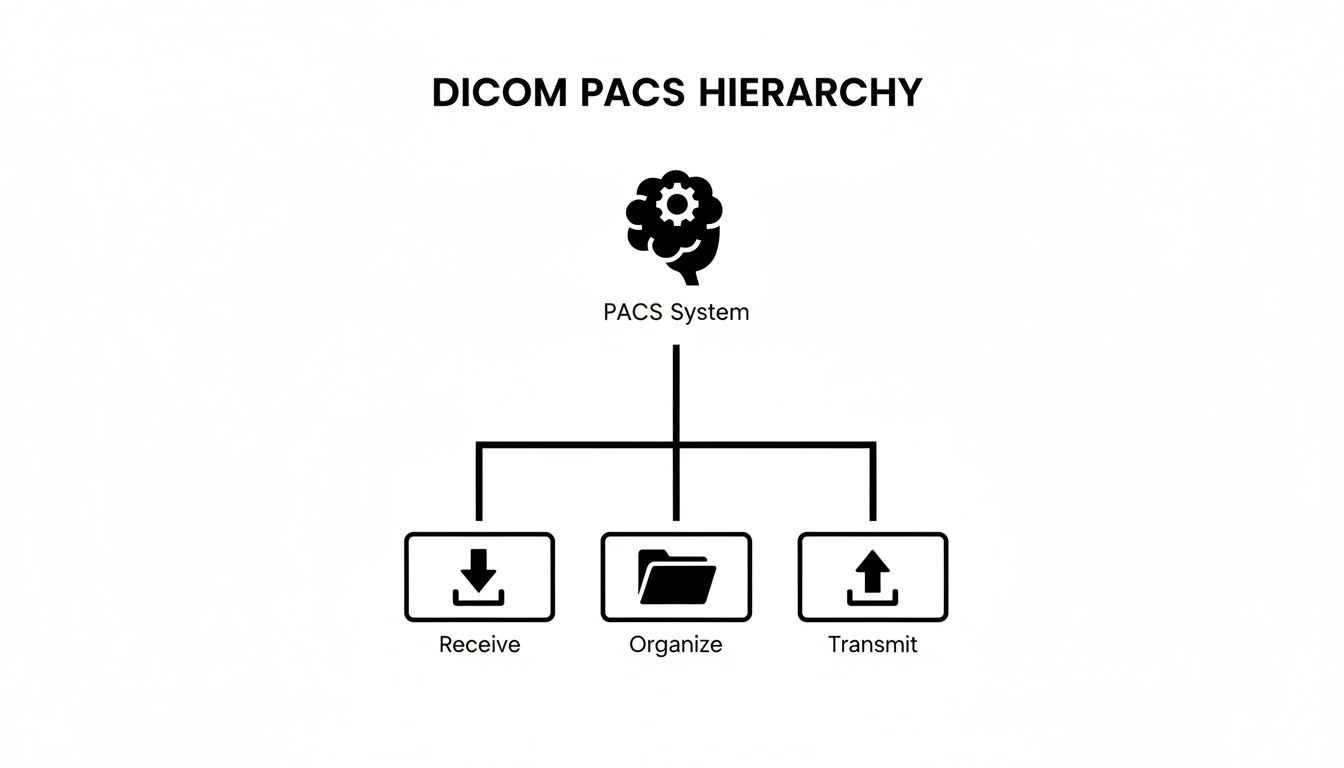
This really shows you that a PACS manages the entire life of a medical image, from the moment it's created on a scanner to the instant a doctor uses it to make a diagnosis.
The Core Components and Their Roles
A DICOM PACS system is built from a few key components, and each one plays a specialized role. To make it easier to grasp, let’s imagine we’re building a high-tech digital library specifically for medical images.
Here’s a quick breakdown of how each part of a PACS fits into that analogy.
| Component | Analogy | Primary Function |
|---|---|---|
| Imaging Modalities | The 'Authors' | These are the devices (CT, MRI, X-ray) that create the original content—the raw imaging data. |
| PACS Server | The 'Central Library' | This is the secure, long-term archive where every image is meticulously cataloged, stored, and protected. |
| Radiologist Workstations | The 'Private Reading Rooms' | High-performance computers with special software where radiologists can view, analyze, and interpret the images. |
| RIS/HIS Integration | The 'Master Librarians' | These systems (Radiology/Hospital Information Systems) manage patient data, appointments, and billing, adding vital context to the images. |
This interconnected setup ensures that a patient's entire imaging history is perfectly linked to their overall medical record, giving clinicians the full story.
The Universal Language of Medical Imaging
So, how do all these different pieces of hardware and software, often from different companies, talk to each other? They use a shared language: DICOM (Digital Imaging and Communications in Medicine). This is the universal standard that allows them to exchange information without anything getting lost in translation.
If you want to dive deeper into the technical nuts and bolts, our guide on DICOM standards is a great place to start.
DICOM is what ensures an image file is more than just pixels. It wraps the image in a rich layer of metadata—patient info, study details, and machine settings. Without it, interoperability would be a nightmare, and hospitals would be stuck with a single vendor for everything.
At the end of the day, a DICOM PACS system’s architecture is designed for one thing: to get the right image to the right clinician at the right time, every single time. This is what empowers life-saving decisions.
Choosing Your Deployment: On-Premise, Cloud, or Hybrid
Deciding where your DICOM PACS system will live is one of the most critical choices you'll make. Think of it as choosing a home for your organization's most vital medical imaging data—a decision that will shape your budget, security, and ability to grow for years to come.
The path you take—on-premise, cloud, or a mix of both—will define how clinicians access patient scans, how your IT team manages the underlying infrastructure, and how nimble you are in adopting the next wave of medical technology. Each model comes with its own set of trade-offs, and the right fit is all about aligning with your long-term strategic goals.
The On-Premise Fortress
The traditional approach is an on-premise deployment, which is a lot like building your own private, high-security fortress. You own, operate, and maintain all the hardware and software right inside your own data center. This gives you unparalleled control over every nut and bolt of the system, from security protocols to maintenance schedules.
This model has long been the go-to for large institutions with established IT teams and strict rules about data sovereignty.
- Complete Control: Your team calls all the shots, ensuring every policy is enforced to your exact specifications.
- Airtight Security: With data never leaving your physical premises, you drastically minimize exposure to external threats.
- Peak Performance: Local network access usually means faster image retrieval for users working on-site.
But this level of control comes with a hefty price tag. The upfront capital investment in servers, storage, and networking gear can be massive. On top of that, you're on the hook for all ongoing maintenance, upgrades, and making sure the system can handle ever-growing data volumes.
The Scalable Cloud Solution
In sharp contrast, a cloud-based DICOM PACS is like leasing a secure, fully-managed apartment in a state-of-the-art building. You hand off the headaches of infrastructure, security, and maintenance to a trusted cloud provider, freeing up your team to focus on clinical workflows instead of managing hardware.
The shift to the cloud in medical imaging has been nothing short of explosive. Globally, cloud-based PACS adoption surged by 64% between 2022 and 2025, and today, over 70% of new systems are deployed as Software-as-a-Service (SaaS) models. This trend, pushed into overdrive by the need for remote diagnostics during the pandemic, has made imaging more scalable and accessible than ever before.
This model transforms a large capital expense into a predictable operational one, typically based on usage. The key benefits are incredible flexibility and near-universal accessibility.
A cloud deployment liberates medical imaging from the confines of the hospital walls, empowering collaboration and diagnostics from anywhere in the world.
For healthcare organizations looking to innovate, this is a game-changer. Our guide on the Google Cloud Healthcare API dives into how these platforms provide powerful tools for managing and analyzing medical data at an incredible scale. At PYCAD, we specialize in building custom web DICOM viewers and integrating them into these cloud platforms, turning siloed data into a universally accessible and actionable asset. Our portfolio page shows how these solutions come to life.
The Hybrid: Best of Both Worlds
So, what if you want the security of a fortress but the flexibility of a modern high-rise? That’s where the hybrid model comes in. It’s a balanced strategy that blends the strengths of on-premise and cloud, allowing you to keep sensitive or frequently accessed data on-site while using the cloud for things like long-term archiving, disaster recovery, and remote access.
This approach is perfect for organizations that need the ironclad security of an on-premise system but also crave the agility and cost-efficiency of the cloud. Thinking about this requires a solid grasp of scalable application deployment strategies, as you're essentially managing two interconnected environments.
A common hybrid setup often looks something like this:
- On-Premise "Hot" Storage: Active, recent studies are kept locally for blazing-fast retrieval by radiologists inside the hospital.
- Cloud-Based Archive: Older, less-used images are automatically moved to a secure, cost-effective cloud VNA (Vendor Neutral Archive).
- Unified Web Viewer Access: A web DICOM viewer seamlessly connects to both locations, giving users a single, unified experience without them ever knowing where the data lives.
This model provides an elegant solution for balancing performance, security, and cost. It’s a forward-thinking choice that prepares your organization for the future without demanding a complete rip-and-replace of your existing infrastructure.
The Power of Integration: Web Viewers, AI, and Beyond
A standalone DICOM PACS system is powerful, but its true potential is only unlocked when it starts talking to other technologies. A modern PACS is no longer a silent, isolated archive; it's an intelligent, interconnected hub at the very center of clinical decision-making. The real magic happens when you connect it to other systems, extending its reach far beyond simple storage.
This is the shift that defines the future of medical imaging—from a passive library of images to an active partner in diagnostics. By linking your PACS to other critical systems, you build a complete, data-rich view of the patient, automate routine work, and give clinicians tools that once felt like science fiction.
Unlocking Universal Access with Web DICOM Viewers
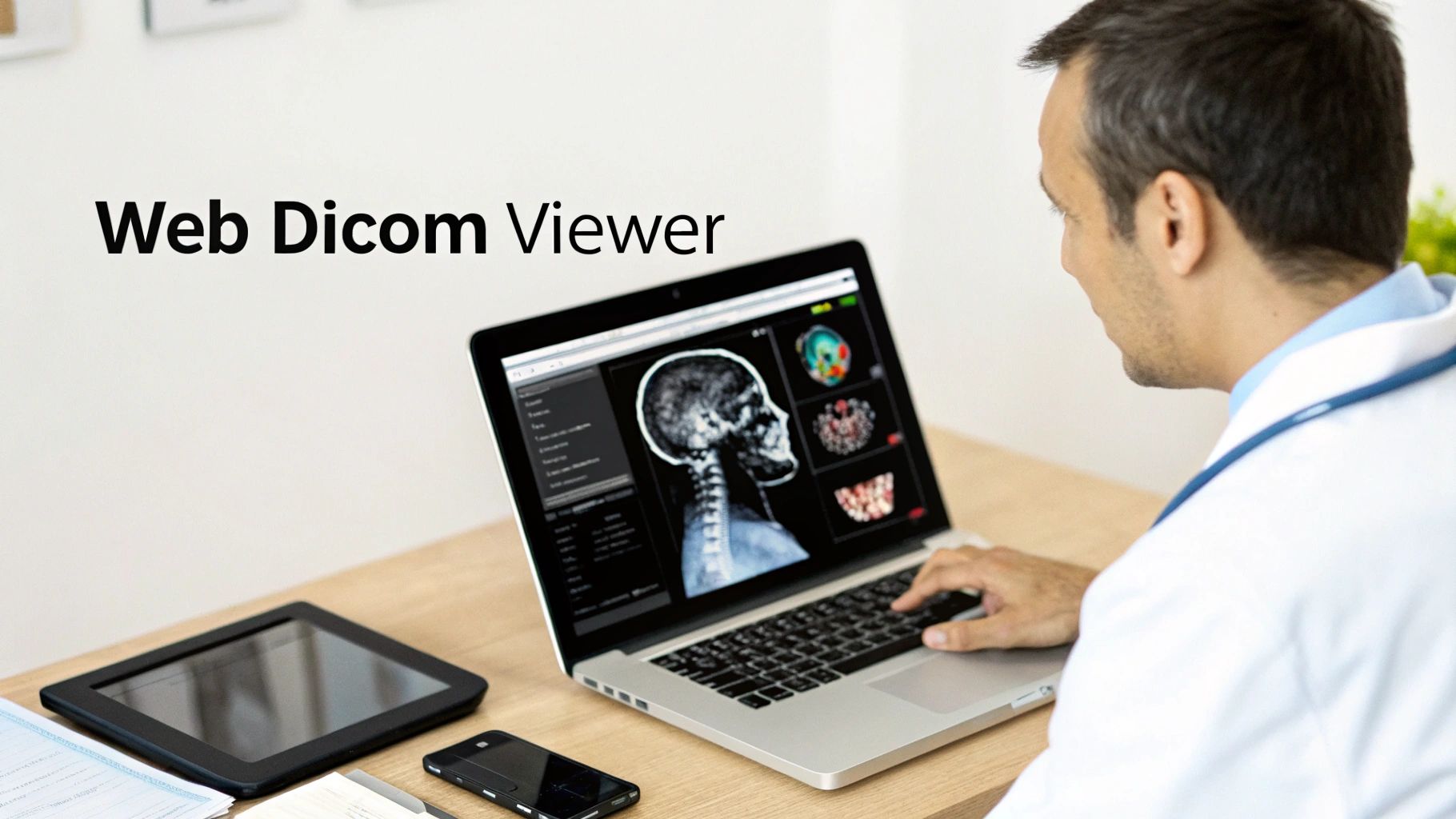
Perhaps the single most impactful integration today is the web DICOM viewer. This technology shatters the old limitations of needing dedicated, on-site workstations. Instead, it provides secure, browser-based access to medical images from any device, anywhere in the world. Imagine a radiologist providing a critical consultation from home or a specialist across the country reviewing a complex case in real time.
This is exactly what we specialize in at PYCAD. We build custom web DICOM viewers and integrate them into medical imaging web platforms. Our goal is to supercharge diagnostic workflows, enable seamless teleradiology, and create a fluid, intuitive experience for clinicians. It’s how you transform a PACS from a locked box into an open, accessible resource for collaborative care.
The benefits are immediate and substantial:
- Better Collaboration: Specialists can view and discuss images at the same time, without having to be in the same room.
- Faster Turnaround: Teleradiology workflows become incredibly efficient, cutting down the time from scan to report.
- Reduced IT Overhead: No more installing and maintaining special software on every single computer in the facility.
- Improved Accessibility: Physicians get instant access to imaging data during patient consultations or while on the move.
The Rise of AI in Medical Imaging
The next great frontier is integrating Artificial Intelligence (AI). When you connect powerful AI algorithms to a DICOM PACS system, the archive comes alive, turning into a proactive analytical engine. AI can sift through thousands of images, flagging potential abnormalities, automating measurements, and prioritizing the most urgent cases for human review.
Think of it as giving every radiologist a brilliant, tireless assistant.
By integrating AI, a DICOM PACS system evolves from a system of record into a system of intelligence, actively contributing to the diagnostic process and improving clinical accuracy.
This kind of integration is already delivering incredible results. For instance, AI can help spot subtle signs of disease that the human eye might miss, especially in high-volume environments where fatigue is a real factor. It also excels at handling tedious tasks like segmenting organs or measuring tumors, which frees up clinicians to focus on complex diagnostic thinking. If you want to dive into the technical side, our guide on PACS integration strategies offers a much deeper look.
Creating a Complete Patient Picture
Finally, connecting the DICOM PACS with other core healthcare platforms—like the Electronic Health Record (EHR) and Radiology Information System (RIS)—is absolutely essential. This is how you create a holistic, 360-degree view of the patient. When a clinician opens a patient’s chart in the EHR, they should be able to instantly pull up the associated medical images without logging into a separate system.
This seamless connection provides critical context. A radiologist reading a scan can see the patient's full medical history, lab results, and clinical notes, leading to a more informed and accurate interpretation. This kind of interoperability ensures that an image isn't just an isolated picture, but a vital piece of a much larger clinical puzzle.
Navigating Security, Compliance, and Scalability
When you're building a DICOM PACS system, you're doing more than just plugging in new technology. You’re making a serious commitment to security, compliance, and performance. Think of security less as a feature and more as the bedrock of the entire system. Protecting patient data isn't just a good idea; it's about building an impenetrable digital vault for the most sensitive information imaginable.
That vault has to meet some incredibly strict rules. Maintaining the confidentiality and integrity of patient data is the top priority, which means you have to live and breathe regulations like HIPAA. Getting the hang of HIPAA compliant software development isn't just a box to check—it’s a fundamental responsibility. This means ironclad encryption for data whether it's moving or sitting still, granular access controls, and detailed audit trails that log every single touchpoint.
Engineering for Future Growth
Beyond security, your system has to be ready to grow. Picture your network as a major highway. It needs to be built to handle rush hour traffic—those sudden, massive surges in imaging data—without causing a complete standstill. A system that grinds to a halt during peak hours isn't just an inconvenience; it can directly impact patient care by delaying diagnoses when every second counts.
The key is to plan for growth before you need it. That means taking a hard look at your performance metrics and making sure your infrastructure can handle not just today's workload, but whatever comes next.
Here are a few things to keep on your radar:
- Network Bandwidth: Can your network actually move massive DICOM files without sputtering?
- Storage IOPS: Is your storage fast enough to read and write large images without a frustrating lag?
- Server Processing Power: Do you have enough CPU and RAM to handle all your users and their complex queries at the same time?
Answering these questions honestly is the first step toward building a DICOM PACS system that’s not just powerful today, but ready for the future.
A Thriving Market Fueled by Innovation
This constant drive for better, more secure systems is playing out in the market. North America, with its solid infrastructure, is currently leading the charge in PACS innovation. In 2024, the region claimed 38.7% of the specialty PACS market, and the US market alone was valued at a whopping USD 1.2 billion. That’s a steady climb from USD 1.09 billion in 2021 and USD 1.15 billion in 2023.
Looking ahead, the global specialty PACS market is projected to expand from USD 3.4 billion in 2024 to USD 5.7 billion by 2034. A huge part of that growth is coming from AI integration, which is helping automate analysis and make clinical workflows smoother than ever. For a deeper dive, you can explore the numbers in this detailed PACS market report.
Building a scalable and secure DICOM PACS system isn’t just about dodging problems. It’s about creating an environment of trust where clinicians can work confidently and patients know their data is safe.
At PYCAD, we get this delicate balance. We build custom web DICOM viewers and integrate them into medical imaging web platforms, with security and scalability baked in from day one. Our solutions are designed to grow right alongside your organization, ensuring top-tier performance and compliance are never an afterthought. You can check out some of our work in our portfolio. This forward-thinking approach ensures your imaging infrastructure remains a powerful asset, not a liability, for years to come.
Your Strategic Implementation Checklist
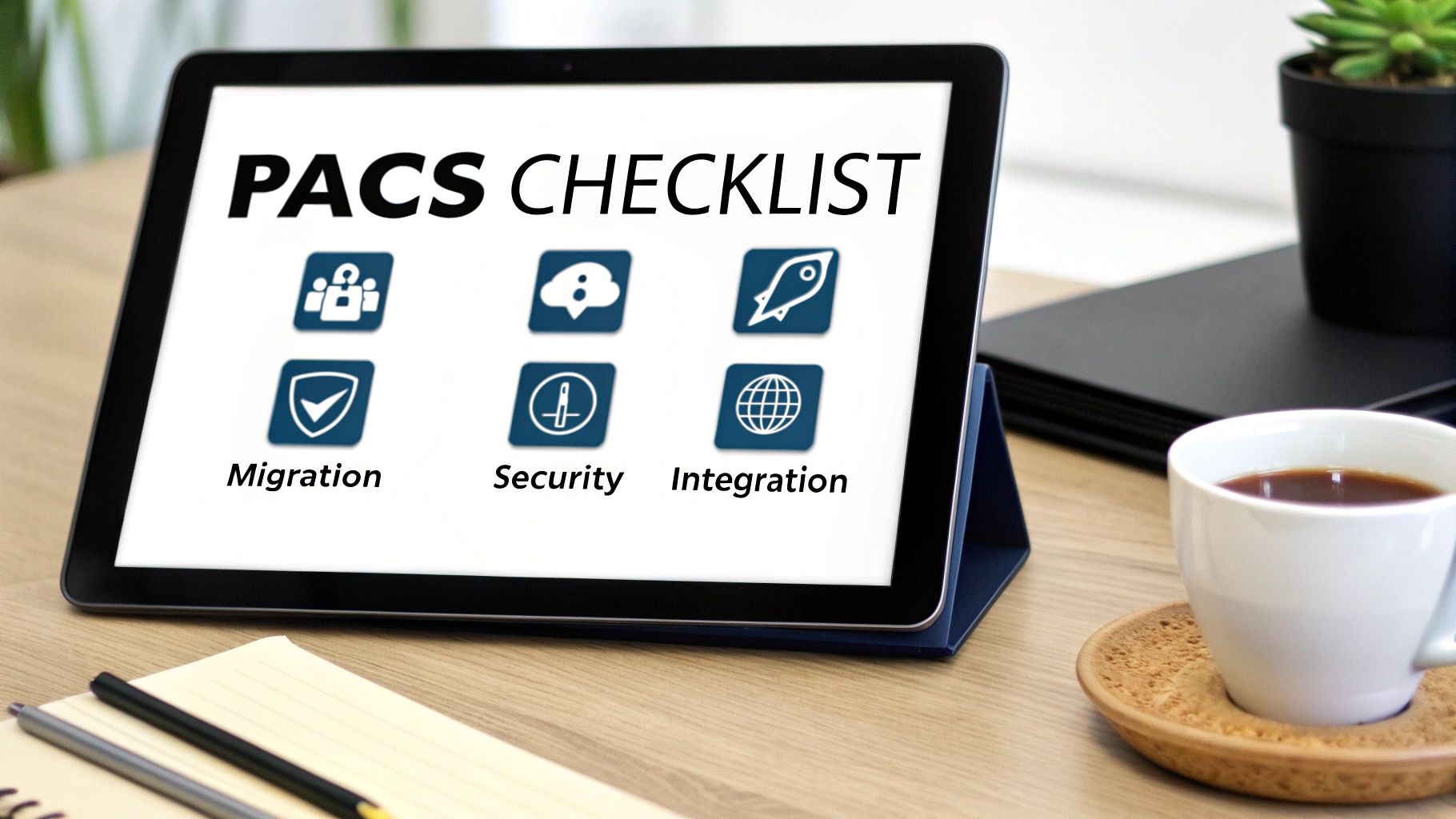
Bringing a new DICOM PACS system online is more than just an IT project; it’s a foundational shift in how you deliver patient care. Getting it right demands a solid game plan, buy-in from everyone involved, and a crystal-clear vision for the future. This checklist is your guide, a step-by-step path from a great idea to a powerful, living imaging ecosystem.
Step 1: Lay the Groundwork with Core Requirements
Before you even think about vendors, you need to look inward. The most successful PACS projects start with a brutally honest assessment of your organization’s real-world needs. This is the bedrock of your entire project, ensuring the final system fits your clinical and technical workflows like a glove.
- Map Out Clinical Needs: Get in the trenches with your team. Talk to radiologists, technologists, and referring physicians to understand their day-to-day reality. What are the bottlenecks in your current system? What features would genuinely make their jobs easier and improve diagnostic accuracy?
- Define Your Technical Specs: This is where you bring in the IT experts. Document everything: your current infrastructure, how much data you're handling now, and what you expect in the next five years. Most importantly, identify every single integration point, from your RIS and HIS to the EMR.
- Create an Interoperability Blueprint: Be explicit about how the new PACS needs to talk to your existing software. Specify exactly what you need for HL7 and FHIR to ensure patient data, orders, and reports flow seamlessly across the entire organization.
Step 2: Plan for a Flawless Transition
With your requirements set in stone, it’s time to focus on the "how." A meticulously planned migration and rollout are what separate a smooth launch from a clinical nightmare. Your goal is zero disruption.
A PACS implementation isn't just a technical upgrade; it's a strategic evolution of your clinical capabilities. Treat it with the foresight and detailed planning it deserves to unlock its full potential for patient care.
Here at PYCAD, we know that world-class systems demand specialized skills. We’re experts who build custom web DICOM viewers and integrate them into medical imaging web platforms. By partnering with a specialist for these critical elements, you get an intuitive, fluid experience for clinicians—one that’s ready for whatever comes next. You can visit our portfolio page to see examples.
Step 3: Choose Your Partner and Lock in the Plan
The final piece of the puzzle is finding the right partner to bring your vision to life. You're not just buying software; you're choosing a team that needs to understand your goals and have the experience to see a complex project through to the finish line.
- Vet Your Vendors: Create a shortlist of vendors who tick all your boxes. Insist on live demos that are tailored to your workflows, not some generic sales pitch.
- Nail Down the Data Migration: This is a big one. You need a detailed plan for moving your historical imaging data. Is it an all-at-once migration, or does a phased approach make more sense? Don’t leave this to chance.
- Plan for People: A new system is only as good as the people using it. Develop a robust training program for every user group and make sure your partner provides dedicated, on-site support when you flip the switch and go live.
This journey is a chance to build an imaging infrastructure that’s more connected, efficient, and intelligent than ever before. To see what’s possible, take a look at some of the successful projects in our portfolio.
Frequently Asked Questions
Diving into the world of DICOM PACS systems can feel like learning a new language, especially when you're planning a new setup or upgrading an old one. Let's clear up some of the most common questions with straightforward answers to help you navigate the process.
What Is the Main Difference Between DICOM and PACS?
It's helpful to think of it like this: DICOM is the universal language of medical images, and PACS is the library where they all live.
DICOM (Digital Imaging and Communications in Medicine) is the global standard that ensures an MRI scan from a GE machine can be perfectly read on a Siemens workstation. It's the file format itself—the what.
PACS (Picture Archiving and Communication System) is the entire infrastructure—the software and hardware—that uses that DICOM language to store, retrieve, and share those images. It's the system that manages the entire workflow—the how.
Why Is a Web DICOM Viewer So Important for Modern Systems?
A web DICOM viewer completely redefines accessibility and collaboration in healthcare. In the past, viewing medical images meant being chained to a specialized, high-powered workstation inside the hospital.
Web-based viewers break down those physical barriers. They empower authorized clinicians, specialists, and radiologists to securely review critical images from virtually any device with a web browser. This isn't just a convenience; it's a critical tool for enabling teleradiology, speeding up remote consultations, and making faster, more informed clinical decisions.
At PYCAD, this is our specialty. We build custom web DICOM viewers and integrate them into medical imaging web platforms, creating a truly flexible and connected ecosystem. You can see what this looks like in practice by exploring our project portfolio.
How Do I Ensure My PACS Integrates With Existing Hospital Systems?
True integration isn't just a feature; it's the foundation of a functional system. It all comes down to industry standards like HL7 and FHIR.
Before you even start talking to vendors, take stock of your existing systems—your RIS, HIS, and EMR. Your new DICOM PACS system absolutely must speak their language.
Seek out vendors who can prove their systems play well with others. They should offer robust support for HL7 (for exchanging patient data and reports) and FHIR (for modern, API-based connections). A Vendor Neutral Archive (VNA) can also be a game-changer, acting as a universal translator between systems and freeing you from vendor lock-in. Don't just take their word for it—insist on a live demo showing seamless integration with systems like yours.
At PYCAD, we know that a powerful DICOM PACS system is the beating heart of modern diagnostics. We build the secure, high-performance web platforms and custom DICOM viewers that bring your imaging data to life. Discover how we can elevate your medical imaging capabilities by visiting our portfolio at https://pycad.co/portfolio.