Imagine a healthcare experience where you feel truly known. Where every doctor, specialist, and nurse understands your history, anticipates your needs, and communicates with you as a whole person, not just a chart number. This isn't science fiction; it's the reality taking shape thanks to healthcare CRM solutions. These platforms are more than just software—they represent a profound shift in how medicine is practiced, placing the patient right at the center of it all.
The New Heartbeat Of Modern Medicine

Not long ago, a patient's journey was often a puzzle with missing pieces. A visit to a specialist here, a lab test there—each interaction was a separate event, stored in its own silo. This fragmentation led to communication gaps, forcing patients to repeat their medical stories over and over while navigating a confusing maze of appointments and follow-ups.
Healthcare CRM (Customer Relationship Management) solutions are here to fix that. Think of a CRM as the central nervous system for a hospital or clinic, connecting every single touchpoint into one unified, continuous patient story. It’s the technology that turns raw data into understanding and complex logistics into lasting patient trust.
A Philosophy Of Connection
At its heart, a healthcare CRM is about building and strengthening relationships. It gives providers the tools they need to move beyond just treating symptoms and start offering proactive, continuous care. This is the new pulse of modern medicine, and it’s powered by connection. To really get a handle on how these systems change the game, it's worth understanding the core ideas behind customer relationship management explained.
This move toward connected care isn't just a fleeting trend; it’s a full-blown industry movement, and the numbers back it up.
The global healthcare CRM market was valued at USD 17.87 billion in 2023 and is on track to hit USD 43.40 billion by 2034. This massive growth signals a deep industry commitment to putting patients first.
This incredible expansion shows just how much demand there is for more integrated and responsive healthcare. In specialized fields like medical imaging, this level of integration isn't just nice to have—it's essential. At PYCAD, we tackle this head-on by building custom web DICOM viewers and integrate them into medical imaging web platforms.
This creates a seamless environment where diagnostic images and patient data live side-by-side, giving clinicians the complete picture they need to make informed decisions. By uniting systems that were once separate—from scheduling and billing to advanced diagnostics—a healthcare CRM ensures every provider has the context to deliver exceptional care. It’s what makes every patient feel seen, heard, and supported from start to finish.
The Core Features That Make It All Work
To really get a feel for what a modern healthcare CRM can do, you have to look past the buzzwords and see what’s actually powering it. These platforms aren’t just glorified address books; they’re smart, interconnected systems built to weave together every thread of the patient journey. They turn a mountain of scattered data into a clear, actionable story of care.
At the very center of it all is the 360-degree patient view. Picture this: a single, clean dashboard where you can see every single touchpoint a patient has had with your organization. Every appointment, every call to the front desk, every prescription, every specialist referral—it's all right there. This isn't just about hoarding data; it's about seeing the full context.
When a care provider can see the complete picture in an instant, the quality of care skyrockets. It becomes more personal, more proactive, and ultimately, more effective. This comprehensive view is what keeps patients from getting lost in the system and ensures every decision is made with their full history in mind.
Giving Your Team Time Back with Smart Automation
One of the first things you'll notice after implementing a healthcare CRM is how it takes the repetitive, administrative grind off your team's plate. It's like giving everyone a hyper-efficient assistant who handles the tedious tasks, freeing up your skilled professionals to focus on the human side of medicine.
These automated workflows can handle an incredible range of tasks that are vital but time-consuming:
- Appointment Reminders: Automatically sending a text or email can slash no-show rates, which can climb as high as 23% in some outpatient clinics.
- Preventative Care Nudges: You can create campaigns that gently remind specific patient groups about flu shots, annual physicals, or important screenings based on their health profile.
- Post-Discharge Check-ins: The system can trigger automated follow-ups after a hospital stay, making sure patients are recovering well and have a chance to ask questions.
- Targeted Health Education: Send articles, videos, or prep instructions that are directly relevant to a patient’s upcoming procedure or recent diagnosis.
By automating this work, you empower your team to do what they do best: build relationships, show compassion, and provide exceptional care.
Connecting Seamlessly with Your Existing Tech
A CRM can't be an island. It only reaches its full potential when it’s deeply connected to the tools your team already uses every day, especially your Electronic Medical Record (EMR) or Electronic Health Record (EHR) system. This connection breaks down the walls between departments, creating a single, reliable source of information for everyone.
For highly specialized fields like medical imaging, that integration needs to be even more sophisticated. A CRM must talk to the diagnostic tools themselves. This is exactly what we specialize in at PYCAD. We at PYCAD, build custom web DICOM viewers and integrate them into medical imaging web platforms. This creates a beautifully fluid experience where patient relationship data sits right alongside complex medical images, giving clinicians everything they need in one place. You can see some of our advanced integration projects in our portfolio.
The Unbreakable Bedrock: Security and Compliance
In healthcare, nothing is more important than trust. That trust is built on the absolute certainty that patient data is safe and private. The best healthcare CRM solutions are engineered from day one to meet the rigorous standards of the Health Insurance Portability and Accountability Act (HIPAA). If you want to go deeper on this, check out our guide on customer relationship management in hospitals.
This isn't just an afterthought or a feature to check off a list; it’s woven into the very fabric of the software.
Think of a top-tier CRM as a digital vault for patient information. It uses powerful encryption, granular access controls, and meticulous audit logs to safeguard every piece of sensitive data. It ensures that information is readily available for providing great care but completely locked down from anyone who shouldn't see it.
This commitment to security is what gives you the confidence to personalize patient communication and build strong relationships, knowing your most valuable asset—your patients' trust—is always protected.
Building Bridges With Strategic Referral Management
Referrals are the lifeblood of specialized care. But let's be honest—for many, the process is a leaky pipeline. A faxed form vanishes into thin air, a follow-up call gets missed, and a patient who needs critical care falls through the cracks. This isn't just a logistical hiccup; it's a breakdown in the continuum of care that can erode patient trust and leave revenue on the table.
This is where a dedicated healthcare CRM solution really shines. It takes the chaotic, manual grind of referral management and transforms it into a transparent, streamlined growth engine. Instead of a series of disconnected handoffs, it creates a secure digital bridge between primary care physicians, specialists, and the patients they all serve.
The visual below breaks down how a modern CRM brings order to this chaos, focusing on the ability to view, automate, and secure patient data at every turn.
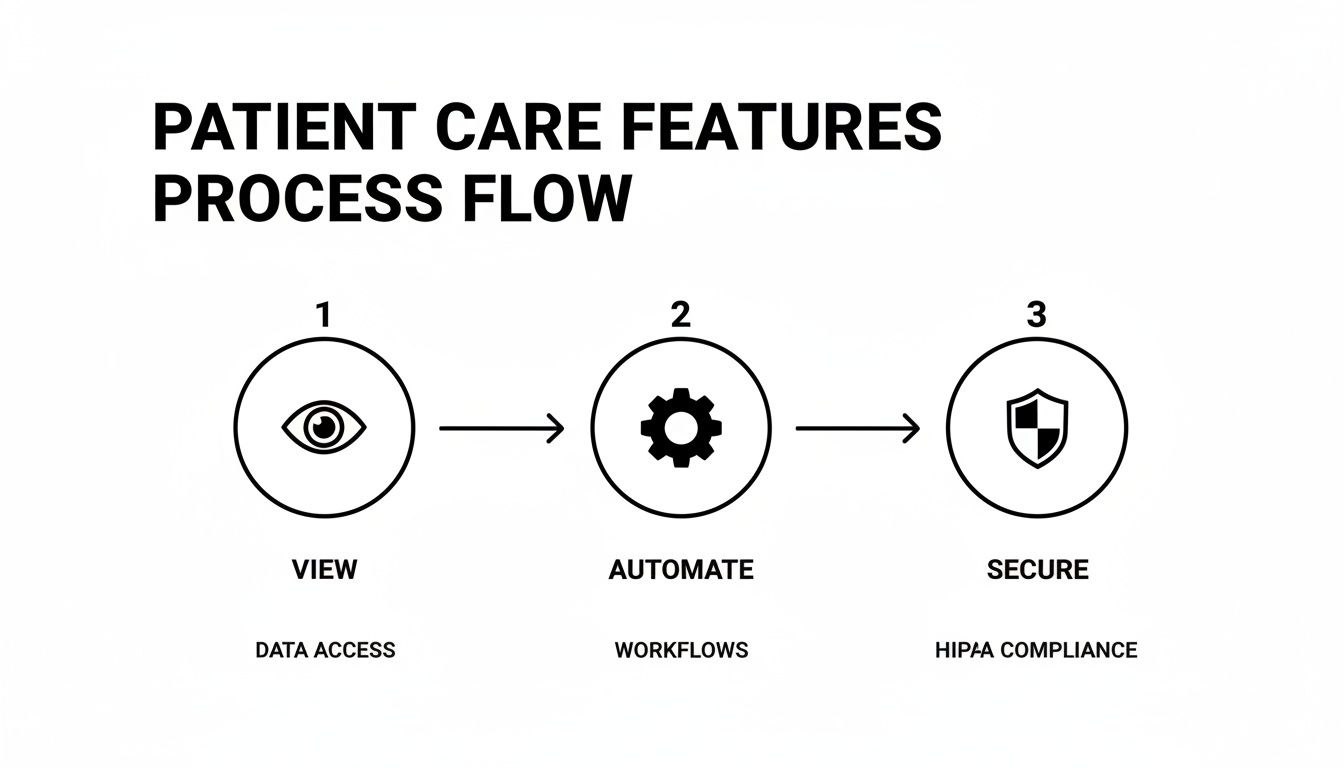
This flow isn't just a diagram; it's a roadmap. It shows how a CRM provides crystal-clear visibility into patient records, automates workflows to boost efficiency, and wraps the entire process in robust security to ensure compliance isn't just an afterthought, but a foundation.
From Chaos To Cohesion: A Referral's Journey
Think about how this played out in the past. A primary care physician (PCP) refers a patient to a cardiologist. Their office faxes the referral over. Did it arrive? Did the patient actually schedule an appointment? Without a connected system, the PCP is flying blind, and the patient might never get the specialized care they desperately need.
Now, let's replay that scene with a healthcare CRM in place. The moment the PCP enters the referral, a digital record springs to life. The system automatically pings the cardiology clinic, tracks the patient's scheduling status in real-time, and sends a confirmation back to the PCP as soon as the appointment is booked.
What you get is a perfect, closed-loop system where everyone stays in the loop. The PCP has peace of mind knowing their patient is on the right track, the specialist’s office has a predictable flow of new patients, and most importantly, the patient gets the care they need without becoming a project manager for their own health.
Empowering Your Provider Liaisons
A CRM does more than just track paperwork; it’s a strategic tool that empowers your provider liaisons to build and nurture their professional networks. These are the people on the front lines, forging relationships with referring physicians, and a CRM gives them the data-driven insights they need to be incredibly effective.
With detailed analytics at their fingertips, a liaison can instantly see:
- Top Referral Sources: They can identify and double down on relationships with the physicians sending the most patients your way.
- Declining Referrals: They can proactively reach out to physicians whose referral numbers have dipped to find out why and fix the issue.
- Network Gaps: They can pinpoint geographical areas or specialties where the referral network is weak and needs attention.
This isn't guesswork; it's precision. This data-driven approach allows liaisons to focus their time and energy where it will make the biggest impact. The industry gets it, too. In fact, the referral relationships category is projected to be the fastest-growing segment in the entire healthcare CRM market. Everyone is scrambling to consolidate data from disparate sources into HIPAA-compliant platforms that foster direct engagement and capture more business. This kind of strategic management is what builds a truly robust and interconnected healthcare ecosystem.
The AI Revolution In Patient Relationship Management
Artificial intelligence isn't some far-off concept anymore. It's the very engine pushing modern healthcare CRM solutions into a whole new era of proactive and truly personal care. Think of AI as a partner to clinicians, a tool that scales their expertise and empathy in ways we could only dream of just a few years ago. It’s all about turning mountains of data into genuine wisdom that can literally change a patient's outcome.
Imagine an AI that works a bit like a seasoned physician's intuition. By sifting through millions of data points—from EHR records and lab results to lifestyle factors—predictive analytics can flag patients at high risk for conditions like sepsis or heart failure long before the first critical symptom appears. This kind of foresight is a game-changer. It allows care teams to step in early, moving the focus from reactive treatment to life-saving preventative action.
This is a monumental leap forward. Instead of just responding to a crisis, providers can proactively reach out with the right support at the right time, whether that means adjusting medication, suggesting lifestyle changes, or simply scheduling a vital check-up.
Making Care Personal At Scale
One of the biggest hurdles in medicine today is making every single patient feel seen and understood. AI helps bridge that gap by powering hyper-personalization right inside your CRM. Machine learning algorithms get to work analyzing communication preferences, engagement history, and clinical data to make every interaction count.
What does this look like in practice? It means a post-op follow-up message can be tailored to a patient's specific procedure and recovery milestones. It means a mammogram reminder can be timed and worded based on what’s proven most effective for that specific patient’s demographic. This isn't just generic messaging; it's communication that feels relevant, effective, and deeply human.
AI isn't here to replace the human touch; it's here to amplify it. It takes on the heavy lifting of data analysis, freeing up healthcare professionals to do what they do best: build trust and provide compassionate, focused care.
This intelligent automation is a foundational piece of modern medical technology. At PYCAD, for example, we at PYCAD, build custom web DICOM viewers and integrate them into medical imaging web platforms, which can be supercharged with AI-driven analytics. When you connect specialized tools like these with a smart CRM, you create a seamless, intelligent ecosystem for managing the entire patient journey. You can check out real-world examples in our extensive PYCAD portfolio.
Your 24/7 Digital Assistant
Patient needs don't neatly fit into a 9-to-5 box. AI-powered chatbots, when integrated into a healthcare CRM, give patients the instant, around-the-clock support they deserve. And these aren't your basic Q&A bots—they are sophisticated conversational partners.
These AI assistants can:
- Answer Common Questions: Patients get immediate answers about appointment times, potential medication side effects, or pre-procedure instructions, anytime.
- Guide Patients to Resources: A chatbot can effortlessly direct a user to the right educational article, the patient portal, or the billing department, which significantly cuts down on administrative tasks.
- Triage Urgent Needs: A well-designed bot can recognize keywords that signal a serious problem and instantly escalate the conversation to a human nurse or an on-call physician.
This constant availability offers patients incredible peace of mind while lightening the load on your front-desk staff. Recent studies show a significant number of executives are already using AI in at least one business function, yet we're still just scratching the surface of what’s possible.
As AI technology continues to mature, its role in patient support will only expand. For a deeper dive into what's on the horizon, you can explore the applications of various healthcare AI solutions. By welcoming AI, healthcare organizations aren't just adopting new tech—they are fundamentally rethinking what it means to deliver smarter, more empathetic care.
Your Blueprint For Choosing The Right CRM
Picking a healthcare CRM solution isn't just another software purchase. It's a foundational decision that will define your patient relationships and drive your operational efficiency for years. For anyone in hospital IT, a medtech startup, or a medical device company, this choice needs a clear, strategic game plan.
The right place to start isn't with a flashy demo. It's with a hard look at your own organization's goals. What are you actually trying to accomplish? Do you need to slash patient no-show rates? Are you trying to build a more streamlined referral network? Or maybe you're focused on launching preventative care campaigns that actually move the needle.
Defining these objectives upfront is your north star. It guides every decision you make and ensures you end up with a true partner, not just a piece of software. This clarity is what keeps you from getting distracted by features that sound impressive but don't solve your real-world problems.
Define Your Core Needs And Integration Points
Once your goals are crystal clear, it’s time to get technical. A CRM has to play nice with the technology you already have, especially your Electronic Health Record (EHR) and Picture Archiving and Communication System (PACS). If it just creates another data silo, you're moving backward, not forward.
You need to ask potential vendors the tough questions. Don't be shy. Ask for case studies showing successful integrations with your specific EHR. Dig into how they handle data mapping and synchronization to maintain a single source of truth. These conversations are where you separate the talkers from the doers.
For those in medical imaging, the bar is even higher. At PYCAD, for example, we at PYCAD, build custom web DICOM viewers and integrate them into medical imaging web platforms. This is the kind of deep, specialized integration that modern healthcare runs on. To get a feel for how these complex systems can be woven together, take a look at the projects in our portfolio.
Security And Compliance Are Non-Negotiable
In healthcare, data security is everything. It's the very bedrock of patient trust. Your evaluation has to include a deep dive into each vendor's security protocols and compliance certifications. As this guide on HIPAA compliant document management explains, getting this wrong isn't an option. A data breach can cause irreparable damage to your reputation and your finances.
We're seeing a major trend here. In the U.S., healthcare providers are the biggest CRM users, managing staggering patient volumes across more than 6,200 hospitals. To better protect this ocean of sensitive data, on-premise deployments are making a comeback. They offer superior data privacy and more customization options, which is a powerful combination for minimizing cyber threats. You can find more details about U.S. healthcare CRM market trends here.
Don't Forget The Human Element
Finally, always remember this: the most powerful technology on the planet is worthless if your team won't use it. A successful CRM rollout is just as much about managing change as it is about installing software. You have to get buy-in from your key stakeholders—from the doctors and nurses to the front-desk staff—right from the very beginning.
Bring them into the selection process. Show them how this new system will make their lives easier, not more complicated. Position the CRM as a tool that empowers them to deliver better care by automating the mundane tasks and surfacing the insights that matter. Be the champion for the change, provide fantastic training, and make sure to celebrate the small wins along the way. That’s how you build momentum.
Ultimately, the human side of this technology shift is what determines whether your investment leads to a true transformation.
Healthcare CRM Vendor Evaluation Checklist
Choosing the right partner requires a systematic approach. This checklist is designed to help you cut through the marketing noise and compare potential vendors on the criteria that truly matter. Use it to structure your conversations and ensure you cover all your bases.
| Evaluation Criteria | Question To Ask Vendor | Importance (High/Medium/Low) |
|---|---|---|
| EHR/PACS Integration | Can you provide a list of EHRs you've successfully integrated with? Can you walk us through the integration process for our specific systems? | High |
| HIPAA/HITECH Compliance | How does your platform ensure HIPAA compliance? Can you provide your Business Associate Agreement (BAA) and SOC 2 Type II report? | High |
| Scalability & Performance | How does the system handle a sudden increase in patient data or user activity? What are your uptime guarantees and performance benchmarks? | High |
| Customization & Flexibility | How easily can we customize workflows, reports, and dashboards to match our unique processes without extensive coding? | Medium |
| User Training & Support | What does your onboarding and training program look like? What are your standard support hours and guaranteed response times? | High |
| Reporting & Analytics | Can you show us how to build a report tracking patient referral sources and conversion rates? What AI/ML features are available for predictive analytics? | Medium |
| Total Cost of Ownership | Beyond the license fee, what are the costs for implementation, data migration, training, and ongoing support? Are there any hidden fees? | High |
| Future-Proof Roadmap | What is your product roadmap for the next 18-24 months? How do you incorporate customer feedback into new feature development? | Medium |
Taking the time to ask these detailed questions will pay dividends, ensuring the CRM you choose is not just a good fit for today, but a strategic asset that grows with you into the future.
Proving the Real-World Value of Your CRM
So, how do you actually prove your healthcare CRM is worth the investment? It's easy to say things "feel" better, but to make a real case, you need to look at the hard numbers and the tangible changes it brings to your practice. The goal is to draw a straight line from your software investment to the metrics that define the health of your organization and, most importantly, the well-being of your patients.
A powerful healthcare CRM pays for itself in more ways than one, but you have to be systematic about tracking its impact. Instead of just a vague sense of improvement, you can—and should—track specific key performance indicators (KPIs). These numbers tell a powerful story of growth, efficiency, and genuinely better care.
This isn't just about justifying an expense. It's about building an undeniable business case that proves your CRM is a vital engine for success, not just another line item on a budget.
The Financial and Operational Payoff
The most direct way to measure your return is by looking at the money and time you're saving. A well-implemented CRM should start patching up leaks in your revenue cycle and making your team's day-to-day work smoother almost immediately. With the right analytics, you stop guessing and start making data-driven decisions that fuel growth.
Start by keeping a close eye on these critical KPIs:
- New Patient Growth: Are your targeted outreach campaigns, managed right inside the CRM, bringing in more new patients? Track the numbers.
- Stronger Referral Pipelines: Use your CRM dashboards to watch for an uptick in referrals from key physicians. Even better, track how many of those referrals actually turn into scheduled appointments.
- Fewer No-Shows: Automated reminders are a simple feature, but their impact is huge. Measure the drop in no-show appointments after you turn them on. Even a 5% reduction can mean thousands in recovered revenue.
- Better Team Efficiency: How many hours is your team getting back each week by automating follow-ups and data entry? Those are hours they can now spend on high-value, direct patient interaction.
These aren't just abstract figures on a spreadsheet. They represent real dollars saved and new revenue earned, giving you concrete proof of your CRM's financial punch.
Measuring the Human Impact
While the financial metrics are essential, the ultimate return on a healthcare CRM is found in stronger patient relationships and better health outcomes. This is where technology helps you deliver a more connected, supportive, and human care journey. For specialized fields like medical imaging, this connection is everything. At PYCAD, we at PYCAD, build custom web DICOM viewers and integrate them into medical imaging web platforms, creating a seamless flow between clinical data and patient relationships. You can see how this level of integration elevates the entire care experience in our portfolio.
The real magic happens when operational efficiency translates into a better human experience. A great CRM enables you to scale empathy, ensuring every patient feels seen, heard, and cared for throughout their entire journey.
You can put numbers to this "human impact" by focusing on:
- Higher Patient Satisfaction: Watch how your patient survey scores (like HCAHPS or your own custom feedback forms) improve after the CRM is in place.
- Improved Treatment Adherence: Use the CRM to send personalized follow-ups and educational content. Then, track how that communication improves the rates at which patients stick to their treatment plans and medication schedules.
In the end, the greatest return is building a healthier, more connected community. By strengthening every single patient relationship, your healthcare CRM solution delivers a value that goes far beyond the bottom line—it builds trust that can last a lifetime.
Common Questions We Hear About Healthcare CRMs
Diving into the world of healthcare CRM solutions always sparks a few key questions. Let's walk through the most common ones to give you a clearer picture of how they work and where they fit.
How Is a Healthcare CRM Different From a Standard Sales CRM?
Think of it this way: a standard sales CRM is built to track a transactional journey—from lead to close. It’s all about the deal. A healthcare CRM, on the other hand, is built around a person's lifelong health journey.
It’s specifically designed to handle sensitive health information with unshakable HIPAA compliance. Instead of just tracking sales pipelines, it integrates with clinical systems like EMRs to create a complete view of a patient's care. The end goal isn't a sale; it's a stronger patient relationship built on trust and better health outcomes.
A standard CRM sees a customer. A healthcare CRM sees a patient. One focuses on the transaction, the other on continuous, compassionate care.
How Hard Is It to Connect a CRM With Our Existing EHR System?
This is a big one, and the honest answer is: it depends. The complexity can vary, but modern CRMs have made this much smoother than it used to be. They use standardized tools like APIs and protocols like HL7 to talk to other systems.
The real key to success is picking a technology partner who’s done it before—specifically with your EHR. For instance, we at PYCAD, build custom web DICOM viewers and integrate them into medical imaging web platforms. That kind of deep, specialized integration work is exactly what you should look for in a vendor. Always ask to see their track record of successful integrations, like the projects we showcase in the PYCAD portfolio.
Can Smaller Clinics Actually Benefit From a Healthcare CRM?
Yes, absolutely. In fact, for a smaller practice, a good CRM can be a game-changer. It acts like a digital assistant, automating all those time-consuming administrative tasks that can bog down a small team. This frees up your staff to do what they do best: focus on patients.
Beyond just saving time, it helps you be more proactive. Imagine easily sending out reminders for flu shots or annual check-ups to the right patient groups. That simple act improves the health of your community while also strengthening your practice's financial stability. Modern, cloud-based healthcare CRM solutions deliver a powerful return on investment, no matter your clinic's size.
At PYCAD, our passion is building smart, integrated platforms that bring patient management and advanced medical imaging together. If you're ready to build a more connected and efficient care ecosystem, let's talk. You can see our solutions in action at https://pycad.co/portfolio.