Imagine a patient trying to navigate their own healthcare journey. It often feels like being lost in a maze of different appointments, specialists, and follow-ups. Healthcare CRM solutions are designed to completely change that fragmented experience by piecing together a single, unified story for every patient.
Think of these platforms as the new command center for modern medicine, turning scattered data points into a powerful tool for proactive, personalized care.
The New Heartbeat of Modern Medicine
Healthcare has never been short on data. The real challenge has always been connecting the dots. Patient information is typically locked away in separate silos—lab results live in one system, appointment histories in another, and communication logs somewhere else entirely. This disconnect creates frustrating gaps and leads to care that feels impersonal and reactive.
A healthcare CRM is built to bridge those gaps. It acts as the central nervous system for patient engagement, connecting everything and everyone involved in a patient's care.
Don't just think of it as software. See it as a powerful new way to build a more connected, human-centered healthcare model. This is about more than just managing contacts; it's about orchestrating the entire patient journey. By giving providers a complete 360-degree view, these systems empower them to anticipate needs, build stronger relationships, and deliver care that feels truly coordinated.
Why Is This Shift Happening Now?
The move toward these integrated platforms is picking up speed, driven by an urgent need for better data management and smart automation. The numbers tell the story: the global healthcare CRM market was valued at USD 17.87 billion in 2023 and is projected to soar to USD 30.65 billion by 2030. This incredible growth signals a fundamental shift in how medical organizations are thinking about their operations.
This evolution is a critical piece of the bigger picture. It's all part of the industry-wide move towards a more connected healthcare ecosystem. You can dive deeper into how technology is reshaping patient care in our guide on the digital transformation in healthcare.
A healthcare CRM transforms fragmented data points—from lab results to patient communications—into a single, coherent patient story. This holistic view is the foundation for building a more efficient and empathetic healthcare system.
At PYCAD, we're right in the middle of this ecosystem. We at PYCAD, build custom web DICOM viewers and integrate them into medical imaging web platforms. Our work ensures that even complex diagnostic data becomes a seamless part of that unified patient record, ready and accessible when it's needed most. You can see some of our specialized projects over on our portfolio page.
Now, let's explore the core capabilities, AI-driven advancements, and practical steps for building a better care experience.
Core Capabilities That Power Patient-Centric Care
A great healthcare CRM isn't just another piece of software; it's the central nervous system for patient management. It takes all the scattered bits of information—from appointment notes to lab results—and weaves them into a single, coherent picture. This is how we move from reactive, fragmented care to a proactive system that truly understands and anticipates patient needs.
It all starts with the Patient 360 view. Forget thinking of it as a static digital file. Imagine instead a living, breathing "digital biography" for every patient. This profile chronicles their entire health journey in one place, pulling together every interaction, diagnosis, and communication into a story that makes sense. Giving providers this kind of context is what empowers them to make truly informed, empathetic decisions.
Your Compass for Coordinated Care
One of the most powerful features here is advanced referral management. Think of it as a dedicated GPS for care coordination, seamlessly guiding patients from their primary doctor to a specialist and back, ensuring no one ever gets lost in the system. It tracks the entire journey in real-time, automating the handoffs so that no patient ever falls through the cracks.
What does this really mean for healthcare organizations?
- Less administrative drag: When the referral loop is automated, your team is freed up to focus on what they do best—caring for patients.
- A better patient journey: Patients feel seen and supported, confident that their care path is being actively managed every step of the way.
- A stronger provider network: Smooth, clear communication builds trust and collaboration between referring physicians and specialists, creating a real community of care.
Then there’s automated communication, which acts like a personal health concierge for every patient. This feature can send out timely appointment reminders, share educational articles tailored to a patient’s specific condition, or deliver clear follow-up instructions after a visit. These simple, consistent touchpoints keep patients engaged and turn them into active partners in their own health.
By taking the friction out of routine tasks like communication and referrals, a healthcare CRM clears the way for what really matters: building genuine, trusting relationships between people and their providers.
This is all about putting the patient's complete story at the heart of everything, connecting all the dots in their care journey.
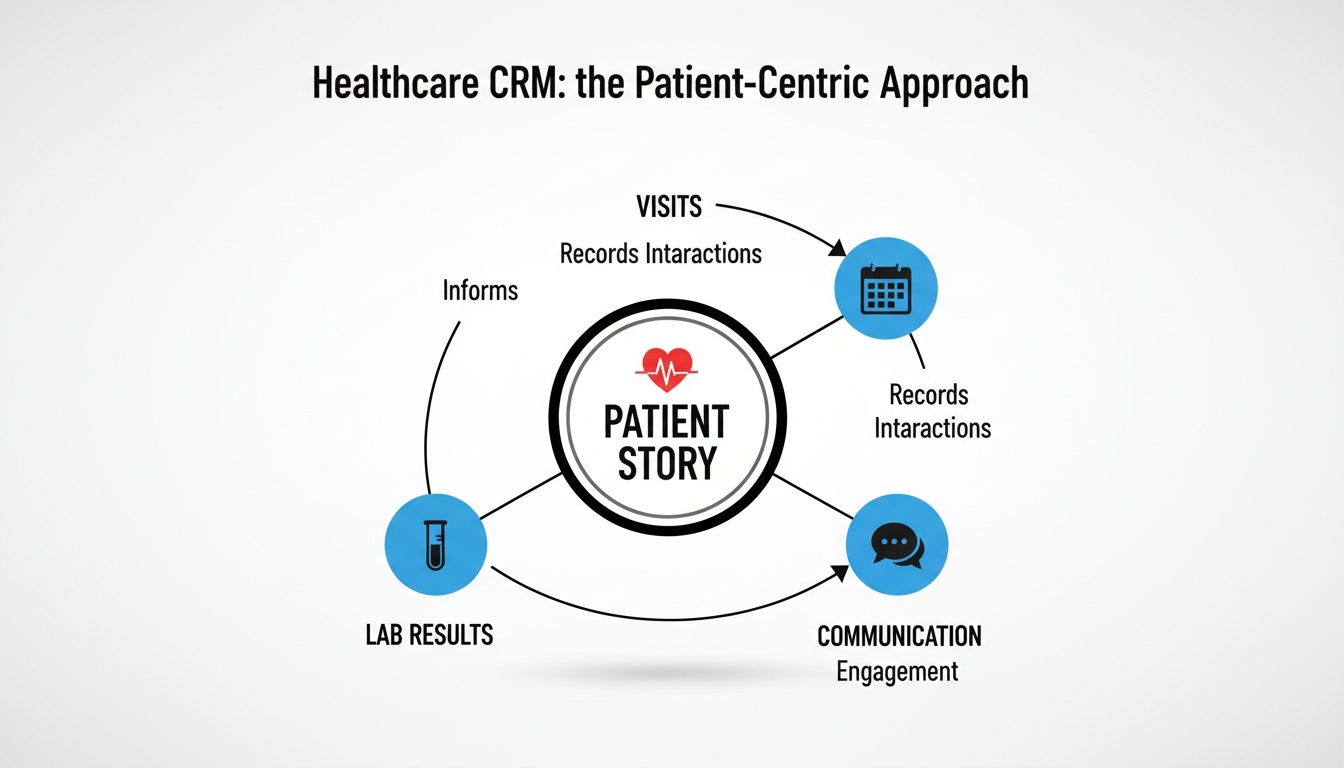
As you can see, every piece of data—from a quick check-in to complex lab results—builds upon the last, creating a dynamic profile that truly reflects the individual.
Bridging the Clinical Data Gap
For medical device manufacturers and medtech innovators, a healthcare CRM offers something more. It becomes a critical tool for tracking device performance, monitoring patient outcomes, and gathering user feedback. This creates an invaluable feedback loop that fuels real-world product improvements and drives meaningful innovation.
But the real magic happens when the CRM connects with the complex clinical systems already in place, like Electronic Health Records (EHRs) and medical imaging archives. Its value skyrockets. This is where deep technical expertise is non-negotiable. For instance, we at PYCAD, build custom web DICOM viewers and integrate them into medical imaging web platforms.
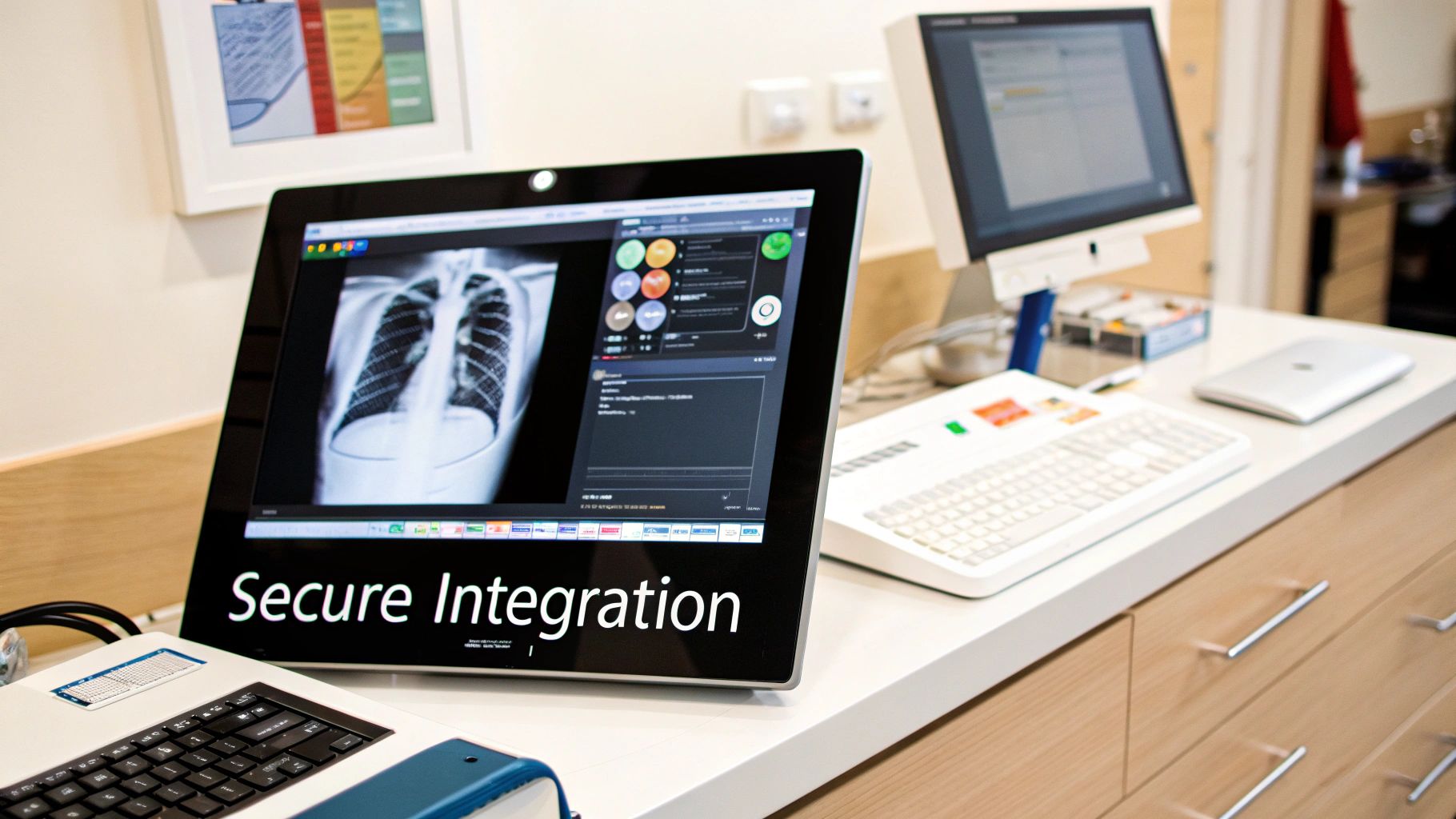
This kind of integration means a clinician can pull up a patient’s diagnostic images—an X-ray, an MRI, a CT scan—right inside their CRM profile. Suddenly, they aren’t just looking at clinical notes and appointment history; they’re looking at the actual diagnostic evidence side-by-side. This blends the administrative and clinical worlds, creating a truly holistic view for more precise, effective care.
You can see some of the advanced integration projects we've brought to life in our portfolio. By combining these core capabilities, healthcare CRM solutions lay the groundwork for a more connected, responsive, and ultimately more human approach to medicine.
Building Your Integrated and Secure CRM Ecosystem
Bringing a healthcare CRM into your organization isn't just about installing new software. It’s about weaving a digital thread through the very fabric of your operations, connecting all the scattered pieces into one intelligent, cohesive whole.
This process lives and dies by one word: interoperability. Without it, your shiny new CRM is just another island, another data silo in an already fragmented sea of information. The goal is to build an ecosystem where your CRM speaks fluently with your Electronic Medical Records (EMRs), billing systems, and critical clinical archives like PACS and VNA. Only then can you get that 360-degree view of patient health and your own operational pulse.
Forging the Links of a Truly Connected System
The real magic happens when a healthcare CRM starts breaking down the walls between departments and data sources. This takes more than just a few standard API calls; it requires specialized integrations built for the unique, high-stakes world of medicine. For a deeper dive, mastering CRM integration is a crucial skill set.
This is where custom solutions really shine. For instance, at PYCAD, we build custom web DICOM viewers and bake them right into medical imaging platforms. Imagine a clinician pulling up a patient's CRM profile and seeing their MRI or CT scans right there, next to their communication history and appointment notes. No more logging into a separate system.
This kind of deep, thoughtful integration isn't just a "nice-to-have." It's a game-changer.
- It demolishes data silos. Clinicians no longer have to bounce between four different applications to piece together a patient's story.
- It sharpens clinical decision-making. With imaging data just a click away, providers can make faster, more confident diagnoses.
- It smooths out the entire workflow. By removing these little points of friction, you give precious time back to your care teams.
We've built these kinds of powerful, integrated systems before, and you can see them in action on our portfolio page. Getting these different systems to talk to each other is the core challenge. If you're curious about the technical underpinnings, we cover it in our guide on https://pycad.co/data-interoperability-healthcare/.
Constructing a Fortress of Patient Trust
If integration is about connecting your systems, then security is about protecting your most valuable asset: patient trust. Think of your CRM’s security architecture as a digital fortress. Its very foundation must be built on absolute compliance with regulations like HIPAA in the U.S. and GDPR in Europe. These aren't just checkboxes on a list; they are the promises you make to every single patient who walks through your doors.
Security in a healthcare CRM is not a feature—it is the bedrock of patient trust. Every layer of protection, from data encryption to access control, reinforces the promise that sensitive health information will be kept safe.
A real fortress has multiple layers of defense, and your CRM should be no different. It requires a potent mix of technological safeguards and rigorous human processes designed to shield patient data from every possible threat.
Building this level of security means focusing on several non-negotiable pillars:
- End-to-End Data Encryption: Data must be unreadable and secure, whether it’s sitting on a server or moving across the network.
- Granular Access Controls: This is the "principle of least privilege." People should only be able to see and touch the specific information they absolutely need to do their jobs. Nothing more.
- Comprehensive Audit Trails: You need a detailed, unchangeable log of who accessed what data, and when. It’s all about accountability and transparency.
- Regular Security Audits: You have to proactively kick the tires and test your own defenses to find and fix weak spots before someone else does.
When you design your healthcare CRM to be both deeply integrated and fundamentally secure, you create more than just a powerful tool. You build a system that is worthy of the immense trust your patients place in you.
How AI Is Shaping Proactive and Personalized Healthcare
A traditional healthcare CRM is a fantastic tool for keeping data organized. But the future of patient care isn't just about organization; it’s about anticipation. When you infuse a CRM with Artificial Intelligence, it evolves into something more—an "intelligent clinical assistant" that doesn't just hold information but actively helps you deliver better outcomes.
AI is what turns a CRM from a passive filing cabinet into a proactive partner. It’s the engine that can sift through mountains of data to spot subtle patterns, predict a patient's future needs, and personalize communication on a scale that’s simply not humanly possible. This shift marks the end of purely reactive care and the dawn of a new, predictive strategy that helps keep people healthy from the very beginning.
From Reactive to Predictive Care
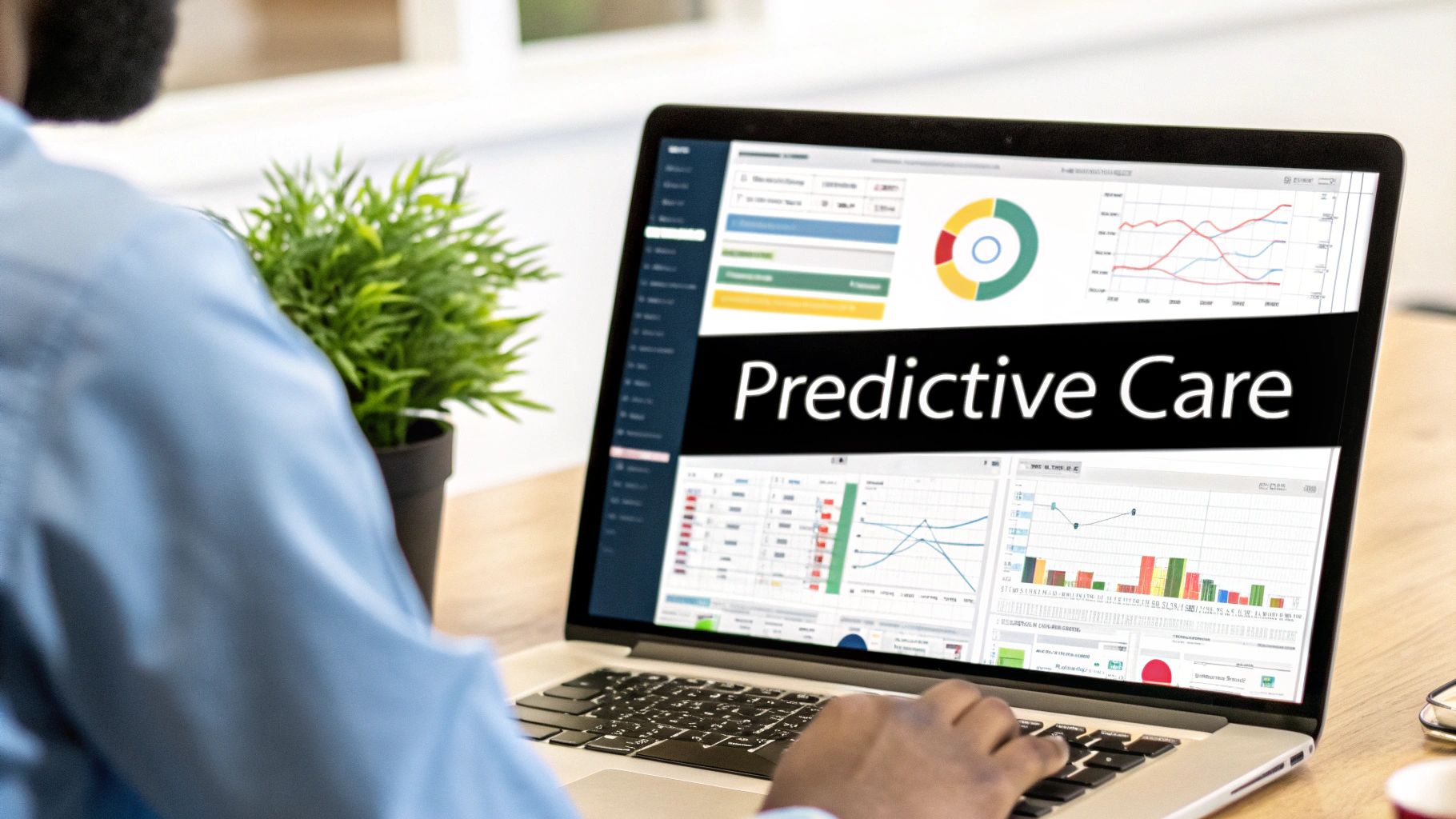
Perhaps the most exciting gift AI gives us is the ability to see the future hidden in our data. Predictive analytics engines can chew through thousands of data points—from clinical histories to how often a patient responds to messages—to identify individuals at high risk for specific conditions.
Imagine an AI algorithm flagging a patient with diabetes for an immediate check-in. Not because they missed an appointment, but because their communication patterns signal disengagement—a crucial, yet often overlooked, predictor of declining health. That's the power of predictive care. It empowers providers to step in before a crisis, not just clean up after one.
Another incredibly practical use is predicting appointment no-shows. By learning from past behavior, an AI-powered CRM can identify patients likely to miss their slot with uncanny accuracy. This gives your staff a chance to proactively confirm, reschedule, or offer the spot to someone else, keeping schedules full and operations running smoothly.
Unlocking Insights with Natural Language Processing
Patient feedback is a goldmine, but it's usually messy and unstructured. This is where Natural Language Processing (NLP), a fascinating branch of AI, comes in. NLP essentially teaches computers to read and understand human language.
When built into a CRM, NLP can analyze thousands of patient comments from surveys, emails, or even call transcripts to pinpoint hidden trends and feelings. It might discover widespread confusion about a new medication's side effects or identify a common frustrating step in the check-in process. You get direct, actionable insights to make the entire experience better.
AI doesn't replace the human touch in healthcare; it amplifies it. By automating analysis and prediction, it frees up clinicians to focus their expertise and empathy where it matters most—on the patient.
These intelligent systems are a cornerstone of modern medical technology. To explore this topic further, you can learn more about the role of artificial intelligence in our detailed guide on healthcare AI solutions.
Personalizing the Patient Journey at Scale
Finally, machine learning algorithms are masters of personalization. Forget sending generic wellness tips to your entire patient list. An AI-driven CRM can tailor every single message based on individual health profiles, preferences, and past interactions.
- Customized Education: A newly diagnosed hypertension patient might automatically receive articles on diet and exercise, while someone recovering from surgery gets timely reminders about their physical therapy.
- Optimized Outreach: The system learns whether a patient prefers email, text, or a phone call and the best time to reach them, dramatically increasing the chances they'll actually engage.
- Dynamic Care Plans: As a patient’s health changes, machine learning can help adjust their care plan recommendations on the fly, ensuring the guidance they receive is always relevant.
The table below breaks down just how much of a leap forward this technology truly is.
Comparing Traditional CRM vs AI-Powered Healthcare CRM
This table highlights the transformative impact of AI by comparing the capabilities of standard CRM systems with those enhanced by artificial intelligence.
| Feature | Traditional CRM Capability | AI-Powered CRM Capability |
|---|---|---|
| Data Analysis | Stores and displays data entered by users. | Actively analyzes data to identify trends, predict risks, and segment patient populations automatically. |
| Patient Outreach | Supports manual or rule-based mass communication. | Personalizes communication for each patient based on their health status, behavior, and preferences. |
| Risk Identification | Relies on clinicians to manually flag at-risk patients. | Proactively identifies at-risk patients using predictive models based on thousands of data points. |
| Operational Efficiency | Helps organize schedules and track appointments. | Predicts no-shows, optimizes schedules, and automates routine follow-ups to reduce administrative burden. |
| Patient Feedback | Stores survey responses and notes for manual review. | Uses NLP to analyze unstructured feedback (emails, comments) to uncover sentiment and actionable insights at scale. |
| Decision Support | Provides a historical record for clinicians to reference. | Offers data-driven suggestions for care plans and interventions, acting as an intelligent assistant. |
In the end, it's clear that AI doesn't just make a CRM better—it fundamentally changes its purpose from a system of record to a system of intelligence.
Here at PYCAD, we live at the intersection of these advanced technologies. We at PYCAD, build custom web DICOM viewers and integrate them into medical imaging web platforms, creating a unified and intelligent view of the patient. As you can see in our portfolio, connecting rich clinical imaging with AI-driven CRM insights creates an incredibly powerful ecosystem for delivering care that is truly personal and proactive.
Measuring Success and Calculating Your ROI
So, you're considering a healthcare CRM. It’s a big move, and you need to know if the investment will actually pay off. But here’s the thing: the real return isn't just about dollars and cents. It's measured in healthier patients, less-stressed clinicians, and the kind of sustainable growth that makes a lasting impact.
Proving that value requires looking beyond a simple balance sheet. While a solid software development cost estimation helps set the budget, the "return" comes from creating a smarter, more responsive, and genuinely patient-first system.
What Does Success Actually Look Like?
The best way to gauge success is to look at the tangible, on-the-ground improvements that a great CRM brings to your daily operations and patient care. Forget abstract financial goals for a moment and focus on these core metrics:
- Fewer Empty Chairs: What's your appointment no-show rate? Automated reminders and real communication can slash this number, keeping your schedules full and ensuring continuity of care.
- Happier, Healthier Patients: How are your patient satisfaction scores (HCAHPS)? A CRM that personalizes every touchpoint makes patients feel seen and heard, which is a cornerstone of value-based care.
- More Loyal Patients: A CRM helps you build real relationships, not just process transactions. This boosts patient retention, turning a single visit into a long-term health partnership.
- A Smoother Referral Process: How quickly and effectively do you manage referrals? Tracking conversion rates and turnaround times helps you spot and fix a broken process, strengthening your entire provider network.
The true ROI of a healthcare CRM is a powerful combination of quantitative gains and qualitative improvements. It’s the fusion of lower operational costs with higher patient trust, creating a virtuous cycle of growth and better health outcomes.
The market backs this up. The global push for value-based care has added a +3.2% uplift to the forecasted growth for healthcare CRMs. And while big enterprises still dominate with 70.66% of the market, smaller organizations are jumping in to chase the 25-40% boosts in patient retention and 35% drops in operating costs. You can dive deeper into these trends in this detailed industry report.
Building Your ROI Business Case
Alright, let's talk numbers. The classic ROI formula is straightforward: (Net Gain from Investment – Cost of Investment) / Cost of Investment. The real work is in figuring out that "Net Gain."
Let’s make it concrete. Imagine reducing no-shows by 15% saves your clinic $50,000 a year. At the same time, a more efficient referral system brings in another $30,000. Your total gain is $80,000. If your CRM subscription costs $40,000 annually, your ROI is a clean 100%.
At PYCAD, we take this a step further. We at PYCAD, build custom web DICOM viewers and integrate them into medical imaging web platforms. When we embed those diagnostic tools directly into a CRM, clinicians no longer have to waste time bouncing between different software. That time saved is a direct efficiency gain that cuts costs and helps them make faster, more informed decisions.
This is what turns a simple tool into a strategic powerhouse. Check out our portfolio to see how this deep integration works in the real world. In the end, a healthcare CRM shouldn’t just pay for itself—it should become the engine that drives better medicine and a healthier bottom line.
Choosing the Right Healthcare CRM Partner
Picking a healthcare CRM isn't just a software purchase; it's about finding a long-term partner who will fundamentally shape how you deliver care. You need someone who gets that your world is filled with unique clinical and operational hurdles that a generic, off-the-shelf solution simply can't handle. This is your chance to team up with a collaborator who will help you build a more connected, patient-first organization from the inside out.
The market is crowded, and it's easy to feel overwhelmed. But if you focus on a few key qualities, the best partners will quickly stand out. A true partner isn't just thinking about the sale; they're invested in creating a solution that scales with you and adapts as your needs change.
Evaluating Your Potential CRM Partner
Before you even think about signing a contract, you need to put potential vendors through their paces. You're looking for more than just a slick platform; you need a team that lives and breathes the healthcare industry.
Here’s a practical checklist to help you cut through the noise:
- Deep Integration Capabilities: Have they successfully connected their CRM with complex systems like EMRs, PACS, and VNAs before? This isn't a nice-to-have; it's the absolute foundation for a single, unified view of the patient.
- Customization and Scalability: Can the platform bend to fit your specific clinical workflows? A rigid system will force you to change how you work. The right one adapts to you.
- Security and Compliance: Do they show a rock-solid commitment to HIPAA and other regulations? Look for proof in their encryption, access controls, and transparent audit trails.
- Ongoing Support and Training: What happens after go-live? You want a provider who offers dedicated support and real-world training to make sure your team actually uses the system and gets every bit of value out of it.
Choosing a CRM partner is like choosing a co-pilot for your organization's journey. You need a team with the technical skill to navigate complex integrations and the strategic vision to help you reach your destination of better patient outcomes.
This becomes especially critical when you're dealing with specialized data. For example, we at PYCAD, build custom web DICOM viewers and integrate them into medical imaging web platforms, making sure diagnostic images are a seamless part of the CRM. Finding a partner with that kind of niche expertise is a game-changer. You can see what these integrated solutions look like in our portfolio.
The right healthcare CRM solutions are quickly becoming a non-negotiable part of modern medicine. In the U.S. alone, the market is expected to jump from USD 9.92 million to USD 19.94 million by 2034, driven by a growing focus on data privacy and new government initiatives. You can find more details about this growing market and its drivers.
Ultimately, the choice is yours. Look for a partnership that gives you the tools not just to manage relationships, but to redefine care itself and build an organization that’s truly ready for the future.
Your Top Questions About Healthcare CRM, Answered
Stepping into new technology always brings up a few questions. That's a good thing—it means you're thinking critically. To help you find your footing, we’ve put together some straight-talk answers to the most common questions we hear about bringing a healthcare CRM on board. Our goal is to give you the clarity and confidence you need to make the right move.
How Long Does It Actually Take to Implement a CRM?
Honestly, there’s no single answer here. The timeline really hinges on the complexity of your world and how deep you need the integrations to go. A small, focused clinic might be up and running in just a few weeks. It's a different story for a large hospital system that needs to connect its CRM with multiple EMRs, billing systems, and specialized medical imaging platforms—that kind of project is more likely to span several months.
The smartest way to tackle it is with a phased approach. Get the core features, like patient communication and scheduling, live first. This delivers quick wins and builds momentum. Then, you can layer in the more complex integrations over time without overwhelming your team.
Can a Cloud-Based CRM Really Be HIPAA Compliant?
Absolutely, and here's why: top-tier cloud CRM providers often have security measures that are light-years ahead of what a single organization could realistically build and maintain on its own. They pour immense resources into data protection because their entire reputation and business model depend on it.
When you're vetting a partner, make sure they offer these non-negotiables:
- End-to-end encryption for all data, whether it's sitting on a server or moving between systems.
- Granular access controls that let you decide exactly who sees what, right down to the individual user level.
- A Business Associate Agreement (BAA). This is the legally binding contract that proves they are committed to protecting patient health information under HIPAA regulations.
How Do You Get a CRM and an EHR to Talk to Each Other?
Connecting your CRM to your existing Electronic Health Record (EHR) is probably the most critical part of the puzzle. This magic happens through Application Programming Interfaces (APIs). Think of APIs as secure interpreters that allow the two systems to communicate and share data safely and in real-time. This eliminates the soul-crushing task of manual data entry and ensures everyone has a complete, current picture of the patient.
A truly successful integration isn't a one-way street. It's a conversation. Your CRM should pull demographic and clinical data from the EHR, while also sending communication and engagement data back. This two-way flow makes both systems smarter and more valuable.
Things get even more interesting when you need to connect with things like medical imaging archives. This is where you need specialized expertise. For instance, we at PYCAD, build custom web DICOM viewers and integrate them into medical imaging web platforms, making even complex diagnostic data a seamless part of the patient's unified record. You can see what these deep integrations look like on our portfolio page. Done right, the CRM becomes the true command center for everything related to your patients.
At PYCAD, our passion is building these deeply integrated, secure, and intelligent healthcare platforms. If you're ready to build a solution that truly unites your data and empowers your care teams, take a look at our work at https://pycad.co/portfolio.