Healthcare software engineering is so much more than just writing code. It’s about building the digital lifelines that power our modern healthcare system—the specialized, deeply human discipline of creating secure, reliable, and compliant software that physicians and patients depend on every single day.
The Mission Behind Modern Healthcare Software
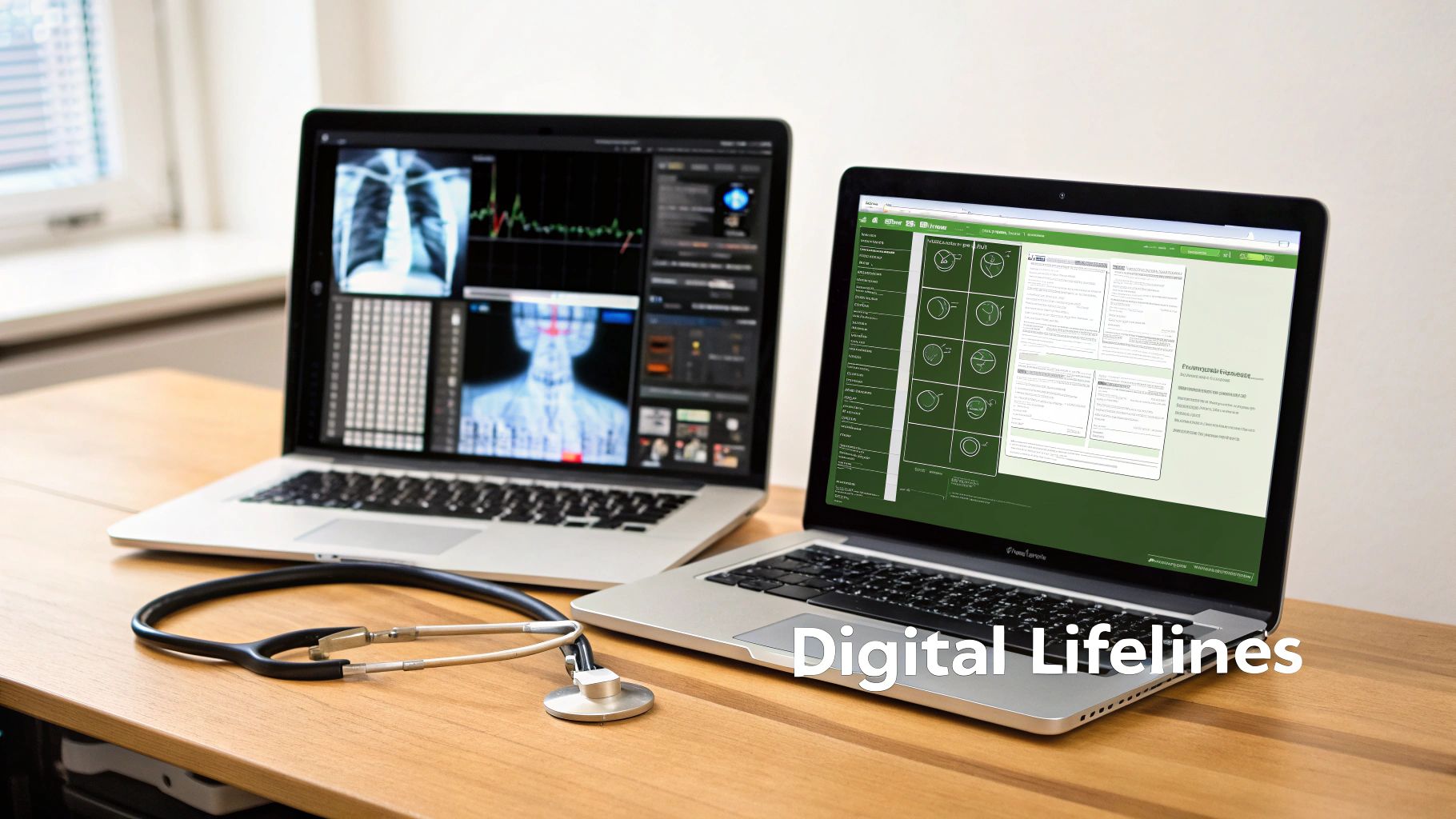
Think of it like designing the blueprint for a cutting-edge hospital. A physical building needs a rock-solid foundation, specialized wings for different treatments, and fortified vaults for patient records. Its digital counterpart requires that same level of meticulous planning and execution.
This software has to be robust enough to manage millions of patient files, fast enough to deliver critical data in the ER, and secure enough to protect our most personal information. It’s a field where deep technical expertise meets an unwavering commitment to human well-being. A single line of code can genuinely influence a clinical decision or protect a patient's privacy. The stakes couldn't be higher.
A Fusion of Technology and Responsibility
Success in this space comes down to a few core promises we make to both clinicians and the people they care for:
- Unyielding Security: Protecting patient data isn't just a feature; it's a profound ethical and legal responsibility. Every system must be a fortress, built from the ground up to guard against breaches and guarantee confidentiality.
- Seamless Interoperability: Medical systems and devices have to speak the same language, fluently. This is what allows a doctor viewing a CT scan to instantly access a patient’s full health history, creating a complete picture.
- Regulatory Adherence: Navigating complex standards like HIPAA isn't optional. It’s the bedrock of trust.
These principles aren't just checked off a list; they guide every single decision, from the first architectural sketch to the final line of code. It’s a discipline where precision engineering meets the profound weight of patient care.
Healthcare software is the central nervous system of modern medicine. It connects disparate parts of the care journey, turning raw data into actionable insights that can save lives. The goal is to empower clinicians with tools so intuitive and reliable they become a natural extension of their expertise.
Turning Challenges into Innovations
This intricate balance of needs creates some serious engineering puzzles. How do you build a system that is instantly accessible to authorized staff across a hospital network but completely impenetrable to outsiders? That’s where specialized knowledge becomes the key.
This mission is what drives us. At PYCAD, we build custom web DICOM viewers and integrate them into medical imaging web platforms, fundamentally changing how clinicians interact with diagnostic data. We believe that with the right expertise, these tough technical hurdles can become the launching point for life-saving innovations. You can see how we approach these challenges firsthand in our portfolio of healthcare software projects.
Ultimately, healthcare software engineering is about building a better, safer, and more efficient future for medicine—one well-written line of code at a time.
Navigating the High Stakes of Regulatory Compliance
In healthcare software, compliance isn't just a box to tick—it’s the very foundation of trust. Think of regulations like HIPAA in the United States or GDPR in Europe not as legal red tape, but as a promise you make to every patient to safeguard their most personal information. Building compliant software is like constructing a digital fortress; every line of code, every architectural choice, must reinforce the walls protecting that sensitive data.
This isn't an area where you can afford to cut corners. A data breach doesn't just lead to staggering fines; it can permanently damage the trust that patients and clinicians place in your platform. Our job as engineers is to turn dense legal documents into real, functioning software principles. This means security and privacy can't be bolted on at the end—they have to be baked into the architecture from day one.
HIPAA: The Digital Patient Privacy Mandate
In the U.S., the Health Insurance Portability and Accountability Act (HIPAA) is the law of the land for patient data. For engineers, this translates into very specific technical requirements that must be met.
- Fine-Grained Access Controls: This is about enforcing the "minimum necessary" rule. A nurse, a doctor, and a billing specialist all need different levels of access. Your system must ensure they can only see the specific Protected Health Information (PHI) required for their role, and nothing more.
- Robust Encryption: Patient data has to be unreadable to unauthorized eyes, period. That means strong encryption both at rest (when it's sitting in your database) and in transit (as it travels across the network).
- Comprehensive Audit Trails: You need a bulletproof record of every single interaction with PHI. The system must log who accessed the data, what they did with it, and precisely when they did it. This is non-negotiable for accountability and security investigations.
This intense focus on security is a huge driver behind the industry's growth. In fact, the global healthcare SaaS market was valued at USD 25.13 billion and is on track to hit USD 74.74 billion by 2030, largely because of the urgent need for platforms that can handle these complex rules.
Beyond HIPAA: A Global Perspective on Compliance
While HIPAA is king in the U.S., building software for a global audience means understanding a much wider array of regulations. To give you a clearer picture, here’s a quick rundown of the major players you'll encounter.
Key Healthcare Regulations and Their Core Focus
| Regulation | Geographic Scope | Primary Focus |
|---|---|---|
| HIPAA | United States | Protecting the privacy and security of Protected Health Information (PHI). |
| GDPR | European Union | Granting individuals comprehensive rights and control over their personal data, including health information. |
| ISO 13485 | International | Establishing a quality management system for the design and manufacture of medical devices (including software). |
As you can see, the principles often overlap, but the specifics can vary dramatically. You can’t simply assume that being HIPAA compliant makes you ready for the European market. Navigating GDPR compliance, for instance, introduces different rules around patient consent and data processing that demand their own unique technical solutions.
Then you have standards like ISO 13485, which is critical if your software is part of a medical device. This isn't just about data privacy; it's about the entire quality management process.
Following a standard like ISO 13485 sends a powerful message. It tells regulators, hospitals, and patients that your software isn’t just compliant—it’s built with an unwavering commitment to quality and safety, ensuring it performs reliably when lives are on the line.
If this is an area you're diving into, our guide on the regulatory requirements for medical devices is a great starting point.
Ultimately, mastering these regulations is about more than just avoiding penalties. It's how you earn the right to operate in the healthcare space and build lasting trust with the entire medical community.
Connecting Systems with DICOM, HL7, and FHIR
At its core, great healthcare is about connection. When a patient's health record, a radiologist's imaging system, and the scheduling desk can all talk to each other without a hitch, something incredible happens. We create a smarter, faster, and safer path for patient care. This seamless conversation between systems is what we call interoperability, and it’s the very pulse of modern healthcare software engineering.
But how do you get different systems, often built decades apart, to speak the same language? You need a set of universal rules—standards that act as the shared grammar and vocabulary for all medical data. Without them, we'd be stuck in a digital Tower of Babel, where a CT scan from one hospital would be gibberish to another, creating dangerous blind spots in a patient's care.
DICOM: The Universal Translator for Medical Images
When it comes to medical imaging, one standard reigns supreme: DICOM (Digital Imaging and Communications in Medicine). This is the global language for everything from MRIs and CT scans to ultrasounds. It’s so much more than a simple image file like a JPEG. DICOM is a sophisticated protocol that wraps the image in a rich layer of essential metadata.
This data includes everything: the patient’s ID, the specific device used to capture the image, and details about the study itself. So when a radiologist opens a scan, they get the full picture, not just a bunch of pixels on a screen.
Building software that can fluently speak DICOM is a unique craft. At PYCAD, for instance, we build custom web DICOM viewers and integrate them into medical imaging web platforms. This work solves a huge challenge: making complex, high-resolution diagnostic images easily accessible and fully functional within a web browser, no matter the clinician's location. We've brought this to life in our portfolio of healthcare software projects.
The flowchart below shows how fundamental compliance standards protect patient data before any of this data exchange can even happen.
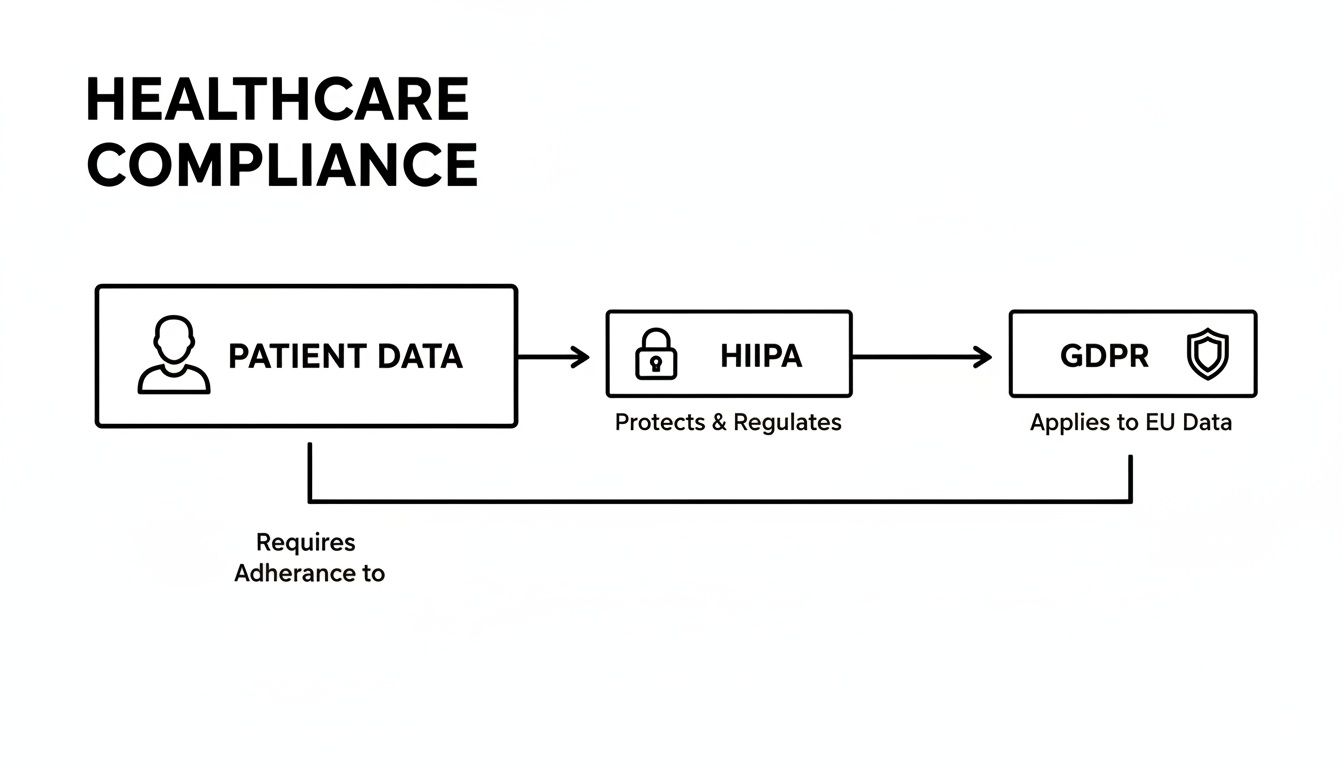
It’s a clear visual reminder that behind every byte of data are strict frameworks like HIPAA and GDPR, which are the bedrock of patient trust.
HL7 and FHIR: The Languages of Clinical Data
While DICOM is the master of the visual world, a different set of standards handles the massive flow of clinical and administrative data that keeps a healthcare system running.
- HL7 (Health Level Seven): For decades, HL7 has been the workhorse. It’s the protocol that exchanges critical information like patient admissions, discharge summaries, lab results, and billing details. It uses a rigid, structured message format to ensure that when a lab system pings an Electronic Health Record (EHR), the information arrives intact and is understood perfectly.
- FHIR (Fast Healthcare Interoperability Resources): FHIR is the modern answer to HL7's legacy, built for the internet age. It uses the same web-native technologies that power the rest of the digital world, like RESTful APIs and JSON. This makes it worlds easier for today's developers to build apps that can securely request and receive specific snippets of information—or "resources"—from massive clinical systems.
A simple way to think about it: HL7 is like sending a detailed, structured fax from one department to another—reliable, but a bit clunky. FHIR, on the other hand, is like using a modern API to ask a very specific question and get just the answer you need. It's built for speed, flexibility, and the world of mobile apps and cloud platforms.
Creating a Truly Connected Ecosystem
The real magic happens when these standards start working in concert. Imagine a system where a clinician opens a patient’s chart (managed via FHIR), reviews their latest blood work (transmitted via HL7), and instantly pulls up the related MRI scans in a built-in DICOM viewer. All in one place. All in a single click.
This is the ultimate goal. It's about breaking down the walls between departments and giving providers a holistic, real-time view of a patient's entire health journey. This powerful connectivity is what boosts patient safety, speeds up diagnoses, and drives better outcomes for everyone.
To dig deeper into this, you can learn more about achieving data interoperability in healthcare and the incredible impact it's having. Building systems that speak these languages fluently isn't just a technical problem to solve—it's one of the most inspiring missions in software engineering today.
Architecting Secure and Scalable Medical Platforms
When you're building the architecture for a modern healthcare platform, you’re not just writing code—you're designing the blueprint for a digital-first hospital. It has to be airtight, endlessly scalable, and almost impossibly resilient. Every choice, from the server setup to the application framework, has a direct line to patient safety and data integrity. We’re not just building software that works; we're engineering a digital fortress that can stand up to anything.
The financial stakes alone tell you how critical this is. The global healthcare IT market was valued at USD 354.04 billion and is on track to hit an incredible USD 1,380.51 billion by 2034. A massive portion of this growth—over 66% of total revenue—is driven by software and services like EHRs that bring clinical workflows into the modern era. These aren't just numbers; they represent the industry's deep reliance on systems that can handle staggering amounts of data with flawless security and efficiency. Discover more insights about the healthcare IT market on fortunebusinessinsights.com.
What this all means is that your architectural foundation must be ready not just for today's demands, but for whatever tomorrow throws at it.
Embracing a Defense-in-Depth Security Strategy
In healthcare software engineering, security can’t just be a single checkbox. A firewall at the edge is table stakes, but it’s nowhere near enough when you're safeguarding a person's most private health information. The real gold standard is a defense-in-depth strategy.
Think of it like securing a vault in a bank. You don't just have one big door; you have guards, cameras, pressure plates, and multiple locks. If one layer fails, another is right there, waiting to stop an intruder. This multi-layered approach ensures data is protected from every conceivable angle.
- Network Security: This is your perimeter, controlling who and what gets in or out of your system.
- Application Security: Here, you’re focused on secure coding, constant vulnerability scans, and iron-clad authentication to protect the software itself.
- Data Security: This crucial layer is all about encrypting patient data, both when it’s sitting on a server (at rest) and when it's moving across the network (in transit).
Layering your defenses this way creates a formidable barrier that makes unauthorized access to protected health information exceptionally difficult.
Building for Unpredictable Demand with Cloud-Native Architectures
A hospital’s emergency room can go from quiet to chaotic in minutes. Your platform has to be able to handle that same kind of unpredictable surge. This is precisely why cloud-native architecture is no longer a "nice-to-have"—it's a must.
By building on cloud platforms like AWS, Azure, or Google Cloud, you can design systems that automatically expand their resources when demand spikes and shrink them back down when things quiet down. This elasticity means your platform stays lightning-fast for every user without forcing you to pay for servers you aren't using.
A cloud-native approach gives your platform the agility to handle a sudden influx of a million users as seamlessly as it handles a thousand. It’s about building for resilience and ensuring that performance never falters, even under extreme pressure.
Using Microservices for Agility and Maintenance
Not long ago, most applications were built as monoliths—a single, massive block of code. In healthcare, that model is a liability. It’s a nightmare to update, and a single bug can crash the entire system. The answer is a microservices architecture.
Instead of one giant application, you break it down into a collection of small, independent services. Each service has one job and does it well, whether it's patient scheduling, billing, or medical imaging. At PYCAD, we see this in action when we build custom web DICOM viewers and integrate them into medical imaging web platforms. By designing the viewer as its own microservice, it can be updated, scaled, or debugged without ever touching the rest of the platform. You can see how we put this into practice in our portfolio of healthcare projects.
This modular design makes the whole system more resilient, vastly simpler to maintain, and allows you to innovate much, much faster. It's the architectural blueprint for the dynamic, secure, and scalable platforms that modern healthcare desperately needs.
Weaving AI into the Fabric of Modern Healthcare
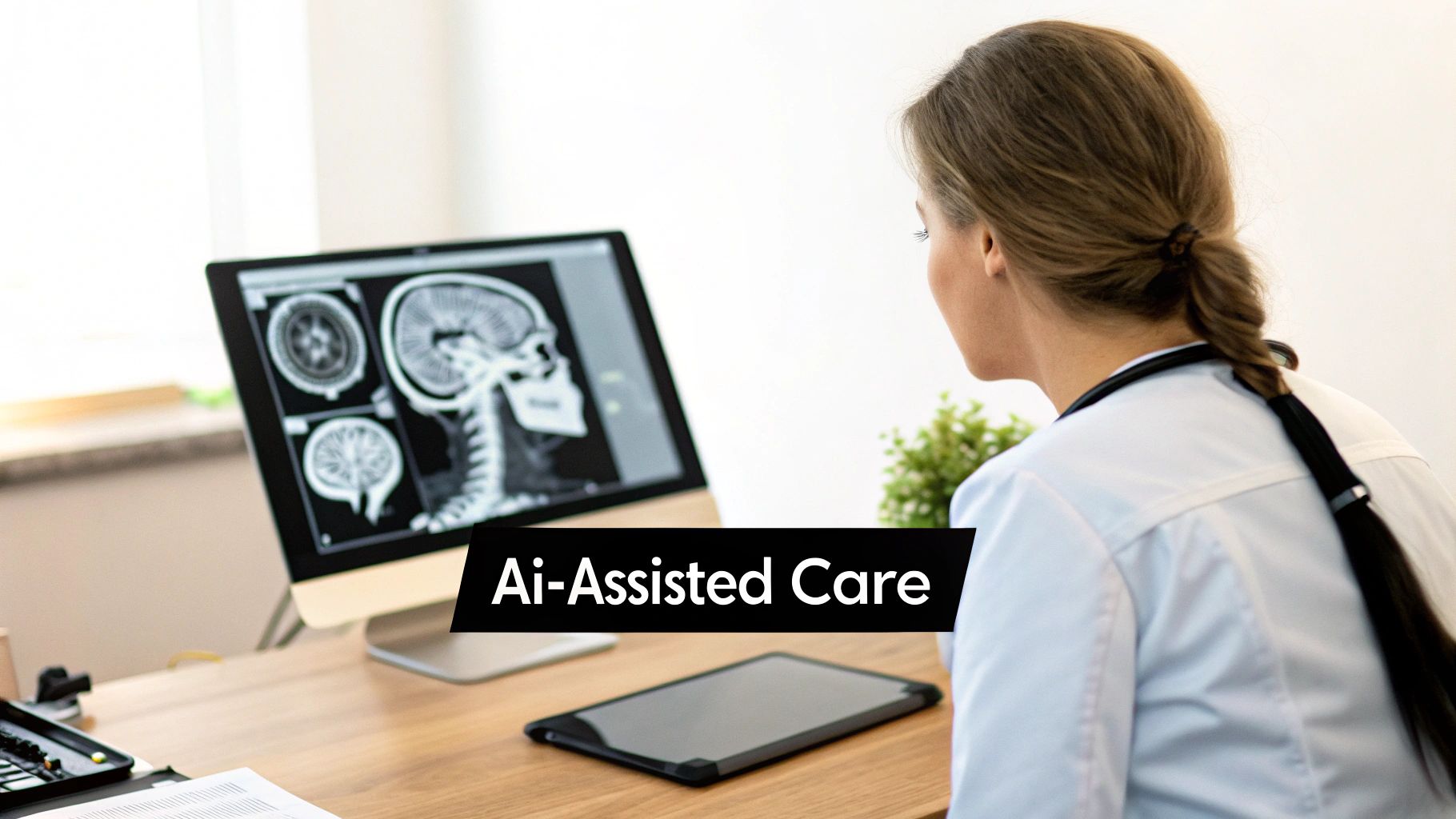
The future of healthcare is intelligent, predictive, and deeply personal. Artificial Intelligence (AI) and Machine Learning (ML) are stepping onto the stage, not to replace human expertise, but to act as a powerful partner for every clinician. When we build AI into medical platforms, we can finally unlock insights that were once buried in mountains of data, changing the very foundation of diagnostics and treatment.
Think of AI as an incredibly sharp assistant working alongside a radiologist. It can sift through thousands of medical images in minutes, flagging subtle anomalies the human eye might miss at the end of a long shift. This isn’t just about speed; it's about adding a new layer of precision and confidence, allowing specialists to pour their energy into the most complex cases.
A New Era for Medical Imaging and Diagnostics
The most tangible impact of AI in healthcare software engineering is happening right now in medical imaging. Algorithms, trained on millions of scans, are learning to spot the earliest signs of disease with breathtaking accuracy.
This is a game-changer in fields like oncology and neurology, where catching a problem early can completely change a patient's story. AI models can track tumor growth with perfect consistency or identify biomarkers for neurodegenerative diseases long before the first symptom appears.
At PYCAD, this is where we live and breathe. We build custom web DICOM viewers and integrate them into medical imaging web platforms, often enhancing them with AI-powered analytical tools. These systems don't just display images; they provide a data-driven second opinion, turning a standard viewer into a smart diagnostic command center.
The entire healthcare software market is buzzing with this kind of innovation. The ecosystem includes over 3,180 companies and 1,770+ startups, with patent growth hitting 3.47% annually. This shows a vibrant industry that's more than ready for what’s next.
Shifting from Reactive to Predictive Care
Beyond diagnostics, AI is the engine powering a monumental shift from reactive to proactive care. By analyzing electronic health records (EHRs), lab results, and real-time data from wearables, AI can build predictive models that pinpoint patients at high risk for specific conditions.
AI's true power in healthcare isn't just about finding what's already wrong; it's about predicting what could go wrong and giving clinicians the chance to intervene before it does. This transforms medicine from a practice of treatment into a discipline of prevention.
Think about what this makes possible:
- Risk Stratification: We can identify patients most likely to be readmitted to the hospital, allowing care teams to provide targeted, preventative follow-up.
- Personalized Treatment Plans: By analyzing a patient's genetics and health history, we can suggest the most effective therapies, minimizing trial and error.
- Operational Efficiency: We can optimize hospital bed management and staff schedules based on predictive patient flow, cutting down on wait times and making the most of every resource.
This level of insight moves us toward a future of truly personalized medicine, where treatment is no longer one-size-fits-all but is instead tailored to an individual’s unique biology.
Key Considerations for AI Integration
Bringing AI into a medical platform is about more than just a clever algorithm; it demands a thoughtful and ethical approach to healthcare software engineering.
One of the biggest hurdles is algorithmic bias. If a model is trained on data from one demographic, its predictions might falter for others. As engineers, it’s our responsibility to champion diverse datasets and constantly audit our models for fairness and equity.
It's also crucial that the technology always empowers, never replaces, the human element. AI should be a tool that enhances a clinician's judgment, freeing them from repetitive work so they can spend more time on what really matters: connecting with their patients. For a deeper dive into deploying this technology responsibly, check out this strategic guide to artificial intelligence for enterprise transformation.
Ultimately, building AI into healthcare platforms is about creating smarter, more responsive systems that lead to better outcomes for everyone. It's about a future where technology and humanity work in perfect harmony to heal.
Essential DevSecOps Practices for Medical Software
When you're building medical software, the stakes are incredibly high. There's simply no margin for error. This reality demands an engineering culture where quality and safety aren't just goals; they're non-negotiable from day one. This is where DevSecOps comes in.
Think of it as weaving security into the very fabric of your development lifecycle, rather than trying to bolt it on at the end. It’s a fundamental shift in mindset. Instead of security being a final gatekeeper, it becomes a shared responsibility at every single step—from the first line of code to the final deployment. This approach is crucial for preventing vulnerabilities from ever seeing the light of day, because in healthcare, a single bug can have real-world consequences for patient care.
The Pillars of Reliability: Testing and Performance
To build this kind of trustworthy software, automated testing is your best friend. Every new feature, every bug fix, needs a robust suite of tests to prove it works as intended and doesn’t accidentally break something else. This practice is your defense against regressions—those sneaky bugs that can creep in and silently undermine the integrity of your platform over time.
Performance is the other side of the coin. A medical application has to be rock-solid and lightning-fast, especially when a clinician is relying on it in a high-pressure situation.
Engineers need to simulate worst-case scenarios—imagine dozens of doctors pulling up massive imaging files all at once. The system must remain stable and responsive. A slow or crashing app isn't just an inconvenience; it's a barrier to effective care.
Monitoring for Proactive Problem Solving
Once the software is live, the work isn't over. Comprehensive monitoring gives you the eyes and ears you need to keep the system healthy. By tracking performance metrics, error rates, and resource usage in real-time, your team can spot trouble and fix it before it impacts users. This isn't just about reacting to problems; it's about getting ahead of them.
Adopting these practices is more than just checking boxes on a list; it’s about building a foundation of trust. To see how these ideas fit into the bigger picture, you can dive deeper into our complete guide to the medical software development process. It’s this deep commitment to engineering excellence that ensures the software we build is not only innovative but, most importantly, fundamentally safe and dependable.
Your Questions Answered: Navigating Healthcare Software Engineering
As we wrap up this deep dive, you probably have some lingering questions. It’s a complex field, after all. Let's tackle some of the most common ones that come up when teams are in the trenches, building the future of healthcare tech.
What Are the Toughest Hurdles We'll Face?
You're essentially juggling three critical priorities at all times. First, you have the regulatory maze—think HIPAA—where every single line of code that touches data is under intense scrutiny. It’s not just a guideline; it’s the law.
Next up is the puzzle of interoperability. Getting brand-new systems to talk fluently with decades-old hospital infrastructure using standards like FHIR and DICOM is a constant engineering challenge. Finally, and most importantly, is security. You're building a fortress to protect incredibly sensitive patient data from sophisticated, relentless cyber threats.
The real art of healthcare engineering is innovating and delivering a great user experience while never, ever compromising on these foundational pillars.
Isn't a DICOM Viewer Just Another Image Viewer?
Not even close. Building a DICOM viewer is a whole different ballgame. A standard app might just display a JPEG, but a DICOM file is so much more than a picture. It’s a rich, complex data package that includes the image itself plus a ton of protected patient metadata—who they are, the specifics of the scan, the equipment used, and more.
Because this data is Protected Health Information (PHI), the viewer has to be built with bank-vault-level security from the very first concept sketch. On top of that, performance is non-negotiable. Radiologists and surgeons need to load and manipulate massive imaging files instantly, with zero lag. At PYCAD, we build custom web DICOM viewers and integrate them into medical imaging web platforms, engineering them for both uncompromising security and the split-second speed clinicians rely on. You can see how this plays out in our portfolio of healthcare software projects.
Why Is Everyone Talking About FHIR Now?
FHIR (Fast Healthcare Interoperability Resources) is taking over because it finally speaks the language of the modern web. It uses RESTful APIs and JSON, tools that developers are already masters of. This means you can build connected health applications much, much faster.
Older standards like HL7v2 are the workhorses of healthcare, but they can be incredibly rigid and clunky to work with. FHIR is built for a different world—one of mobile apps, cloud platforms, and AI. Its flexible, resource-based design is exactly what we need to create a truly connected and modular healthcare ecosystem.
At PYCAD, we thrive on these challenges, transforming complex engineering problems into secure, scalable, and genuinely useful healthcare platforms. If you’re ready to build something that makes a real difference, we have the deep expertise to help you get there.