
When we talk about healthcare technology, we're no longer just discussing isolated digital tools. We're talking about a fully connected ecosystem—a network of systems designed to enhance patient care, sharpen clinical workflows, and drive medical research forward at an unprecedented pace.
This is the new foundation of modern medicine, bringing together everything from electronic health records and medical imaging to AI-powered diagnostics.
The New Frontier of Patient Care and Medical Innovation
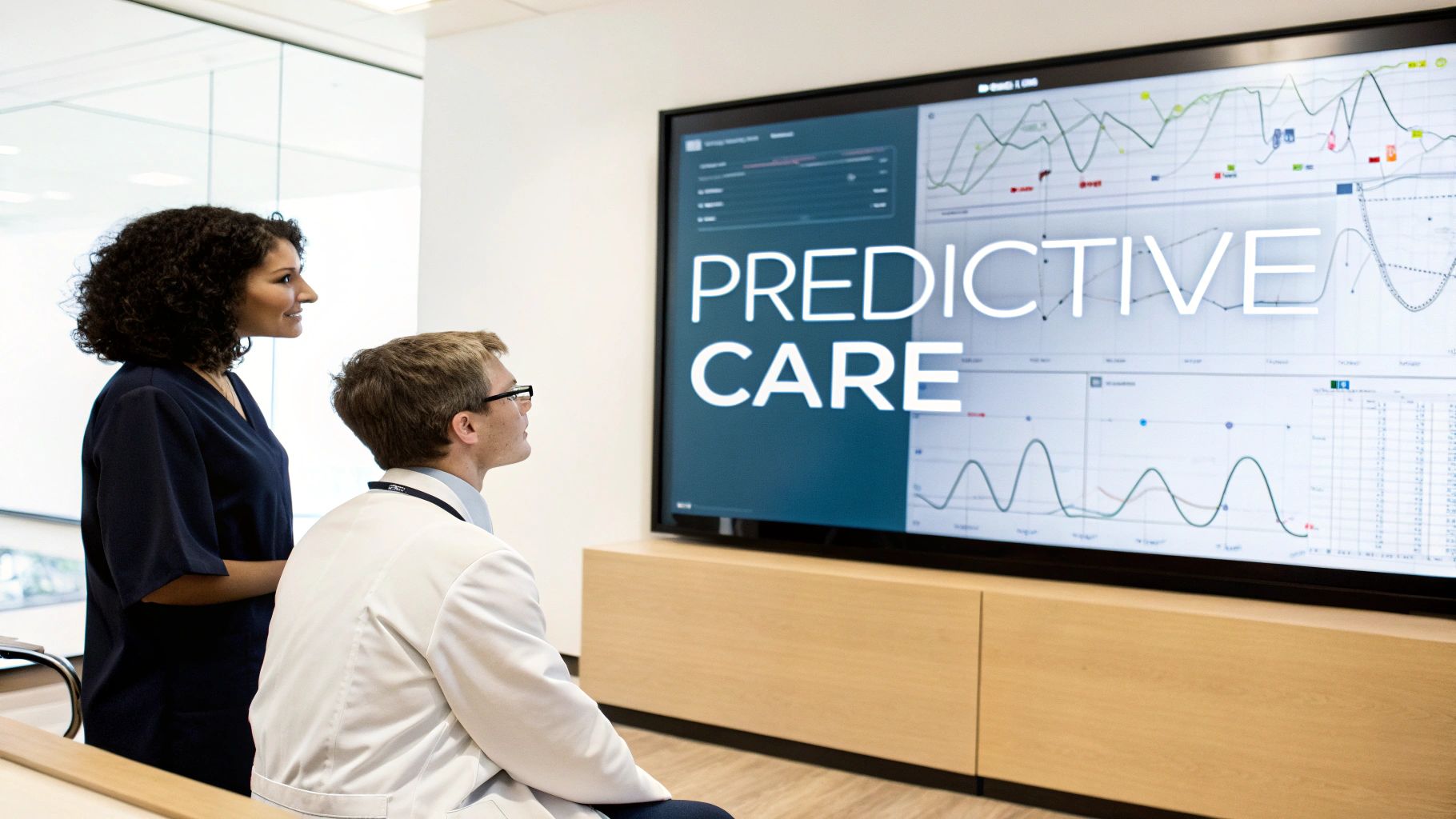
Picture a healthcare system that doesn't just react to illness but actively predicts it. A world where a patient's data flows instantly and securely between specialists, and where researchers can find the key to medical breakthroughs in record time. This isn’t a far-off dream. It's the reality being built right now with integrated healthcare technology solutions.
We're leaving behind the era of siloed tools and entering a new age where every piece of technology speaks the same language. This guide is your map to this incredible shift, revealing how these solutions are fundamentally changing what's possible for patient outcomes. This isn't just a fleeting trend; it’s a global movement.
The Driving Force Behind Medical Innovation
The momentum is staggering. The global healthcare IT market, valued at USD 880.56 billion in 2025, is on a trajectory to hit an astonishing USD 3,715.34 billion by 2035. This explosive growth isn't just about numbers; it reflects a deep, urgent need for smarter digital solutions to tackle the world's most pressing health challenges.
This surge is fueling several key advancements:
- Predictive Analytics: We can now use data to forecast disease outbreaks and identify at-risk patients long before their conditions become critical.
- Interoperability: This is about making sure all systems—from EHRs to complex diagnostic tools—can communicate seamlessly. No more data gaps.
- Personalized Medicine: Treatment is no longer one-size-fits-all. We can now tailor therapies to a person's unique genetic code and lifestyle, dramatically improving results.
This connected approach creates a powerful feedback loop. Better data generates deeper insights, which in turn leads to superior patient care and faster discovery. It's about building a healthcare system that's not just more efficient, but more intelligent and responsive for everyone.
At PYCAD, we're right in the thick of this movement. We build the foundational tools that make this new era a reality, specializing in building custom web DICOM viewers and integrating them into medical imaging web platforms. Of course, technology alone isn't enough; a thoughtful digital marketing strategy for healthcare is also crucial for building patient trust and driving the adoption of these life-changing innovations.
Our work is all about turning visionary concepts into real-world, life-saving tools for clinicians and researchers. You can explore some of these powerful platforms in our portfolio of work. By building these purpose-driven systems, we’re helping make the promise of predictive, data-driven medicine a daily reality.
The Power of Integrated Medical Imaging Platforms
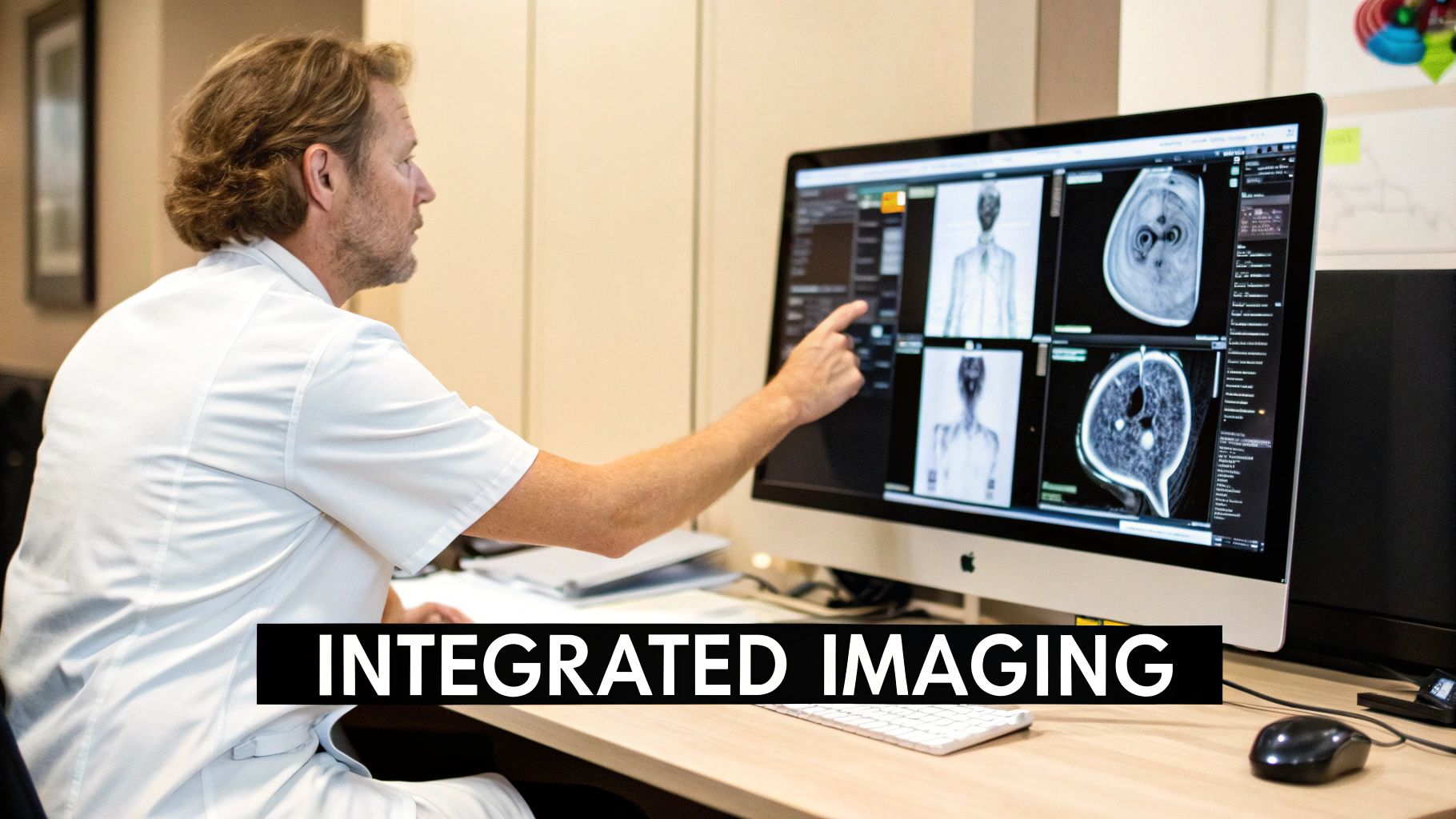
Medical imaging sits at the very heart of modern diagnostics. But too often, its incredible potential is trapped inside isolated, clunky systems. Think of a basic DICOM viewer as a flat paper map—it’s useful for one specific purpose, but it's completely static and lacks any real-world context. It shows you one thing, and one thing only.
Now, imagine a custom, web-based platform. This isn’t just a map; it's a living, breathing GPS system, layered with real-time data, collaborative tools, and even predictive insights. That’s the monumental difference an integrated solution makes. It elevates a simple image into a deep well of actionable intelligence.
This move toward integrated healthcare technology solutions isn't just about making things easier; it's a fundamental necessity. For today's clinicians and researchers, seamless access and real-time collaboration aren't just "nice-to-haves." They are the bedrock of high-quality care and accelerated medical discovery.
Beyond Viewing to True Integration
An integrated platform doesn't just show you an image. It builds a central hub where diagnostics and research can truly flourish. This is where a custom-built solution completely outshines generic, off-the-shelf software.
Instead of forcing your team into a one-size-fits-all box, a purpose-built platform delivers:
- Workflows That Fit You: Your processes are designed around your team's actual needs, cutting out wasted steps and boosting efficiency.
- Security from the Ground Up: Security isn't an afterthought; it’s baked into the platform's foundation, ensuring ironclad protection for sensitive patient data.
- Ready for What's Next: The entire architecture is built to embrace advanced artificial intelligence and machine learning algorithms from day one.
Here at PYCAD, this is exactly what we do. We build custom web DICOM viewers and integrate them into medical imaging web platforms. Our goal is to create a seamless environment where every tool works in perfect harmony, letting medical professionals focus on what truly matters: their patients and their progress.
The ultimate goal is to create a single source of truth. When a radiologist, an oncologist, and a surgeon can all view and annotate the same study simultaneously from different locations, the quality and speed of decision-making improve dramatically.
The Impact on Collaboration and Diagnostics
Picture a research team scattered across the globe, all able to access and analyze complex imaging data through a single, secure web portal. They can share findings, run analyses, and collaborate as if they were sitting in the same room. That's the real power of a centralized platform.
This kind of connectivity doesn't happen by accident—it’s the result of thoughtful system design. By focusing on how different pieces of the healthcare puzzle talk to each other, we can finally break down the information silos that have held back progress for decades. For a deeper dive into the technical side, understanding the details of Picture Archiving and Communication System integration is a fantastic place to start.
By bringing these separate systems together, integrated healthcare technology solutions become more than just software. They become catalysts for innovation, empowering teams to work smarter and faster. The results speak for themselves: quicker diagnoses, more effective treatment plans, and a huge leap forward in research timelines. To see these concepts in action, take a look at our portfolio of real-world projects.
How AI Is Augmenting Human Expertise in Healthcare
Artificial intelligence in healthcare isn't about replacing doctors; it's about giving them superpowers. Forget the old sci-fi movies. The reality is much more exciting. Think of AI as a tireless, brilliant assistant for clinicians, working quietly in the background to uncover insights that were once impossible to see.
This is where today's best healthcare technology solutions really shine. AI algorithms can scan millions of data points in the blink of an eye, picking up on subtle patterns in a medical image that the human eye might miss. They can even forecast disease progression with startling accuracy, giving doctors a critical head start on creating a treatment plan.
This partnership between human intuition and machine intelligence is already changing the game. We’re seeing fewer diagnostic errors, faster research, and the beginning of truly personalized medicine. It's the perfect fusion of human experience and artificial intelligence, leading to breakthroughs we only used to dream about.
From Raw Data to Life-Saving Intelligence
The real magic happens when AI becomes a natural part of the clinical workflow—not just another piece of software to learn. It’s about embedding this intelligence directly into the platforms doctors already use every day, turning raw data from scans into clear, actionable knowledge.
Imagine these scenarios, which are already happening today:
- Predictive Diagnostics: AI models analyze a patient's history, genetics, and lab results to flag risks for conditions like heart disease or cancer, allowing for intervention before the problem even starts.
- Enhanced Imaging Analysis: In radiology, AI can act as a second pair of eyes, highlighting suspicious areas on an MRI or CT scan. This helps radiologists prioritize the most urgent cases and reduces the chance of overlooking a small but critical detail.
- Accelerated Drug Discovery: Researchers are using AI to comb through massive molecular databases, predicting which compounds are most likely to become effective drugs and shaving years off the discovery process.
This incredible potential is driving explosive growth. The global AI market in healthcare is projected to soar from around USD 1 billion in 2017 to an estimated USD 28 billion by 2025. Much of that growth is coming from diagnostics and imaging, which tells you just how valuable these tools have become. You can learn more about the expanding AI health market and its key drivers and see the data for yourself.
Building Trust Through Explainable AI
For any of this to work, clinicians have to trust the technology. That’s where "explainable AI" comes in. It’s not enough for an algorithm to just give you an answer; it has to show its work.
When an AI model flags a tumor, it should also be able to visually indicate the exact pixels in the DICOM image that it identified as abnormal. This transparency builds confidence and allows the clinician to remain the ultimate decision-maker, using AI as a powerful validation tool.
This is a core principle for us at PYCAD. We don’t just bolt on AI features. We build custom web DICOM viewers and integrate them into medical imaging web platforms with explainable AI at their heart. By making the "why" behind an AI's suggestion crystal clear, we empower medical professionals to make faster, more informed decisions with absolute confidence. If you want to dive deeper, you can explore our guide on the critical role of explainable AI in healthcare.
Ultimately, the goal is a true partnership. The AI does the heavy lifting with the data, and the human expert provides the wisdom, context, and final clinical judgment. That powerful synergy is what elevates patient care to a whole new level. To see how we’ve put these ideas into practice for our clients, feel free to visit our portfolio page.
3. Building Your Connected Healthcare Ecosystem
Think of it like this: a world-class orchestra isn't just a collection of incredible instruments. It’s the harmony they create together that produces beautiful music. The same principle applies to healthcare technology. You can have the most advanced systems in the world, but if they don't talk to each other, you just have noise.
This is the challenge of interoperability—the absolute necessity for different systems to work together seamlessly.
When your Electronic Health Records (EHRs), Picture Archiving and Communication Systems (PACS), and even your patient CRM operate in their own little silos, they create friction. This digital disconnect causes frustrating delays for clinicians, adds unnecessary steps to workflows, and can even introduce risks to patient safety. An integrated platform, on the other hand, creates a symphony of information where data flows effortlessly, empowering everyone.
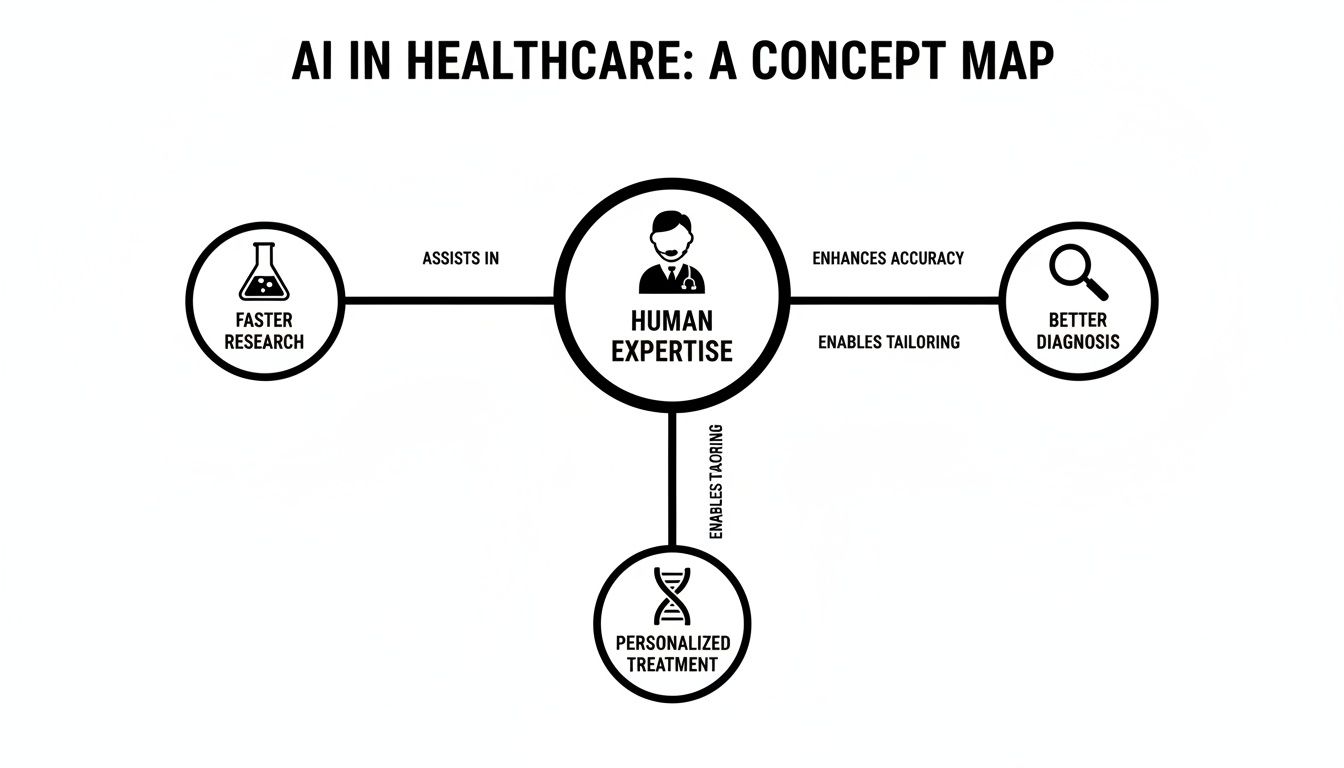
As you can see, the real power comes from amplifying human expertise with technology. This connected approach is what leads to faster research, more accurate diagnoses, and truly personalized care.
The Common Language of Healthcare Data
To make this vision a reality, every piece of software needs to speak the same language. In healthcare IT, that language is built on interoperability standards. These are the agreed-upon rules of the road that allow software from completely different vendors to exchange and understand data securely.
Two of the most foundational standards you'll encounter are:
- HL7 (Health Level Seven): For decades, HL7 has been the bedrock for transferring clinical and administrative data between healthcare applications. It's the foundational grammar that makes most of our data exchange possible.
- FHIR (Fast Healthcare Interoperability Resources): The modern evolution of these standards, FHIR (pronounced "fire") is built for the web. It uses modern API technology, which makes it much easier for mobile apps, cloud platforms, and new tools to securely tap into and share health information.
The Core Pillars of Your Technology Stack
Building a cohesive system isn't just about picking the right standards; it's about understanding how the key components fit together. Each piece of the puzzle plays a specific role, but their true value is unlocked when they are integrated into a single, unified platform.
Below is a breakdown of the essential technologies and how they contribute to a connected ecosystem.
Key Components of an Integrated Healthcare Technology Ecosystem
| Technology Component | Primary Function | Integration Benefit |
|---|---|---|
| DICOM Viewer | Displays and analyzes medical images (MRIs, CTs). | Links diagnostic images directly to patient records in the EHR for a complete clinical picture. |
| Integrated CRM | Manages patient relationships and communications. | Provides a 360-degree view of patient interactions, from appointments to follow-ups. |
| AI Integration | Automates analysis and provides decision support. | Speeds up diagnostic workflows and uncovers insights from vast datasets. |
| Security & Compliance | Protects patient data and ensures regulatory adherence. | Creates a unified security framework, reducing vulnerabilities across all connected systems. |
| Interoperability Hub | Facilitates data exchange between disparate systems. | Acts as the central nervous system, ensuring seamless data flow based on HL7/FHIR standards. |
This table illustrates how a truly integrated platform is far more than the sum of its parts. When these technologies work in concert, they create a powerful, efficient, and secure environment for modern healthcare delivery.
Why a Unified Platform Is a Strategic Must
Thinking about interoperability isn't just a task for the IT department; it's a strategic imperative for the entire organization. A unified technology stack does more than just make things run smoother—it’s fundamental to patient safety and data security. When all your systems are connected, you close the dangerous gaps where critical information can get lost in translation.
This is why we're seeing a massive push for cohesive healthcare technology solutions. In fact, spending in this area is on track to hit a staggering USD 279.5 billion globally by 2025. You can dive deeper into these healthcare IT spending trends and see that the major investments are flowing into cloud infrastructure, security, and data intelligence—all hallmarks of a modern, unified platform.
A truly connected ecosystem means a specialist can view a patient's entire story—from lab results in the EHR to detailed scans in the DICOM viewer—all within a single screen. This holistic view isn't a luxury; it's the new standard of care.
At PYCAD, this is exactly what we build. At PYCAD, we build custom web DICOM viewers and integrate them into medical imaging web platforms to create this harmony. Whether you're a hospital IT team or an ambitious medtech startup, we help you create the ecosystem your organization needs to thrive.
By prioritizing a unified approach from day one, you build a resilient, secure, and future-proof foundation for your organization. To see how we've brought this vision to life for others, we invite you to explore our portfolio of projects.
Mastering Security and Compliance in Medtech
In healthcare technology, trust isn't a soft skill—it's the absolute currency. Security and compliance aren't just hurdles to clear; they are the very foundation upon which you build patient confidence and create successful healthcare technology solutions.
Imagine a patient's sensitive health information as the contents of a Swiss bank vault. Regulations like the Health Insurance Portability and Accountability Act (HIPAA) in the U.S. and the General Data Protection Regulation (GDPR) in Europe are the architectural blueprints for that vault. They provide the exact specifications needed to construct a digital fortress that protects our most personal data from prying eyes.
Building a Digital Fortress for Patient Data
Every single interaction, data transfer, and stored image has to be shielded by the highest levels of protection. This is non-negotiable. It demands a proactive, almost obsessive approach to security where every potential weakness is found and fixed before it ever becomes a threat. For any technology partner you consider, this commitment must be part of their DNA.
For example, understanding modern approaches to things like secure electronic faxing solutions for patient data protection is just one piece of the puzzle. The real goal is to create layers upon layers of defense, making sure data is locked down at every step of its journey.
To know if you're working with a partner who truly gets this, you have to ask the right questions. Their answers will tell you everything you need to know about whether they see security as a core principle or just another box to check.
Critical Questions for Your Technology Partner
When you're vetting potential partners, their security posture should be at the top of your list. A partner worth their salt will welcome this scrutiny and give you transparent, detailed answers.
Drill down into these essential areas:
- Encryption Standards: Ask them to get specific. What protocols do they use for data in transit (as it's moving) and at rest (when it's stored)? You want to hear them say things like AES-256, a current, robust standard.
- Access Controls: How do they lock the doors? Look for role-based access control (RBAC), a system that ensures people can only see the information they absolutely need to do their jobs—and nothing more.
- Audit Trails and Monitoring: Can they prove who did what, and when? Their platform must keep a detailed, unchangeable log of all data access and modifications. This is your safety net for accountability and for spotting suspicious activity.
- Regulatory Adherence: How do they keep up with ever-changing rules like HIPAA? They should be able to clearly describe their ongoing compliance programs, staff training, and how they stay ahead of the curve.
At PYCAD, this relentless commitment to security is at the core of everything we build. We don't just create custom web DICOM viewers and integrate them into medical imaging platforms; we engineer them to not just meet, but to blow past these strict industry standards.
Choosing a partner is about more than just technology; it's about entrusting them with your patients' privacy. A partner who prioritizes security is demonstrating their commitment to protecting the people at the center of your mission.
Our expertise ensures that every solution we architect is fortified from the ground up. You can see what we mean by exploring our detailed guide on achieving HIPAA-compliant data transfer for medical imaging. We believe that by mastering security, we give you the freedom to innovate with absolute confidence. And you can always view our completed work on our portfolio page.
A Strategic Roadmap for Bringing Your Solution to Life
Inspiration is where it all begins, but a clear roadmap is what turns that initial spark into a roaring fire of progress. This is the moment to transform the incredible potential of healthcare technology solutions into a solid action plan for your organization. It's where your vision for better patient outcomes, accelerated research, and a more empowered team starts to take shape.
Getting there isn’t about taking a wild leap of faith; it’s about a steady, methodical journey. Real success comes from moving past abstract goals and creating a structured plan that’s built around your specific clinical or research objectives. You’re not just buying software—you’re building a foundation for innovation that will last for years to come.
Know Your Destination Before You Start the Journey
The first step is always the most important: define what success truly looks like for your team. Before you even think about talking to a vendor, you need absolute clarity on the core problems you’re trying to solve. Think of this needs analysis as your North Star—it will guide every single decision you make from here on out.
This is the time for a deep, honest look at your current workflows and the friction points holding you back.
- Pinpoint Your Needs: Are you trying to slash diagnostic turnaround times? Do you need to help remote research teams collaborate more effectively? Is the goal to seamlessly integrate imaging data directly into patient records? The more specific you are, the better.
- Get Everyone on Board: Bring your key people into the conversation early—clinicians, researchers, IT staff, and administrators. A solution that’s a game-changer for one department but a headache for another isn’t really a solution at all.
- Measure What Matters: Think bigger than just cost savings. How will you measure the real return on investment? Consider improved patient outcomes, faster research timelines, or even a boost in staff morale and satisfaction.
This screenshot from our portfolio shows a few of the custom medical imaging platforms we've built from the ground up.
Every single one of these projects started as a unique challenge, which we solved by working hand-in-hand with our partners to build something truly special.
Look for Partners, Not Just Vendors
Once your needs are crystal clear, it’s time to find a team that can help you build the future, not just sell you a product. A vendor gives you a tool; a true partner invests themselves in your success. They dig in, listen to your challenges, and work with you to create a solution that feels like it was made just for you.
A true partner doesn't just ask, "What do you want to buy?" They ask, "What are you trying to achieve?" This fundamental shift in perspective is the difference between a simple transaction and a genuine partnership that drives meaningful results.
At PYCAD, this partnership philosophy is at the core of everything we do. We specialize in building custom web DICOM viewers and integrating them into complete medical imaging platforms designed to solve your specific problems. We believe in crafting bespoke solutions that empower your team and elevate the incredible work you do.
The path forward is clear. It’s time to move from vision to reality. We invite you to explore our work and see how we've helped organizations just like yours build the future of healthcare, one challenge at a time.
Your Questions, Answered
Venturing into the world of healthcare technology can feel like navigating a maze. It’s completely normal to have questions as you figure out the best way forward for your organization. Let's tackle some of the most common ones we hear from medtech leaders.
Here are some clear, straightforward answers to help guide your journey.
| Question | Short Answer |
|---|---|
| What's the absolute first step? | Start with a deep dive into your own needs. Before you even look at a single vendor, you need to know exactly what problem you're trying to solve. |
| How do we make sure new tech actually works with our old tech? | You have to make interoperability a non-negotiable. Look for a partner who speaks the language of integration, using standards like HL7 and FHIR. |
| Is a custom solution really worth it? | If you want technology that adapts to you—not the other way around—then yes. Custom builds are designed for your unique workflows, security needs, and future growth. |
Let's unpack these a bit more.
What Is the First Step in Choosing a Solution?
The most important thing you can do is a thorough needs analysis. Seriously, before you look at a single demo, you have to get crystal clear on the specific problems you need to solve. Are you aiming to sharpen diagnostic accuracy? Make collaboration between researchers less of a headache? Or finally get your different systems to talk to each other?
When you have a detailed map of your unique challenges, it becomes your compass for the entire selection process. This focus is what ensures you invest in a solution that delivers real, measurable value from the get-go.
How Can We Ensure a New Technology Integrates?
You need to find a partner who lives and breathes interoperability. Don't be shy about asking potential vendors about their track record with standards like HL7 and FHIR. Ask for real-world case studies of successful integrations with the systems you already use, like your EHRs and PACS.
A true partner, like PYCAD, won't just sell you a product. They’ll start with a discovery phase to truly understand your current tech stack. From there, they'll architect a solution where seamless integration is the foundation, not an afterthought.
What Makes a Custom Solution Better?
Off-the-shelf products can seem appealing because they're quick, but they often come with a hidden cost: you have to bend your workflows to fit their rigid limitations. A custom solution, on the other hand, is built from the ground up around your specific needs, your team's processes, and your vision for the future.
This approach delivers concrete advantages that generic software just can't touch:
- Workflows That Flow: Your processes are designed to make your team more efficient, not box them in.
- Purpose-Built Security: Security isn't a one-size-fits-all patch; it's engineered for your specific data and compliance needs.
- Ready for Tomorrow: The platform is built to grow with you and easily accommodate future technologies, like more advanced AI.
It’s an investment in a platform that truly works for you. At PYCAD, this is our specialty. We build custom web DICOM viewers and integrate them into medical imaging web platforms that are meticulously crafted to meet our clients' precise needs. You can see this philosophy in action by exploring our portfolio of successful projects.
Ready to build a healthcare technology solution that truly fits your vision? At PYCAD, we create bespoke platforms that empower clinicians and researchers. Explore our work at https://pycad.co/portfolio and contact us to start the conversation.