Forget clunky desktop software and siloed medical records. The future of medicine is being built in the cloud, and it all runs through a browser. We're talking about creating secure, intuitive web platforms that connect doctors, patients, and researchers in a single, unified ecosystem—handling everything from patient charts to complex medical imaging files like DICOM.
The Future of Medicine is Built on the Web
Imagine a world where critical medical data flows instantly and securely, weaving together every touchpoint of a patient's care journey. This isn't science fiction; it's the reality we're building today with modern healthcare web applications. We're finally moving away from disjointed, on-premise systems and toward intelligent, cloud-based platforms that give clinicians the tools they need, right at their fingertips, no matter where they are.
This isn't just a minor tech upgrade; it's a complete reimagining of healthcare infrastructure. And the momentum is undeniable. The digital health market, encompassing everything from telehealth to web-based patient portals, was already valued at around $312.9 billion in 2024. Projections show it soaring to over $1 trillion by 2034, fueled by the relentless demand for more efficient and accessible care. This explosive growth makes one thing clear: browser-based workflows are rapidly becoming the new standard. Discover more insights about the digital health market's growth.
Core Pillars of Modern Healthcare Applications
To build these systems right, you have to focus on a few non-negotiable pillars. Think of it as constructing a digital ecosystem that's not only powerful but also fundamentally trustworthy.
Here's what truly matters:
- Impenetrable Security: We're talking end-to-end encryption and strict access controls to shield sensitive patient data from any threat.
- Ironclad Regulatory Compliance: Strict adherence to standards like HIPAA and GDPR is paramount. There's no room for error when it comes to patient privacy.
- Intuitive User Experience: The goal is to design interfaces that clinicians actually want to use—tools that simplify their day, not add another layer of complexity.
- Powerful Data Handling: These platforms must effortlessly manage incredibly complex data, from lab results to high-resolution medical images.
This isn't just about writing code. It's about architecting the very infrastructure for a more connected, intelligent, and human-centric future in patient care. The mission is to create a seamless environment where technology empowers clinicians to deliver world-class medical services.
At PYCAD, we live and breathe this work. We specialize in creating these exact platforms, with a deep focus on the unique challenges of medical imaging. At PYCAD, we build custom web DICOM viewers and integrate them into medical imaging web platforms, crafting solutions that feel like a natural extension of the clinical workflow.
This guide is our blueprint for turning the vision of a connected healthcare future into a tangible reality. To see what’s possible, feel free to explore our portfolio of advanced medical web applications.
Building a Secure and Compliant Foundation
In healthcare, trust is everything. It’s the bedrock of the patient-provider relationship, and when we build digital tools for this space, that trust must be our north star. We’re not just building software; we’re creating a digital sanctuary for some of the most sensitive, personal data on the planet.
This means security and compliance can't be bolted on at the end. They have to be baked in from the very first line of code, from the initial architectural sketch. It’s the difference between adding a deadbolt to a flimsy door and building a bank vault. The vault’s strength comes from its holistic design—walls, door, and locks engineered to work as one impenetrable system.
This "secure-by-design" philosophy is about creating an entire ecosystem where security, compliance, and a great user experience are all interconnected, especially within a modern cloud environment.
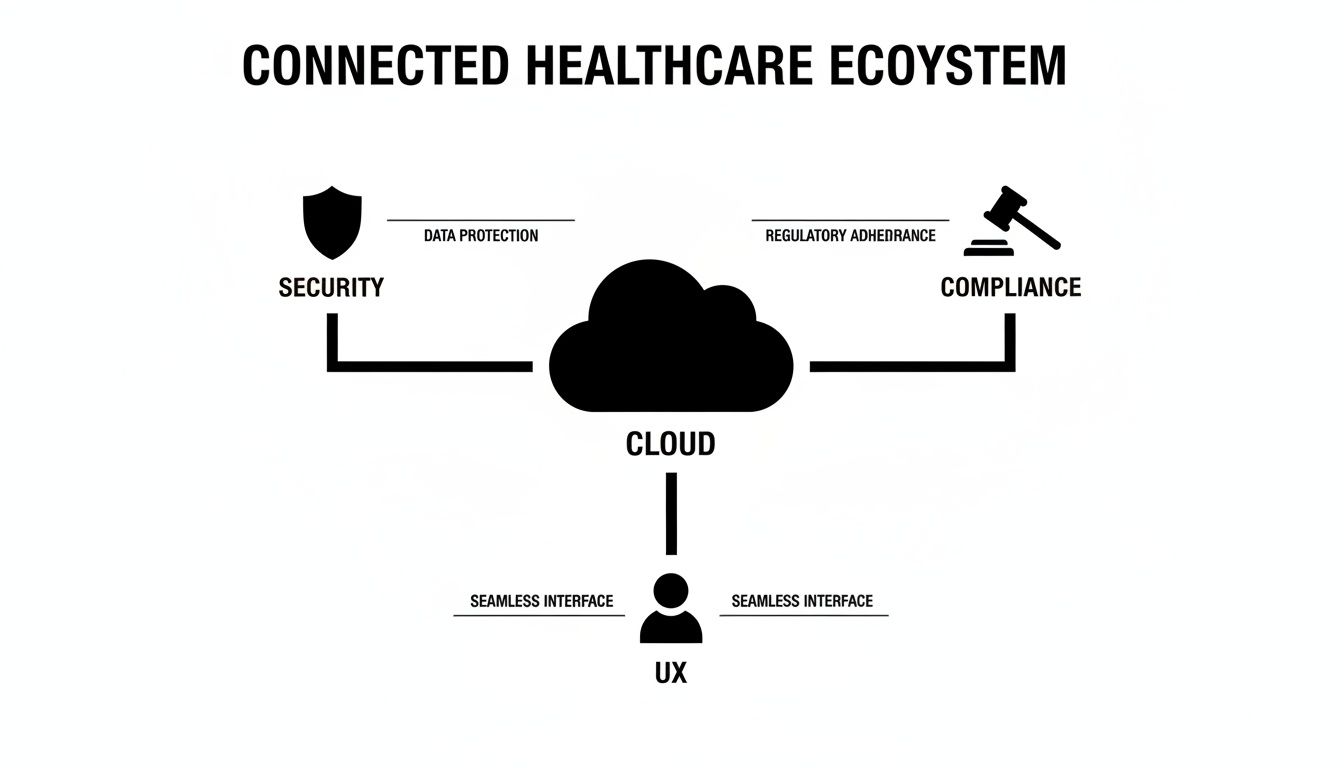
As you can see, you can't sacrifice one piece for another. A brilliantly secure system that's impossible to use won't get adopted, and an easy-to-use app with weak security is a disaster waiting to happen. It's all about finding that perfect balance.
Core Security and Compliance Measures
Let’s be honest, regulations like HIPAA (Health Insurance Portability and Accountability Act) and GDPR (General Data Protection Regulation) can feel like dense legal mazes. The real art is translating those rules into practical, actionable design principles for your application. These aren't just checkboxes to tick off; they're blueprints for protecting patient privacy and ensuring data is handled with the respect it deserves.
Every secure healthcare application absolutely must have these foundational elements in place:
- End-to-End Encryption: Think of this as an unbreakable code. All data, whether it's sitting on a server (at rest) or traveling across the internet (in transit), must be encrypted. This makes the information completely unreadable to anyone who isn't authorized to see it, even if they somehow get their hands on it.
- Robust Access Controls: Not everyone in a hospital needs access to every patient's file. Role-Based Access Control (RBAC) is critical. It ensures that users—from nurses to radiologists to billing clerks—can only see the specific information they need to do their jobs, and nothing more.
- Multi-Factor Authentication (MFA): In today's world, a password just isn't enough. MFA adds a powerful second layer of defense, forcing users to prove their identity with something extra, like a code sent to their phone. It’s a simple step that shuts down a huge percentage of unauthorized access attempts.
- Comprehensive Audit Trails: Imagine a security camera that records every single action inside your application. That’s what an audit trail does. It logs who accessed what data, when they did it, and any changes they made. This immutable record is your best friend during compliance audits and is absolutely essential for investigating any security incidents.
One of the most basic, non-negotiable first steps here is understanding HTTP vs HTTPS. Using secure protocols like HTTPS is table stakes for protecting any data moving between the user and your application.
Navigating HIPAA and Data Management
Getting HIPAA right requires a deep, practical understanding of Protected Health Information (PHI). This isn't just a patient's diagnosis; it's their name, their address, and even their medical imaging files. A huge challenge is making sure every single component of your application, from the database to the user interface, handles PHI with the utmost care.
For example, when we at PYCAD build custom web-based DICOM viewers, we're engineering them to manage enormous imaging files while maintaining ironclad compliance. The viewer has to authenticate every user, log every single access, and ensure that no sensitive data is accidentally left behind on a local computer's cache. You can get a much deeper look into how to tackle this by reading about best practices for secure and https://pycad.co/hipaa-compliant-data-transfer/.
A truly compliant application doesn't just meet the letter of the law; it embodies its spirit. It anticipates risks, protects against them proactively, and creates an environment where both clinicians and patients feel confident that their data is safe.
This mindset extends to details like data residency—knowing exactly where your data is physically stored to comply with national laws—and weaving privacy into every feature from day one. By making these smart architectural choices early on, you build a platform that doesn’t just pass an audit. You create a trusted tool that empowers the future of healthcare.
Weaving in the Power of a Custom DICOM Viewer
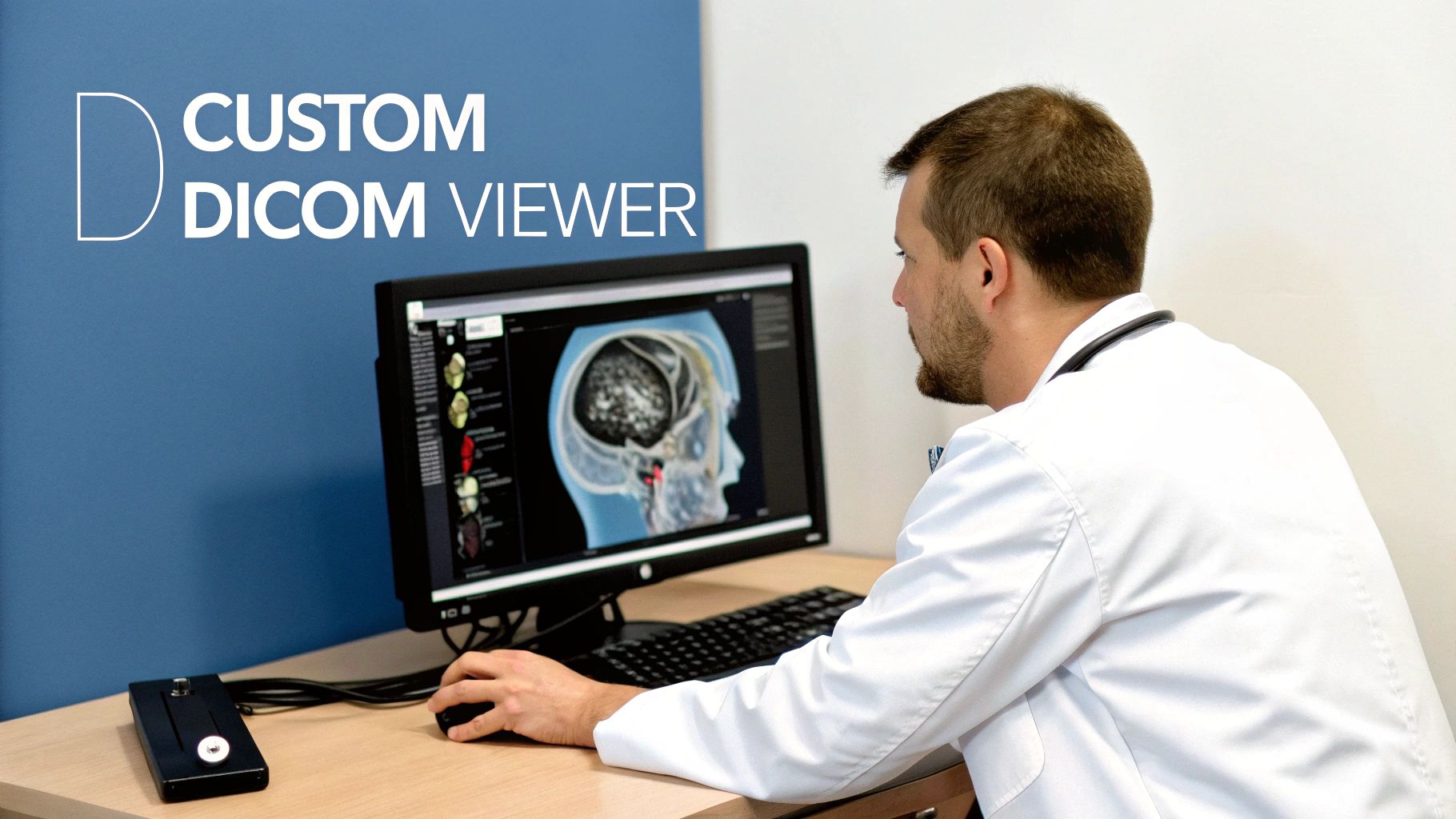
In medical diagnostics, every single pixel tells a part of the story. When you're building a healthcare web application around medical imaging, the DICOM viewer isn't just another feature—it's the very heart of the clinical workflow. This is the digital space where doctors make diagnoses, form treatment plans, and ultimately, change lives.
Trying to shoehorn a generic, off-the-shelf viewer into a specialized medical practice just doesn't work. It’s like handing a world-class chef a blunt knife; they might get the job done, but you lose all the precision, efficiency, and artistry. The real magic happens when you build a viewer specifically for the clinicians who will depend on it every single day.
Why Customization Drives Better Outcomes
The true value of a custom viewer is its power to perfectly mirror the unique workflow of a specific medical discipline. A one-size-fits-all approach always forces compromises, making clinicians adapt to their tools instead of having tools that adapt to them. A purpose-built viewer, on the other hand, actively speeds up diagnosis and boosts accuracy.
Think about these real-world scenarios:
- For Radiologists: A custom viewer with integrated multi-planar reconstruction (MPR) is a game-changer. It lets them instantly see anatomical structures from multiple angles—axial, coronal, and sagittal—all from a single 3D scan. This is absolutely critical for spotting subtle issues that a standard 2D view might miss.
- For Cardiologists: Imagine a viewer with automated tools built right in to measure ejection fraction or analyze coronary artery stenosis. These aren't just minor conveniences; they are essential for diagnosing heart conditions and planning interventions with millimeter-perfect precision.
- For Surgeons: Advanced 3D rendering gives surgeons a crystal-clear view of complex anatomy before they ever make an incision. They can map out surgical approaches, run through procedures, and even use the models to educate patients, which leads to better-prepared teams and more confident patients.
Seamless Integration and Workflow Harmony
A custom viewer becomes exponentially more powerful when it's woven seamlessly into your larger web platform. The aim is to create one unified digital environment. An experience where imaging tools work in perfect concert with patient records, reporting systems, and collaboration features.
This eliminates the constant, frustrating friction of jumping between different apps—a notorious source of errors and lost time in busy clinical settings.
The ultimate goal is to make the technology disappear. We want to create such an intuitive environment that the clinician's focus stays entirely on the patient's images and data, not on battling clunky software.
This seamless fusion of technology and clinical practice is what separates a good application from a great one. To get a better sense of what’s possible, it’s worth exploring the core components of powerful DICOM viewer software.
Standard vs Custom DICOM Viewer Features
The difference between a standard viewer and a custom-built solution is night and day. While a basic viewer gets the job done, a custom one delivers a true competitive advantage and a far superior clinical experience.
| Feature | Standard Viewer (Off-the-shelf) | Custom PYCAD Viewer (Integrated) |
|---|---|---|
| Workflow Integration | Operates as a standalone tool, often requiring manual data entry or context switching. | Fully embedded within the EMR/PACS, with automatic data synchronization and a unified user interface. |
| Specialty Tools | Limited to generic measurement and viewing tools that may not suit specific disciplines. | Includes highly specialized tools like cardiac analysis, orthopedic templating, or oncology follow-up. |
| AI & Automation | Lacks native AI capabilities; any analysis must be done manually or with separate software. | Natively integrates custom AI models for tasks like lesion detection, automated measurements, or report generation. |
| Performance & Scalability | May struggle with large datasets or concurrent user access, leading to slow loading times. | Optimized for high performance, capable of streaming large studies quickly and supporting multiple users. |
By choosing a custom viewer, you are investing directly in the clinical efficiency and diagnostic confidence of your users. It’s a decision that pays dividends in both workflow and patient outcomes.
Creating an Intelligent and Connected Ecosystem
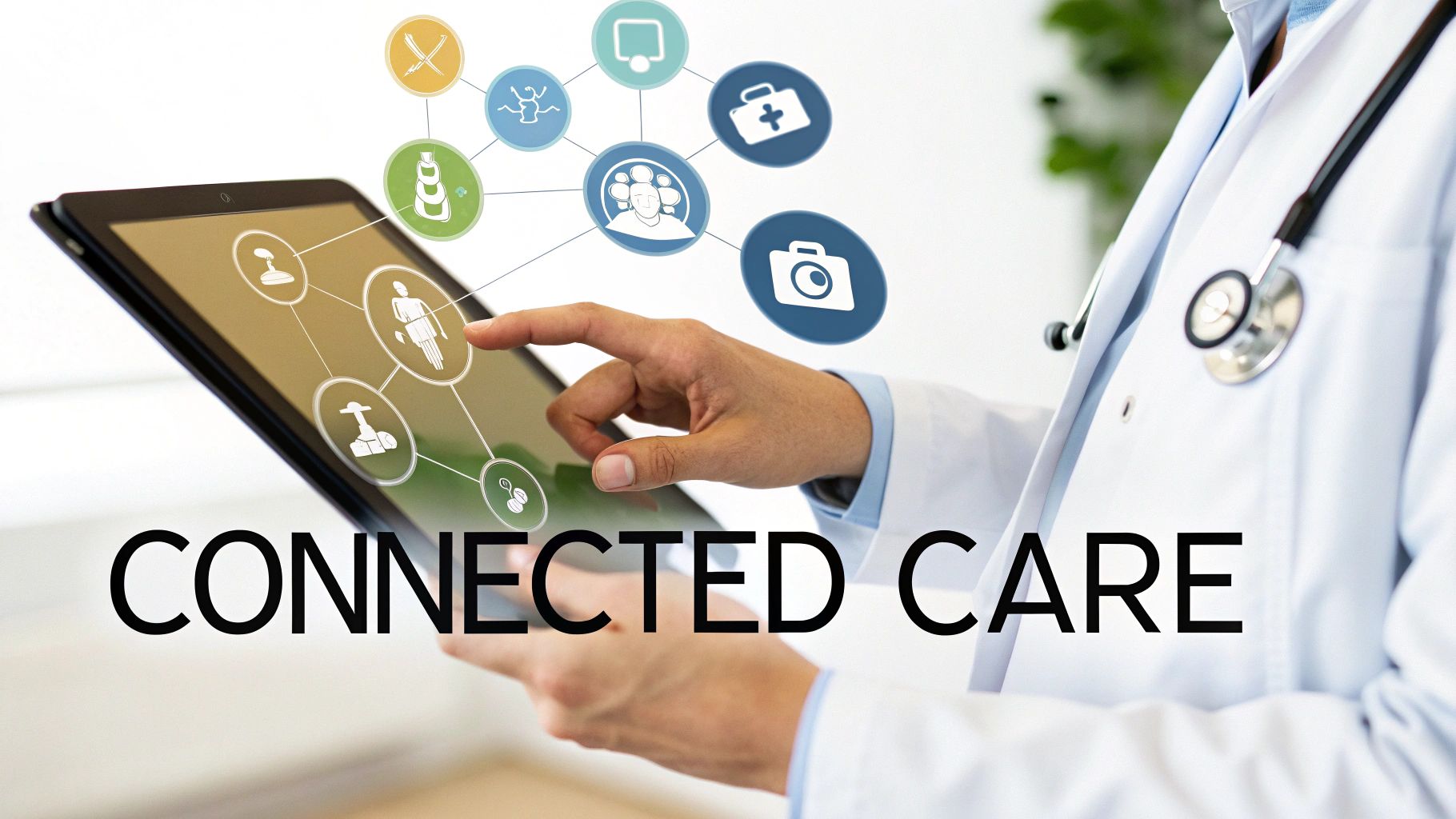
A truly exceptional healthcare web application is never a lonely island. It needs to be the central nervous system for a whole network of intelligent tools—a bustling hub connecting patient management with advanced diagnostic intelligence. This creates a single, powerful ecosystem.
So, how do you bring this vision to life? It comes down to strategically weaving in two key technologies: Customer Relationship Management (CRM) platforms and Artificial Intelligence (AI). When you plug a CRM into your application, you transform it from a purely clinical tool into a dynamic platform for managing the entire patient journey. It becomes perfect for coordinating complex research studies or even tracking medical device performance in the real world.
Unlocking Patient Insights with CRM Integration
Think of a CRM as your application's memory and communication center. It goes far beyond just storing clinical data; it captures every single interaction, preference, and communication touchpoint. Suddenly, you have a rich, 360-degree view of the patient or study participant.
For instance, a medical device company could use its integrated CRM to:
- Track Patient Outcomes: Correlate device performance data, pulled right from the web application, with patient-reported outcomes logged in the CRM.
- Manage Clinical Trials: Seamlessly enroll participants, schedule follow-ups, and automate communication—all from one interface.
- Provide Proactive Support: Spot potential issues by analyzing usage data and automatically trigger support tickets or educational outreach inside the CRM.
This depth of integration is what builds strong relationships and drives operational excellence. By getting these systems to talk to each other, you unlock a new level of coordination that leads to better care and smarter business decisions. This is the heart of what true https://pycad.co/data-interoperability-healthcare/ is all about—letting different systems speak the same language.
Demystifying AI in Medical Imaging
If the CRM is the organizational backbone, AI is the cognitive power. In medical imaging, AI and machine learning models are quickly becoming indispensable partners for clinicians. They act as a second set of expert eyes, analyzing images with incredible speed and precision.
The role of AI isn't to replace clinicians but to augment their expertise. It’s about filtering out the noise, highlighting areas of concern, and automating tedious tasks so doctors can focus their invaluable time on critical decision-making and patient care.
When you integrate these AI models directly into a medical imaging web platform, they can perform some remarkable tasks. Imagine an AI algorithm that automatically flags a potential nodule on a chest CT scan for the radiologist to review first. Or consider another that precisely measures cardiac chamber volumes, saving a cardiologist precious minutes on every single study. This is where healthcare web application development moves from simply presenting data to offering intelligent assistance.
This shift toward intelligent, connected platforms is clearly reflected in the market. The virtual health service market, built on these very web applications, is projected to skyrocket from USD 19.45 billion in 2025 to USD 137.99 billion by 2032. At the same time, the big data market in healthcare—the foundation for all this AI and CRM integration—is expected to hit nearly USD 645 billion by 2035. The numbers don't lie: the future of medicine depends on secure, AI-ready web platforms that can manage complex data like DICOM and integrate seamlessly with patient management systems.
At PYCAD, we specialize in making this vision a reality. We don't just build software; we architect complete, intelligent ecosystems. A core part of our expertise is that we at PYCAD, build custom web DICOM viewers and integrate them into medical imaging web platforms. More importantly, we develop and integrate custom AI solutions right inside these platforms, creating a single, fluid environment that drives both clinical excellence and operational efficiency. You can see examples of our work on our portfolio page.
Your Practical Roadmap from Development to Launch
This is where the rubber meets the road. All the careful planning, architectural design, and coding come together as you prepare to bring your healthcare application to life. Moving from a developer's screen to a trusted clinical tool is a journey in itself, demanding a clear, pragmatic plan for testing, deployment, and long-term success. The launch isn't the finish line; it's the start of a whole new chapter.
Rigorous Validation with Clinical Experts
In the world of healthcare, testing isn't just about finding bugs. It's about ensuring safety, accuracy, and usability in a high-stakes environment. The single most important phase here is User Acceptance Testing (UAT), and that means getting your application into the hands of the doctors, nurses, and technicians who will use it every day.
Their feedback isn't just nice to have—it's everything.
- Scenario-Based Testing: We ask clinicians to walk through their actual daily routines. From admitting a new patient to reviewing a complex scan, we need to see if the app works in their world, not just ours.
- Workflow Efficiency Analysis: Does the app genuinely make their life easier, or does it add frustrating clicks? UAT is brilliant at uncovering hidden bottlenecks that a development team would never spot.
- Data Integrity Checks: This is non-negotiable. Clinicians must verify that every piece of patient data, especially sensitive images and lab results, is displayed perfectly and securely.
Building a Resilient Deployment Pipeline
Once you have that green light from your clinical users, you need a way to release updates that is safe, repeatable, and doesn't cause downtime. This is where a robust Continuous Integration/Continuous Deployment (CI/CD) pipeline becomes your best friend. Think of it as an automated assembly line for your code, ensuring quality control and smooth delivery every single time. It automates testing and deployment, dramatically reducing the chance of human error.
A well-structured CI/CD pipeline is the secret to moving fast without breaking things. It lets your healthcare app evolve with clinical needs while maintaining the rock-solid reliability that healthcare demands.
With a solid pipeline, every code change is automatically put through its paces before it ever reaches a live environment. It’s a critical safety net you simply can't do without. For a deeper dive into the nuts and bolts of implementation, this guide on how to create a website app offers some excellent, practical steps.
Choosing Your Cloud Foundation
Selecting a cloud provider like Amazon Web Services (AWS), Microsoft Azure, or Google Cloud Platform (GCP) is one of the most significant decisions you'll make. This isn't just about servers; it's about choosing a partner for security and compliance. Each of these giants offers specialized services for healthcare, complete with features built to align with regulations like HIPAA.
The right choice will depend on your unique needs, whether that's advanced data analytics or powerful AI/ML services. These platforms provide the secure, scalable backbone essential for modern healthcare web application development.
Sustaining Excellence After Launch
The day you go live is just day one. True success is measured over years of reliable, secure, and effective operation. Staying on top of the application's health is a continuous effort.
Your post-launch checklist must include:
- Performance Monitoring: Keep a constant eye on speed, uptime, and system resources. This helps you spot and fix potential problems before users ever notice them.
- Disaster Recovery Planning: Hope for the best, but plan for the worst. You need a tested, proven plan to get services back online quickly if an outage occurs.
- Ongoing Security Management: The threat landscape is always changing. Regular vulnerability scans, penetration testing, and security updates are not optional—they're essential to protecting patient data.
This cycle of testing, deploying, and maintaining is what ensures your application doesn't just launch with a splash but becomes an indispensable tool in the clinical world for years to come.
Let's Build the Future of Healthcare, Together
We've covered a lot of ground, from laying a foundation of secure architecture to navigating the complexities of compliance and even weaving in the power of artificial intelligence. It's clear that the future of medicine isn't just about technology—it's about creating intelligent, interconnected systems that live on the web and make a real difference in people's lives.
Building these applications is far more than a coding exercise. It’s a chance to fundamentally reshape how doctors deliver care, how scientists conduct research, and ultimately, how patients experience their health journey. This isn't just another project; it’s a mission that demands a partner who truly gets the weight of that responsibility and knows this specialized world inside and out.
The Mobile Health Revolution is Here
One of the biggest drivers of this change is the powerful link between web platforms and mobile health. The global market for healthcare mobile apps, which all rely on robust web backends, was valued at a massive USD 114.06 billion in 2024. But that's just the start. It's projected to skyrocket to USD 4,710.54 billion by 2034. You can dig into the numbers yourself in this detailed market research.
This isn't just a trend; it's a fundamental shift in how healthcare operates. Here’s what it means in practice:
- Mobile apps are fantastic for patient engagement and capturing data on the go.
- Secure web applications are the mission control center, managing complex clinical workflows and handling heavy-duty data like medical imaging.
- Custom web DICOM viewers, the kind we at PYCAD build and integrate, are the critical bridge that allows clinicians to review and diagnose from anywhere.
Creating the next wave of healthcare solutions means building a single, unified ecosystem. It’s about making every piece work together flawlessly to empower clinicians and improve patient outcomes. It’s about turning a mountain of complex data into clear, actionable insights—instantly and securely.
Bringing a vision like that to life requires more than just a team of coders. You need a partner with deep experience in both the medical field and the technical craft. This is exactly where we live and breathe. At PYCAD, we specialize in building the very platforms that are defining this new age of digital medicine.
We’d love for you to see what happens when that kind of vision and expertise come together. Take a look at our portfolio to see how we’re helping our partners build the future of healthcare, one intelligent web application at a time.
A Few Common Questions
When you're diving into the world of healthcare web development, a few key questions always come up. Let's tackle them head-on, drawing from our experience building these complex systems from the ground up.
How Do You Make Sure a Web Application is Genuinely HIPAA Compliant?
Achieving true HIPAA compliance isn't about checking off a list; it's a deep, ongoing commitment that's baked into the very DNA of the application. It all starts with a "secure-by-design" mindset, where every single choice, from the database structure to the API endpoint, is made with Protected Health Information (PHI) front and center.
This means putting some non-negotiable safeguards in place:
- Data Encryption: All PHI must be locked down with encryption, both when it's sitting on a server (at rest) and when it's moving across the internet (in transit).
- Strict Access Controls: We use what’s called Role-Based Access Control (RBAC). In plain English, this means people can only see and do what is absolutely necessary for their job—nothing more.
- Comprehensive Audit Trails: Every touchpoint with PHI is recorded. This creates a bulletproof log of who did what, and when, which is absolutely critical for accountability.
- Business Associate Agreements (BAAs): Any third-party partner, like a cloud provider, that could potentially interact with PHI must sign a BAA. This is a legally binding contract that holds them to the same high standards of data protection.
Here's the thing: compliance isn't just a technical problem. It's a human one. It demands a company-wide culture of security, constant risk analysis, and regular training so everyone on the team understands the immense responsibility of protecting patient data.
What's a Realistic Timeline for Building a Custom Medical Imaging Platform?
There’s no single answer here because it really depends on the ambition of the project. That said, a custom medical imaging platform typically takes anywhere from six months to well over a year. We almost always build in phases to get value into the hands of users as quickly as possible.
A starting point, or what we call a Minimum Viable Product (MVP), usually takes about 4-6 months. This first version would nail the essentials: secure logins, the ability to upload and view DICOM images, and basic patient record management. From there, each new phase might add another 3-5 months to the timeline as we layer in more sophisticated capabilities like advanced measurement tools, AI-powered diagnostics, or integrations with Electronic Health Record (EHR) systems.
Ultimately, the scope of the custom features you need is what drives the schedule. A simple image viewer is one thing; a complex 3D reconstruction engine or a custom-trained AI model is another thing entirely.
Why Build a Custom DICOM Viewer When Open-Source Options Exist?
Open-source DICOM viewers are fantastic tools for learning or for academic research. But when you step into a high-stakes clinical setting, they often don't have what it takes. A custom-built viewer isn't just about looking at images—it's about creating a purpose-built tool that solves a specific clinical problem and makes a doctor's workflow faster and more intuitive.
The real difference comes down to three things: precision, integration, and compliance. An off-the-shelf tool might give you a generic ruler. A custom viewer, on the other hand, can be designed with specialized tools that a cardiologist or an orthopedic surgeon needs to make a critical diagnosis with greater accuracy and speed.
This is exactly what we specialize in. Here at PYCAD, we build custom web DICOM viewers and integrate them seamlessly into medical imaging web platforms. This creates a single, fluid experience where the viewer, patient data, and reporting tools all work together perfectly. It removes the clunky, error-prone process of switching between different programs and frees up clinicians to do what they do best: care for patients.
At PYCAD, we don't just build software; we architect solutions that address the deepest needs of the clinical world. We turn complex challenges into secure, powerful, and beautiful web applications that truly make a difference. To get a feel for how we bring visions like yours to life, take a look at our work in our portfolio.