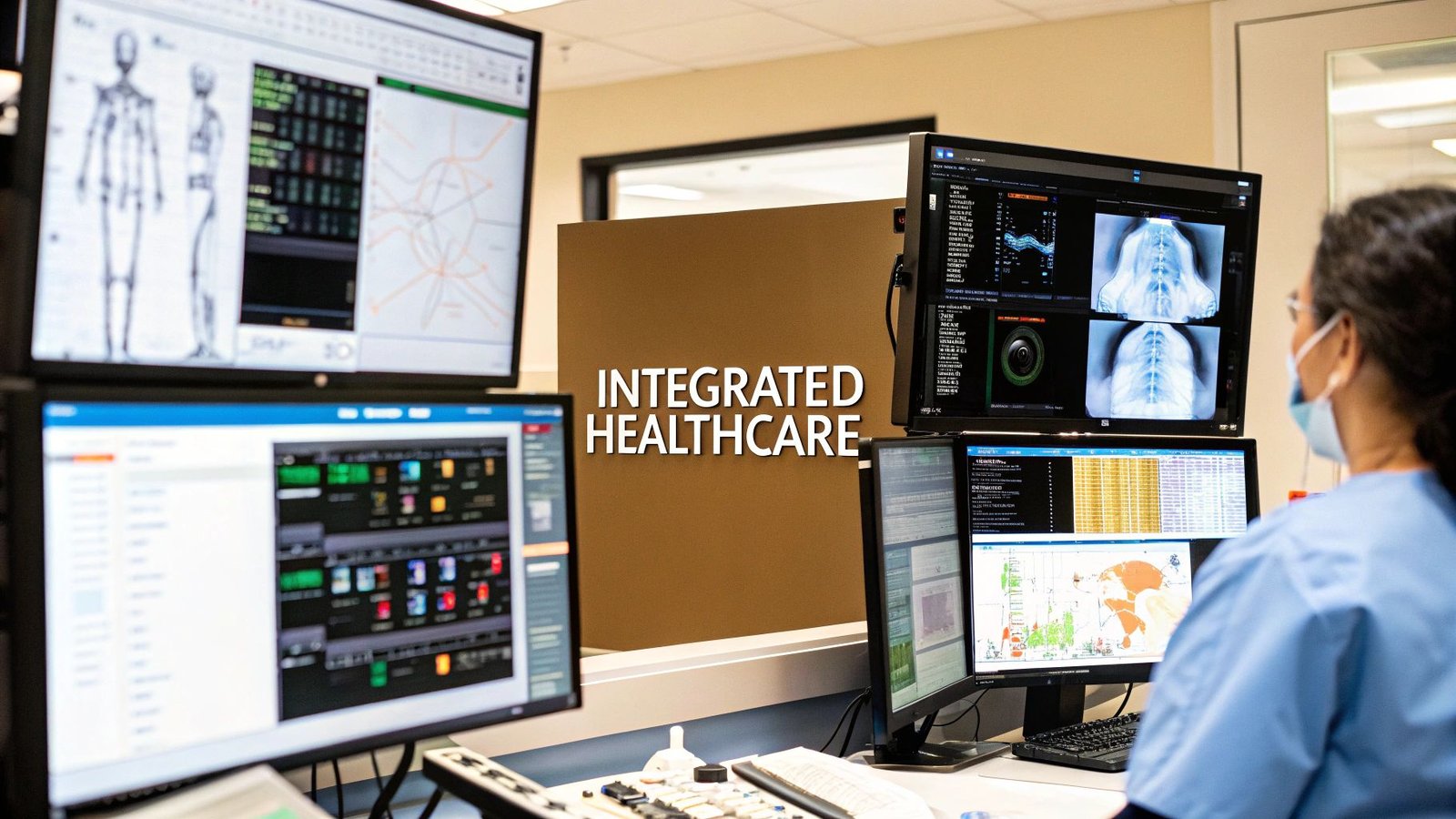
Picture this: your entire medical history, from blood work to complex MRI scans, available instantly and securely to any doctor who needs it, right when they need it. This isn't science fiction. It's the new reality being forged by integrated healthcare solutions. These systems are tearing down the digital walls that have kept critical patient information locked away, creating a single, unified view of a patient's health.
A New Era of Connected Care
Not long ago, healthcare data was a mess. It was scattered across dozens of different systems, none of which could talk to each other. A patient's records were fragmented—a piece here with their family doctor, another with a specialist, and a crucial scan stored only in a hospital’s imaging archive. This created dangerous blind spots, leading to duplicate tests, delayed diagnoses, and sometimes, tragic medical errors.
Integrated healthcare solutions are the answer to that fragmented past. Think of it as building a digital nervous system for healthcare, connecting what were once isolated islands of information. Instead of doctors relying on faxes or patients hand-carrying their own records, clinicians get a complete, real-time picture of a patient's entire health journey. This 360-degree view is the bedrock of safer, smarter, and truly personalized medicine.
Putting the Pieces Together
This connected approach isn't just about tidying up data; it's about fundamentally changing how medicine is practiced. It gives doctors and their teams the tools they need to make better, faster decisions when it matters most. The impact is profound:
- Sharper Diagnostic Accuracy: A radiologist can instantly pull up a patient's entire imaging history, making it far easier to spot subtle changes in a new MRI that might otherwise be missed.
- Fewer Medical Errors: When a doctor has full visibility into a patient's allergies and current medications, the risk of a dangerous prescription error drops dramatically.
- A Better Patient Journey: People no longer have to be the go-between, chasing down their own records. The experience becomes seamless, coordinated, and far less stressful.
The drive behind this movement is massive. The global market for these solutions was valued at around USD 3.94 billion and is expected to explode to USD 14.47 billion by 2034. That's not just a trend; it's a clear signal of the industry's demand for systems that finally let data flow freely and securely. You can explore more market growth insights here.
At its core, an integrated system is about getting the right information to the right person at the right time. It’s about establishing a single source of truth for a patient's health—something modern medicine simply can't function without.
At PYCAD, we're building this future one connection at a time. We specialize in developing custom web DICOM viewers and seamlessly weaving them into medical imaging platforms. Because real integration means making even the most complex data, like medical images, easy for anyone authorized to access and use. We build the digital bridges that connect these vital data points, a process we break down in our guide on innovative medical device connectivity solutions. You can see our work for yourself over on our portfolio page.
The Four Pillars of a Modern Health System
Building a truly connected healthcare system isn't about just buying a bunch of software. It’s about architecture. A modern system is built on four interconnected pillars, and when they work together, they create something far more powerful than the sum of their parts—an ecosystem that can genuinely change how we deliver care.
Pillar 1: The Secure Web Platform
Think of the Secure Web Platform as the system's central nervous system. This is the bedrock, the secure infrastructure that manages the constant, critical flow of information. We're talking about everything from patient demographics to complex billing codes.
It’s more than just a database; it’s the compliant, resilient backbone ensuring the right data gets to the right person at the right time, every single time. This is ground zero for breaking down the data silos that have held healthcare back for decades.
Pillar 2: Advanced Medical Imaging Access
Next up is the Advanced DICOM Viewer. This is your specialized window into the world of medical imaging. A simple JPEG or PNG file just won't cut it here. Medical scans—MRIs, CT scans, X-rays—are packed with rich detail and metadata that demand a purpose-built viewer to make any sense of them.
This is the tool that lets clinicians dive deep, manipulating and analyzing images with the precision needed for a confident diagnosis.
At PYCAD, we specialize in building custom web DICOM viewers and integrating them directly into medical imaging web platforms. Why is this so important? It makes complex imaging data accessible from any secure web browser, freeing clinicians from being chained to a specific, high-powered workstation in a specific room. Imaging becomes a fluid, integrated part of the patient's story.
This journey from fragmentation to cohesion is what it's all about.

As you can see, connecting those disparate systems is the crucial step that transforms raw, isolated data into real clinical intelligence.
Pillar 3: The Human Connection
The third pillar brings us to Integrated CRM and Patient Portals. This is where we focus on the most important part of healthcare: the people. A healthcare-specific Customer Relationship Management (CRM) system helps orchestrate patient communications, manage appointments, and send follow-up reminders, making the entire journey feel personal and coordinated.
Patient portals, in turn, give people a sense of ownership over their health. They can access lab results, see visit summaries, and review treatment plans on their own time. When the CRM and portal are fully connected to the central platform, the magic happens. A specialist's note can automatically trigger a follow-up reminder through the portal, creating a proactive and genuinely supportive experience.
Pillar 4: The Predictive Powerhouse
Finally, we have the AI and Machine Learning Engine. If the web platform is the nervous system, then AI is the brain. It constantly sifts through the immense streams of data—from clinical notes to DICOM images—to find patterns and offer insights that a human simply couldn't.
For instance, an AI model could analyze thousands of anonymized records to flag individuals at high risk for a certain disease, opening the door for early, life-saving intervention. In radiology, it can act as a second set of eyes, highlighting subtle anomalies on a scan that might otherwise go unnoticed. This is what turns a passive data repository into an active, intelligent partner in care.
To help visualize how these components come together, here’s a quick breakdown:
The Four Pillars of Integrated Healthcare Solutions
| Component | Primary Function | Impact on Patient Care |
|---|---|---|
| Secure Web Platform | Acts as the central, secure infrastructure for all data flow and communication. | Ensures data integrity and accessibility, creating a reliable foundation for all clinical activities. |
| Advanced DICOM Viewer | Provides specialized tools for viewing and analyzing complex medical images. | Empowers clinicians with precise diagnostic capabilities, leading to more accurate and timely diagnoses. |
| Integrated CRM & Portals | Manages patient relationships, communication, and provides self-service access to health information. | Improves patient engagement, satisfaction, and adherence to care plans through seamless communication. |
| AI & Machine Learning | Analyzes vast datasets to uncover patterns, predict outcomes, and support clinical decisions. | Enables proactive interventions, enhances diagnostic accuracy, and personalizes treatment strategies. |
As you can see, these four pillars aren't just standalone features; they're deeply interwoven. The DICOM viewer needs the secure platform to operate, the patient portal is only useful if it's fed with rich clinical data, and the AI engine is only as smart as the integrated information it can access.
To see how we bring these powerful elements to life, feel free to explore the projects on our portfolio page.
Unlocking Health Data with Universal Standards
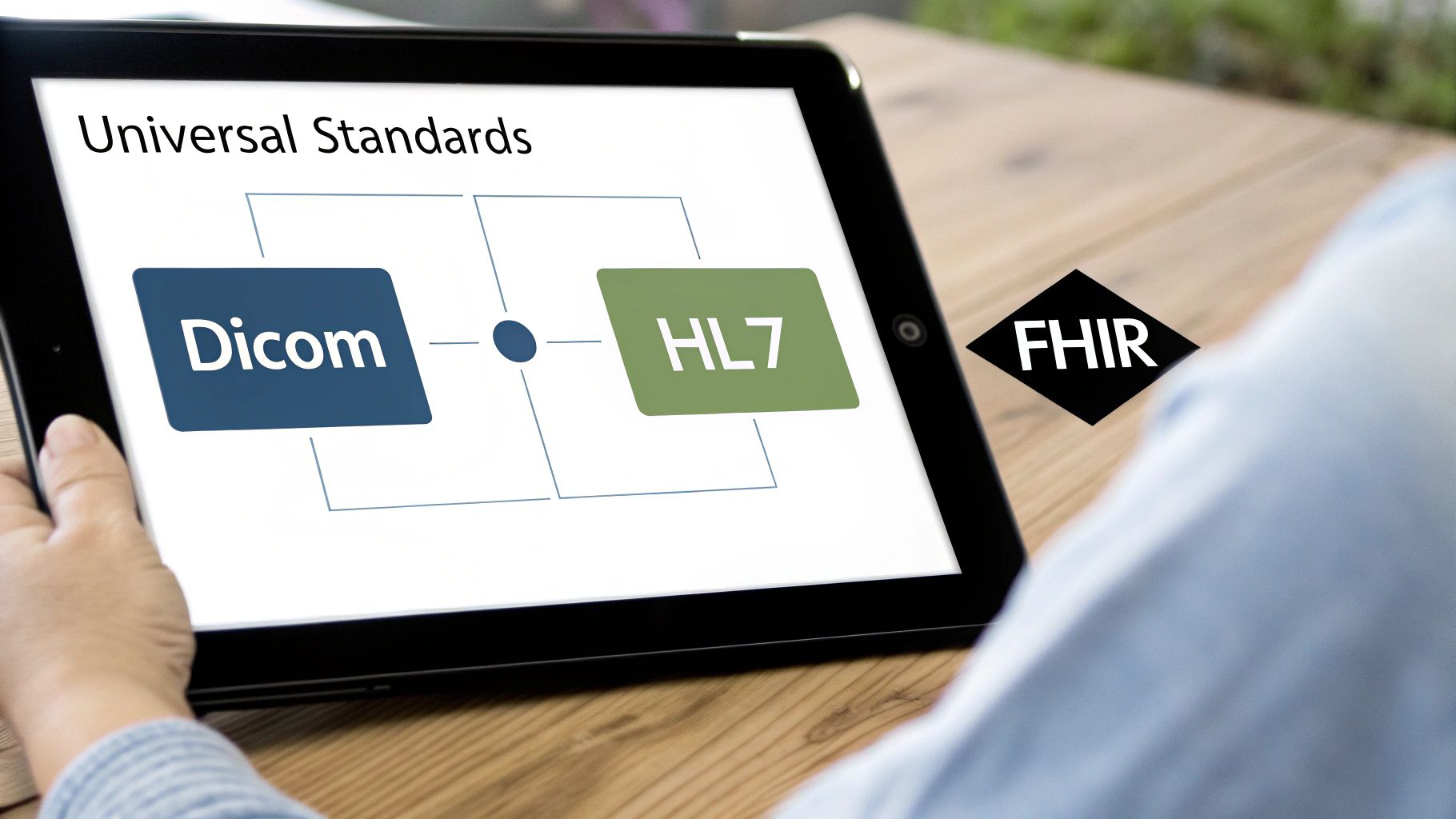
For all the pieces of an integrated health system to click together, they need a common language. In healthcare tech, this shared language comes from universal standards—the digital protocols that let different systems from different creators talk to each other without missing a beat.
Without them, we're stuck in the past, with critical patient information trapped in digital silos. It's like trying to have a conversation where everyone speaks a different language and there’s no translator. These standards are that essential translator, making sure patient data means the same thing whether it's viewed in a massive urban hospital or a small rural clinic.
DICOM: The Universal Grammar of Medical Imaging
When you're dealing with medical scans, the first and most vital standard is DICOM (Digital Imaging and Communications in Medicine). This is so much more than a simple file format like a JPEG. DICOM is a complete set of rules for how medical images are stored, shared, and found across networks.
Think of it as the universal grammar for all medical imaging. It ensures an MRI scan—with all its intricate layers and patient data baked right in—looks and behaves the exact same way for a radiologist in New York as it does for a consulting specialist in London. That consistency is the very foundation of reliable remote diagnostics.
This is precisely why at PYCAD, we build custom web DICOM viewers and integrate them into medical imaging web platforms. By creating solutions that are fluent in DICOM, we ensure this vital imaging data can be woven into any integrated healthcare system and accessed from any secure web browser.
HL7: The Workhorse of Clinical Data Exchange
While DICOM is the master of images, HL7 (Health Level Seven) is the tireless workhorse handling almost everything else. It’s the standard that lets a hospital’s electronic health record (EHR) system chat with the lab’s system to automatically pull in blood test results.
HL7 is all about exchanging the core clinical and administrative data that keeps a healthcare facility running. This includes:
- Patient details and insurance info
- Doctor's orders and prescriptions
- Lab results and clinical notes
- Billing codes and appointment schedules
For decades, HL7 has been the quiet engine powering the flow of this text-based information between different healthcare apps. It’s a true cornerstone of any functional integrated healthcare solution.
These standards aren't just technical acronyms. They are the invisible threads connecting a patient's entire journey, turning a collection of separate events—a lab test, a doctor's visit, a scan—into a single, coherent story.
FHIR: The Modern Standard for a Connected World
The newest and most agile player on the scene is FHIR (Fast Healthcare Interoperability Resources). If HL7 is the reliable workhorse, think of FHIR as its nimble, modern cousin built for the internet age. It uses the same web technologies that power the apps on your phone, which makes it incredibly easy for developers to work with.
FHIR is all about speed and flexibility. It's what allows a patient’s smartphone app to securely pull their latest medication list directly from the hospital’s EHR. This standard is unlocking the next wave of patient-centered tools and real-time data sharing. It’s no wonder, then, that the digital health market was valued at USD 312.9 billion and is expected to rocket to USD 2.19 trillion by 2034. Read the full research about digital health market growth.
Together, these three standards create an incredibly powerful team. Of course, moving all this sensitive data around means you have to be vigilant about privacy. A solid guide to HIPAA compliance for email is non-negotiable for any organization building a modern, connected system. To see how these pieces fit together in the real world, you can explore the interoperability of electronic health records in our detailed article.
Powering Predictive Care with Artificial Intelligence
If an integrated healthcare system is the body, then artificial intelligence is its predictive brain. It's the critical element that elevates a connected ecosystem from a simple library of health data into an active, intelligent partner in patient care. AI has the incredible ability to sift through immense volumes of information—from EHRs, lab results, and medical images—finding subtle patterns that even the most brilliant human mind could miss.
This isn't just about better data organization; it's about anticipating what comes next. AI algorithms can pinpoint patients at high risk for chronic conditions long before symptoms ever surface, opening the door for truly proactive intervention. They can even forecast potential disease outbreaks in a community by analyzing aggregated health data, giving public health officials a priceless head start.
This is the moment where integrated healthcare solutions truly begin to save lives, marking the shift from reactive treatment to predictive, preventive care.
Revolutionizing Medical Imaging with AI
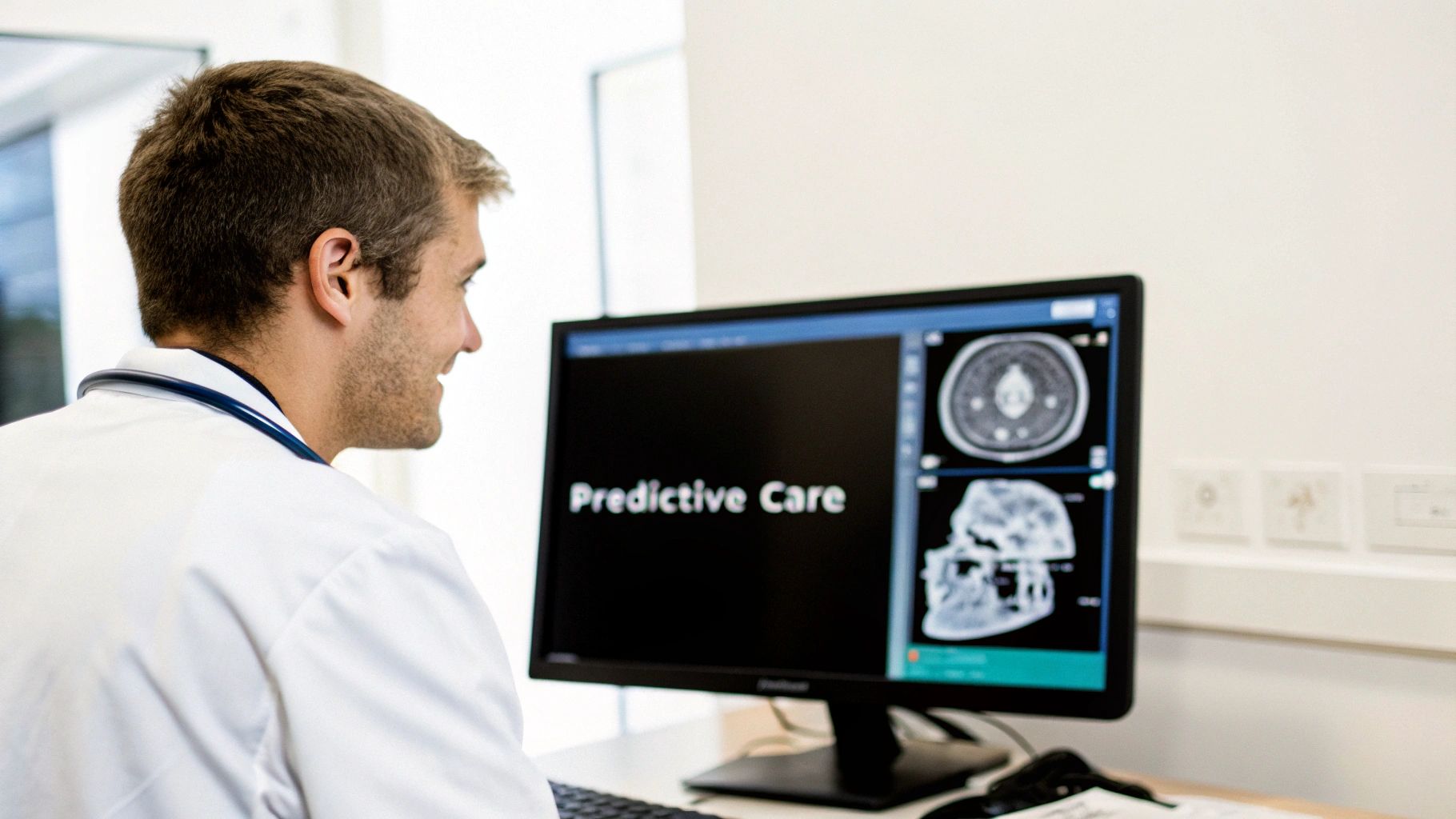
Nowhere is the impact of AI more visually striking than in medical imaging. Radiologists are tasked with the monumental job of examining incredibly detailed scans, where the smallest anomaly can mean everything. In this high-stakes environment, AI serves as an invaluable assistant—a second set of brilliant eyes that never gets tired.
At PYCAD, we build custom web DICOM viewers and integrate them into medical imaging web platforms, creating the perfect foundation for these AI tools to shine. Right inside our viewers, AI algorithms can perform amazing feats:
- Highlight Suspicious Areas: Automatically flag regions on a CT scan or MRI that might contain abnormalities, guiding the radiologist’s attention directly to areas needing a closer look.
- Quantify Disease Progression: Measure subtle changes in tumor size or lesion density over time with superhuman precision. This provides hard, objective data to fine-tune treatment plans.
- Accelerate Workflow: Pre-analyze scans in the queue to prioritize the most urgent cases, making sure that critically ill patients get attention first.
This powerful synergy between a skilled clinician and a sharp AI doesn't replace human expertise; it supercharges it, paving the way for faster, more accurate diagnoses. You can dive deeper into how this works in our article on AI-powered clinical decision support.
The Engine of Actionable Insight
Of course, none of these advanced AI applications can get off the ground without a solid data infrastructure. The ability to create systems that can handle a massive influx of health information is absolutely critical. This requires deep expertise in architecting intelligent, AI-ready data pipelines.
The global enthusiasm for this technology speaks for itself. The AI in healthcare market, currently valued at USD 29.01 billion, is projected to rocket to an incredible USD 504.17 billion by 2032. This explosive growth shows a clear, industry-wide commitment to using AI for smarter workflows and better patient outcomes.
AI is the intelligent layer that transforms raw, integrated data into actionable, life-saving insights. It’s the engine that finally allows us to not only understand a patient's past but to actively shape their future health.
By weaving AI into the very fabric of a connected healthcare system, we create a platform that learns, adapts, and constantly seeks better ways to deliver care. This intelligent foundation isn't some far-off dream—it's the future we are actively building right now.
Integrated Healthcare Solutions in Action
Seeing is believing, right? While we can talk about the components of integrated healthcare all day, the real magic happens when you see them solving tough, real-world problems. These aren't just ideas on a whiteboard; they are powerful systems actively changing how we deliver patient care and run our operations. By weaving together data points that were once isolated, they deliver real, measurable results for everyone involved.
The true test of any integrated healthcare solution is how it performs under pressure. Each person in the healthcare world—from the engineer designing a new device to the doctor at the bedside—faces their own set of daily challenges. A thoughtfully designed integrated system cuts right to the heart of those problems and offers a genuine solution.
These success stories are what make the concept click, turning an abstract idea into solid proof that the investment pays off.
For Medical Device Manufacturers
Think about a company that makes state-of-the-art cardiac monitors. Traditionally, their job was pretty much done once the device was shipped and installed. They were flying blind, with almost no data on how their monitors performed in the real world. This made improving their products a slow, frustrating guessing game based on old feedback or, worse, failure reports.
Now, picture a new reality. With an integrated solution, that same cardiac monitor connects securely to the hospital's network, streaming anonymized performance data directly back to the manufacturer. This isn't just an update; it's a game-changer that creates a continuous, powerful feedback loop.
- Spotting Trouble Before It Starts: Engineers can now monitor crucial metrics like battery life and sensor accuracy across thousands of devices in real time. This allows them to catch potential issues and fix them before they become big problems.
- Building Smarter, Better Products: This flood of real-world data is gold for R&D teams. It guides the design of the next generation of devices, making them more reliable, efficient, and perfectly tuned to what clinicians actually need.
- Directly Improving Patient Care: By tweaking device algorithms based on live data, manufacturers are no longer just vendors—they become active partners in making treatments safer and more effective.
For Healthcare IT Teams
If you've ever met a healthcare IT team, you know they are the unsung heroes holding the digital fortress. They're in a constant battle against administrative chaos and relentless security threats. A fragmented system with dozens of different applications, each with its own login and security rules, is a management nightmare. It's clunky, expensive, and full of security holes.
A single, unified platform is like a breath of fresh air. It brings everything—from patient scheduling to medical imaging archives—under one secure roof, immediately slashing the administrative workload. IT teams can finally stop juggling endless vendor contracts and patching countless separate systems.
A unified system does more than just make life easier—it makes it safer. When data is managed centrally, you can implement stronger, more consistent security controls and make compliance monitoring a straightforward process. It’s a level of protection a patchwork of apps could never hope to achieve.
For Medical Researchers
For researchers, data is the fuel for discovery. But historically, getting that fuel has been a painfully slow and manual process, involving pulling records from countless incompatible systems. This friction has been a major roadblock, slowing down clinical trials and holding back medical breakthroughs.
Integrated healthcare solutions completely flip the script. They create a central, searchable pool of anonymized patient data. This allows researchers to:
- Find the Right Patients, Faster: They can instantly identify groups of patients who meet the very specific criteria needed for a clinical trial.
- Discover Hidden Connections: By analyzing massive health trends, they can uncover links between lifestyle, treatments, and outcomes that were previously invisible.
- Prove New Therapies Work: It becomes much easier to track the long-term results of new treatments across a wide and diverse patient population.
The benefits of integrated systems touch every corner of the healthcare field, solving unique problems for each group of professionals.
Integrated Solutions Impact by Audience
| Audience | Key Challenge | Integrated Solution Benefit |
|---|---|---|
| Device Manufacturers | Lack of real-world performance data for R&D. | Enables a continuous feedback loop for data-driven product improvements and proactive maintenance. |
| Healthcare IT Teams | Managing a complex, fragmented web of applications. | Centralizes management, strengthens security, and dramatically reduces administrative burden. |
| Medical Researchers | Slow, manual, and difficult access to patient data. | Provides a unified, queryable data source to accelerate clinical trials and discovery. |
Ultimately, connecting these systems empowers each professional to do their best work, which leads to better outcomes for everyone.
At PYCAD, we build custom web DICOM viewers and integrate them into medical imaging web platforms—a critical piece of this integrated puzzle. Our work ensures that even the most complex medical images are seamlessly included in this unified data ecosystem.
To see what this looks like in practice, we invite you to take a look at our portfolio of work.
How to Choose the Right Integration Partner
Deciding to build an integrated healthcare solution is a huge step for any organization. It's more than just a tech upgrade; it's about finding a partner who becomes a true extension of your team. You need someone who can see the big picture and expertly navigate the maze of healthcare technology. The right partner can turn a daunting project into a creative collaboration, building a platform that doesn't just work, but truly sings.
So, how do you find that perfect partner? It's not about ticking boxes on a generic vendor checklist. You're looking for a team that has a deep, almost instinctual grasp of the healthcare world. This means they need to be fluent in the languages of medicine and technology—speaking DICOM for imaging and FHIR for data exchange without a second thought. And, of course, they must have a rock-solid history of building platforms with uncompromising, HIPAA-compliant security baked in from the ground up.
Evaluating Technical Mastery and Clinical Insight
A great integration partner lives at the intersection of code and the clinic. They don't just see technology; they see its impact on doctors, nurses, and ultimately, patients. When you're talking to potential partners, dig into how they approach unique clinical workflows. Do they listen and adapt, building flexible solutions that mold to your specific needs? Or do they try to shoehorn you into a rigid, one-size-fits-all box?
The ideal partner is a strategic ally who gets that in healthcare, context is everything. They should be able to explain not just what they build, but why it matters for improving patient outcomes and making care delivery smoother.
This is the philosophy we live by at PYCAD. We don't just ship software; we build custom systems tailored to solve very specific clinical problems. A big part of what we do is build custom web DICOM viewers and integrate them into medical imaging web platforms, making sure your most critical data is both secure and instantly accessible. That kind of specialized skill is essential for anyone serious about medical imaging.
Custom Development Versus Off-the-Shelf Solutions
One of the biggest forks in the road is deciding between a pre-packaged product and a custom-built platform. Off-the-shelf solutions might look tempting with their promise of a quick start, but they often bring hidden costs and frustrating limitations that can stifle your growth and hurt your ROI down the line.
A custom-built integrated healthcare solution, however, is designed from day one to fit your strategic goals like a glove. This approach almost always delivers a much higher return on investment, particularly in specialized fields like medical imaging. Why? Because it’s built to eliminate friction in your workflow and scale with your biggest ambitions.
Your partner should feel less like a vendor and more like a co-creator, genuinely invested in seeing you succeed. If you're curious to see how we bring this collaborative spirit to life, take a look at our portfolio of work to see some of the groundbreaking solutions we've built with our clients.
Got Questions? We’ve Got Answers.
Stepping into the world of integrated healthcare is a big move, but it’s one that promises a smarter, more connected way of delivering care. It’s only natural to have questions. Think of this as a conversation with an expert, designed to clear up the common sticking points and give you the confidence to move forward.
Let’s dive into some of the most frequent questions we hear from teams just like yours.
What’s the Toughest Part of Implementation?
You might think the biggest hurdle is the technology itself, but it’s almost always the people and processes. The real challenge lies in getting different systems—often with their own unique, proprietary data formats—to speak the same language using standards like HL7 and FHIR. It’s a classic organizational puzzle.
This requires a clear vision and getting everyone on board, from IT to the clinical staff. You need a technology partner who isn’t just a coder, but an expert in navigating these tricky data migrations and integrations. On top of that, weaving a tight web of security and HIPAA compliance through every single connection is non-negotiable and demands absolute precision.
How Do These Solutions Actually Help Patients?
It’s all about giving doctors the full story, right when they need it. Integrated solutions provide a complete, 360-degree view of a patient’s health journey in real-time. This closes the dangerous information gaps that can lead to misdiagnoses, repeated tests, or harmful drug interactions.
Picture this: a patient arrives in the ER, unconscious. With an integrated system, the doctor can instantly see the patient's known allergies, review recent heart scans from their cardiologist, and check notes from their primary care physician. This immediate access leads to faster, safer, and more informed decisions when every second is critical. It also lays the groundwork for predictive analytics, helping to spot at-risk patients before a crisis ever happens.
An integrated healthcare solution transforms fragmented data points into a cohesive patient story. This comprehensive view empowers clinicians to make decisions based on the full picture, dramatically elevating the quality and safety of care.
Can We Keep Our Existing Medical Imaging Equipment?
Yes, absolutely. In fact, a hallmark of a great integrated solution is that it enhances the tools you already have. You’ve made significant investments in your imaging devices, and the goal is to unlock their full potential, not replace them.
This connection is made possible by the DICOM standard, the universal language for medical imaging that most modern devices already speak. A skilled integration partner can build the digital bridge between your existing PACS (Picture Archiving and Communication System) and a new, centralized web platform. This is a highly specialized skill, blending deep imaging expertise with modern web development.
At PYCAD, we build custom web DICOM viewers and integrate them into medical imaging web platforms. Our entire focus is on making your vital imaging data securely accessible and clinically useful across your entire ecosystem. This ensures your existing hardware becomes a more powerful, interconnected part of your future-ready infrastructure. We’ve successfully built these seamless connections for many clients, as you can see in our portfolio of projects.
The shift to an integrated system is a journey of partnership, smart strategy, and technical skill. PYCAD is here to be the expert guide you can trust, especially when it comes to the complex world of medical imaging. We build custom web DICOM viewers and integrate them into medical imaging web platforms, turning your most challenging data into a seamless asset for a more connected future.
Ready to see what a truly integrated platform can do for you? Take a look at our work by visiting our portfolio page today.