
Imagine a patient's health story scattered across a dozen different libraries, each with its own unique cataloging system and books written in a different language. Interoperability in EHR is the master key and universal translator that unlocks all of them, allowing these disparate electronic health record systems to finally speak to one another. It’s how we piece together a patient’s complete, unified story, not just chapter by chapter, but word by word.
This isn't just a technical upgrade; it's a fundamental shift in how we practice medicine.
Why Connected Healthcare Data Is No Longer Optional
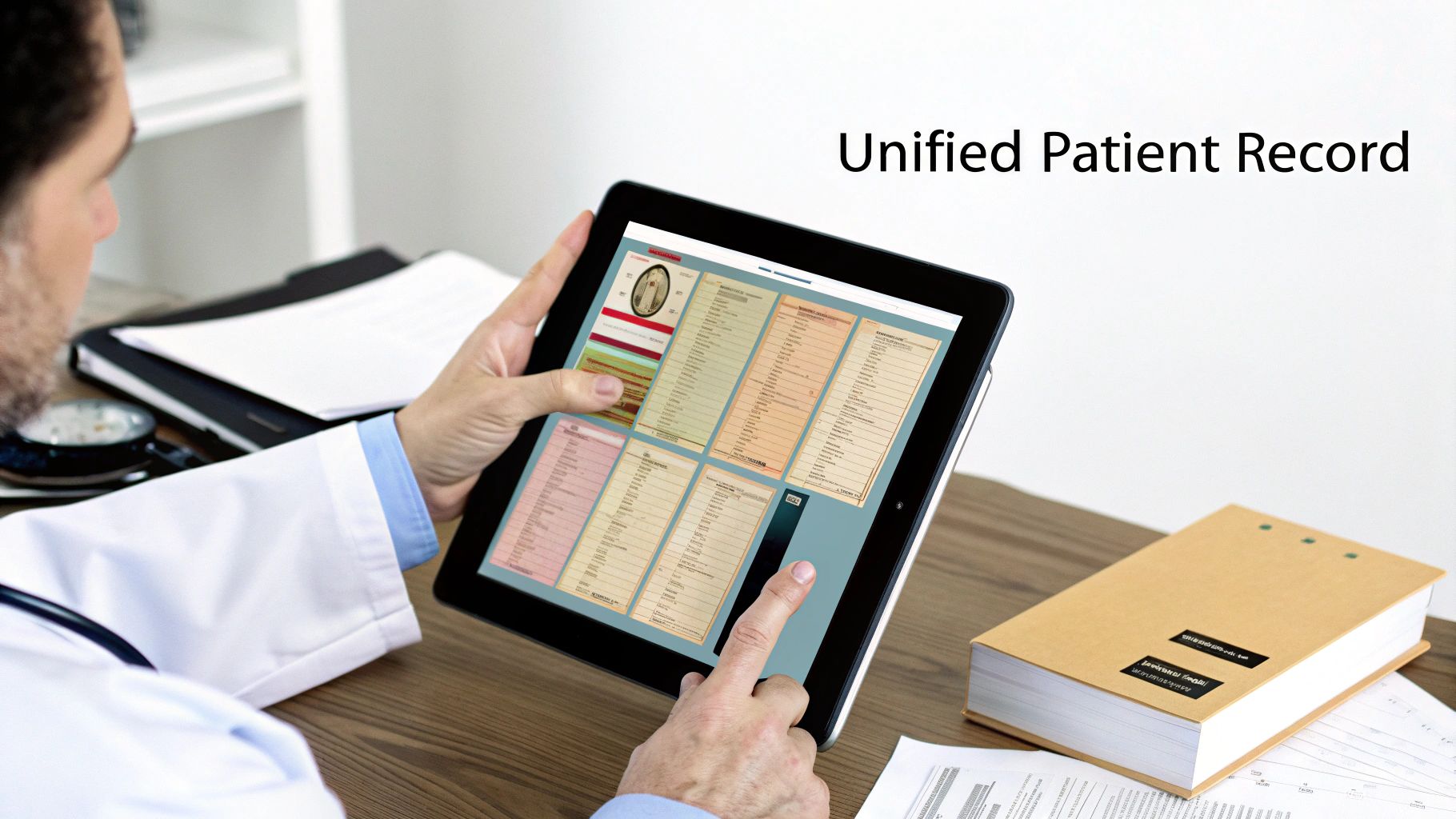
In healthcare, a complete picture isn't a luxury—it’s the bedrock of safe and effective treatment. For far too long, critical health information has been trapped in digital silos, completely inaccessible to the very clinicians who need it most. When a family doctor can't see the results of a weekend emergency room visit, or a specialist is blind to a new allergy flagged by another provider, the potential for error skyrockets.
This fragmentation is more than just an inconvenience. It forces clinicians into the impossible position of making critical decisions with incomplete data. This can lead to a cascade of problems: redundant tests, conflicting prescriptions, and dangerous diagnostic delays. It also places a huge burden on patients, who are tired of repeating their entire medical history at every single appointment, and on providers, who burn precious time just trying to track down records.
The Three Levels of EHR Interoperability
To truly grasp what interoperability means, it helps to break it down into layers. Think of it as a journey from simply connecting two systems to ensuring they actually understand each other.
This table breaks down the foundational, structural, and semantic levels of interoperability, giving you a quick framework for understanding how data exchange truly works.
| Interoperability Level | What It Means | Real-World Analogy |
|---|---|---|
| Foundational | Establishes a basic, secure pipeline for data to move from System A to System B. | Plugging a cable between two computers. They're connected, but that's it—they can't necessarily open each other's files. |
| Structural | Ensures the data structure is consistent and interpretable at the receiving end. | Two people agreeing to write letters in the same format (e.g., date on top, salutation, body, closing). |
| Semantic | The highest level, where the meaning of the data is understood by both systems. | Two doctors speaking the same medical language, understanding that "systolic" means the same thing in both contexts. |
Achieving that final, semantic level is the ultimate goal. It's where the real magic happens, turning raw data into actionable clinical insight.
The Moral and Financial Case for Connection
Getting EHR interoperability right is more than a technical puzzle; it's a moral imperative for modern medicine. It's a promise to put the patient at the center of their own care, ensuring their complete health story travels with them—securely and instantly—no matter where they seek treatment.
The financial cost of doing nothing is staggering. By 2025, the lack of interoperability is expected to contribute to nearly $30 billion in annual waste for the U.S. healthcare system alone. This comes from things like repeated tests and bloated administrative work. Yet, despite these numbers, only about 30% of healthcare providers worldwide have achieved full EHR interoperability. You can get more context from these electronic health records statistics and see the clear gap between what’s needed and what’s been done.
Building Bridges, Not Walls
The path forward requires a spirit of collaboration and the right technology. It’s about building bridges between systems instead of reinforcing the digital walls that have kept them separate for so long. This is where foundational standards and deep expertise become so important.
For example, when you're dealing with something as complex as medical imaging, a standard EHR just won't cut it. At PYCAD, we specialize in building custom web DICOM viewers and integrating them directly into medical imaging platforms. This focused approach ensures that vital diagnostic images aren't just stored away; they are fully accessible and interactive right inside the patient's unified record. It gives clinicians the complete visual story they need to make the best decisions. You can see what these powerful integrations look like on our portfolio page.
Interoperability transforms the EHR from a static filing cabinet into a dynamic, living document. It empowers clinicians with a 360-degree view of the patient, enabling proactive, coordinated, and ultimately safer care.
The conversation has to shift from if we should pursue interoperability to how we can make it happen faster. This is a collective mission—to ensure every patient's story is whole, accessible, and ready to inform the next chapter of their care.
The Universal Languages of Health Data
For a healthcare system to be truly connected, every piece of technology involved needs to speak the same language. This is the heart of the challenge with EHR interoperability, and the solution is found in a set of powerful data standards. Don't think of these as just complex code; see them as the universal languages that allow different systems to communicate without a hitch.
Imagine a diplomat trying to foster global cooperation without understanding the local dialects. It wouldn't work. In the same way, healthcare systems must master these standards to share a patient's story accurately and completely. Each standard has its own job, acting as a specialized translator for a specific kind of health information. Together, they create the linguistic bedrock of modern, connected care.
Once you grasp how these languages work together, a new future comes into view—one where data flows freely and securely, empowering clinicians and ultimately saving lives.
HL7: The Foundational Grammar of Healthcare
For decades, Health Level Seven (HL7) has been the quiet workhorse of health data exchange. Think of it as the formal, foundational grammar of the medical world. It's the established protocol that has reliably powered communication between a hospital's core systems, like sending a patient's admission details from the front desk straight to the lab.
HL7 messages are structured and incredibly dependable, making sure that critical demographic info, orders, and results are transmitted with precision. While older versions can feel a bit rigid, HL7’s long-standing presence has made it an indispensable part of our healthcare infrastructure, handling billions of transactions every single day. It’s the time-tested language that keeps everything consistent and reliable behind the scenes.
DICOM: The Non-Negotiable Language of Medical Imaging
When it comes to medical images, there’s only one language that truly matters: Digital Imaging and Communications in Medicine (DICOM). For anyone working with MRIs, CT scans, X-rays, or ultrasounds, this standard is simply non-negotiable. It’s the universal translator that ensures an image created on a Siemens scanner is perfectly viewable and analyzable on a GE workstation or within an EHR across the country.
DICOM does more than just move a picture from point A to point B. It intelligently bundles the image with critical patient metadata—like the patient ID, the date of the scan, and the specific equipment settings. This creates a complete, self-contained diagnostic record that is absolutely essential for clinical accuracy and patient safety.
This all-in-one approach is why integrating imaging data can be so tricky, demanding specialized expertise. We at PYCAD, build custom web DICOM viewers and integrate them into medical imaging web platforms. Our solutions make these powerful visual records directly accessible within the EHR, transforming a static patient file into a dynamic, interactive diagnostic tool. You can explore some of our advanced integrations in our portfolio.
FHIR: The Modern Dialect for a Connected World
The newest and most dynamic language on the block is Fast Healthcare Interoperability Resources (FHIR). If HL7 is the formal grammar, think of FHIR as the modern, web-friendly dialect built for today’s fast-paced, app-driven world. It’s built on the same web technologies that power giants like Google and Facebook, so it’s designed from the ground up for speed, flexibility, and ease of use.
Instead of wrestling with large, clunky messages, FHIR lets applications ask for small, specific pieces of data—like just a patient's current medication list or a single lab result. This nimbleness makes it perfect for:
- Patient-facing mobile apps that need to pull specific health data on demand.
- Real-time clinical decision support tools that require instant access to the latest information.
- Wearable device integrations that stream a continuous flow of health metrics.
The impact has been massive. FHIR API adoption has exploded globally, pushed forward by regulations like the U.S. 21st Century Cures Act. In fact, over 90% of EHR vendors now support FHIR as a baseline, opening the door for near real-time data sharing between old-school systems and innovative new applications. Discover more insights about health data integration in 2025 to see just how profoundly this shift is reshaping the industry.
Choosing Your Path to EHR Integration
So, you understand the universal languages of health data. That’s the first crucial step. But how do you actually build the roads that connect these different systems? This is where architecture comes in, providing the blueprint for genuine interoperability in ehr. The model you choose will dictate how data flows, how well your network can grow, and how much of a headache it will be to maintain down the line.
Think of it like city planning. A city thrown together without a plan becomes a frustrating maze of traffic jams and dead ends. A well-designed city, on the other hand, lets people and information move effortlessly. The exact same principle applies to your health data infrastructure; choosing the right path is everything if you want to build a connected, efficient, and future-proof healthcare ecosystem.
Point-to-Point Interfaces: The Private Road Problem
The most basic, old-school approach is the point-to-point (P2P) interface. Imagine building a separate, private road from your house directly to every single place you ever need to go—the grocery store, the office, the gym.
At first, it seems simple enough. You need to connect your EHR to the lab system, so you build a custom connection. Problem solved, right?
But then you need to connect to the radiology department. Then the pharmacy. Then a partner clinic. Each time, you have to build a brand new "road" from scratch. This quickly spirals into a chaotic, unmanageable web of custom interfaces. Maintaining this "spaghetti architecture" is an absolute nightmare, and adding just one new system becomes a monumental project. While it might work for a couple of simple connections, it completely fails at scale.
This is where understanding the core data languages—like FHIR, HL7, and DICOM—becomes essential. Any architectural path you choose has to support them.
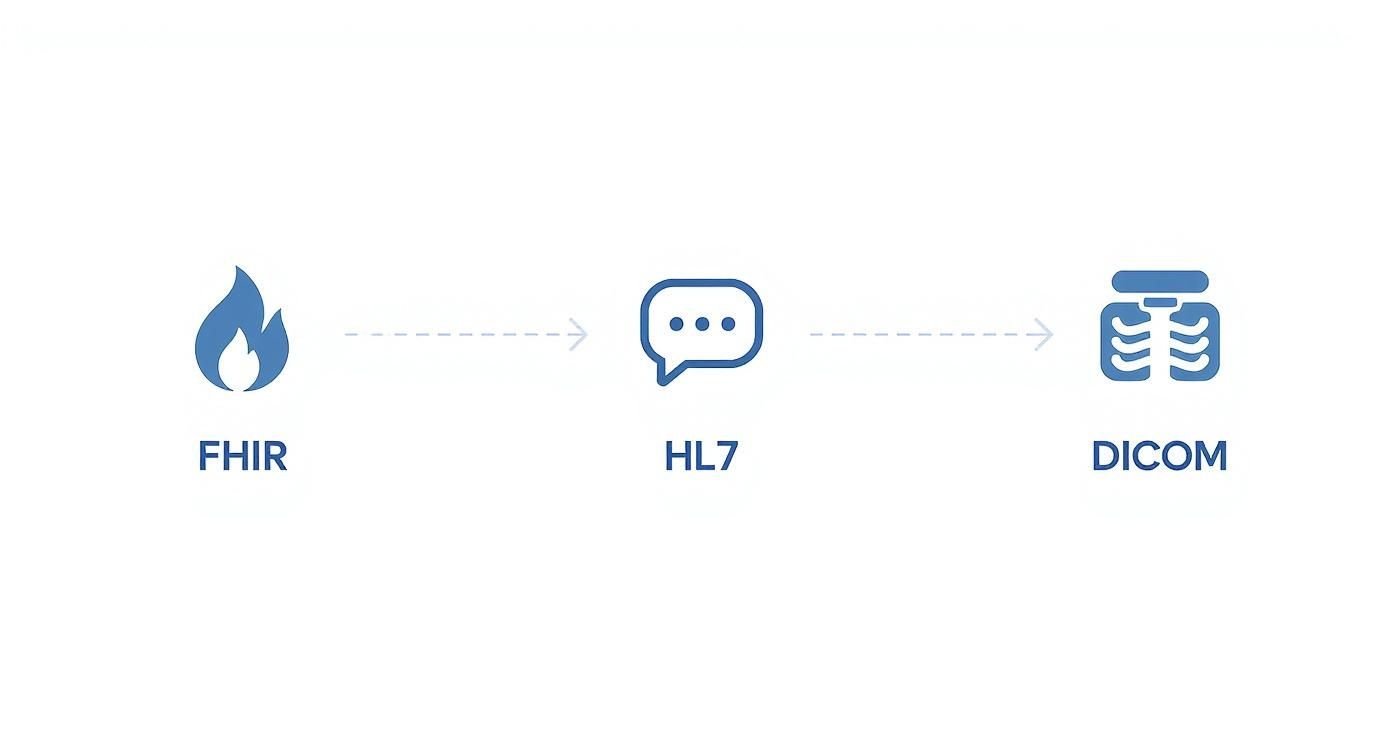
This visual really brings it home, showing how these distinct standards come together to form a cohesive ecosystem, with each one handling a different, yet critical, piece of health data.
The Integration Engine: A Central Hub
A much more organized and sane approach is to use an integration engine. Picture this as your city's central train station. Instead of building countless private roads, every system connects to this single, powerful hub. The engine acts as a master translator and traffic controller, taking in data in one format, transforming it, and routing it to the right destination in the language it understands.
This model is a massive leap forward from P2P. Adding a new system is far simpler because you only need to build one track to the central hub, not to every other system in your network. This gives you:
- Centralized Management: You can monitor and control all your data traffic from one place.
- Improved Scalability: It's dramatically easier to plug in new applications and services.
- Message Transformation: The engine can seamlessly convert data between different standards, like old-school HL7v2 and modern FHIR.
Of course, this central hub can also become a single point of failure. If the integration engine goes down, the entire data exchange network grinds to a halt. Reliability is absolutely paramount here.
Choosing an integration architecture is not just a technical decision; it's a strategic commitment to how your organization will grow, adapt, and collaborate in the future.
APIs: The Modern Rideshare Network
The most flexible and modern path forward involves using Application Programming Interfaces (APIs). This is like having a dynamic rideshare network for your data. Instead of being limited by fixed roads or train routes, APIs let systems request specific data on-demand, exactly when and where it's needed. It's a lightweight, agile model built for the real-time demands of today's healthcare world.
Many organizations are turning to cloud platforms to manage these complex data flows. If you're looking to build with this modern approach, exploring solutions like the Google Cloud Healthcare API can offer a fantastic look into how to manage diverse data standards in a secure, scalable environment.
This API-first strategy truly empowers innovation. It allows developers to easily build new tools and apps that securely plug into EHR data, opening up a world of possibilities. While it demands strong governance and security, the API model offers unparalleled adaptability for the future of connected care.
Bringing Medical Imaging and AI into Your EHR
Let's be honest: swapping text-based lab results and clinical notes between systems is a huge win, but it's only part of the story. The real challenge, the final frontier for interoperability in EHR, is medical imaging. We're not talking about small text files here. We're talking about massive, complex datasets that most EHRs simply weren't built to handle.
The result is a workflow that’s frustratingly fragmented. Clinicians are constantly jumping between the EHR for patient history and a separate Picture Archiving and Communication System (PACS) for the images. This isn't just inefficient; it creates a dangerous gap in the patient narrative. When specialists have to work outside the primary record, connecting imaging findings with other clinical data in real-time becomes a struggle, opening the door to missed insights and potential errors.
True interoperability means closing that gap and bringing this vital visual data right into the heart of the EHR.
Transforming the EHR into a Diagnostic Hub
The goal is to stop thinking of the EHR as a digital filing cabinet and start seeing it as an interactive diagnostic command center. This requires specialized tools that can stream and display complex DICOM files seamlessly within the patient's chart.
Imagine a single screen where a physician can review a patient's latest bloodwork, read a cardiologist's notes, and manipulate a 3D reconstruction of a CT scan. That’s the dream. It’s about creating a single source of truth.
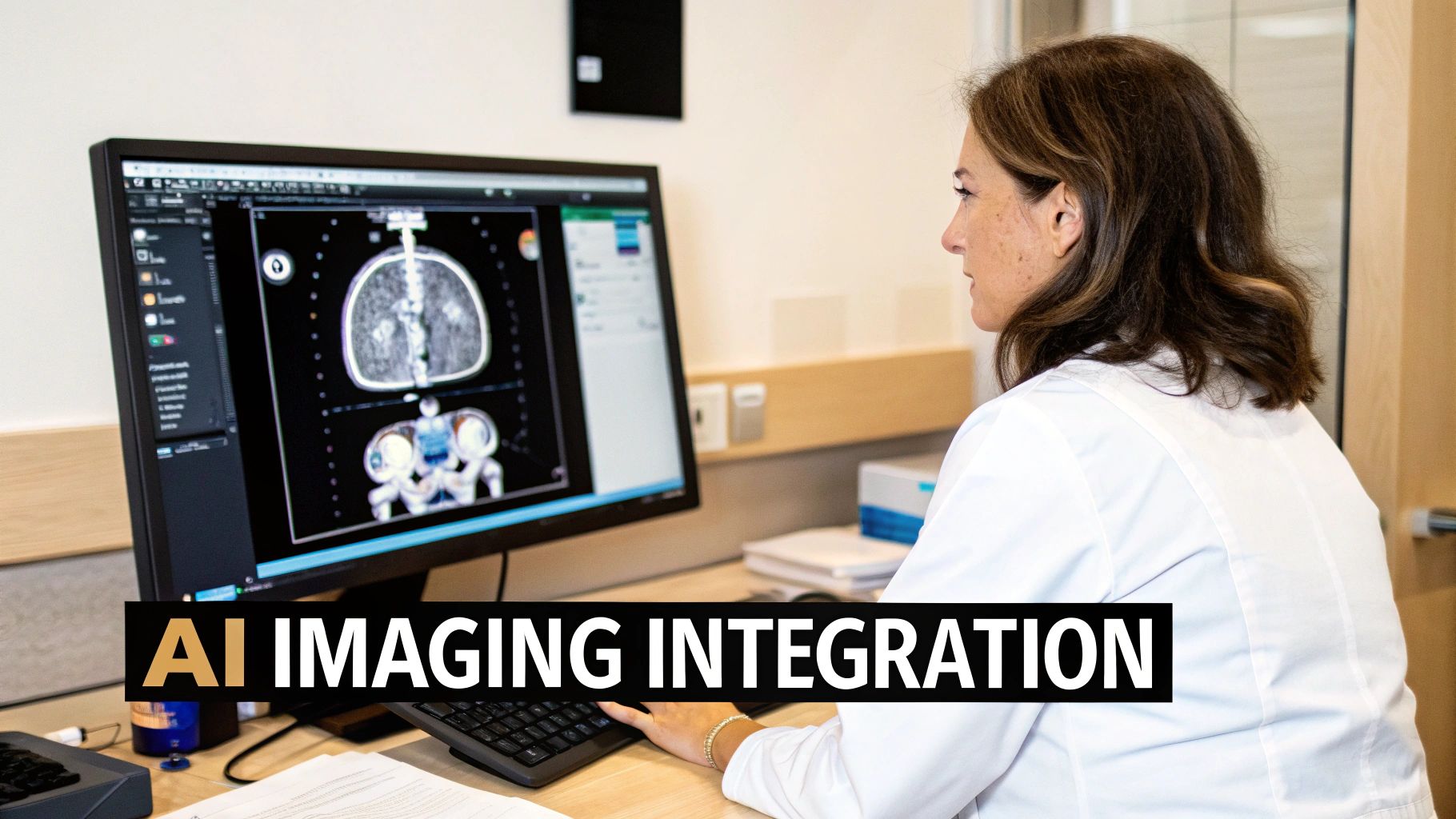
This is where having the right partner is everything. We at PYCAD specialize in bridging this exact divide. We build custom web DICOM viewers and integrate them into medical imaging web platforms, allowing clinicians to analyze scans with powerful, intuitive tools without ever having to leave the patient's record. It’s not about just linking to an image; it’s about embedding a diagnostic-quality, interactive experience directly into the clinical workflow.
The Power of Integrated AI
Once you have imaging data living natively inside the EHR, the possibilities explode—especially when you introduce Artificial Intelligence. With direct access to both the pixels and the patient's broader clinical story, AI algorithms can deliver a level of real-time analysis that was once pure science fiction.
By uniting imaging, clinical records, and AI, we elevate the EHR from a system of record to a system of intelligence. It becomes a proactive partner in care, helping to identify patterns and risks that a human eye might miss.
This synergy unlocks some truly game-changing applications:
- Automated Triage: AI can scan incoming studies, flag critical findings like a potential brain bleed, and instantly push them to the top of the queue for immediate radiologist review.
- Predictive Analytics: By correlating subtle features in an image with a patient's history and lab values, AI can help forecast disease progression or predict how well a patient might respond to a certain treatment.
- Quantitative Analysis: Instead of manual measurements, algorithms can automatically calculate tumor volumes or track changes in tissue density over time, giving clinicians objective, data-driven insights.
This is where diagnostic medicine is headed. Static images are becoming dynamic sources of deep insight. If your organization is ready to move in this direction, understanding the nuts and bolts of PACS integration strategies is the essential first step.
Ultimately, weaving medical imaging and AI into the EHR fabric is about creating a truly complete and intelligent patient record. It's about giving clinicians every piece of the puzzle, right when they need it, so they can deliver the best care imaginable.
Fortifying Your Data: Security in an Interoperable World
When we talk about making healthcare data flow seamlessly, what we're really talking about is building on a foundation of absolute trust. True interoperability in EHR isn't just a technical challenge of connecting systems; it’s about creating a safe harbor where sensitive health information can get to the right clinicians at the right time, without a shadow of a doubt about its security. This means going far beyond a checklist for regulations like HIPAA and GDPR. It means architecting a digital fortress around every single piece of patient data.
Imagine this fortress has several layers of defense. Each one has a specific job, and they all have to work in concert to ensure that innovation and privacy can thrive together. This is a profound commitment to protecting the very people this technology is meant to serve.
The Gatekeepers: Authentication and Access Control
The very first line of defense is simply controlling who gets through the gates. Solid authentication methods confirm that only verified users—whether they're doctors, nurses, or patients themselves—are granted entry into the system. Modern protocols like OAuth 2.0 act as the vigilant gatekeepers here, granting specific, limited permissions for certain tasks instead of just handing over the keys to the whole kingdom.
For example, a scheduling app might get the green light to see a doctor’s availability, but it will hit a brick wall if it tries to access clinical notes. This is all about enforcing the principle of least privilege, a cornerstone of modern data security.
Protecting patient data isn’t an obstacle to interoperability; it is the essential foundation upon which a connected and trustworthy health ecosystem is built.
Once a user is properly identified, access control then dictates what they are allowed to see and do. Think of these rules as the sentries patrolling the fortress walls, making sure a billing specialist can't wander into the radiology image archive or a primary care physician can't alter a specialist's finalized report.
The Walls: End-to-End Encryption
Data is never more vulnerable than when it's on the move between systems. End-to-end encryption acts as the impenetrable wall of our fortress. It scrambles data into unreadable code the instant it leaves one system and only unscrambles it once it arrives safely at its intended destination. Even if someone managed to intercept it mid-journey, the information would be complete gibberish without the right decryption key.
This level of protection is absolutely non-negotiable for any data in transit. The same goes for data at rest—the information sitting in databases or on servers—which must also be encrypted. A truly robust defense also involves understanding various data sanitization methods to ensure that when a system is retired, the data is gone for good.
We at PYCAD know that security is everything, especially when dealing with sensitive medical images. That’s why we build custom web DICOM viewers with security at their core from day one, ensuring powerful diagnostics never come at the expense of patient privacy. Our solutions are designed to plug securely into your existing platforms. You can see examples of our secure work over on our portfolio page.
The Watchtowers: Audit Trails and Compliance
The final layer of our defense is the watchtower: the detailed audit trail. Every single action taken within the system—every login, every file opened, every piece of data changed—is logged and monitored. This creates an unchangeable record of who did what, when, and why. These logs are invaluable for spotting suspicious activity, investigating potential breaches, and proving compliance with regulations.
Maintaining this fortress demands constant vigilance. For a closer look at the nuts and bolts of securing these data flows, our guide on https://pycad.co/hipaa-compliant-data-transfer/ offers some essential insights. By weaving together strong authentication, relentless encryption, and meticulous auditing, we can create a system where life-saving data flows freely and securely, building the trust we need for a truly connected healthcare future.
Your Roadmap to Achieving True Interoperability
This is where the theory gets real. For any healthcare organization serious about breaking down data silos, this is the moment where the big, ambitious goal of EHR interoperability turns into a series of concrete, achievable steps. It's time to map out a clear path forward and turn that vision of connected care into reality.
The journey doesn't start with technology—it starts with purpose. Before you write a single line of code or sign a single contract, the first move is to define the specific clinical and operational problems you’re trying to solve. This clarity will be your north star for every decision that follows.
Phase 1: Define Your Strategic Goals
First things first: get the right people in the room. Bring together a team of clinicians, IT specialists, and administrative leaders. This collaboration is non-negotiable for making sure everyone is pulling in the same direction. Together, you can pinpoint the biggest pain points that better data flow could actually fix.
Your core objectives might look something like this:
- Slash diagnostic errors by giving specialists instant access to a patient’s full history from their primary care physician.
- Speed up patient referrals by automating how clinical summaries and imaging are shared between departments.
- Cut down on costs by getting rid of redundant lab tests and the administrative busywork that comes with them.
- Boost patient engagement by giving people easy, direct access to their own health records through a patient portal.
Phase 2: Audit Your Systems and Pick Your Partners
With your goals locked in, it’s time to take a hard look at your current tech stack. Map out every system you use, identify the most significant data bottlenecks, and figure out which platforms are ready for modern integration—and which ones might need to be retired. This audit tells you just how big the mountain is that you're about to climb.
Choosing the right technology partners is a make-or-break decision. You don't just need vendors; you need true collaborators who get the unique headaches of healthcare data. This is especially true for something as complex as medical imaging. For example, we at PYCAD live and breathe this exact challenge. We build custom web DICOM viewers and integrate them into medical imaging web platforms, making sure that vital visual data moves effortlessly within your EHR. You can see what these kinds of powerful integrations look like in our portfolio.
The path to interoperability is a marathon, not a sprint. A phased rollout allows you to build momentum, learn from early successes, and demonstrate value every step of the way, inspiring confidence across your organization.
Phase 3: Plan a Phased Rollout
Trying to do everything at once—a "big bang" launch—is a recipe for disaster. A much smarter approach is to plan a phased rollout that delivers value in small, steady increments. Kick things off with a pilot project that tackles a high-impact but low-complexity workflow. This gives you a quick win, helps you work out the kinks, and builds confidence before you go bigger.
By 2023, about 70% of non-federal acute care hospitals were actively working on interoperability. But the numbers tell a deeper story: 53% of large hospitals were deeply engaged, while only 22% of smaller, independent hospitals could say the same. This proves that having the right resources and a smart strategy makes all the difference. You can discover more insights about EHR adoption statistics to get a clearer picture. This data really drives home why a well-thought-out plan is crucial for closing that adoption gap, no matter the size of your organization.
Frequently Asked Questions About EHR Interoperability
As we move toward a future of truly connected healthcare, it's natural to have questions. Getting clear on the fundamentals is the best way to prepare for the challenges—and the incredible opportunities—that come with achieving genuine interoperability in EHR.
Let's walk through a few of the most common questions. My hope is to bring these big ideas down to earth, leaving you inspired and ready to push this vital mission forward in your own work.
What’s the Real Difference Between Interoperability and Integration?
This is a fantastic question because the two terms are often used interchangeably, but they represent entirely different philosophies.
Think of integration as soldering a specific wire between two devices. It creates a custom, point-to-point connection that solves one problem, right here, right now. It works, but it’s rigid and doesn't scale. If you add a third device, you have to build another custom bridge.
Interoperability, on the other hand, is like creating the USB-C standard. It’s not about building one-off connections; it’s about establishing a universal language that allows any system to plug in, communicate, and exchange information that both sides can actually understand and use. It’s the ability to connect without needing a special adapter every single time.
How Is FHIR an Improvement Over Older Standards Like HL7 V2?
While HL7 V2 has been the backbone of health data exchange for decades—and we should respect its legacy—it was built for a different era. Think of it like sending a massive file cabinet from one office to another. You get everything, but it's slow, and you have to sort through the whole thing to find the one document you need.
FHIR is a complete reimagining, built for the modern, web-based world. Instead of moving the entire file cabinet, FHIR lets you make a quick, precise request for just a single piece of paper—like a patient's known allergies or one specific lab result. This lightweight, nimble approach is exactly what’s needed for mobile apps and real-time clinical decision support.
We at PYCAD rely on these modern standards when we build custom web DICOM viewers and integrate them into medical imaging web platforms. It ensures data flows quickly and efficiently, right where it’s needed most.
The first step toward better interoperability isn't buying new technology—it's building a shared vision. Aligning clinical, technical, and administrative goals is the foundational work that ensures every subsequent decision moves you closer to meaningful, connected care.
Where Should My Organization Even Begin?
The journey starts with people and purpose, not with purchasing software. Your first move should be to get your clinicians, IT team, and administrators in the same room to map out what you actually want to achieve. Are you aiming to speed up patient referrals? Or is the top priority to eliminate redundant and costly lab tests?
Once you have that shared goal, the next step is to conduct an honest audit of your current systems. Where are the data logjams? What are the biggest points of friction for your care teams? This strategic groundwork is what separates successful projects from failed ones. It transforms a daunting goal into a clear, step-by-step plan.
We at PYCAD have expertise in navigating the complexities of medical imaging data. We don't just build technology; we build solutions. We develop secure, custom web DICOM viewers and integrate them flawlessly into your existing platforms, giving clinicians the complete patient picture they need.
To see how we bring these ideas to life, take a look at our portfolio of innovative solutions.