What if you could pull up a patient's entire imaging history—every X-ray, MRI, and CT scan—from anywhere in the world, securely, in seconds? That’s not science fiction anymore. It’s the reality of moving PACS to the cloud. This isn't just a small step; it's a giant leap from the old, clunky on-premise systems to a flexible, global digital library that’s always on. This is where healthcare is headed, and it's unlocking a more connected and intelligent future.
The Future of Medical Imaging Is in the Cloud
For years, Picture Archiving and Communication Systems (PACS) have been the backbone of radiology departments. These systems were traditionally housed on local servers, which meant they needed a ton of physical space, a dedicated IT crew, and constant upkeep. Think of it like a town library—incredibly valuable, but stuck in one building with set hours and physical limitations.
But modern medicine is moving way too fast for that old model. We need instant collaboration between specialists in different cities, the ability to read scans remotely, and a way to handle the ever-increasing flood of imaging data. A server crash in the middle of a critical diagnosis isn't just a technical glitch; it's a direct threat to patient care.
Why Cloud Adoption Is Accelerating
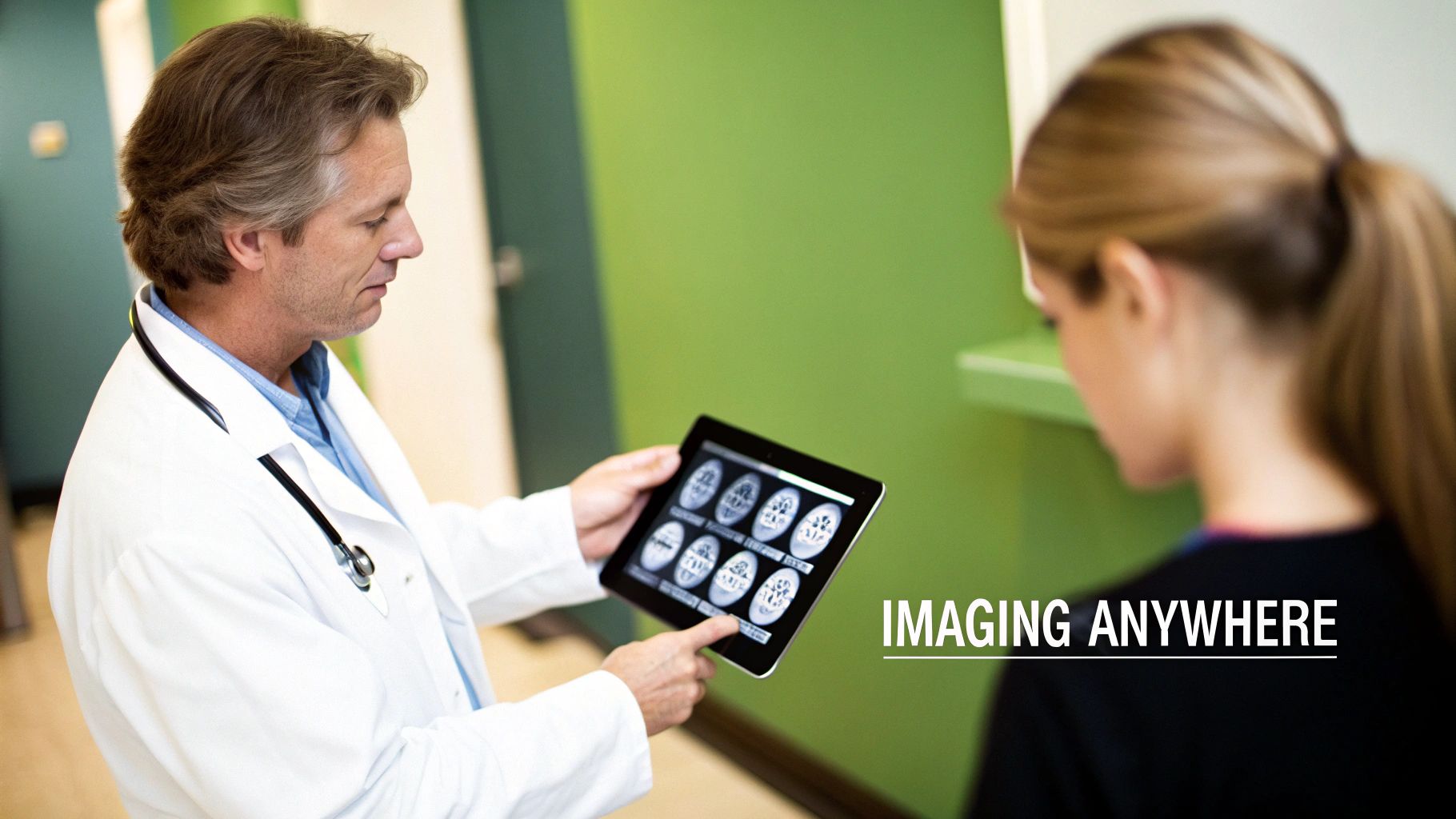
Moving to a cloud-based PACS solves these problems directly. It’s so much more than just shifting files from a local machine to a remote one. It fundamentally changes how we manage, share, and use medical images. This shift is happening for a few very good reasons:
- Greater Accessibility: Doctors and specialists can securely pull up patient studies from any device with an internet connection. This means faster diagnoses, easier remote consultations, and better collaboration.
- Effortless Scalability: As your data grows, the cloud simply grows with you. There are no more expensive, disruptive hardware upgrades. You just get the space you need, when you need it.
- Smarter Cost Structures: Instead of massive upfront investments in hardware, the cloud operates on a predictable subscription model. This makes top-tier technology accessible to organizations of all sizes.
This is exactly why we're seeing medical device manufacturers and health IT companies building more powerful, interconnected tools. At PYCAD, we specialize in creating custom web DICOM viewers and integrating them into cloud-based platforms, turning that storage into a living, interactive diagnostic workspace.
By moving PACS to the cloud, healthcare organizations are not just upgrading their IT infrastructure; they are building a foundation for future innovation, including AI-driven diagnostics and enterprise-wide imaging strategies.
A Strategic Leap Forward
At the end of the day, adopting a cloud PACS is a strategic move, not just a technical one. It brings medical imaging in line with the core tenets of modern digital health: being agile, secure, and able to work with other systems. As healthcare becomes more distributed and data-centric, the ability to seamlessly access and analyze imaging data is no longer a luxury—it’s a necessity.
The journey to the cloud is essential for any organization that wants to stay at the forefront. You can read more about what's next by checking out our guide on the future of medical imaging. This shift is creating a more resilient, efficient, and intelligent ecosystem for patient care.
Cloud PACS vs. On-Premise Systems: A Clear Comparison
Deciding between a cloud PACS and a traditional on-premise system is one of the biggest calls a healthcare organization can make. This isn't just an IT decision; it's a strategic move that ripples through your entire operation, affecting everything from clinical workflows and financial planning to your ability to innovate. It’s not about where the data lives—it's about how agile and resilient you want your organization to be.
Think about this real-world scenario: a lead radiologist is in the middle of a complex, time-sensitive diagnosis. Suddenly, the on-premise server humming away in a climate-controlled room down the hall goes down. Access is severed. The diagnosis grinds to a halt, and critical time is lost. This isn't just a hypothetical; it's a real risk that comes with relying on physical hardware.
Now, let's flip the script. With a cloud PACS, that same study is safely stored across multiple, geographically separate data centers. A single point of hardware failure on-site becomes a non-issue. The radiologist keeps working without a hitch, backed by a level of redundancy most hospitals could never dream of building on their own.
Financial Models: Capital vs. Operational Costs
The money side of this is where things get really different. On-premise systems are a classic Capital Expenditure (CapEx). You're looking at a huge upfront investment in servers, storage arrays, networking gear, and software licenses, not to mention the physical space to house it all. It’s a massive initial cash outlay that can be tough to swallow.
Cloud PACS turns this model on its head, shifting to an Operational Expenditure (OpEx) model. Instead of buying everything, you pay a predictable subscription fee. This gets rid of the heavy upfront cost, making state-of-the-art imaging technology accessible without locking up capital that could be used for patient care or new research.
A cloud-based model transforms your PACS from a depreciating asset that requires constant maintenance into a scalable, managed service that evolves with your needs.
This operational approach also bundles in all the maintenance, security patches, and software updates, which are handled by the vendor. This frees your internal IT team from the endless cycle of hardware babysitting, letting them focus on projects that actually move the needle for your clinicians.
On-Premise PACS vs Cloud PACS Feature Breakdown
To really see the difference, let's break it down side-by-side. The contrast in day-to-day reality, from costs to accessibility, is stark.
| Feature | On-Premise PACS | Cloud PACS |
|---|---|---|
| Initial Cost | High (CapEx) – servers, licenses, storage | Low (OpEx) – subscription-based |
| Scalability | Limited and costly; requires new hardware | Nearly infinite; scale on demand |
| Maintenance | In-house IT team required for all tasks | Managed entirely by the cloud provider |
| Accessibility | Restricted to the local network; requires VPNs | Secure access from any location, any device |
| Disaster Recovery | Complex and expensive to implement | Built-in, with geographic redundancy |
| Security Updates | Manual; relies on internal staff schedules | Automatic and continuous |
| IT Staff Focus | Hardware management and troubleshooting | Strategic initiatives and clinical support |
This table makes it clear: while on-premise gives you physical control, the cloud offers a path to greater operational freedom and resilience.
Maintenance and Accessibility: A Tale of Two Realities
Keeping an on-premise PACS running is a major commitment. It demands a specialized IT crew to handle backups, fix hardware when it inevitably fails, and manage complex system upgrades that almost always require planned downtime. And access? Giving secure access to teleradiologists or specialists at other facilities usually means wrestling with complicated VPNs.
In sharp contrast, cloud PACS solutions are built from the ground up for simplicity and access.
- Zero Hardware Maintenance: The cloud provider takes care of all the physical infrastructure, so your system just works. No more late-night server reboots.
- Automatic Updates: The latest software features and security patches are rolled out automatically, keeping your system secure and modern without disrupting your day.
- Anywhere, Anytime Access: Authorized users can securely view images and reports from any device with an internet connection. This is a game-changer for collaboration and teleradiology.
For medical device companies and health IT innovators, this level of access is everything. At PYCAD, we build custom web DICOM viewers and integrate them into medical imaging web platforms, turning this cloud accessibility into a powerful diagnostic tool. By building on the cloud, we can deliver advanced viewing capabilities straight to a web browser, empowering clinicians wherever they are. You can see examples of our innovative solutions on our portfolio page.
Ultimately, while on-premise systems offer a comforting sense of direct control, they come with a heavy operational price. Cloud PACS clears a path to greater flexibility, better security, and predictable costs, setting the stage for a more connected and efficient future in medical imaging. Before you make the leap, you need a solid plan for your data. For help on that front, check out our guide on data migration best practices to ensure a smooth transition.
How Cloud PACS Architecture Really Works
To really grasp what makes a Cloud PACS tick, it helps to look past the buzzwords and see the machinery behind the curtain. Think of it less like a single product and more like an advanced, interconnected system, where each part has a specific job designed for speed, security, and growth.
The whole process is a beautifully engineered journey for every single medical image. It all starts the moment a study is captured. When an MRI or CT scanner creates a DICOM image, it's not just saved—it's securely transmitted into a cloud environment, ready to be managed by this powerful architecture.
The Building Blocks of a Modern Cloud PACS
A true cloud PACS isn't just one thing; it’s a system built on several key pillars, usually from a major cloud provider like Amazon Web Services (AWS) or Microsoft Azure. Each component works together to create a system that's both tough and agile.
- Object Storage: This is your foundation. Think of services like Amazon S3 or Azure Blob Storage as a nearly bottomless archive for your imaging data. Unlike old-school server rooms with physical hard drives, object storage is built for incredible durability and scales automatically. You simply never run out of room.
- Compute Instances: These are the engines doing the heavy lifting. Virtual servers, like AWS EC2 instances, provide all the processing power needed to handle DICOM communications, run complex image processing tasks, and respond to every user click. Best of all, you can spin them up or down in minutes to meet real-time demand.
- Managed Databases: Every image comes with a story—patient info, study details, access logs. That story needs to be perfectly organized. Managed databases like Amazon RDS or Azure SQL Database store all this critical metadata securely. They also take care of backups and updates on their own, which is a huge load off your IT team.
- Networking and Security Layers: This is the digital fortress protecting your data. A Virtual Private Cloud (VPC) carves out your own isolated, private section of the cloud. From there, firewalls, encryption, and identity management tools give you fine-grained control over who can see what, and from where.
This chart really puts the differences between the old way and the new way into perspective.
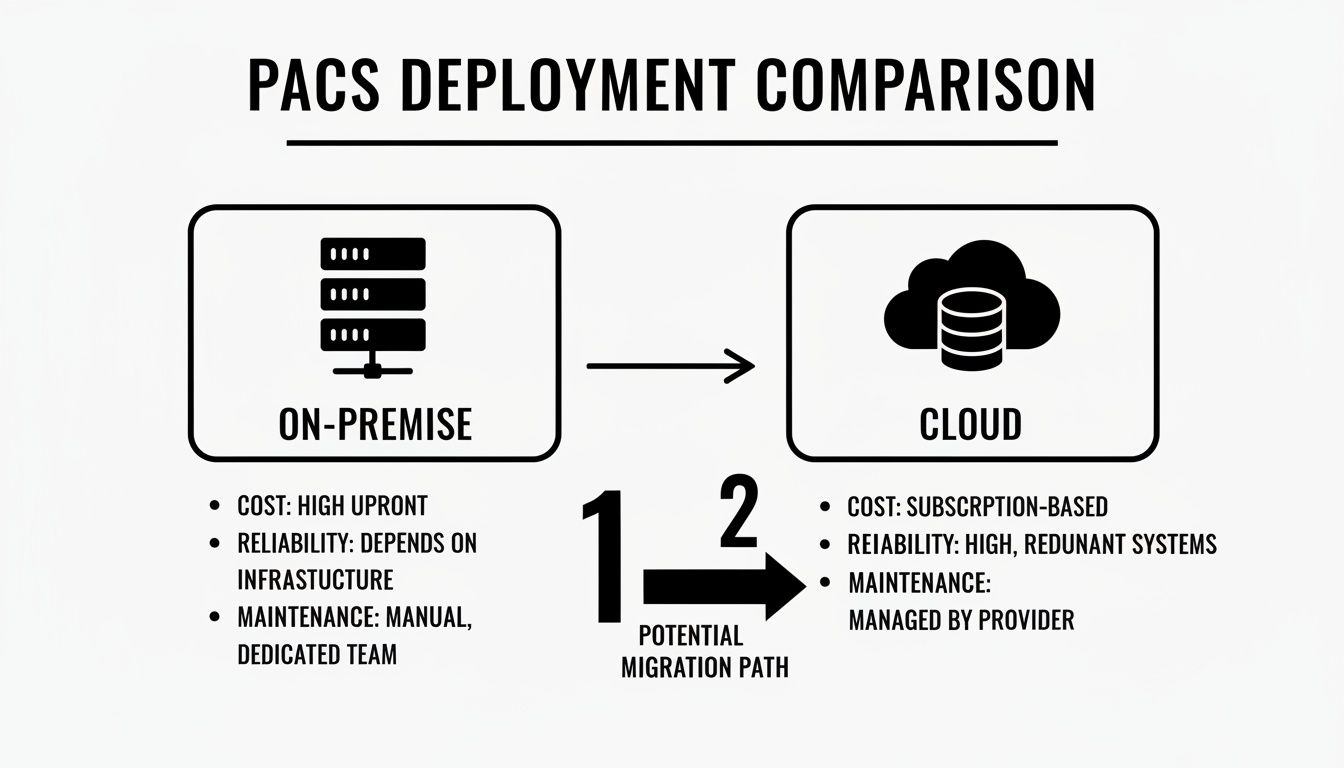
You can see how the cloud flips the script, trading massive upfront capital costs for predictable operational expenses while dramatically improving reliability through built-in redundancies.
Weaving It All Together with Your Existing Systems
A cloud PACS can't live on an island. Its real power is unleashed when it talks fluently with the other critical systems you already rely on. This is where a smart architecture proves its worth—by connecting the dots and creating one smooth, unified workflow.
The most critical handshakes are with the Electronic Health Record (EHR) and the Radiology Information System (RIS). Using standard protocols like HL7, the cloud PACS can sync patient demographics, pull down new study orders from the RIS, and then push the final reports right back into the patient’s chart in the EHR. This simple, automated loop closes the door on manual errors and gives clinicians the complete picture they need.
A well-architected cloud PACS becomes the central nervous system for imaging data, orchestrating its flow from the scanner all the way to the final diagnostic report inside the EHR.
Getting this level of integration right is where deep expertise really matters. Just dumping images into cloud storage is the easy part. The real art is making that data immediately useful within a clinician's daily routine.
This is exactly what we live and breathe at PYCAD. We don't just understand the cloud; we build custom web DICOM viewers and integrate them directly into medical imaging web platforms. Our solutions are designed from the ground up to make the most of what cloud architecture offers, ensuring your team gets fast, intuitive access to patient imaging without ever leaving their primary application.
Take a look at our portfolio page to see how we turn powerful architecture into practical, real-world clinical tools that just work.
Securing Patient Data with HIPAA and GDPR in the Cloud
For many in healthcare, the thought of moving sensitive patient data to the cloud can still feel like a leap of faith. But here’s the thing: that apprehension is often based on an outdated view of what the cloud actually is.
Security isn't a barrier to adopting a pacs in the cloud. When done right, it becomes one of its greatest strengths, turning that initial uncertainty into a foundation of unshakable confidence.
Let's put the myth that the cloud is inherently insecure to rest. Major cloud providers like AWS and Azure have poured billions into building digital fortresses that far surpass what most individual hospitals could ever hope to build on-site. Their infrastructure isn't just for startups; it's engineered to support global banks, government agencies, and of course, healthcare systems, with compliance and protection built into its very DNA.
A properly configured cloud environment doesn't just meet security standards—it raises the bar entirely, offering a level of resilience and oversight that’s often out of reach for on-premise setups.
Understanding the Shared Responsibility Model
To really get it, you have to grasp the shared responsibility model. Think of it like renting a high-security vault at a bank. The bank is responsible for the building itself—the guards, the alarms, the thick steel door. That’s the cloud provider’s job. They secure the underlying infrastructure, the "cloud itself."
But you’re still responsible for what you put inside that vault and who you give the keys to. This is your organization's role. You manage who gets access, you encrypt your own data, and you configure your applications securely. It’s a partnership that creates multiple, robust layers of security with clear accountability at every turn.
The shared responsibility model isn't about offloading risk. It’s about leveraging a world-class security platform to build an even stronger defense for your patient data.
This collaborative approach frees up your team to focus on what matters most: securing the data and applications, not the physical servers in a back room.
Core Security Measures for Compliance
Meeting the strict standards of regulations like the Health Insurance Portability and Accountability Act (HIPAA) in the US and the General Data Protection Regulation (GDPR) in Europe is completely non-negotiable. Fortunately, a cloud PACS architecture gives you the powerful tools needed to do just that.
Here are the key pillars that make it happen:
- End-to-End Encryption: Your data is scrambled and protected both while it's traveling across networks (in transit) and while it's stored on a server (at rest). This makes the information completely unreadable to anyone who shouldn't have access.
- Granular Access Controls: Not everyone in a hospital needs to see everything. To effectively protect patient data in the cloud and ensure compliance with regulations like HIPAA and GDPR, understanding and implementing strong security measures such as Role Based Access Control (RBAC) best practices is essential. This principle ensures clinicians only see the specific patient data directly relevant to their job.
- Immutable Audit Trails: Every single action taken—every view, every download, every modification—is logged in a permanent, unchangeable record. This creates total transparency and accountability, something that is absolutely critical during compliance audits.
- Robust Disaster Recovery: Cloud platforms are built with geographic redundancy in mind. Your data can be automatically replicated across multiple data centers, which means a fire, flood, or power outage in one location won't result in catastrophic data loss.
At PYCAD, we don't just build software; we build secure medical imaging ecosystems. We specialize in creating custom web DICOM viewers and integrating them into medical imaging web platforms with these security principles baked in from the very first line of code. Our entire development process is built around protecting patient data, ensuring the tools we deliver are both powerful and compliant. For a deeper dive, our guide on HIPAA-compliant data transfer offers even more insight.
Ultimately, moving to a cloud PACS is an incredible opportunity to elevate your entire security posture, providing a safer, more resilient, and more compliant home for your most critical data. You can explore some of our secure, innovative solutions on our portfolio page.
Unlocking Innovation with AI and Advanced Viewers
A modern pacs in the cloud is so much more than a digital filing cabinet. Think of it as a launchpad—an ecosystem where game-changing technologies like Artificial Intelligence can truly take off and redefine patient care.
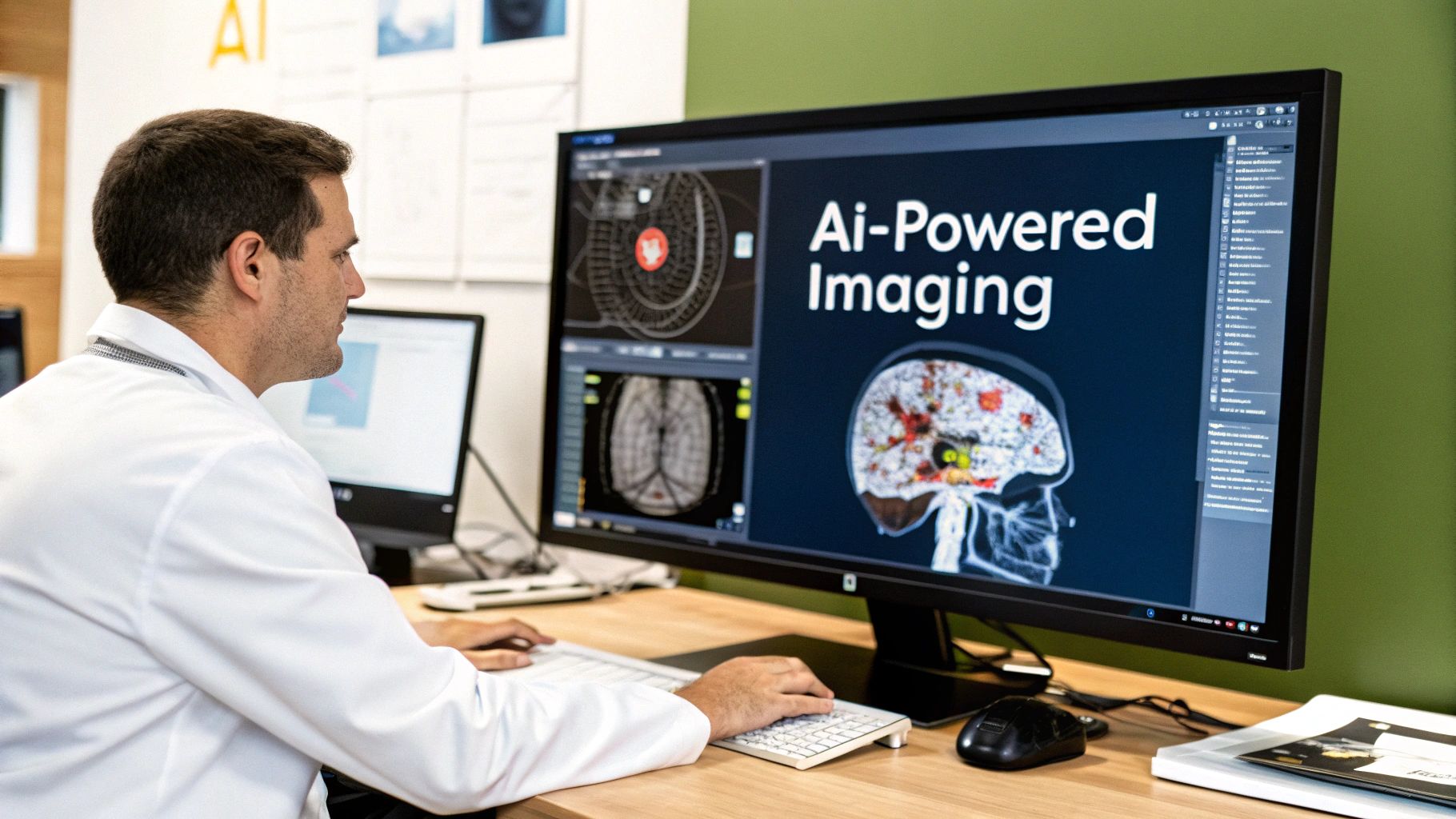
The real magic behind this shift is the near-infinite computational power the cloud offers. On-premise servers have their limits. A cloud environment, on the other hand, can instantly scale to run incredibly complex diagnostic algorithms across massive imaging datasets. This is the exact environment that sophisticated AI and machine learning models need to thrive.
Fueling AI-Powered Diagnostics
The partnership between AI and cloud-based imaging is already making a huge difference. AI algorithms can sift through thousands of studies in minutes, spotting subtle patterns the human eye might miss and flagging potential issues for a radiologist to review. This isn't about replacing doctors; it's about giving them superpowers.
This synergy brings real-world benefits to the entire diagnostic process:
- Smarter Workflows: AI takes on the repetitive tasks, like triaging studies. Imagine an algorithm spotting a potential brain bleed and automatically bumping that case to the top of the worklist. That’s a life-saving efficiency boost.
- Predictive Insights: By analyzing vast image archives, AI models can help spot patients at high risk for certain diseases long before symptoms show up. This opens the door to truly proactive, preventative medicine.
- Precision Measurements: AI is brilliant at quantitative tasks, like precisely tracking tumor growth over time. This gives clinicians objective data to guide treatment and see if it’s working.
The cloud provides the essential fuel—scalable storage and immense processing power—that allows AI engines to learn, adapt, and deliver valuable clinical insights at scale.
This isn't some far-off future; it's happening right now. Studies have shown that integrating AI can dramatically shorten report turnaround times and sharpen diagnostic accuracy, leading directly to better outcomes for patients. The cloud puts this power within reach for healthcare organizations of any size.
The Critical Role of Advanced DICOM Viewers
But all that data and algorithmic power is only half the equation. The real breakthrough happens when clinicians can interact with that information in a natural, intuitive way. This is where the viewer becomes the heart of the diagnostic experience. Old-school desktop applications just can't keep up with the dynamic, data-rich world of modern imaging and AI.
This is why we at PYCAD are obsessed with building powerful, custom web DICOM viewers and integrating them into medical imaging web platforms. Our viewers are designed to be the bridge between the raw potential of the cloud and the expert hands of a clinician, creating a workspace that is both interactive and insightful.
What can these next-generation viewers do? It's a world away from the old systems:
- Seamless AI Visuals: They can display AI-generated heatmaps, annotations, and overlays directly onto the DICOM images. This lets clinicians instantly see and validate what the algorithm found, all within their normal workflow.
- Next-Level Visualization: Features like Multiplanar Reconstruction (MPR) and 3D rendering are available right in the web browser. Clinicians can explore anatomy from any angle without being tied to a specific high-powered workstation.
- True Collaboration: They enable specialists in different hospitals—or even different countries—to securely share and review images in real-time, eliminating geographical barriers to expertise.
The goal is to turn a static medical image into a dynamic, interactive source of truth. By pairing the infinite scale of a pacs in the cloud with a viewer built for the modern era, we unlock an entirely new dimension of diagnostic insight.
To see how we bring these advanced capabilities to life, feel free to explore some of our work on our portfolio page.
Why Healthcare Is Shifting to the Cloud
The move to PACS in the cloud isn't just a trend anymore; it's a fundamental shift that's redefining how healthcare works. We're seeing powerful forces at play—the explosion of teleradiology, the push for value-based care, and the need for cohesive, enterprise-wide imaging strategies—all pointing in one direction: the cloud.
This isn’t just a game for massive hospital networks either. From major urban medical centers to small, independent clinics in rural areas, organizations of all sizes are finding a new sense of agility. The cloud offers a way out from under the weight of heavy upfront hardware costs and the constant headache of on-premise maintenance, putting powerful imaging technology within everyone's reach.
The Market Is Speaking Loud and Clear
The numbers don't lie. The adoption of cloud-based PACS solutions has hit a serious growth spurt. A 2023 study found that 35% of healthcare organizations had already moved their PACS to the cloud.
That's a huge leap from just 18% in 2021. We're talking about 94% relative growth in only two years, a clear signal that confidence in cloud technology is skyrocketing. You can dive deeper into these global PACS adoption trends to see the momentum firsthand.
Of course, a big part of the appeal is the promise of cost savings. Realizing those savings, however, comes down to smart management. Exploring actionable cloud cost optimization strategies is a crucial step to make sure your cloud PACS investment pays off.
More Than Just Storage—It's a Launchpad for Innovation
The real story here isn't just about ditching old servers. It's about what the cloud makes possible. It lays the groundwork for real innovation, offering the kind of scalable power needed for AI-driven diagnostics and sophisticated visualization tools that were once pipe dreams for many.
Cloud PACS is the strategic pivot that allows healthcare to move from static image archiving to dynamic, intelligent diagnostic ecosystems accessible from anywhere.
This is exactly where we at PYCAD come in. We at PYCAD, build custom web DICOM viewers and integrate them into medical imaging web platforms, transforming simple cloud storage into a collaborative and powerful workspace for clinicians. Our work is all about unlocking the cloud’s full potential to help deliver faster, more accurate diagnoses.
The industry has spoken, and the message is clear. Moving to a cloud PACS isn't just a simple upgrade—it's an essential step toward building a smarter, more resilient healthcare system for the future. Take a look at how we’re helping build that future on our portfolio page.
Your Cloud PACS Questions, Answered
Stepping into the world of cloud-based medical imaging naturally brings up a lot of questions. It's a big move, after all. We've gathered some of the most common questions we hear from Health IT leaders and medical device innovators to give you the straightforward answers you need.
What's the Single Biggest Hurdle in Moving to a Cloud PACS?
Honestly, the toughest part isn't the technology itself—it’s the planning. The real challenge is orchestrating a flawless data migration that guarantees zero downtime and maintains perfect data integrity.
Think about it: you're moving massive, sensitive datasets. You have to ensure every DICOM file is validated after the move and that the new system talks seamlessly with your existing EHR and RIS. This isn't just a technical lift; it's a strategic operation. The key is working with a partner who gets both the cloud and the clinic, ensuring the transition is smooth and doesn't disrupt patient care for a single second.
How Can a Cloud PACS Keep Up with DICOM Viewing Demands?
This is where the cloud really shines. Instead of forcing clinicians to download huge studies, modern cloud systems use smart streaming technology. Your web DICOM viewer pulls pixel data as needed, giving radiologists near-instant access, even on a less-than-perfect internet connection.
On top of that, cloud providers use global Content Delivery Networks (CDNs) to cache data closer to your users, slashing latency even further.
At PYCAD, our entire focus is on this experience. We at PYCAD, build custom web DICOM viewers that ensure a buttery-smooth diagnostic session, perfectly integrated into medical imaging web platforms.
Can We Really Tailor a Cloud PACS to Our Unique Workflow?
Absolutely. One of the best things about modern cloud platforms is how adaptable they are. Using APIs (Application Programming Interfaces), a cloud PACS can be molded to fit just about any need you can imagine.
Maybe your medical device requires a unique viewing protocol, or your research team needs an AI analysis tool built right in. This is where a specialized partner can make all the difference. We at PYCAD, build custom web DICOM viewers and integrate them into medical imaging web platforms. We can build custom viewers, analytics modules, or other components that plug directly into the cloud PACS, turning a standard system into a solution built just for you.
At PYCAD, we don't just work with cloud technology; we shape it to fit the real-world demands of healthcare. We at PYCAD, build custom web DICOM viewers and integrate them into medical imaging web platforms. To see how our expertise can accelerate your innovation, explore our work on our portfolio page.