Picture this: you’re trying to build a puzzle, but the pieces are scattered all over the house, with some locked away in different safes. For many organizations, managing critical data feels exactly like that. Records retrieval solutions are the master key, designed to unlock and bring all that scattered information together for fast, secure, and accurate access.
The Future of Data Access Is Here
For years, getting your hands on important documents was a painfully slow and manual process. It was a world of physical paperwork, faxes, and endless follow-up calls. This old way of doing things created frustrating bottlenecks in fields like healthcare, legal services, and finance—places where getting the right information on time is absolutely critical.
The move from these outdated methods to sophisticated digital systems isn't just a simple upgrade; it’s a complete overhaul of how modern organizations work.
Modern records retrieval solutions are the engine powering efficient operations. They swap out chaotic, fragmented workflows for a single, unified system. Think about a hospital being able to instantly pull up a patient’s complete medical history, or a law firm gathering crucial evidence without expensive delays. This shift is at the very heart of the digital transformation in healthcare, where data accessibility can literally change outcomes.
Driving Growth and Innovation
It's no surprise that the demand for these systems is skyrocketing. The global medical records retrieval market is currently valued at around USD 1.1 billion and is expected to climb to USD 2.8 billion by 2035.
That’s a compound annual growth rate (CAGR) of 10.1%, fueled by the non-negotiable need for secure and efficient information access. For a deeper dive, check out this insightful market analysis.
At its core, effective records retrieval is not just an administrative task—it's a strategic advantage. It empowers professionals with the right information at the right time, turning data from a liability into a powerful asset for decision-making and innovation.
Ultimately, these platforms do so much more than just fetch files. They lay the groundwork for solid compliance, real innovation, and top-tier service. At PYCAD, we’re proud to be part of this movement. We at PYCAD, build custom web DICOM viewers and integrate them into medical imaging web platforms, making complex medical data instantly accessible. You can see what we've built in our PYCAD portfolio.
How Records Retrieval Technology Works
To really get what makes modern records retrieval possible, you have to look under the hood. It all comes down to the brilliant technologies that turn the dream of seamless data access into a reality.
Imagine trying to have a conversation where everyone speaks a different language—it would be pure chaos. For decades, that was the reality in healthcare. A CT scan from one hospital was often an unreadable digital file at another. This was the problem that needed solving, and universal data protocols were the answer.
These protocols act like master translators. They ensure that information from one system is perfectly understood by another, no matter the hardware or software. They create a common language, finally breaking down the digital walls that kept critical patient data locked away in silos.
The Universal Translators of Healthcare Data
Think of these protocols as the unsung heroes of modern medicine. They form the backbone of a connected health ecosystem, each playing a specific, vital role in making sure information can flow freely and securely.
Let's break down the major players.
- DICOM (Digital Imaging and Communications in Medicine): This is the gold standard for medical imaging worldwide. From MRIs to X-rays, DICOM ensures that every image and its associated data are stored and sent in one consistent format. It’s why a radiologist can confidently open a scan from halfway across the world.
- FHIR (Fast Healthcare Interoperability Resources): FHIR is the new kid on the block, built for the web age. It’s designed to exchange smaller, specific pieces of health records—like lab results, medication lists, or allergy information—quickly and efficiently. It's the engine behind many of today's patient-facing health apps.
- XDS (Cross-Enterprise Document Sharing): This protocol is all about sharing entire clinical documents between different healthcare organizations. It provides a registry and a way for authorized doctors to find and retrieve a patient's records, no matter where they were created within a trusted network.
This is more than just a technical detail; it’s the foundation of collaborative care. The diagram below shows how a records retrieval solution acts as a central hub, connecting otherwise separate industries that all depend on access to the same secure information.
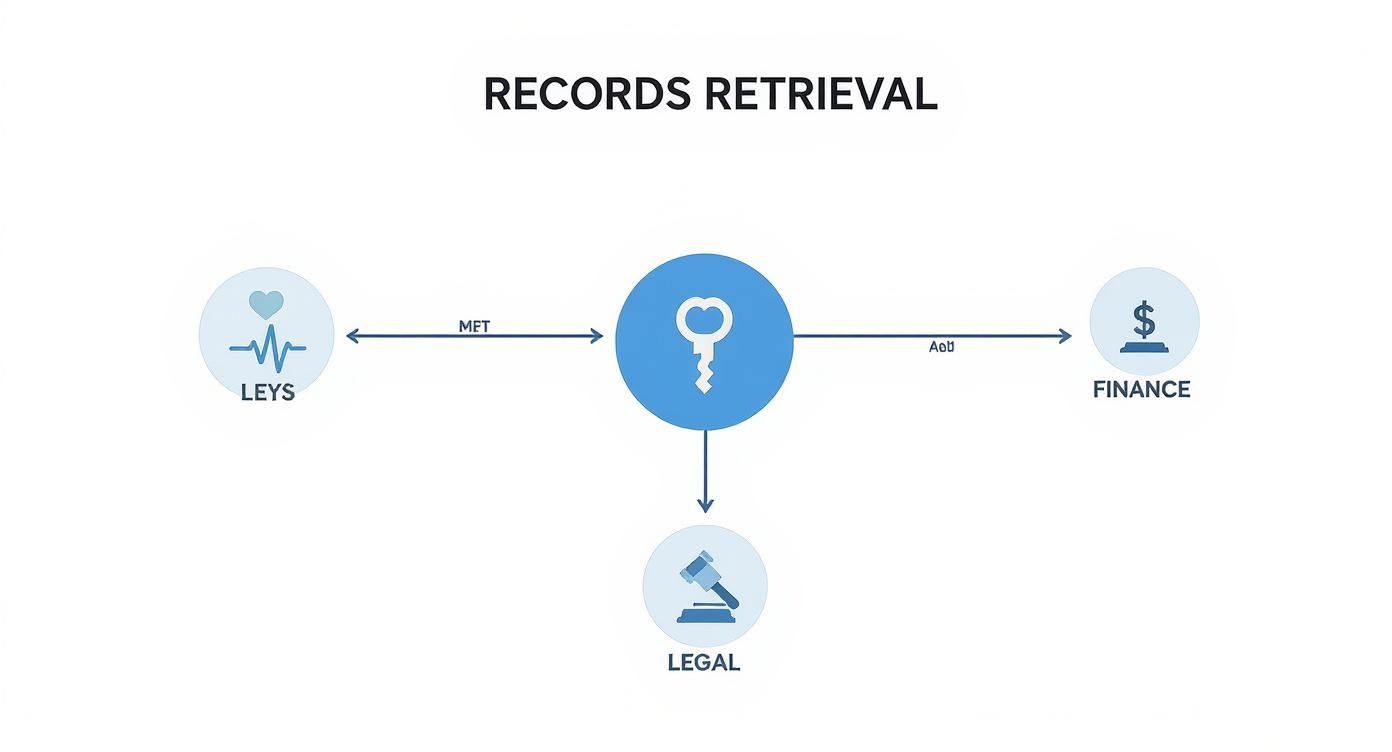
While the end goals for healthcare, legal, and finance may differ, the image makes it clear: the need for a centralized, secure, and reliable data access point is universal.
Bringing Medical Imaging to the Web
DICOM was a huge step forward, but it had a limitation: you often needed specialized desktop software to view the images. The next great leap was DICOMweb, a set of services that brought the power of DICOM to any standard web browser.
Suddenly, you could view a complex MRI scan on a laptop, a tablet, or even a smartphone, without installing a single piece of proprietary software. It was a game-changer for accessibility.
DICOMweb represents a fundamental shift. It empowers clinicians, researchers, and even patients with the ability to view and interact with vital medical images from anywhere, at any time, securely over the internet.
This is exactly where our expertise at PYCAD shines. We at PYCAD, build custom web DICOM viewers and integrate them into medical imaging web platforms, turning these complex protocols into tools that are practical, intuitive, and powerful. We believe technology should simplify the path to better care and discovery, not complicate it. You can see examples of our work on our portfolio page: https://pycad.co/portfolio.
For a deeper dive, check out our guide on powerful PACS integration strategies. It shows how we put these principles into practice every day.
Keeping Your Sensitive Data Safe
In the world of records retrieval solutions, security isn't just a feature—it's the entire foundation. When you're dealing with someone's personal health information or sensitive financial data, trust is everything. Modern systems are built to be digital fortresses, engineered from the ground up to shield your most critical information with multiple, overlapping layers of defense.
Think of it like a bank vault, but with an unchangeable digital logbook that tracks every single move. Every piece of data is wrapped in end-to-end encryption, which scrambles the information so it's completely unreadable to anyone without the right key. This protection stays with the data whether it’s flying across a network or sitting quietly in storage.
The Cornerstones of Data Protection
But safeguarding information is about more than just locking it down. It’s about creating a transparent and accountable ecosystem where every action is tracked and logged. This is where the core pillars of data security work together, forming an impenetrable shield around your sensitive records.
- Robust User Authentication: This is your front gate. It’s the first line of defense, making absolutely sure that only authorized individuals can get in. The best systems insist on multi-factor authentication, adding a crucial verification step that goes beyond a simple password.
- Detailed Audit Trails: Just like that vault’s logbook, every single action is recorded. Who accessed a record? What did they look at? When, exactly, did it happen? This total traceability is non-negotiable for compliance and for getting to the bottom of any potential issues.
- Strict Access Controls: Not everyone on your team needs to see everything. Administrators can set granular permissions, giving users access only to the specific information they need to do their jobs. This simple principle of "least privilege" dramatically shrinks the risk of accidental or intentional exposure.
These measures aren't just nice-to-haves; they are the absolute bedrock of compliance with regulations like HIPAA. At PYCAD, we build custom web DICOM viewers and medical platforms with these principles embedded from day one, ensuring data integrity is never an afterthought. You can see examples of our secure platforms in our portfolio.
True security in records retrieval isn’t about building walls; it’s about creating an environment of complete control, visibility, and accountability. It transforms data management from a point of risk into a source of confidence.
Blending Speed with Uncompromising Security
Here’s the good news: world-class security doesn't have to slow you down. In fact, the leading solutions today prove you can have both.
While the industry-standard HIPAA regulation gives providers a 30-day window to deliver medical records, top-tier companies are now turning them around in just 15 days on average. This is a powerful testament to a system that marries lightning-fast service with ironclad compliance and predictable operations—a combination that builds incredible trust with clients. You can dive deeper into these industry benchmarks and the medical record retrieval landscape.
Ultimately, a trustworthy records retrieval solution is a guardian for your most valuable data. We take that responsibility to heart, which is why we’ve created a guide detailing what it really takes to achieve HIPAA-compliant data transfer in today's demanding environment.
The Power of AI and System Integration
A records retrieval solution is a solid tool on its own, but its real power is unleashed when it’s connected to everything else you use. Think of it less as a standalone app and more as the central nervous system for your entire operation. This is what turns a useful tool into a game-changer.
When your systems talk to each other, you create a single, unified workflow that does away with the soul-crushing task of manual data entry. More importantly, you dramatically slash the risk of human error that inevitably creeps in when you're copying and pasting information all day.
The magic behind this connection comes from APIs (Application Programming Interfaces). To truly see what these solutions are capable of, you need to appreciate how seamless API integration works. APIs are like digital handshakes, allowing completely different systems—your PACS, EMR, or EHR—to communicate directly, sharing data automatically and securely in the background.
Creating a Unified Workflow
Imagine a world without digital silos. When these core systems are plugged into your records retrieval solution, information flows exactly where it needs to go, creating a beautifully cohesive ecosystem.
- PACS Integration: Need to see a patient’s X-ray? You can pull it directly into their file without ever leaving the application you’re working in. No more logging into separate systems.
- EMR/EHR Integration: New documents are retrieved and automatically sync with the patient's record, ensuring you always have a complete, up-to-the-minute medical history at your fingertips.
- CRM Integration: For legal or insurance teams, you can link case files with their corresponding records, giving everyone a 360-degree view of every client interaction and all its related paperwork.
This kind of connectivity is a foundational shift. It moves your team from just managing data to actually using it to make smarter, faster, and better-informed decisions.
The AI Revolution in Data Retrieval
If integration brings efficiency, Artificial Intelligence (AI) injects a whole new level of intelligence into the process. AI elevates records retrieval from a simple search-and-find job into an act of genuine discovery. It has the incredible ability to turn mountains of raw, unstructured data into actionable insights that can change the entire equation.
AI-powered records retrieval isn't just about finding files faster. It’s about understanding what’s inside those files, spotting hidden patterns, and uncovering knowledge that was completely invisible before.
For instance, an AI tool can analyze a medical image, automatically annotating it and flagging potential anomalies for a radiologist to review. For researchers, AI algorithms can comb through thousands of patient records in seconds, identifying the perfect cohort for a clinical trial based on dozens of complex criteria. This is where we're heading—a future where data retrieval is less about access and more about generating new knowledge.
Unlocking Deeper Insights with RAG
One of the most exciting developments in this space is Retrieval-Augmented Generation (RAG). This is a brilliant approach that makes AI language models even smarter by grounding them in your specific, verified documents.
So, instead of answering a question with general knowledge scraped from the internet, a RAG-powered system first finds the relevant information from your secure database. Then, it uses that verified context to generate a precise, accurate, and completely relevant answer.
The impact is already huge. The document retrieval part of the RAG market brought in an estimated USD 389.3 million in revenue, a number expected to skyrocket to nearly USD 3.1 billion. This isn't just a trend; it's a massive shift toward using AI to not only retrieve documents but to truly understand and interact with them.
Finding the Right Partner for Your Medical Records Retrieval
Picking a partner for your records retrieval isn't just another vendor contract to sign. Think of it as bringing on a new team member—one who will fundamentally shape how your organization handles its most sensitive data. Get it right, and you'll see a boost in efficiency, stronger security, and a clear path for future growth.
The right partner becomes an extension of your own team. They anticipate what you need and have the technical chops to make it happen. But the wrong choice? That can lead to maddening delays, serious compliance risks, and a system that feels more like a roadblock than a solution. A great partner doesn't just sell you software; they open the door to a smarter, more secure way of working with your information. This means you have to look past the flashy marketing and get to the heart of what they can actually do for you.
Can They Build What You Actually Need?
Your first real test for any potential partner is their technical depth. Sure, they should know the essential protocols like DICOM and FHIR inside and out. But that's just table stakes. The real question is, can they weave those standards into the fabric of your existing world, connecting everything from your PACS to your EMR? You need to ask sharp questions about their real-world integration projects and how they lock down their security architecture.
Here’s the thing, though: off-the-shelf solutions rarely fit perfectly. Every organization has its own unique quirks and challenges. At PYCAD, we live and breathe this reality. It's why we don't just offer a standard product; we at PYCAD, build custom web DICOM viewers and integrate them into medical imaging web platforms. That ability to build something just for you is what separates a mere vendor from a true partner. You shouldn't have to change your process to fit their tool; they should build a tool that fits your process.
The best way to judge a potential partner is to see if they can solve your specific problems. Look for a team that genuinely listens, buys into your vision, and has the engineering talent to bring it to life for your clinicians, researchers, or legal teams.
Your Decision-Making Checklist
To feel truly confident in your choice, you need to zero in on a few critical areas that reveal a partner's real value. This simple checklist will help you find a company that can protect your data today and scale with you tomorrow.
- Rock-Solid Security and Compliance: This is non-negotiable. Make sure they are fully HIPAA compliant and hold key certifications like SOC 2. Your data's safety depends on it.
- Ready to Scale: Can their system handle your current workload and your five-year plan? Ask for hard numbers, performance metrics, and success stories from clients of a similar size.
- No-Nonsense Pricing: You can't afford surprises. Steer clear of partners with confusing billing structures. Look for clear, flat-fee models that make budgeting simple and predictable.
- Proven Customization Skills: The ability to tailor a solution is a massive advantage. Don’t just take their word for it—ask to see what they’ve built. You can check out our portfolio to see examples of what a truly custom solution looks like.
Focusing on these points will help you move past the sales pitches and find a genuine partner who is invested in your success for the long haul.
Common Questions About Records Retrieval
As you start exploring what's possible with modern records retrieval solutions, you're bound to have questions. Getting a handle on the practical side of things—from the hurdles of implementation to how AI actually makes a difference—is the key to moving forward with confidence. Let's dig into some of the most common questions we hear.
What Is the Biggest Challenge in Implementation?
By far, the number one obstacle is plugging a new solution into your existing, often decades-old, legacy systems. It’s a lot like trying to install a state-of-the-art navigation system into a vintage car—you can’t just stick it on the dashboard. You need a specialist who understands both old and new to wire everything together perfectly.
Data migration is where the real work happens. You need a rock-solid plan to map every piece of information correctly, ensure nothing gets lost or corrupted during the move, and build clean API connections to your current EMR or PACS. This is why it’s so important to work with a vendor who has a proven playbook for these kinds of complex integrations.
But remember, the technology is only half the story. The real measure of success is whether your team actually uses it. You have to invest in great training and show them, step-by-step, how this new tool will genuinely make their jobs easier. Without their buy-in, even the best system will fall flat.
How Do These Solutions Ensure HIPAA Compliance?
HIPAA compliance isn't just a checkbox; it's a deep-seated philosophy woven into the fabric of the entire system. The best records retrieval solutions approach it with a multi-layered strategy, combining strict technical safeguards with clear procedural rules to protect patient information at every turn.
Here’s what that looks like in practice:
- Strict Access Controls: The system is built on a "need-to-know" basis. Role-based permissions ensure that people can only see the specific records necessary for their job, and nothing more.
- End-to-End Encryption: From the moment data leaves your network to the second it's stored on a server, it's completely scrambled. Whether it's in transit or at rest, powerful encryption makes the information unreadable to anyone without a key.
- Detailed Audit Trails: Every click, every view, every action is tracked. The system keeps an unchangeable log of who accessed what record, from where, and at what time, creating total accountability.
On top of all this, any vendor you trust must be willing to sign a Business Associate Agreement (BAA). This is a legal contract that binds them to the same strict data protection standards you follow, offering you real peace of mind.
Can a Single Solution Handle Both Images and Documents?
Yes, and this is where modern platforms truly shine. They are built to be "format-agnostic," acting as a universal translator for all your clinical data. They fluently handle everything from complex medical imaging like MRIs and CT scans (using protocols like DICOM) to lab reports, PDFs, and clinical notes.
The real magic of a modern retrieval solution is its power to bring all these different data types together into one unified, cohesive patient story. It puts an end to the frustrating back-and-forth between different programs, creating a seamless workflow for everyone.
This is where deep technical expertise makes all the difference. At PYCAD, for instance, we specialize in this area. We at PYCAD, build custom web DICOM viewers and integrate them into medical imaging web platforms. This lets a clinician view a high-resolution X-ray and read the corresponding radiologist’s report in a single, intuitive interface. You can get a feel for what this looks like by exploring our portfolio.
How Does AI Improve the Retrieval Process?
Artificial intelligence turns records retrieval from a simple search bar into an intelligent discovery engine. Instead of just matching keywords, AI algorithms understand the context behind the words and images, finding connections and relevant information that a manual search would almost certainly miss.
Think about it this way: AI-powered indexing can automatically read, classify, and tag documents the moment they enter the system, saving countless hours of manual organization. In medical imaging, AI can pre-screen thousands of scans for potential anomalies, flagging the most critical cases for a radiologist to review first. This isn't just about speed; it's about delivering smarter, more relevant results, faster.
At PYCAD, we're committed to building the next generation of secure, intelligent platforms for the medical world. By combining custom web DICOM viewers with advanced AI capabilities, we empower healthcare professionals with the tools they need to turn data into life-changing insights. You can view our work on our portfolio page: https://pycad.co/portfolio.