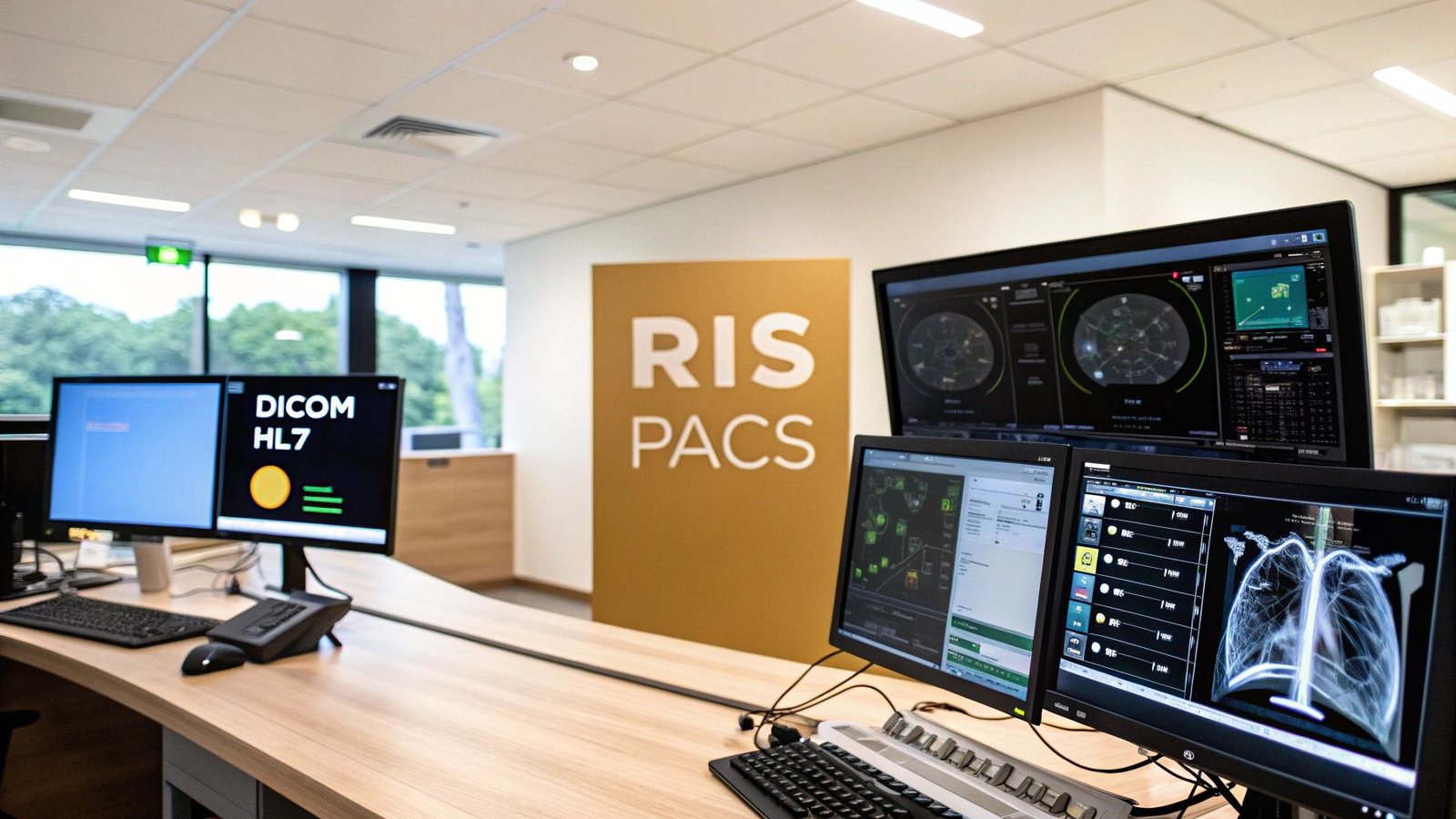
In any modern radiology department, two systems stand as the twin pillars of digital imaging: the RIS and the PACS. Think of the Radiology Information System (RIS) as the air traffic controller of the department—it manages the operational flow, from patient scheduling and billing to the final reports. On the other hand, the Picture Archiving and Communication System (PACS) is the vast, secure digital archive, the library where all the medical images are stored and viewed.
For diagnostics to be efficient and, most importantly, accurate, these two systems can't just coexist; they have to work together in perfect harmony.
The Digital Engine of Modern Radiology
Let's use an analogy. Imagine a bustling radiology clinic is like a finely-tuned orchestra.
The Radiology Information System (RIS) is the conductor. It holds the sheet music and directs the entire performance, coordinating every detail. It handles the "who, what, when, and why" of every imaging exam, managing patient data, scheduling appointments, tracking progress, and handling billing and reporting. It's the administrative and workflow heart of the operation.
The Picture Archiving and Communication System (PACS), then, is the orchestra itself—the powerful instruments creating the final product. It does the heavy lifting of receiving, storing, retrieving, and displaying the massive image files from CT scanners, MRIs, and X-ray machines. Without a powerful PACS, all that critical visual data would be lost in a sea of disorganized files.
Distinct Roles, Shared Purpose
While RIS and PACS have very different jobs, their goals are completely intertwined. Their synergy is what transforms a series of separate tasks into a seamless, fluid diagnostic journey for both the patient and the clinician.
- RIS is the workflow engine: It orchestrates the patient's entire path through the radiology department, from the moment an order is placed to the final report being sent to the referring physician.
- PACS is the image archive: It’s all about the pixels. It ensures the massive datasets from imaging studies are stored securely and are instantly accessible for a radiologist's review.
This powerful duo is fueling incredible expansion in the medical imaging world. The global PACS and RIS market was valued at USD 2.29 billion and is expected to climb to USD 4.62 billion, driven by the ever-growing need for smarter digital healthcare. It's worth noting that the PACS segment alone commands a dominant 83% share of this market, underscoring its central role. You can explore more on the PACS and RIS market growth on Precedence Research.
To help clarify these roles, here's a quick breakdown of how each system functions.
RIS vs PACS At a Glance
| System | Primary Function | Key Responsibilities | Data Type |
|---|---|---|---|
| RIS | Workflow & Patient Management | Scheduling, Patient Tracking, Billing, Reporting | Text-based data |
| PACS | Image Storage & Communication | Image Archiving, Viewing, Distribution, Post-processing | Image-based data |
As you can see, one handles the information about the exam, while the other handles the results of the exam. The magic happens when they communicate flawlessly.
At its core, the relationship between RIS and PACS is about creating a single, cohesive patient story. The RIS provides the context—the "why"—while the PACS provides the visual evidence—the "what." When they are perfectly in sync, clinicians get the complete picture they need to make the best possible decisions.
Here at PYCAD, we specialize in this synergy. We build custom web DICOM viewers and integrate them into medical imaging web platforms, supercharging the PACS "engine." Our focus is on making image access fast, secure, and intuitive, no matter where a clinician is located. By creating a superior viewing experience, we empower healthcare providers to make faster, more confident diagnoses.
You can dive deeper into this topic by reading our detailed guide on what PACS is in healthcare. And to see how we've helped other organizations build powerful imaging solutions, please take a look at our portfolio page.
Following the Patient Journey Through RIS and PACS
To truly grasp how a well-integrated RIS and PACS environment works, let's follow a patient, we'll call her Alex, on her journey from referral to diagnosis. This isn't just a clinical process; it's a story of how two powerful systems work together to orchestrate a complex medical workflow with incredible precision, ultimately creating a seamless experience for everyone involved.
The journey doesn’t start in the imaging suite. It begins with a referral from Alex's primary care doctor, who orders a CT scan and sends the request electronically.
The First Step: Scheduling and Registration
That digital order lands directly in the imaging center's Radiology Information System (RIS), officially kicking off the workflow. A scheduler uses the RIS to find an open time slot, confirm Alex's details, and book the appointment.
Think of the RIS as mission control for all administrative tasks. It logs Alex’s demographic information, the reason for the scan, and her insurance details. This creates a complete digital file before she even steps through the door, preventing data entry errors and ensuring the entire team is on the same page.
When Alex arrives for her appointment, the front desk team uses the RIS to check her in. Her status instantly flips from "scheduled" to "arrived," and a technologist gets a real-time notification that their next patient is ready.
This simple diagram maps out the core stages of the workflow, from the initial scheduling to acquiring the images and generating the final report.
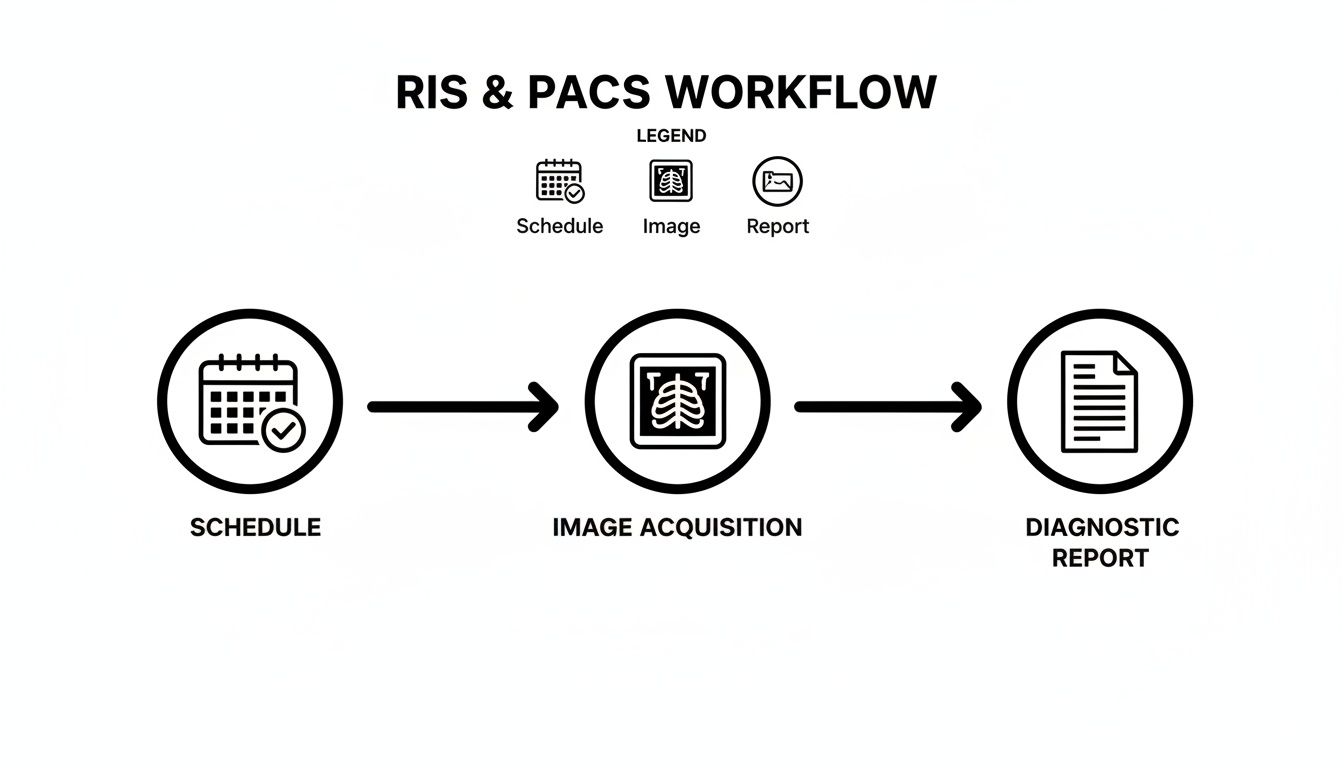
As you can see, the process is a series of critical handoffs between the administrative world of the RIS and the clinical, image-focused world of the PACS.
Image Acquisition and Archiving
Inside the imaging suite, the technologist pulls up Alex’s information on the CT scanner's console. They aren't typing it in by hand. The scanner communicates directly with the RIS through a DICOM Modality Worklist, which automatically populates Alex’s details. This simple but brilliant step ensures every image is correctly tagged from the start.
The moment the scan is finished, the massive image files are sent straight to the Picture Archiving and Communication System (PACS). The PACS is the secure digital vault. It archives the images, links them directly to Alex’s patient record, and makes them instantly available for review. At the same time, it sends a quick message back to the RIS, updating the exam status to "Complete."
This flawless, behind-the-scenes communication is the heartbeat of a modern radiology department.
Diagnosis and Reporting
Now, it’s the radiologist's turn. On a high-resolution workstation, they open the PACS viewer to find Alex’s CT scans ready for interpretation. Using specialized tools, they can zoom, rotate, and measure anatomical structures with incredible detail.
The radiologist isn't just looking at pictures; they are interpreting a story told in pixels. The PACS provides the visual evidence, while the RIS offers the crucial context—patient history, previous reports, and clinical notes—all accessible from the same interface.
After carefully analyzing the images, the radiologist dictates their findings. This report is created and managed right inside the RIS. Once it's finalized and electronically signed, the RIS automatically distributes the report back to Alex’s referring physician, closing the loop.
This whole journey, from a simple doctor's order to a potentially life-changing diagnosis, is a beautiful example of RIS and PACS working in perfect harmony. It’s this seamless user experience that inspires our work at PYCAD. We build custom web DICOM viewers and integrate them into medical imaging web platforms, with a focus on making that diagnostic step even more intuitive and powerful. To see what this looks like in the real world, feel free to explore our portfolio page.
How RIS and PACS Speak the Same Language
For a radiology department to run smoothly, the RIS and PACS need to be in constant conversation. Think of the RIS as the mission control for the entire imaging process and the PACS as the high-tech visual library. For them to work together, they can't have any communication breakdowns. This seamless connection isn't magic—it's built on a set of universally accepted standards that act as a common language.
These protocols ensure that when one system sends a message, the other understands it perfectly, creating the efficient, error-free workflow that modern patient care depends on.
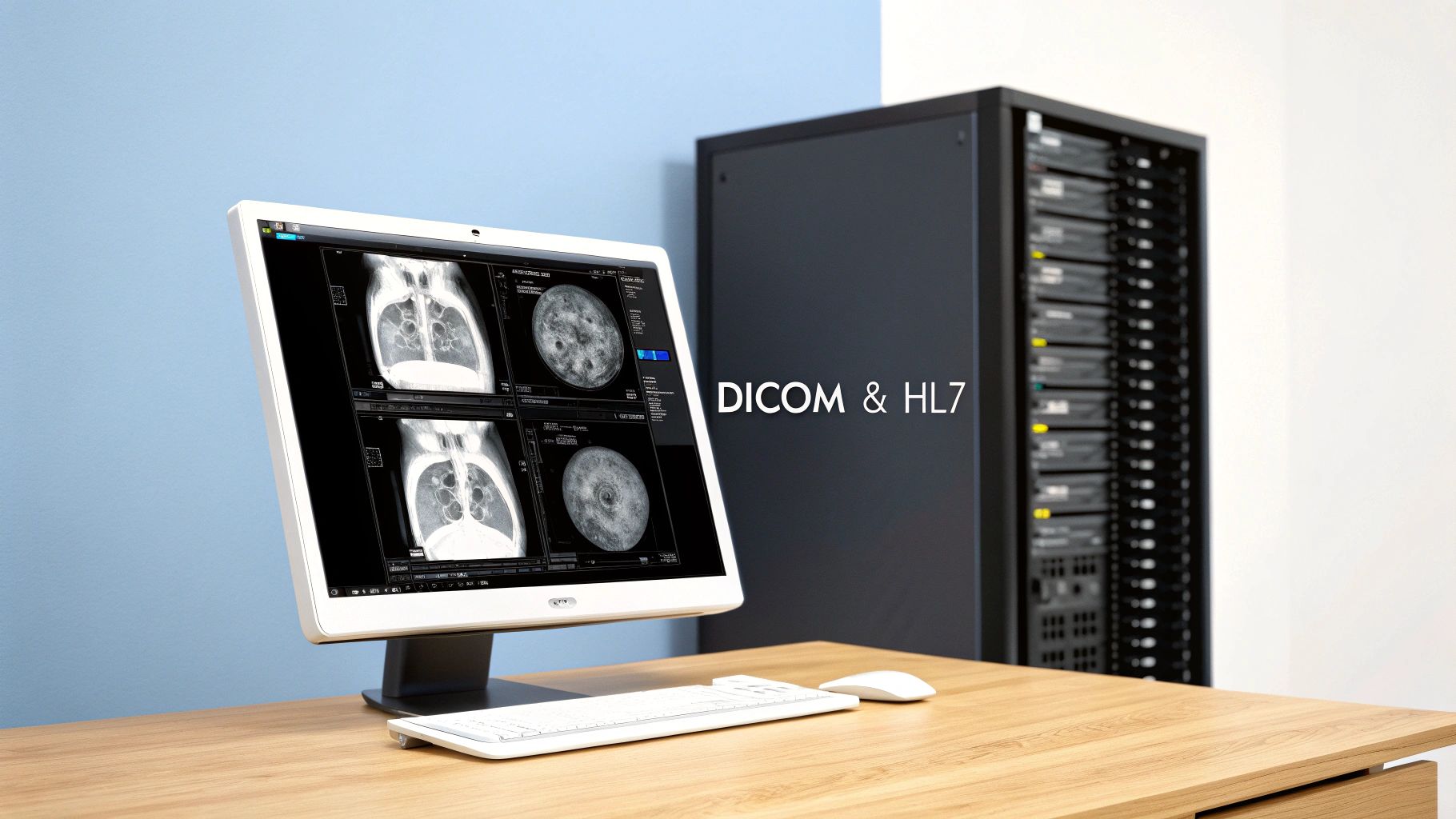
In the world of medical imaging, the two most critical languages that make this all possible are DICOM and HL7.
DICOM: The Universal Language for Images
When it comes to medical images, DICOM (Digital Imaging and Communications in Medicine) is the undisputed global standard. It’s the rulebook for how every medical image is created, stored, and shared.
Imagine DICOM as a super-smart, self-contained digital file folder. It not only holds the image itself—the actual pixels—but it also contains a massive amount of crucial metadata embedded right inside a section called the DICOM header. This header is packed with information, such as:
- Patient Information: Name, ID, date of birth, etc.
- Study Details: What kind of scan it was, when it happened, and why.
- Equipment Data: The specific MRI, CT, or X-ray machine used.
Because all this data is bundled together, an image never loses its context. It’s the reason a CT scan taken in New York can be read flawlessly by a specialist using a viewer in London. To get a better feel for how it works under the hood, you can dive into the essentials of the DICOM communication protocol.
HL7: The Grammar of Patient Data
If DICOM is the language of images, then HL7 (Health Level Seven) is the language of everything else. It handles all the text-based administrative and clinical information that puts the images into context.
HL7 messages are the invisible workhorses that carry information between the RIS, the hospital's main Electronic Health Record (EHR), and other systems. It organizes data into neat, predictable segments, so when the EHR sends an "Order for a Chest X-ray" message, the RIS knows exactly what to do with it. This is how appointments get scheduled and patient records stay updated automatically, without anyone having to re-type information.
Putting It All Together: The Workflow in Action
So how do these two standards create the beautiful harmony we see in a busy imaging center? Let's walk through a typical workflow, which is really just a series of precise, automated handoffs.
A Simplified Data Flow:
- The Order (HL7): A physician orders a scan in the hospital's EHR. An HL7 message zips over to the RIS, carrying the patient's info and the specific exam needed.
- The Worklist (DICOM): The RIS takes that order and creates a DICOM Modality Worklist. This list is sent directly to the scanner (the modality), so the technologist sees the right patient and exam type on their screen—no more manual entry or spelling mistakes.
- The Images (DICOM): The scan is complete. The scanner packages the images into a DICOM file and sends them straight to the PACS for storage and viewing.
- The Report (HL7): A radiologist opens the images on a PACS viewer, dictates their findings, and finalizes the report in the RIS. The RIS then sends the completed report back to the EHR as an HL7 message, closing the loop.
The real power is in how they work together. HL7 provides the story—who the patient is and why they're here. DICOM provides the visual evidence—the images themselves. Together, they create a complete, actionable medical record.
The Next Step: FHIR
While DICOM and HL7 are the bedrock of medical imaging communication, a newer standard called FHIR (Fast Healthcare Interoperability Resources) is quickly gaining ground. FHIR is built for the modern web, making it much easier, faster, and more flexible to exchange healthcare data.
FHIR is paving the way for the next generation of healthcare tools, like cloud-based platforms and mobile apps for clinicians. Here at PYCAD, we're all about this modern approach. We build custom web DICOM viewers and integrate them into medical imaging web platforms, using these advanced standards to deliver fast, secure, and intuitive solutions. It’s what allows doctors to pull up critical patient scans on a tablet from anywhere in the world. See how we make this a reality for our clients on our portfolio page.
Building a Future-Proof Medical Imaging Ecosystem
Putting together a modern medical imaging system is so much more than a simple tech upgrade. It's a strategic move that sets the stage for the future of your patient care. Think of your RIS and PACS ecosystem as the very foundation of your practice—the bedrock that allows you to embrace new technologies, grow your operations, and deliver truly exceptional diagnostic work. This guide will walk you through building an imaging environment that's not just secure and scalable today, but ready for whatever comes next.

The first fork in the road is deciding on your deployment model. There’s no single right answer; each path offers a unique blend of control, cost, and agility, so you can pick the one that truly fits your organization's vision.
Choosing Your Deployment Model
For years, the only real option was to go on-premise. This classic approach means all your servers and hardware live right there in your facility, giving you total control over every byte of data. The trade-off? A hefty upfront investment and the need for a dedicated IT team to handle all the maintenance, updates, and security.
Then, cloud-based solutions changed the game entirely. By hosting your RIS and PACS on secure, remote servers, you unlock incredible scalability and access. This model slashes hardware costs and gives clinicians the freedom to review images and reports from anywhere. For teleradiology and collaborative care, that kind of flexibility is a game-changer.
Of course, there's also a middle path. A hybrid model combines the ironclad security of on-premise storage for your most sensitive data with the sheer flexibility of the cloud for everything else. It’s the best of both worlds, really. At PYCAD, we live and breathe this modern approach. We build custom web DICOM viewers and integrate them into medical imaging web platforms, giving healthcare providers the power of secure, remote access without compromise.
Fortifying Your Ecosystem with Top-Notch Security and Compliance
When you're handling protected health information (PHI), security isn't just a feature—it's the law. A future-proof ecosystem demands a defense strategy with multiple layers, protecting patient data at every single point in its journey.
Protecting patient data is the cornerstone of trust in healthcare. A robust security framework for your RIS and PACS is not just about meeting regulatory requirements; it's about honoring the commitment you make to every patient you serve.
Your security plan needs to be built on a few non-negotiable pillars:
- HIPAA Compliance: Every single piece of your system, from the hard drive where data is stored to the protocols that send it across the network, must strictly follow Health Insurance Portability and Accountability Act (HIPAA) rules.
- Data Encryption: All data needs to be locked down tight. Whether it's sitting on a server (at rest) or flying across the internet (in transit), it must be fully encrypted to keep prying eyes out.
- Access Controls: Not everyone needs to see everything. Implementing role-based access ensures people can only view the information they absolutely need to do their jobs, which dramatically cuts down the risk of internal data breaches.
A truly forward-thinking system must integrate a comprehensive cybersecurity strategy from day one to safeguard patient data and keep the entire system running smoothly. This isn't about reacting to threats; it's about making your infrastructure resilient enough to withstand them in the first place.
Nailing the Validation and Dodging Common Pitfalls
Flipping the switch to "on" is just the beginning. A successful launch depends on relentless testing and validation to make sure your new system is reliable, efficient, and ready for the rigors of clinical work. A solid checklist should confirm the system performs under pressure, verify data integrity after migration, and test every connection to other IT systems. For a closer look at the nuts and bolts of connecting these systems, check out our guide to PACS integration strategies.
Even with the best tech in the world, a few common traps can sink a project. One of the biggest is poor data migration planning. Shifting years of patient histories and images from an old system is a monumental task that demands a meticulous, well-validated plan.
Another classic mistake is skimping on staff training. Your team can't unlock the system's full potential if they aren't comfortable and confident using it. By seeing these challenges coming and preparing for them, you can ensure your RIS and PACS implementation isn't just another project, but a genuine, lasting success. You can see how we’ve navigated these challenges for our own clients on our portfolio page.
Choosing the Right Technology Partner
Picking the right technology partner for your RIS and PACS is one of the most important decisions you'll make. This isn't just about comparing feature lists; it's about finding a true collaborator who gets your vision and has the technical chops to build a medical imaging ecosystem that will last. You need an innovator, not just a vendor—someone who will guide you toward solutions that supercharge your diagnostic abilities and get you ready for what’s next in medical tech.
Making the right choice means looking beyond the glossy brochures and asking the hard questions. You’re building a foundation for growth, so the system you put in place today must be flexible enough to handle the challenges of tomorrow.
Evaluating Interoperability and Scalability
First things first: how will a new solution play with your existing technology? A shiny new RIS or PACS that can't talk to anything else is just a fancy data silo, and that leads to nothing but inefficiency and frustration. Real progress happens when your RIS, PACS, and Electronic Health Record (EHR) systems communicate seamlessly.
When you're talking to vendors, get specific:
- How do you handle integrations with different EHR vendors? They should be able to talk confidently about their deep experience with standards like HL7 and FHIR.
- Can your system handle a 50% increase in imaging volume over the next three years? This question pushes past today's needs and really tests the limits of their architecture.
- What's your strategy for cloud deployment and data migration? A forward-thinking partner will offer flexible options, including cloud-native and hybrid models.
The principles behind selecting a robust technology partner are universal. Much like the advice in this guide on 5 Key Factors To Consider When Choosing A Hosting Provider, thinking about scalability and support from day one will save you massive headaches later on.
The global demand for these systems underscores the need for solid, scalable solutions. North America currently leads the pack with over 42.4% market share, thanks to strict regulations and heavy IT investment. But keep an eye on the Asia Pacific region—it's the fastest-growing market with a projected 9.8% CAGR as healthcare access expands. This worldwide growth makes it crystal clear: you need ris and pacs solutions that can scale and adhere to global standards.
The Importance of Advanced Web-Based Viewers
In a world where teleradiology and remote diagnostics are becoming the norm, the DICOM viewer is no longer just a simple tool. It's the very gateway to patient care. A modern, web-based viewer isn't a luxury; it's an absolute must-have. It frees radiologists from being chained to a specific workstation, giving them secure access to images from any device, anywhere.
A truly great DICOM viewer does more than just display images. It becomes an extension of the radiologist's own diagnostic insight, offering intuitive tools that make complex analysis feel effortless and natural.
This is where we at PYCAD really shine. We build custom web DICOM viewers and integrate them into medical imaging web platforms, making sure clinicians have fast, secure, and intuitive access to the visual data that matters most. Our focus is on creating a user experience that is both powerful and incredibly smooth.
Embracing AI and Future Innovations
Finally, you need a partner who isn’t just keeping up with technology but is actively pushing it forward. Integrating Artificial Intelligence into diagnostic workflows isn't some far-off concept anymore. It's happening right now, and it's dramatically improving patient outcomes.
An innovative partner should be able to show you exactly how they can integrate AI tools to:
- Automate the detection of potential anomalies in scans.
- Intelligently prioritize reading lists based on clinical urgency.
- Streamline reporting with smart, adaptive templates.
When you choose a partner who champions both an exceptional user experience and technological advancement, you're not just buying a system. You're investing in a brighter, more efficient future for your practice and, most importantly, for your patients.
Vendor Evaluation Checklist
Choosing the right partner is a meticulous process. This checklist is designed to help you organize your thoughts and ask the right questions to ensure you find a solution that truly fits your long-term goals.
| Criteria | Key Questions to Ask | Why It Matters |
|---|---|---|
| Interoperability | Which EHRs have you integrated with? Can you provide case studies? How do you support HL7, DICOM, and FHIR standards? | A vendor's integration experience is a direct indicator of future success. You need a system that enhances, not fragments, your existing IT infrastructure. |
| Scalability & Performance | What is the maximum image volume your system can handle? How does performance change under heavy load? What are your cloud and on-premise options? | Your imaging volume will grow. The system must be able to scale effortlessly without performance degradation, ensuring uptime and radiologist productivity. |
| Web-Based DICOM Viewer | Is your viewer zero-footprint? What advanced visualization tools (e.g., 3D rendering, MPR) are included? How fast is image loading over standard networks? | The viewer is the radiologist's primary tool. A fast, intuitive, and feature-rich web viewer is non-negotiable for modern teleradiology and collaborative workflows. |
| AI & Future-Readiness | What is your roadmap for AI integration? Do you support third-party AI algorithms? How do you stay current with emerging technologies? | The future of radiology is intertwined with AI. A forward-thinking partner will have a clear strategy for incorporating AI to enhance diagnostics and efficiency. |
| Security & Compliance | How do you ensure HIPAA/GDPR compliance? What are your data encryption, backup, and disaster recovery protocols? | Patient data security is paramount. A breach can be catastrophic. The vendor must demonstrate a rock-solid commitment to security and regulatory compliance. |
| Support & Partnership | What does your standard support package include? What are your response times for critical issues? Can we speak with current clients about their experience? | You are not just buying software; you are entering a long-term relationship. Reliable, responsive support is crucial for minimizing downtime and resolving issues quickly. |
Using this checklist will help you cut through the marketing noise and focus on what truly matters: finding a partner who will empower your practice for years to come.
Common Questions About RIS and PACS
When you're stepping into the world of medical imaging technology, it's natural to have questions. Getting your head around foundational systems like RIS and PACS is the first step toward building a truly modern diagnostic practice. Let's break down some of the most common questions we hear from healthcare leaders and innovators.
Can a Facility Use a RIS Without a PACS?
Technically, yes, but it’s like having a smartphone that can only make calls—you’re missing the entire point. A facility could use a RIS to manage scheduling and reporting for an old-school, film-based workflow. But doing so means completely ignoring the massive advantages of digital imaging, like instant image access, powerful diagnostic tools, and the ability for specialists to read scans from anywhere.
On the flip side, trying to run a PACS without a RIS is a recipe for chaos. Technologists would be stuck manually typing in patient data for every single study. That's not just painfully slow; it's a huge magnet for errors.
The real magic happens when RIS and PACS are integrated. The RIS handles the who and why of an exam, and the PACS manages the what—the images themselves. When they talk to each other, they create one seamless, reliable source of truth for every patient's journey.
What Role Does the Cloud Play in Modern Radiology?
The cloud didn't just change the game for RIS and PACS; it rewrote the rulebook. We've moved from relying on expensive, high-maintenance servers tucked away in a closet to embracing flexible, scalable, and incredibly secure cloud solutions. This shift isn't just a technical detail—it’s a strategic move with powerful benefits.
- Scale on a Dime: Cloud platforms let you scale your storage and computing power up or down as needed. You no longer have to guess your five-year plan and sink a fortune into hardware you might not even use.
- Access from Anywhere: Cloud-based systems give radiologists and clinicians secure access to images and reports from anywhere, on any device. This is the bedrock of modern teleradiology and collaborative care.
- Ironclad Disaster Recovery: Top-tier cloud providers offer backup and recovery options that are light-years ahead of what most individual facilities can manage, ensuring critical patient data is safe from failures or disasters.
The move to the cloud isn't just an upgrade; it's an evolution. It turns RIS and PACS from static, localized systems into dynamic, accessible platforms that create a more connected and resilient healthcare ecosystem.
Here at PYCAD, we live and breathe this modern approach. We build custom web DICOM viewers and integrate them into medical imaging web platforms, using the full power of the cloud to deliver fast, secure, and intuitive tools. You can see what this looks like in action on our portfolio page.
How Is AI Changing RIS and PACS Technology?
Artificial Intelligence is the next massive leap forward in medical imaging, and it's already making a real impact on RIS and PACS. This isn't science fiction anymore. AI is becoming a trusted co-pilot, augmenting the skills of healthcare professionals and making the entire diagnostic process smarter.
Inside the PACS, AI algorithms are being built directly into advanced DICOM viewers. These tools can automatically flag potential abnormalities—like a subtle lung nodule or a hairline fracture—giving the radiologist a valuable "second look." AI can also intelligently sort worklists, pushing urgent cases to the top of the pile to accelerate critical diagnoses.
Over in the RIS, AI is all about operational excellence. It can optimize complicated schedules to get the most out of every machine and reduce patient wait times. It can even automate tedious administrative work like billing and coding, freeing up your team to focus on what matters most: the patients.
As a company that develops and integrates custom AI solutions, PYCAD is right at the forefront of this shift. We build custom web DICOM viewers and integrate them into medical imaging web platforms, creating a workflow that isn't just efficient, but genuinely insightful.
What Are the First Steps for Implementing a RIS and PACS System?
Jumping into a RIS and PACS implementation is a major undertaking, and a successful project always starts with a solid plan. One of the biggest mistakes we see is teams rushing into a decision without a clear strategy.
Here are the essential first steps to get you started on the right foot:
- Start with a Real Needs Assessment: Before you even think about vendors, look inward. What are you actually trying to solve? Are you looking to slash report turnaround times, give referring physicians better access, or set yourself up for future growth? Write these goals down—they will be your north star.
- Build a Cross-Functional Team: This is not just an IT project. Your team needs to include people from every part of the workflow: radiologists, technologists, administrators, and of course, your tech experts. This is the only way to ensure the solution you choose works for everyone who has to use it.
- Get Specific with Technical Requirements: Now it's time to map out the details. What other systems does this need to talk to (like your EMR)? What are your security must-haves? How fast does it need to be? This blueprint is crucial for properly evaluating your options.
- Research and Vet Your Partners: With your goals and requirements in hand, you can finally start looking at vendors. Find a partner who doesn't just check the technical boxes but also shares your long-term vision—especially if that vision includes modern web viewers and AI integration.
A well-thought-out plan is the single most important ingredient for success. It transforms what could be a complex, frustrating project into a manageable and incredibly rewarding one.
At PYCAD, we get the complexities of building a modern medical imaging ecosystem because we do it every day. We build custom web DICOM viewers and integrate them into medical imaging web platforms, creating solutions that are powerful, intuitive, and ready for whatever comes next. See how we've helped others build the future by visiting our portfolio page.