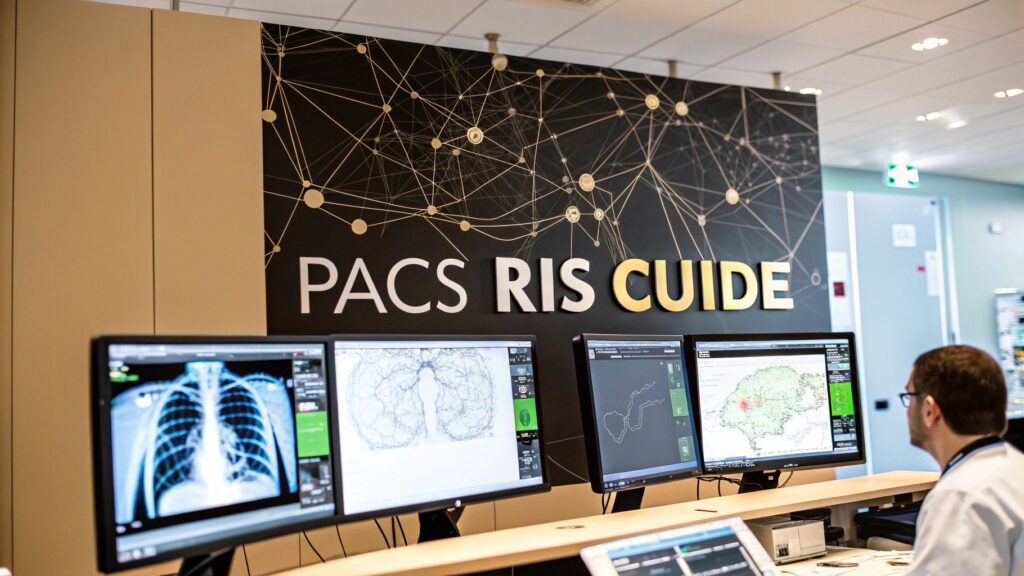
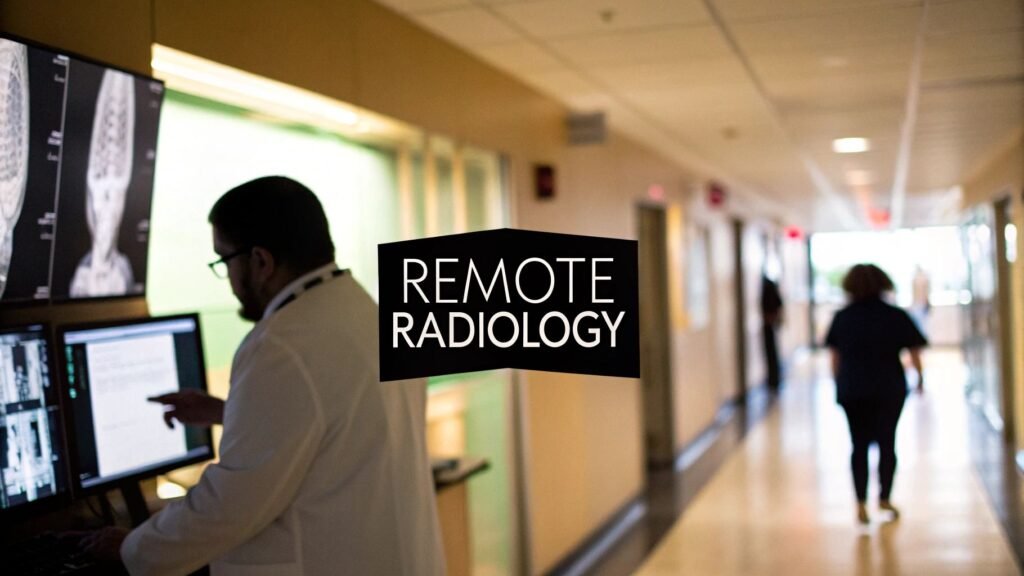
A teleradiologist is a fully licensed, board-certified physician who interprets medical images like X-rays, CT scans, and MRIs from a remote location. Think of them as the special operations team for diagnostics—deploying elite expertise precisely where it's needed, anytime, anywhere. They are the unsung heroes of modern medicine, bridging critical gaps in healthcare with technology.
The Modern Teleradiologist Explained
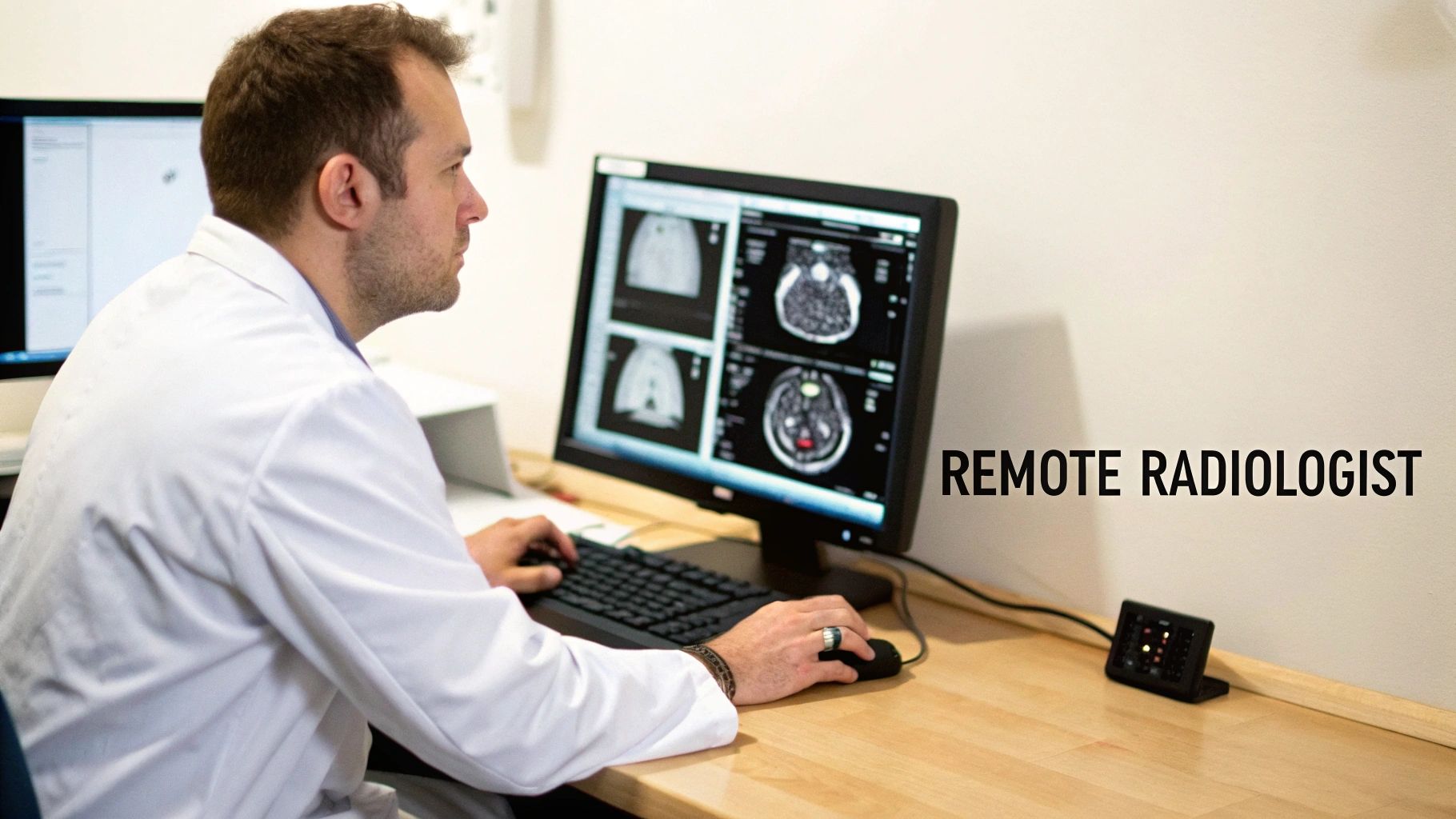
Picture a small, rural hospital at 2 AM. A patient arrives in the emergency room with critical injuries, and the team on call needs an immediate reading of a complex CT scan. The problem? The hospital doesn't have a radiologist on-site overnight, creating a dangerous delay in care. This is exactly where the teleradiologist becomes a lifeline.
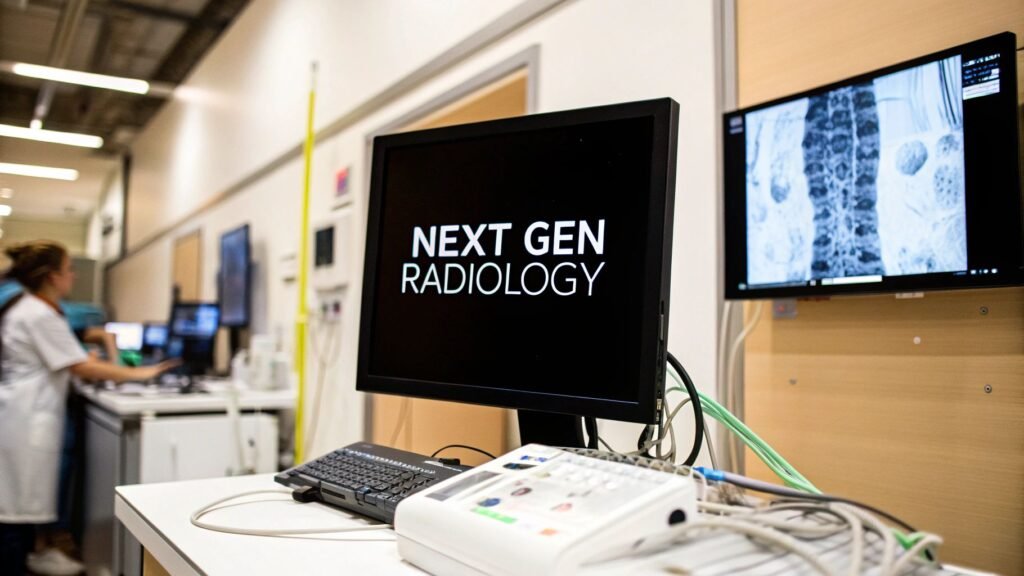
From a secure, high-tech reading room hundreds of miles away, a specialist logs in, accesses the images, and delivers a life-saving diagnosis in minutes. This isn't science fiction; it’s the powerful reality of teleradiology in action. The role extends far beyond just after-hours support, offering a real solution to staffing shortages and democratizing access to specialized medical knowledge.
Core Functions and Impact
At their core, a teleradiologist performs the same critical diagnostic functions as an on-site radiologist. The key difference is their workflow, which is built on a foundation of advanced digital infrastructure. It all started gaining traction in the 1990s and took a massive leap forward when hospitals needed to minimize on-site staff. Today, it’s an indispensable tool for bridging gaps in radiology coverage, especially in underserved areas.
The table below offers a quick snapshot of their key roles and responsibilities.
Teleradiologist at a Glance: Key Roles and Responsibilities
| Aspect | Description |
|---|---|
| Primary Role | Remotely interpret medical images (X-rays, CTs, MRIs, etc.) to diagnose diseases and injuries. |
| Qualifications | Must be a board-certified physician with specialized training in radiology. |
| Key Technology | Relies on PACS (Picture Archiving and Communication System), RIS (Radiology Information System), and secure networks. |
| Typical Use Cases | Nighthawk (overnight) coverage, subspecialty consultations, overflow support, and services for rural facilities. |
| Impact on Care | Drastically reduces report turnaround times, enabling faster treatment decisions and improving patient outcomes. |
This table just scratches the surface. Their true impact is profound, touching multiple layers of the healthcare system.
- Accelerated Patient Care: Rapid turnaround times for image interpretation are a game-changer. This speed helps expedite treatment decisions, which is absolutely vital in emergency medicine.
- Access to Subspecialists: A community hospital can instantly connect with a pediatric neuroradiologist or a musculoskeletal imaging expert, bringing world-class expertise to any patient, anywhere.
- Operational Efficiency: Teleradiology gives healthcare facilities the flexibility to manage fluctuating imaging volumes and provide consistent coverage without the overhead of maintaining a huge on-site radiology department.
This field is a prime example of how technology can amplify medical expertise. As a specialized niche within the broader world of telehealth, teleradiology offers unique opportunities for medical professionals looking for flexible and impactful telehealth jobs.
A teleradiologist is more than a remote image reader; they are a vital hub in a technology-driven, globally connected healthcare ecosystem, ensuring every patient receives the best possible diagnosis, regardless of geography.
Ultimately, teleradiology represents a fundamental shift in how diagnostic medicine is delivered. It's powered by sophisticated platforms that require expert development. At PYCAD, we build custom web DICOM viewers and integrate them into medical imaging web platforms to empower these remote experts. You can see examples of these advanced solutions in our portfolio.
The Technology Behind Remote Diagnostics
A teleradiologist's expertise is delivered through a symphony of technologies all working in concert. This digital ecosystem is the invisible force that shatters geographical barriers, allowing a life-saving diagnosis to travel hundreds of miles in just a few moments. To really get what a teleradiologist is, you first have to appreciate the powerful tools that make their work possible.
Think of it as a highly coordinated logistical operation. It all starts with the foundational elements that manage and move priceless diagnostic information with absolute precision and security. These core components are the very bedrock of teleradiology.
At the heart of it all is DICOM, which stands for Digital Imaging and Communications in Medicine. Think of DICOM as the universal language of medical imaging. It's what ensures a CT scan taken in a rural clinic can be perfectly understood and displayed by a specialist on another continent.
Without this shared language, it would be chaos. DICOM flawlessly packages not just the image pixels but also critical patient information, making sure every scan keeps its diagnostic integrity no matter where it goes.
The Core Infrastructure of Teleradiology
Once an image is captured and "spoken" in DICOM, it needs a home and a system to manage its journey. This is where two other crucial technologies come into play, each with a distinct but connected role. Together, they form the central nervous system of any radiology department, whether it's down the hall or across the country.
-
Picture Archiving and Communication System (PACS): Imagine PACS as a high-security digital vault for medical images. This system securely stores and provides access to every X-ray, MRI, and CT scan. Its role is simple but vital—to archive images and make them ready for review. For a deeper dive, check out our guide on what PACS is in healthcare.
-
Radiology Information System (RIS): If PACS is the vault, the RIS is the air traffic control tower. This system manages the entire radiology workflow, from scheduling a patient's appointment and tracking their journey to handling billing and generating reports. The RIS orchestrates the entire operational side of things.
These systems work hand-in-glove. The RIS manages the patient's workflow, while the PACS stores the images created along the way. This teamwork creates a smooth, efficient pipeline from the scanner to the final report.
The Superhighways and the Virtual Reading Room
With the core systems in place, the next challenge is getting the data from point A to point B. This is where modern cloud infrastructure and high-speed networks act as digital superhighways. A single MRI study can easily be over a gigabyte in size, so rock-solid, secure connectivity is non-negotiable. These networks use advanced encryption and VPNs to make sure sensitive patient data is locked down every step of the way.
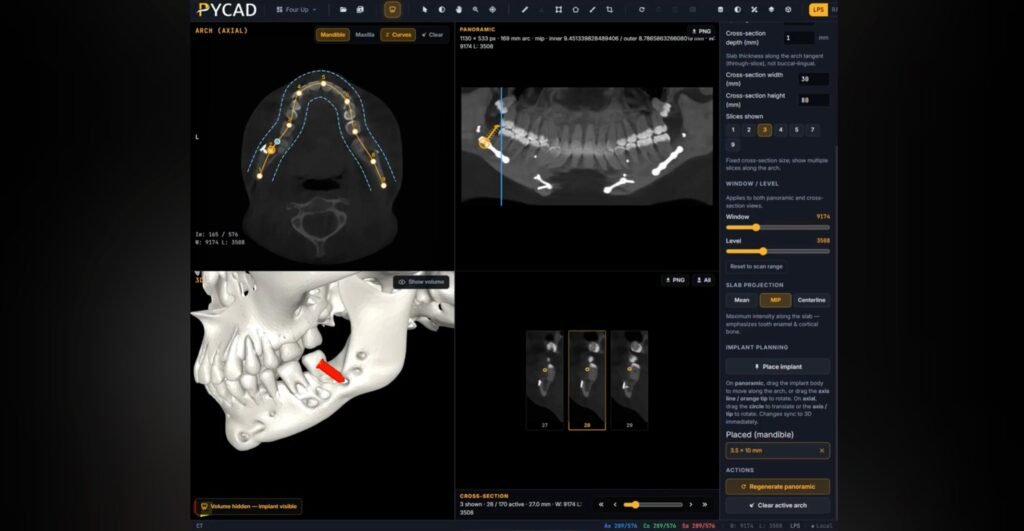
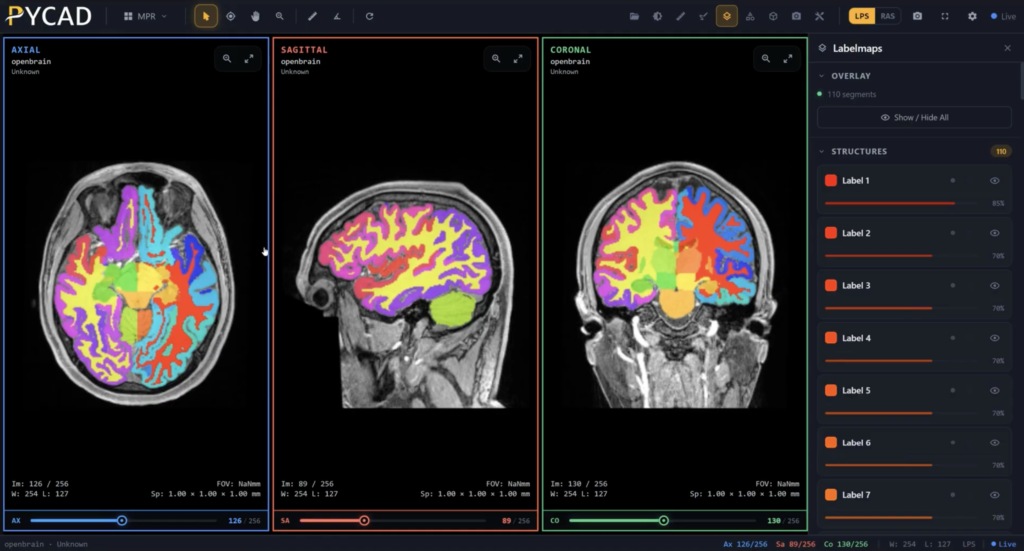
So, where does the teleradiologist actually do their work? This happens in their virtual reading room—a sophisticated web platform armed with an advanced DICOM viewer. This viewer isn't just a simple image display; it's a powerful diagnostic toolkit.
The web DICOM viewer is the teleradiologist’s digital scalpel. It allows them to manipulate images, zoom in on minuscule details, compare current and prior studies side-by-side, and apply specialized filters to uncover subtle signs of disease that might otherwise be missed.
This is exactly where our expertise at PYCAD comes in. We know that a generic, off-the-shelf viewer just doesn't cut it. That's why we at PYCAD, build custom web DICOM viewers and integrate them into medical imaging web platforms. Our goal is to create an intuitive, powerful, and secure environment where a teleradiologist can perform at their absolute best, without being held back by technology.
We engineer these platforms to be the ultimate command center for remote diagnostics. To see how these custom solutions empower healthcare providers, take a look at our portfolio of innovative projects. This is the technology that turns a simple web browser into a world-class diagnostic workstation.
A Day in the Life of a Teleradiologist
To really get what a teleradiologist is, let's step away from the definitions and follow a single medical image on its incredible journey. This isn't just a technical process; it’s a story of connection, technology, and life-saving expertise.
Picture this: it all starts in a small, rural clinic. A patient comes in with symptoms that call for an urgent, specialized brain scan. A talented technologist captures a high-resolution MRI, a detailed digital snapshot of what’s happening inside the patient’s head. The moment that scan is complete, the clock starts ticking, and a team of experts, hundreds of miles away, springs into action.
The Digital Journey Begins
The technologist doesn’t head to a darkroom or run a physical film down the hall. Instead, that MRI study—a massive, complex data file—is instantly uploaded to the clinic's PACS (Picture Archiving and Communication System). Think of it as a secure digital library, immediately making the scan available across the network.
At the same time, the RIS (Radiology Information System) keeps track of all the patient's information, ensuring the scan is perfectly matched with their medical history and the doctor's notes. This whole bundle of information is then securely beamed out to a teleradiology service, all speaking the universal language of medical imaging: DICOM.
This diagram shows how this digital handoff works, moving critical patient data from the local clinic to the remote specialist.
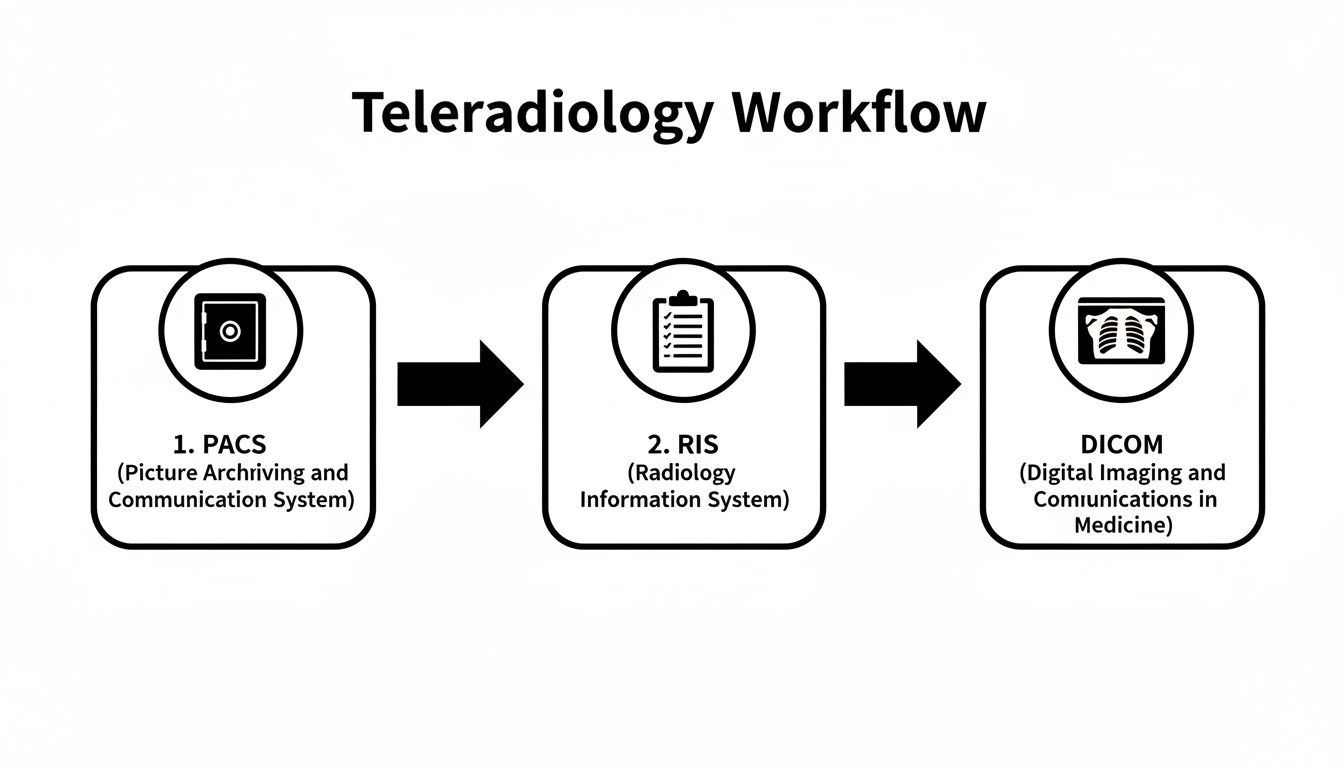
You can see how PACS, RIS, and DICOM are not just separate systems, but a cohesive network designed for one purpose: getting the right information to the right expert, right away.
The Specialist Steps In
The image file arrives in the work queue of a neuroradiologist—a brain scan sub-specialist—working from her home office. She logs into a sophisticated medical imaging web platform and sees the urgent case from the rural clinic flagged for immediate review. This platform isn't just a website; it's her virtual reading room, an advanced command center for diagnostics.
She pulls up the study in a powerful web DICOM viewer. This is her clinical instrument, far more than just a simple image viewer. With a few clicks, she can:
- Manipulate 3D reconstructions of the brain.
- Zoom in on microscopic details with perfect clarity.
- Compare the new scan with the patient's prior images, side-by-side.
- Apply special filters to highlight subtle abnormalities in the tissue.
This is the exact kind of environment we build at PYCAD. We understand that a teleradiologist's ability to deliver a spot-on diagnosis hinges on the quality of their tools. That's why we at PYCAD, build custom web DICOM viewers and integrate them into medical imaging web platforms, giving these specialists everything they need to perform at their best.
The teleradiologist's virtual workstation is where technology and human expertise converge. It transforms pixels on a screen into a clear, actionable diagnosis that can change the course of a patient's life.
The Life-Saving Report
After a careful analysis, the teleradiologist pinpoints the problem. She dictates her findings into a speech-to-text program built right into the platform. Her report is concise, clear, and provides a definitive diagnosis along with her recommendations for the team back at the clinic.
Within minutes of the scan being taken, her final, signed report is securely transmitted back to the clinic's system and sent straight into the referring physician's electronic health record. The entire process—from image capture to final diagnosis—completely erased the distance, bringing world-class neurological expertise to a patient who needed it most, at the very moment they needed it.
This is the daily reality of what a teleradiologist does. To see how we build the platforms that make these workflows a reality, check out our portfolio of groundbreaking projects.
Benefits and Challenges in Teleradiology
Every great leap forward in technology brings with it a new world of possibilities and, of course, a fresh set of challenges. The rise of the teleradiologist has truly reshaped diagnostic medicine, offering incredible speed and access while introducing complexities that healthcare leaders need to master. Getting a handle on both sides of this coin is the key to making smart, strategic decisions for your organization.
On one hand, the benefits are genuinely profound. They go far beyond simple convenience. Teleradiology breaks down geographical barriers, making elite medical expertise available to everyone and creating a much more agile and responsive healthcare system.
The Game-Changing Benefits of Remote Diagnostics
Perhaps the most celebrated advantage of teleradiology is how it accelerates patient outcomes. In an emergency, like a potential stroke where every single second is critical, getting a scan read by a specialist in minutes instead of hours can fundamentally change a patient's life. This speed isn't just for emergencies, either—it quickens the entire diagnostic journey for every patient.
Another massive win is the significant cost savings for healthcare facilities. Staffing a full-time, on-site team of radiologists, especially for around-the-clock coverage, is a major operational expense. Teleradiology offers a flexible, scalable model that lets hospitals pay for the expertise they need, exactly when they need it. This trims overhead without ever sacrificing quality.
- Unprecedented Access to Sub-specialists: A small-town clinic can get an instant consult from a pediatric neuroradiologist for a child's complex case, bringing world-class diagnostics to any corner of the map.
- Load Balancing and Burnout Reduction: Imaging workloads can be spread across a network of professionals. This is huge for preventing burnout among on-site staff and keeping report quality consistently high.
- Enhanced Continuity of Care: By providing solid after-hours and weekend coverage, teleradiology ensures that patient care never hits a wall. It creates a seamless diagnostic safety net, 24/7.
This isn't just a temporary fix; it's a sustainable strategy for growth and efficiency. The market data tells the same story. The global teleradiology market is projected to skyrocket to USD 60.3 billion by 2030, reflecting this powerful shift.
Navigating the Real-World Challenges
Of course, this powerful model isn't without its hurdles. For any healthcare leader, rolling out a teleradiology service means careful planning and a clear-eyed view of the obstacles. Think of these challenges not as roadblocks, but as essential guideposts for getting it right.
One of the biggest headaches is the maze of state-by-state credentialing and licensing. A teleradiologist has to be licensed in every single state where they interpret images. This creates a significant administrative load that demands meticulous management to stay fully compliant.
The greatest challenge in teleradiology isn't just moving images, but ensuring the trust, security, and regulatory adherence that underpins every single diagnosis.
Then there's the non-negotiable need for ironclad data security. Sending sensitive patient data across networks requires absolute adherence to HIPAA regulations. This is about more than just basic encryption; it calls for a rock-solid infrastructure with multiple layers of security. To grasp these critical requirements, you can explore our deep dive into the essentials of HIPAA compliant data transfer for medical imaging.
Finally, you have to consider the initial investment in technology. Setting up the right infrastructure, including a high-quality PACS and secure networks, requires upfront capital. This is where a strategic partner becomes invaluable. Here at PYCAD, we build custom web DICOM viewers and integrate them into medical imaging web platforms, turning that initial investment into a powerful, long-term asset. See our work in our portfolio.
Teleradiology's Next Chapter: The AI Partnership

The next big leap for the teleradiologist isn’t just about faster connections or sharper images. It’s about a profound new partnership between human expertise and artificial intelligence. AI is quickly becoming an essential ally in remote diagnostics, set to reshape the speed, accuracy, and sheer efficiency of how medical images are read.
This isn't a story about replacing radiologists. Far from it. Think of AI as a tireless "digital resident" working shoulder-to-shoulder with the teleradiologist. This intelligent assistant can pre-scan hundreds of studies, flagging the most urgent cases for immediate human attention and pointing out subtle anomalies the human eye might miss on a first pass.
AI as a Diagnostic Co-Pilot
The real magic of AI in teleradiology is its ability to cut through the noise. It expertly manages the overwhelming volume of data and handles the repetitive, time-consuming tasks that can bog down a workflow. By taking on that initial triage, AI frees up human experts to focus their invaluable cognitive energy on the most complex diagnostic puzzles.
The future is all about integrating AI and machine learning into your automation strategy to build world-class teleradiology services. When done right, this collaboration leads to some remarkable improvements.
- Intelligent Triage: AI algorithms can analyze incoming scans for critical findings like brain bleeds or pulmonary embolisms, instantly bumping them to the top of the teleradiologist’s worklist.
- Enhanced Anomaly Detection: Acting as a second set of eyes, AI highlights suspicious nodules or faint fractures, drawing the radiologist's attention to areas that need a closer look.
- Automated Measurements and Reporting: Imagine AI performing routine tasks like measuring a tumor or calculating organ volume. It can even generate preliminary report drafts, which dramatically speeds up the final reporting process.
This shift isn't just a theory; it's happening right now. The teleradiology market itself is a testament to this growth. At its core, a teleradiologist uses telemedicine to diagnose from digital images, and the market is on track to nearly double from an estimated USD 6.66 billion in 2025 to USD 13.01 billion by 2030, all fueled by soaring diagnostic volumes. To keep up, platforms with smart, integrated AI are no longer a luxury—they're a necessity.
Engineering the Future of Diagnostics Today
This convergence of teleradiology and AI is exactly where we live and breathe. At PYCAD, we see a future where the diagnostic platform isn't just a passive tool but an active, intelligent partner. This vision pushes us beyond building standard viewers and drives us to create a unified, intelligent command center for diagnostics.
The integration of AI doesn't just make a teleradiologist faster; it makes them more powerful. It transforms the diagnostic process from a linear review into a dynamic, collaborative analysis between human and machine.
We are right at the forefront of this evolution. We at PYCAD, build custom web DICOM viewers and integrate them into medical imaging web platforms, engineering these systems with the future baked right in. Our solutions are designed to seamlessly incorporate cutting-edge AI tools and CRM systems, creating a cohesive ecosystem where technology amplifies human skill. You can learn more about how these tools are changing the game in our article on https://pycad.co/artificial-intelligence-for-radiology/.
This integrated approach ensures every piece of the puzzle—from the DICOM viewer to the AI algorithms and patient management systems—works in perfect harmony. The result is a platform that empowers the teleradiologist to deliver diagnoses with a level of accuracy and efficiency that was once unthinkable.
So, when we ask, "What is a teleradiologist?" the real answer goes far beyond a simple job title. These aren't just doctors reading scans from a distance; they've become the very heart of a connected, global, and technology-powered healthcare system. Their work is a massive force for good, bringing top-tier diagnostic skills to places that have never had them and giving smaller clinics a fighting chance to provide excellent care.
Teleradiologists are true change-makers, pushing the entire medical field to be better, faster, and smarter. This shift opens up a huge opportunity for medtech pioneers, hospital IT teams, and anyone building medical devices. The world is crying out for more intelligent and deeply integrated diagnostic tools, and that's a call to action for everyone ready to create the next wave of healthcare technology.
A teleradiologist is where human expertise and technological potential meet. They prove that medicine's future isn't about replacing doctors—it's about arming them with tools that break down the old barriers.
This new age of diagnostics is built on a rock-solid technological backbone. Here at PYCAD, creating that backbone is what we do best. We build custom web DICOM viewers and integrate them into medical imaging web platforms, engineering the powerful systems that make this new model of remote care possible.
The future of diagnostics will be built on collaboration, intelligence, and accessibility for everyone. For any organization looking to be at the forefront of this movement, the first step is to partner with experts who know how to turn that vision into a working reality.
Take a look at the innovative solutions we’ve already brought to life in our portfolio and see how we can help you build the platforms that will shape the future of medicine.
Frequently Asked Questions
As remote diagnostics becomes more common, it's natural for questions to pop up for healthcare pros and tech leaders. How qualified are these remote doctors? Is the data really secure? What does this mean for patient care day-to-day? Getting to the bottom of these questions is key before you dive in.
Let's clear up some of the most common ones.
What Qualifications Does a Teleradiologist Need?
A teleradiologist has to meet the exact same tough standards as any radiologist you'd meet in the hospital hallway. It all starts with medical school, then a grueling residency in diagnostic radiology, and finally, earning board certification. Their credentials speak for themselves.
But here's the kicker: they also have to be licensed in every single state or country where they read scans. It's a complex web of regulations, but it ensures they're fully compliant with local standards. Many even go a step further, completing fellowships in specialized areas like neuroradiology or pediatric imaging, which makes their expertise incredibly valuable for tricky cases.
How Is Patient Data Kept Secure in Teleradiology?
Security isn't just a feature; it's the foundation of everything. Teleradiology platforms are built like digital fortresses with layers of protection for sensitive patient information. Think end-to-end encryption for every piece of data zipping across the internet, secure VPNs locking down connections, and strict access controls that mean only the right people can see the right images and reports.
Every single click, every file transfer, every report shared on a teleradiology platform must be fully compliant with regulations like HIPAA. At PYCAD, we don’t just add security on top—we build it into the DNA of our platforms so that patient confidentiality is never an afterthought. We build custom web DICOM viewers and integrate them into medical imaging web platforms with security as a top priority.
Can a Teleradiologist Communicate with On-Site Doctors?
Absolutely. In fact, it's a must. Great patient care depends on clear communication, and modern teleradiology systems are designed for exactly that. We've moved way beyond just sending images back and forth. Today's platforms are packed with tools to make collaboration instant and easy.
This usually includes things like:
- Secure Messaging: Think of it as a HIPAA-compliant text message for quick questions or status updates.
- Direct Voice Calls: The power to pick up the phone and talk through a complex finding with the referring physician, right from the platform.
- Automated Critical Findings Alerts: Smart systems that instantly flag urgent results and notify the on-site team, so a critical diagnosis never gets lost in the shuffle.
This kind of constant connection makes sure that even with miles between them, the care team is always on the same page.
How Does Teleradiology Benefit Rural or Small Hospitals?
For smaller hospitals, especially those in rural areas, teleradiology is a game-changer. It gives them immediate, 24/7 access to world-class radiology expertise without the massive cost or logistical nightmare of trying to staff a full team of on-site radiologists around the clock. It puts them on a level playing field with big-city medical centers.
It also unlocks a whole new level of care. A small community hospital can suddenly tap into a global network of sub-specialists for rare or complex conditions. It means their patients can get the best possible diagnosis without ever having to leave their hometown.
At PYCAD, we’re the ones building the engine that drives this new era of diagnostics. We build custom web DICOM viewers and integrate them into medical imaging web platforms. To see the kind of technology that powers these advanced workflows, take a look at our portfolio of innovative projects.