Let's get right to it: what's the real difference between an EHR and an EMR? Think of it this way: an Electronic Medical Record (EMR) is like a single chapter in a patient's health story, written by one doctor's office. An Electronic Health Record (EHR), on the other hand, is the entire book—a complete, shareable narrative of that patient’s health journey that can be read by authorized providers anywhere, anytime.
Unpacking the Digital Health Record
Although people often use the terms interchangeably, their core functions are worlds apart. This isn't just a matter of semantics; the distinction shapes everything from how a clinic operates to the quality of patient care. Moving from siloed digital files to a truly connected health ecosystem represents a fundamental change in how we manage and share critical medical information.
This shift has been a long time coming. Back in 2008, only 41.5% of office-based physicians in the U.S. were using any type of EMR or EHR. Most of these were basic systems, little more than digital filing cabinets for one clinic. It was this limitation that drove the demand for something better—the interconnected, collaborative EHR systems that are becoming the standard today. You can dive deeper into this history by exploring the CDC's findings on EMR and EHR usage.
EMR vs EHR Key Differences at a Glance
Before we get into the weeds, this table offers a quick, high-level snapshot of what truly separates an EMR from an EHR. Think of it as your cheat sheet for understanding the core distinctions.
| Attribute | EMR (Electronic Medical Record) | EHR (Electronic Health Record) |
|---|---|---|
| Data Scope | Contains a patient's medical history from a single practice or clinic. | Contains a comprehensive, longitudinal view of a patient's health across multiple providers and organizations. |
| Interoperability | Limited; designed for internal use and does not easily share data with other systems. | High; designed to share data seamlessly with labs, specialists, hospitals, and other authorized providers. |
| Data Ownership | Data is typically controlled and maintained by the single healthcare practice. | Patient data follows the patient, with shared access among all involved, authorized providers. |
| Patient Focus | Primarily a tool for diagnosis and treatment within one clinical setting. | A patient-centered tool that supports coordinated care and long-term health management across settings. |
This high-level view makes the contrast clear: one is an internal record, the other is a collaborative health passport.
At PYCAD, our passion lies in that collaborative layer that makes modern EHRs so impactful. We at PYCAD, build custom web DICOM viewers and integrate them into medical imaging web platforms. This work empowers clinicians to see vital imaging data right inside the patient's complete health record, where it belongs. Check out some real-world examples on our portfolio page.
What's the Real Story with Electronic Medical Records?
Think of an EMR as a patient's story, but told from the perspective of a single doctor's office. It's the digital version of the classic paper chart, meticulously detailing a patient's medical history, diagnoses, and treatments—all within the four walls of one practice. This move from paper to pixels was a massive leap forward.
With digital records, clinicians can finally track patient data over time, easily see who’s due for a check-up or preventive screening, and check how well treatments are actually working. For a family doctor trying to manage a patient's hypertension, an EMR is a godsend for logging blood pressure readings and medication tweaks over many years.
A Powerful, Yet Isolated, Tool
At its core, an EMR is built to make a single clinic run better. It’s fantastic for charting visits, sending prescriptions straight to the pharmacy, and making billing a whole lot less painful. This tight focus on internal efficiency makes it a smart, cost-effective choice for smaller, independent practices that don't constantly need to share information with other specialists or hospitals.
But here’s the catch: the EMR's biggest strength is also its greatest weakness. It was never really designed to play well with others.
An Electronic Medical Record is, by its very nature, an internal tool. It’s all about the workflow of one clinic, not the patient’s complete journey across the entire healthcare system.
This siloed approach creates some serious headaches. If that same hypertension patient needs to see a cardiologist, getting their detailed history from the family doctor's EMR is rarely a smooth process. More often than not, records are printed and faxed—a frustratingly analog solution in a digital world. This leaves the specialist with an incomplete puzzle, forcing them to make decisions without seeing the full picture of the patient's health.
How This Plays Out in Real Life
Let’s imagine Dr. Evans, a primary care physician who has looked after her patient, Sarah, for more than 10 years. Sarah’s EMR is a treasure trove of information, capturing every visit, lab result, and prescription. When Sarah comes in for her annual physical, Dr. Evans can pull up her entire history in seconds, spotting trends and ensuring her care is consistent.
But then Sarah develops a complicated issue and needs to see a rheumatologist across town. The data hits a wall. The rheumatologist’s office has to formally request Sarah's records, which eventually arrive as a fax. This new doctor is now working with a static snapshot in time, completely disconnected from any of Dr. Evans's real-time notes or future updates.
This is the fundamental problem with the EMR. It has perfected record-keeping for a single location, but it struggles to tell the connected, cohesive health story that modern medicine demands. To do that, we need to look at its more collaborative cousin, the EHR. At PYCAD, we specialize in breaking down these data silos, especially when it comes to medical imaging. We build custom web DICOM viewers and integrate them directly into medical platforms, making sure that critical visual data is always part of the patient's story. You can see how we've helped other organizations on our portfolio page.
Unlocking the Full Story with the Electronic Health Record
If an EMR is a single chapter in a patient's health story, the Electronic Health Record (EHR) is the entire book. Think of an EHR as a comprehensive, patient-first system that pulls together a person's complete health narrative from beginning to end. It contains everything you’d find in an EMR, but its scope is so much broader. The whole point is to create a living, shareable record that authorized providers can access from anywhere, at any time.
This design fundamentally changes the game, paving the way for truly collaborative care. An EHR is built to connect the dots, integrating information from labs, specialists, different hospitals, and even pharmacies into one unified timeline. This complete picture is absolutely vital for improving patient safety, catching potential medical errors, and coordinating care for patients with complex conditions who see multiple doctors.
A Single Source of Truth for Team-Based Care
Let’s think about a real-world scenario. A patient with a chronic heart condition sees their primary care physician, a cardiologist, and one day ends up in the emergency room. With an EHR, the ER doctor doesn't have to start from scratch. They can immediately see the patient's full history—the medication changes the cardiologist just made, the latest blood work ordered by the family doctor, and any existing allergies.
Every decision becomes part of a cohesive, well-informed strategy because everyone is working from the same playbook. This isn't just a nice-to-have feature anymore; it’s rapidly becoming the expected standard of modern medicine.
"The real magic of an EHR is that it follows the patient. It tears down the informational walls between providers and creates a single, reliable source of truth for a person’s entire health journey."
This move toward connected care has been massive. By 2021, nearly 78% of office-based physicians and an overwhelming 96% of non-federal acute care hospitals in the U.S. had adopted a certified EHR. This is the core distinction between an EMR and an EHR: EHRs are built from the ground up to share information, turning a disjointed system into a connected health ecosystem. You can dig into the full national trends on HealthIT.gov for a closer look.
Bringing Every Piece of the Puzzle Together
For an EHR to be truly powerful, it needs to present all the relevant clinical data, including rich medical imaging. This is where seamless integrations become absolutely essential. At PYCAD, we at PYCAD, build custom web DICOM viewers and integrate them into medical imaging web platforms. This means a clinician can pull up a patient's MRI, CT scan, or X-ray right alongside their lab results and visit notes, all in one window.
Our work ensures that critical visual data isn't stuck in a separate system but becomes an integral part of the patient's story. We empower clinicians with the full context they need to make the best possible decisions. To see what this looks like in practice, take a look at our PYCAD portfolio. This is where healthcare is headed—a future where every provider has the complete picture, leading to safer and more effective care for everyone.
Interoperability: The Real Game-Changer
If you want to understand the true difference between an EMR and an EHR, it all comes down to one crucial concept: interoperability. This isn't just a technical buzzword; it's the very thing that transforms a digital filing cabinet into a living, breathing patient story.
Think of it this way. An EMR is a solo act. It’s designed to work brilliantly within the four walls of a single clinic, serving one team’s immediate needs. But an EHR? It’s a team player, built from the ground up to share that patient’s story with every authorized clinician on their care journey. It’s the difference between a monologue and a conversation.
For that conversation to happen, every system needs to speak the same language. This is where industry standards become the unsung heroes of connected healthcare. They act as the universal translators, making a cohesive health ecosystem a reality.
The Common Languages of Health Data
For a patient's information to move flawlessly from their primary care physician to a hospital and then to a specialist, all the different software systems must follow a shared rulebook. Two of the most important standards driving this are HL7 and DICOM.
-
HL7 (Health Level Seven): This is the engine for exchanging most clinical and administrative data. From booking an appointment to receiving lab results or a new prescription, HL7 standards are working behind the scenes to structure and send that information securely and reliably.
-
DICOM (Digital Imaging and Communications in Medicine): This is the global gold standard for medical imaging. Every MRI, CT scan, and X-ray is captured, stored, and shared using the DICOM format. This ensures an image taken at one facility can be opened and analyzed with perfect clarity at another, miles away.
These standards are what break down the walls between data silos. They are the essential infrastructure that allows an EHR to deliver on its promise of a complete, lifelong patient view. To really dig into how these systems connect, our complete guide on the interoperability of electronic health records offers a much deeper look.
Without interoperability, an EHR is just a more sophisticated EMR. It is the ability to connect and share data that unlocks its true potential to transform patient outcomes.
Making Medical Imaging a Core Part of the Narrative
True interoperability goes beyond just sharing text-based reports. It's about weaving together every thread of a patient's clinical tapestry, and one of the most vital—and often most challenging—threads is medical imaging.
At PYCAD, this is our sweet spot. We build custom web DICOM viewers and integrate them seamlessly into medical imaging platforms and EHRs.
This is a massive leap forward. Instead of a radiologist's report being just another document attached to a file, our solutions let a doctor pull up the actual MRI or CT scan right inside the patient's EHR. They see the images right next to the patient’s history, lab results, and medications, creating a single, powerful command center for clinical decision-making.
The infographic below really captures the core benefits that arise when you have this kind of deeply connected system.
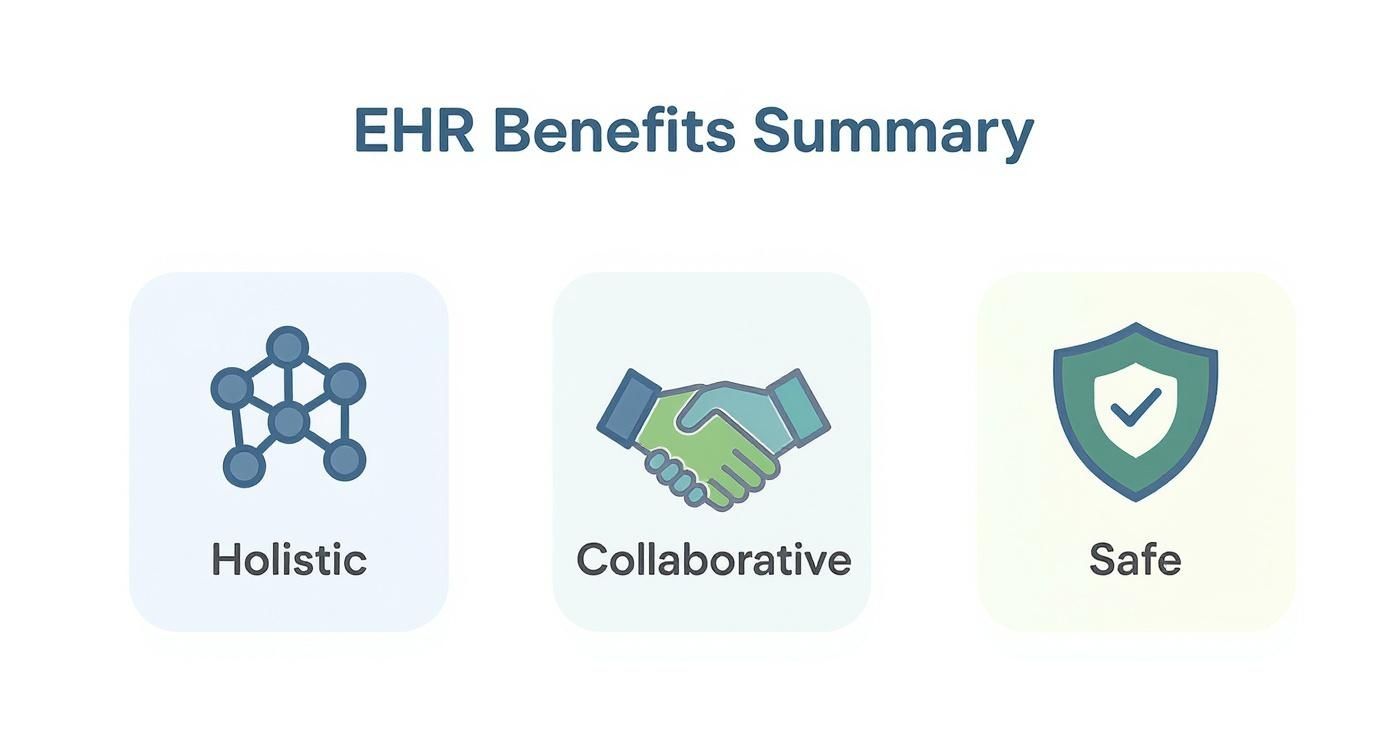
As you can see, a well-integrated EHR fosters a more holistic, collaborative, and ultimately safer environment for patient care.
This kind of integration is exactly what separates a modern EHR from a simple EMR. It's not just about collecting data; it's about making all relevant data, especially complex imaging, instantly accessible and actionable right where it matters most—at the point of care. Our work is dedicated to forging these critical links, ensuring technology empowers clinicians with the full picture they need.
In healthcare, that conversation saves lives.
How EMR and EHR Impact Daily Clinical Workflows
More than just a technical choice, the decision between an EMR and an EHR fundamentally changes the day-to-day rhythm of a clinic. It defines how a doctor interacts with patient information, how care teams work together, and ultimately, how a patient experiences their own healthcare. This isn't just about making things faster; it's about the quality and safety of patient care itself.
An EMR often feels incredibly efficient within the walls of a single practice. It’s designed to help a physician quickly chart a visit, send a prescription to the local pharmacy, or review a patient's history in their office. For routine, in-house care, this focused approach can feel sharp and straightforward.
But that siloed efficiency can become a serious liability the moment a patient’s journey moves beyond that one clinic. And this is where the EMR vs. EHR distinction can become a matter of life and death.
A Tale of Two Emergency Visits
Picture this: a patient is brought into the ER, unconscious. In a world where EMRs are the norm, the emergency team is working in the dark. They have no way of knowing the patient’s allergies, current medications, or chronic conditions because all that information is locked away in their primary care doctor’s isolated system. Every decision is a calculated risk, and crucial minutes are wasted trying to hunt down data that should have been at their fingertips.
Now, imagine that same scenario with an EHR. The ER physician logs in and immediately sees a complete, lifelong picture of the patient’s health. They see the cardiologist’s notes from last month, the new blood thinner prescribed last week, and the penicillin allergy noted five years ago. The team can now act with confidence and precision, armed with the full story. This is the real, life-saving promise of connected care.
The Administrative Load of Connected Care
While the clinical upside of an EHR is undeniable, its implementation brings new layers of complexity to daily work. The very features that enable data sharing, care coordination, and regulatory compliance often add to a clinician's administrative workload.
A 2020 study threw this into sharp relief, showing that U.S. clinicians were spending far more time on their EHRs than their international peers. They were logging an average of 26.5 minutes per day in the system after hours and fielding more than double the number of system-generated messages. These numbers show how an EHR's greatest strengths can also be its greatest challenge—demanding more and more of a clinician's time. You can dig into the findings on clinician EHR usage to see the full picture.
The goal of a modern health system is not just to digitize information but to make it flow seamlessly and intelligently, reducing the clinician's burden while elevating the quality of care.
To prevent this kind of documentation burnout, a well-designed EHR has to be more than just a data repository; it needs smart integrations that give time back to clinicians. This is especially true for complex data types like medical imaging. For example, at PYCAD, we build custom web DICOM viewers that plug directly into medical platforms. This lets a radiologist or specialist view a high-resolution MRI or CT scan right inside the EHR—no more toggling between different applications. See how we tackle this problem by exploring our PACS integration solutions.
Empowering the Patient
Finally, one of the most profound impacts of the EHR is how it reshapes the patient's role in their own care. Through integrated patient portals, EHRs transform patients from passive recipients into active participants. Suddenly, they can view their own lab results, schedule appointments, and communicate securely with their providers.
This direct access gives patients a real sense of ownership over their health. It empowers them to ask smarter questions, stick to treatment plans, and become true partners in decision-making. This isn’t just a nice-to-have feature; it’s a fundamental evolution of the patient-provider relationship, all made possible by the connected architecture of an Electronic Health Record.
How to Choose the Right System for Your Needs
https://www.youtube.com/embed/2EXSjw_yF0I
Choosing between an EMR and an EHR isn’t about picking which system is inherently "better." It's about deciding which one is fundamentally right for your specific vision of healthcare delivery. This decision will literally shape your future, touching everything from day-to-day clinical efficiency to your ability to innovate within a connected ecosystem.
The core question really comes down to scope. Are you a solo practitioner focused on providing deep, continuous care within a single community? If so, an EMR can be a powerful, streamlined tool for managing your internal workflows and patient histories with precision.
But if your ambition is bigger—to be part of a larger care network, to collaborate with specialists, or to truly empower patients as active partners in their health—an EHR is the only path forward. Think of it as the architectural foundation for a future built on shared knowledge and coordinated action.
A Strategic Checklist for Your Decision
Making the right choice requires a clear-eyed assessment of your goals. Use these points as a guide to illuminate the best path for your organization or technology.
- Scope of Practice: Do you operate as a self-contained unit, or is your value tied to collaborating with other providers, hospitals, and labs? Your answer points directly to either an EMR's internal focus or an EHR's external reach.
- Interoperability Needs: Is sharing data seamlessly a "must-have"? For medical device manufacturers, this is completely non-negotiable. Your tech has to integrate flawlessly with modern EHRs using standards like FHIR and DICOM to stay relevant.
- Patient Engagement Goals: Do you want to offer a patient portal, share lab results instantly, and empower individuals in their own care journey? These are native features baked into the patient-centered design of an EHR.
- Long-Term Scalability: Where do you see your organization in five or ten years? An EMR is often built for today's needs; an EHR is a platform for future growth, new partnerships, and emerging models of care.
The right system isn’t just a record-keeper; it’s an enabler of your mission. It should amplify your strengths and open doors to the future of patient care you want to create.
For Medical Device Innovators and IT Leaders
For those of you building the next generation of medical technology, the choice is crystal clear: your future is tied to the EHR. Seamless integration is no longer a nice-to-have feature; it's a baseline expectation from every hospital and clinic. As you navigate these decisions, it's also crucial to master the regulatory landscape, including the stringent HIPAA Security Rule requirements that govern data protection.
This is precisely where deep expertise becomes invaluable. At PYCAD, we at PYCAD, build custom web DICOM viewers and integrate them into medical imaging web platforms, ensuring vital visual data isn't trapped in a silo but becomes an interactive, accessible part of the patient's comprehensive EHR. Our portfolio page showcases how we achieve this for our clients.
Ultimately, choosing the right system is a declaration of your intent. It’s a commitment to either perfecting the art of solo practice or embracing the full power of a connected, collaborative, and patient-centered future.
Your Top Questions About EHR and EMR Answered
Diving into health technology can feel like learning a new language. When it comes to EMR and EHR systems, getting clear, straightforward answers is crucial for making the right call for your practice or product. Let's tackle some of the most common questions we hear.
Can an EMR System Be Upgraded to an EHR System?
That’s a great question, but the reality is it’s less of an "upgrade" and more of a complete replacement. Think of it this way: EMRs were built like a fortress, designed to keep clinical notes safe and sound within one practice. They do that job incredibly well, but their architecture simply wasn't designed for sharing.
True EHRs, on the other hand, are built like a modern communications hub. They are engineered from day one for interoperability, using standards like HL7 and FHIR to talk to other systems across the healthcare landscape. You can certainly migrate patient data from an old EMR, but to get the connected power of an EHR, you need to swap out the entire foundation.
What Is the Role of DICOM in these Systems?
DICOM is the gold standard for medical imaging—it's the universal language spoken by X-rays, MRIs, and CT scans. In a traditional EMR setup, these images usually live on a separate island called a Picture Archiving and Communication System (PACS). This creates a frustrating gap between a patient's chart and their diagnostic images.
A modern EHR closes that gap. This is where custom web DICOM viewers become so important. They allow clinicians to pull up and analyze critical images directly inside the patient's record, right alongside their lab results and clinical notes. This isn’t just a nice-to-have feature; it’s a fundamental shift toward a truly complete patient picture.
The ability to view DICOM images directly within an EHR is not just a feature; it's a transformation in workflow that brings all critical patient data into a single, actionable view at the point of care.
How Do Privacy and Security Differ Between EHR and EMR?
Both systems are bound by the same strict rules, like HIPAA, but the security game they play is completely different. An EMR’s security is primarily about locking down the data inside a single organization's network. It's a well-defined perimeter to defend.
An EHR, however, presents a much bigger security puzzle. Because it's built to share, it has to protect sensitive information as it moves between different, unaffiliated organizations. This demands a whole new level of defense, including robust end-to-end encryption, multi-layered user access controls, and meticulous audit trails that track every single touchpoint with the data across the network.
How Do PYCAD’s Services Support the EHR Ecosystem?
This is exactly where we come in. At PYCAD, our passion is solving one of the most critical challenges in the EHR ecosystem: bringing medical imaging into the fold. We at PYCAD, build custom web DICOM viewers and integrate them into medical imaging web platforms. This is the bridge that connects a patient's imaging studies directly to their electronic health record.
Our solutions tear down the walls that separate text-based charts from rich visual data. By doing so, we help create the unified, efficient, and truly collaborative healthcare environment that a modern EHR is meant to deliver.
At PYCAD, we’re committed to building the secure, interoperable platforms that define the future of healthcare. If you're ready to see how our custom DICOM viewers and integrated solutions can bring your platform to life, take a look at our work on our portfolio page.