
Ever felt like your medical imaging data was trapped? Like every new piece of equipment was creating another isolated island of information that couldn't talk to anything else? For decades, that was the reality for hospitals and clinics. This is the exact problem a Vendor Neutral Archive, or VNA, was built to solve.
A VNA Is the Cornerstone of Your Healthcare Data Strategy
Think of a VNA as the ultimate translator and central library for every single medical image your organization creates or acquires. It’s designed to break down the walls between different imaging systems, departments, and even entire facilities.
For years, healthcare providers were stuck. A new MRI machine from one company couldn't easily share its images with a viewing system from another. This is called "vendor lock-in," and it created massive headaches, stifled innovation, and made it incredibly difficult to get a complete picture of a patient's health. A VNA changes all of that.
Finally, Freedom from Vendor Lock-In
The magic of a VNA lies in one word: neutrality. It doesn't care who made the scanner or what software was originally used. It takes in images from radiology, cardiology, pathology, and more, then stores them in a universal format—most often the DICOM standard.
This simple, powerful idea gives your organization tremendous freedom. When your data is no longer held hostage by a specific vendor's technology, you can:
- Pick the Best Tools for the Job: You're free to choose the most advanced scanners or the best departmental PACS (Picture Archiving and Communication System) on the market, without facing a nightmare data migration project.
- Make Life Easier for IT: Instead of juggling dozens of separate, disconnected archives, your IT team can manage one cohesive, centralized system. This drastically cuts down on complexity and the day-to-day effort of keeping things running.
- Build a True, Unified Patient Record: A VNA brings a patient's entire imaging history together in one place. This gives clinicians a complete, longitudinal view, which is absolutely critical for making accurate diagnoses and informed treatment plans.
A VNA isn’t just a bigger hard drive; it’s a statement of data ownership. It puts you back in control, ensuring your most valuable asset—your patient's clinical history—belongs to you, not the vendor who sold you the last piece of equipment.
This kind of centralized, easy access is where the real clinical breakthroughs happen. At PYCAD, for example, we build custom web DICOM viewers and integrate them into medical imaging web platforms that plug directly into a facility's VNA. This allows a doctor to pull up a patient's complete imaging history on any device, anywhere, with just a few clicks. You can see how we approach these integrations in our portfolio.
To really grasp what a VNA is, you have to see it as the foundation for a smarter, more connected, and future-ready healthcare system. It’s the key that unlocks the true potential hidden within your imaging data, setting the stage for everything from powerful analytics to next-generation AI.
To make this even clearer, let's break down the core principles of a VNA.
VNA Core Principles at a Glance
This table sums up the fundamental ideas that make a Vendor Neutral Archive such a game-changer for healthcare organizations.
| Principle | What It Means for Your Organization |
|---|---|
| Data Liberation | Your imaging data is freed from proprietary formats, preventing vendor lock-in and giving you control. |
| Centralization | All medical images, regardless of origin, are stored in one unified, enterprise-wide repository. |
| Standardization | Images are converted to a standard format (like DICOM) for universal accessibility and interoperability. |
| Data Ownership | You, the healthcare provider, own and control your clinical data, not the equipment manufacturers. |
| Future-Proofing | Your archive is prepared for future technologies, allowing you to adopt new tools without overhauling your entire system. |
Ultimately, these principles work together to create a single source of truth for all imaging data, ensuring it remains a valuable and accessible asset for the life of your organization.
2. Exploring the Architecture of a Modern VNA
To really get what a VNA is, you have to look under the hood. It’s not just a digital filing cabinet. Think of it more like a grand central station for all your medical imaging data, a bustling hub where every piece of information—every scan, every image—is a passenger arriving on a different train line.
These passengers come from all over: different PACS, various imaging machines, and separate departments. The VNA's job is to manage this incredible flow, making sure every passenger gets where they need to go and can be understood by anyone they meet along the way. That’s what makes a VNA the true engine of a connected healthcare system.
The Ingestion Engine: Your Station Master
The moment an image arrives at the VNA, it's greeted by the ingestion engine. This is your station master, and its role is critical. It doesn't just let data in; it inspects, validates, and, most importantly, standardizes it.
For example, a CT scan might show up with proprietary metadata tags unique to its manufacturer. The ingestion engine strips away these non-standard tags and replaces them with universal ones. This "tag morphing" process is absolutely vital for creating an environment where data is free from vendor lock-in.
The Central Storage Core: The Main Concourse
Once the data is standardized, it moves into the central storage core. Picture this as the station's massive main concourse, built for secure, long-term archiving. Modern VNAs don't just rely on a stack of hard drives; they use sophisticated strategies like object storage to handle the sheer volume.
Object storage gives you incredible scalability and durability—a must-have when you're managing petabytes of imaging data. VNAs also use intelligent tiering to keep costs in check. It's a smart, dynamic system.
- Hot Tier: Frequently needed images, like from a patient's recent visit, are kept on high-performance storage for lightning-fast retrieval.
- Warm Tier: Data that’s accessed less often gets moved to a slightly slower, more budget-friendly storage layer.
- Cold/Archive Tier: Old data that has to be kept for legal reasons but is rarely touched is shifted to the cheapest long-term storage available.
This tiered approach means clinicians get the speed they need, while the organization avoids paying top dollar to store every single file on the most expensive hardware.
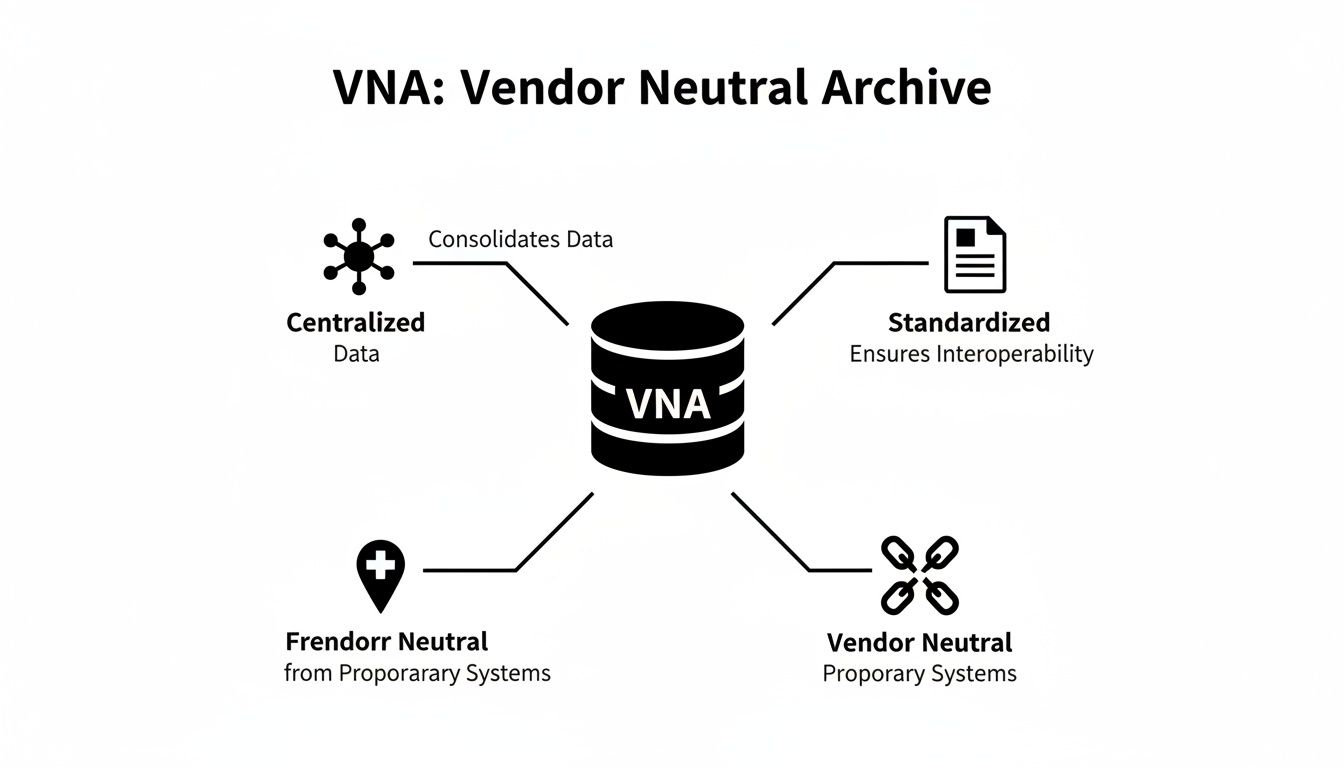
This diagram captures the essence of a VNA's architecture. It’s all about centralizing data, standardizing it, and breaking free from proprietary systems to create a single source of truth for all medical imaging.
The Interoperability Layer: The Universal Translator
Finally, we get to the most powerful part of the VNA: the interoperability layer. Think of this as the station’s universal communication system, allowing it to talk to any other system, whether it’s inside the hospital or across the globe. It relies on standard languages like DICOM and HL7 to make sure data flows seamlessly. If you're curious about the nuts and bolts, you can learn more about how DICOM makes this possible here: https://pycad.co/what-is-dicom/.
This is the layer that empowers a new electronic health record (EHR) to pull up a patient's complete imaging history in seconds. It's what allows a specialist at a partner hospital to view a critical scan without delay. It’s the key to finally breaking down those frustrating data silos. As you think about your own setup, looking into different multi-cloud and hybrid cloud deployment strategies is a smart move for future-proofing your architecture.
This is also where the real magic of custom integration happens. At PYCAD, for instance, we build custom web DICOM viewers and integrate them into medical imaging web platforms that plug directly into this interoperability layer. This creates powerful platforms that give authorized users the ability to view any image, from any source in the VNA, on any device. This architectural freedom is what elevates a VNA from being a simple archive to becoming a living, breathing data hub at the heart of modern healthcare.
Understanding The PACS vs. VNA Relationship
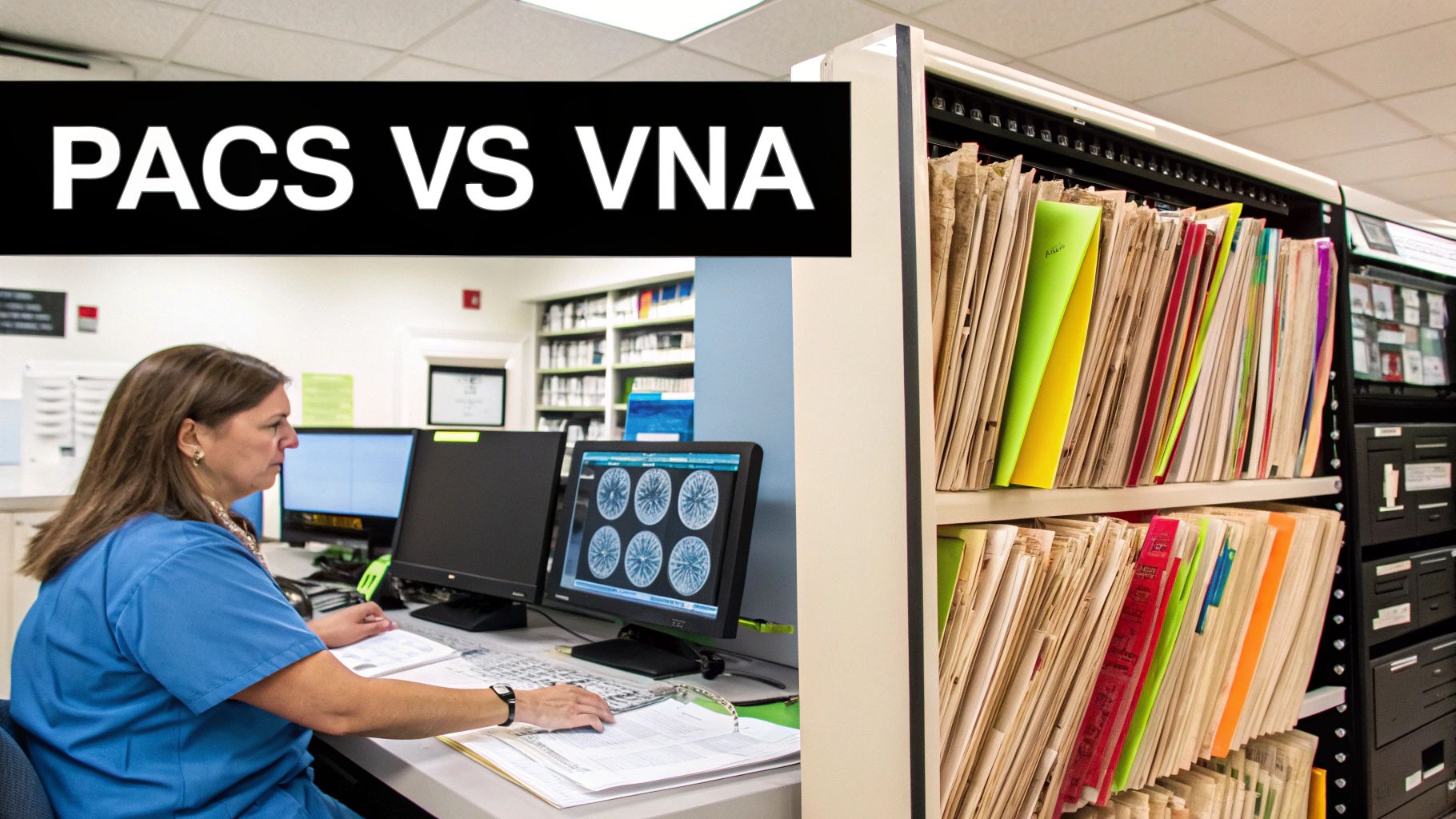
It’s easy to get tangled up trying to figure out where a VNA fits in with a Picture Archiving and Communication System (PACS). Do they compete? Does one replace the other? The answer is a firm no.
Think of them as partners, each with a distinct and vital role. They don’t compete; they complement each other to create a stronger, more flexible imaging environment.
The Workbench vs. The Library
Let's use an analogy. A PACS is like a specialist's high-speed workbench. It's built for the intense, day-to-day grind of a specific department, like radiology or cardiology. Its entire purpose is to help clinicians view, interpret, and report on images as fast as humanly possible. It's all about workflow and immediate performance.
A VNA, on the other hand, is the organization's secure, permanent master library. Its focus isn't on the frantic pace of daily diagnosis but on the long-term, strategic management of all imaging data from every department. It's the central repository that consolidates a patient's complete history into a single, unified record.
This table gives a quick side-by-side look at how their roles differ.
| Aspect | PACS (The Workbench) | VNA (The Master Library) |
|---|---|---|
| Primary Role | Daily clinical workflow, diagnosis, and reporting. | Long-term archival, data lifecycle management, and enterprise access. |
| Scope | Departmental (e.g., Radiology, Cardiology). | Enterprise-wide (all "-ologies" and imaging sources). |
| Data Philosophy | Optimized for speed and short-term access. | Designed for long-term preservation, integrity, and standardization. |
| Vendor Tie-in | Often uses proprietary formats, creating vendor lock-in. | Vendor-neutral by design, using standard formats to ensure data freedom. |
The PACS is for the now—the VNA is for forever. Separating these functions is what unlocks incredible strategic value for a healthcare system. For a deeper dive into the specifics of the workbench itself, our guide explains more about what a PACS is in healthcare.
This separation allows for clinical excellence today while safeguarding your most valuable data assets for the future.
A VNA doesn't replace the PACS; it elevates it. By shouldering the heavy burden of long-term archiving, the VNA frees up the PACS to do what it does best: deliver blistering performance for the daily clinical grind.
Creating Strategic Freedom
One of the biggest game-changers this partnership brings is freedom. For years, hospitals were handcuffed to their PACS vendors. All that crucial imaging data was trapped inside a proprietary system. Swapping out that PACS meant facing a massive, terrifyingly expensive, and risky data migration.
A VNA shatters those chains. By acting as the permanent system of record, it sits above any and all departmental PACS.
- Decoupled Systems: Your long-term archive (VNA) is completely independent of your day-to-day workflow tools (PACS).
- Easy Upgrades: Want to replace your radiology PACS with a better, more affordable option? No problem. The historical data never moves—it stays safe in the VNA. The new PACS just plugs right in.
- Consolidated Viewing: Every image, no matter which department or PACS it came from, is accessible from one central source.
This is where the vision of true enterprise imaging comes to life. It’s what we live and breathe at PYCAD. We specialize in building custom web DICOM viewers and integrating them into medical imaging web platforms that connect directly to a VNA. This is how you empower clinicians to pull up a complete patient imaging history—spanning decades and multiple care sites—from anywhere, on any device.
You can see real-world examples of how we bring this vision to life over on our portfolio page.
In the end, it’s a powerful partnership. The PACS handles the speed of now, while the VNA secures the invaluable history of a patient’s journey.
Where a VNA Truly Shines: Real-World Wins
The real magic of a Vendor Neutral Archive isn't in the technical jargon or architectural diagrams. It's in the stories—the tangible, on-the-ground wins it creates for hospitals, researchers, and patients every single day. Let's move past the theory and look at how a VNA becomes the backbone for incredible advances in healthcare.
This is where a simple concept—a central, standardized archive—transforms from an IT project into a game-changer for patient care and operational agility.
Merging Hospitals Without the Migraine
Picture this all-too-common scenario: a large hospital system just acquired a smaller, independent clinic. In the old days, this meant one thing: a data integration nightmare. The clinic’s imaging data would be completely locked up in its proprietary PACS, an isolated island of information. Bringing that data into the fold would mean a brutally expensive, months-long migration project, fraught with the risk of losing or corrupting priceless patient records.
For weeks, even months, clinicians would be flying blind, working with incomplete patient histories. It’s a situation that puts quality of care on the line.
Now, imagine that same scenario, but this time the hospital system has a VNA at its core.
Everything changes. Instead of a massive, high-risk migration, the hospital simply connects the clinic’s old PACS to its enterprise VNA. The VNA’s smart ingestion engine gets to work, pulling in the new data, re-tagging it to a universal standard, and seamlessly weaving it into existing patient files.
What used to be a six-month headache is now handled practically overnight. A patient from the newly acquired clinic can walk into the main hospital, and the specialist can instantly pull up their entire imaging history. Scans from five years ago at the clinic sit right alongside scans from last week at the hospital.
This isn't just about IT convenience. It's a massive leap forward for patient safety and diagnostic confidence. A complete, lifelong patient record is one of the most powerful tools in medicine, and a VNA is what makes it possible.
Fueling the Next Wave of Medical AI
Let's shift gears to a major research university, a place buzzing with the promise of medical AI. Their top team is trying to build an algorithm to spot the earliest signs of neurodegenerative diseases in brain MRIs. To make it happen, they need one thing above all else: data. A ton of it. They need a massive, diverse, and perfectly organized dataset of thousands of de-identified scans.
Without a VNA, this would be a soul-crushing effort. Researchers would have to go hat-in-hand to different departments, begging for data locked away in separate PACS silos. They’d likely spend 80% of their time just finding, cleaning, and trying to standardize the data before a single line of code could be written. It’s a slow, frustrating, and error-prone process.
With an enterprise VNA, the whole dynamic flips. The VNA is the institution's clean, curated "data lake" for all medical imaging. The research team can now simply query the archive for exactly what they need—say, "all adult brain MRIs from the last 10 years."
The VNA then does the heavy lifting:
- Effortless Curation: Researchers can pull together a huge batch of relevant studies from one unified source in minutes, not months.
- Automatic De-identification: The VNA can apply rules to automatically strip all protected health information (PHI) before the data ever reaches the research team, keeping patient privacy locked down and ensuring HIPAA compliance.
- Standardized Formats: Every single image is already in a consistent DICOM format. The endless drudgery of data cleaning and conversion simply disappears.
This shift radically speeds up the pace of innovation. Researchers get to focus on what they do best—building and training their AI models—instead of getting bogged down in data logistics. The VNA becomes the engine of discovery, turning a hospital's clinical data into a priceless asset for the future of medicine.
Making Modern Telehealth a Reality
Finally, think about the explosive growth of telehealth. A leading specialist needs to consult on a complex case for a patient who lives hundreds of miles away. To do their job right, they need more than just a brief report or a single recent scan; they need the full story told by the patient's complete imaging history.
This is where instant, seamless access is non-negotiable. Trying to shuttle massive imaging files between facilities is slow, clunky, and insecure. A written report just doesn't cut it. The specialist needs to see the pixels for themselves.
A VNA, paired with a modern web-based viewer, solves this beautifully. At PYCAD, this is our bread and butter. We build custom web DICOM viewers and integrate them into medical imaging web platforms. These platforms plug directly into the VNA, allowing an authorized specialist to log in securely from any device, anywhere in the world, and have a patient's entire imaging portfolio at their fingertips in seconds.
This empowers clinicians to deliver expert-level care without geographical limits, making specialized medicine more accessible than ever. To see how we help make complex data universally available, you can check out some of our projects on our portfolio page.
In every one of these cases, the VNA proves it’s so much more than a digital storage closet. It’s a strategic tool that delivers tremendous real-world value by unifying data, fueling innovation, and knocking down the barriers that stand in the way of great patient care.
A Practical Guide to VNA Deployment and Migration
Deciding to bring a VNA into your healthcare ecosystem is a foundational move. It’s a decision that will echo through the future of your data management. The journey really boils down to two make-or-break stages: picking the right deployment model and then pulling off a flawless data migration.
When you get these two steps right, what looks like a daunting technical project transforms into a clear, manageable path toward a more connected, data-driven organization. The first big question you need to answer is where your VNA will live. Each option strikes a different balance between control, cost, and scalability, so it's critical to match your choice to your institution's real-world needs and long-term vision.
Choosing Your VNA Deployment Model
You’ll find three main paths for deploying a VNA. The "best" one is entirely dependent on your organization’s unique requirements for security, your budget, and the IT resources you have on hand.
- On-Premise: This is the traditional approach. You house the VNA on your own servers, right inside your facility. It gives you the ultimate control over your data and security, which is a massive plus for institutions with strict compliance rules and a strong in-house IT team ready to manage it.
- Cloud-Based: A fully cloud setup means your VNA is hosted by a third-party provider like AWS, Google Cloud, or Azure. This route offers incredible scalability—you can expand storage whenever you need it—and it lifts the heavy burden of hardware maintenance off your shoulders, which often translates to lower upfront costs.
- Hybrid: For many, the hybrid model hits the sweet spot. It's the best of both worlds. You typically keep recent, frequently used images ("hot" data) on-premise for lightning-fast access, while older, less-accessed studies are archived in the cloud for cost-effective, long-term storage.
A hybrid VNA is often the perfect fit for established healthcare systems. It delivers the performance and security of an on-premise solution for daily clinical work while tapping into the cloud's economic advantages for data preservation.
Successfully rolling out a VNA is a complex project that demands meticulous planning. A great starting point is to explore effective IT infrastructure project management strategies to keep your implementation on track. This kind of disciplined approach is absolutely essential when you get to the most demanding part of the whole process: the migration.
Mastering the Art of Data Migration
Once you've settled on a deployment model, the next great mountain to climb is moving all your legacy data into the shiny new VNA. Let me be clear: this is so much more than a simple "copy and paste" job. It's a delicate, high-stakes operation where data integrity is everything. A rushed or poorly planned migration can easily lead to corrupted files, lost patient histories, and massive disruptions to clinical workflows.
A winning migration is always built on a solid foundation of planning, validation, and a phased rollout. It's the only way to guarantee a smooth transition without putting patient care at risk.
A structured plan is non-negotiable. To make sure nothing slips through the cracks, we always recommend a proven, multi-step process. In fact, you can dive deeper into this by reading our guide on data migration best practices.
The core steps always look something like this:
- Conduct a Comprehensive Data Audit: Before you move a single byte, you have to know exactly what you're working with. This means cataloging all of your existing imaging data, figuring out where it came from, its format, its age, and flagging any files that are already corrupted or incomplete.
- Define Your Migration Rules: This is where you build the "brain" for the VNA's ingestion engine. You'll map out precisely how to handle proprietary data tags, standardize patient IDs across different systems, and reconcile any discrepancies to create a single, clean source of truth.
- Perform Rigorous Validation: Don't try to boil the ocean. Start with a small, but representative, sample of data. Migrate just that batch to the new VNA and then test it like crazy. Confirm that every image is accessible, displays perfectly in your viewers, and has all its critical metadata intact. Think of this as your quality control checkpoint.
- Execute a Phased Rollout: Whatever you do, don't attempt a "big bang" migration all at once. Start with data from a single, low-risk department. Once that's complete and fully validated, move on to the next one. This step-by-step approach keeps risk to a minimum and lets you iron out any kinks on a much smaller scale.
This careful process demystifies the whole migration, turning what feels like an overwhelming task into a series of achievable milestones. It’s also where having the right partners in your corner can make all the difference. Here at PYCAD, we specialize in creating these kinds of seamless data ecosystems. We build custom web DICOM viewers and integrate them into medical imaging web platforms that connect directly to your newly deployed VNA, making all that migrated data instantly and beautifully accessible.
You can see how we make data universally available on our portfolio page.
Fueling the Future of Medicine with VNA and AI
Think of a Vendor Neutral Archive as much more than a digital filing cabinet. It’s the launchpad for the next generation of medicine. Artificial intelligence and machine learning algorithms need one thing to thrive: a massive pool of clean, standardized, and accessible data. A VNA delivers exactly that.
By creating a pristine ‘data lake’ for all your medical imaging, you’re setting the stage for incredible breakthroughs. Unifying decades of patient scans gives you the raw material for predictive models that could one day forecast disease before a single symptom appears. It’s the perfect foundation for training and deploying the diagnostic tools of tomorrow.
Enabling Intelligent Clinical Workflows
The real magic happens when AI isn't just a background process but a real-time partner for clinicians. A VNA makes this a reality. It provides a single, reliable source for AI algorithms to pull imaging data and push their findings right back into the clinical workflow. This is where theory meets practice.
Imagine AI tools that can:
- Highlight Areas of Interest: Automatically flag potential anomalies on a scan for the radiologist, helping them prioritize the most critical cases.
- Perform Quantitative Analysis: Instantly measure tumor growth or track subtle changes in tissue density over time, giving doctors objective data to guide treatment.
- Enable Predictive Insights: Analyze imaging data across entire patient populations to spot at-risk individuals who could benefit from early intervention.
A VNA transforms your historical imaging data from a passive archive into an active, intelligent asset. It’s not just about storing the past; it’s about unlocking the intelligence within that data to build a healthier tomorrow.
This organized data environment is essential for paving the way to truly personalized medicine. When a clinician can access a patient's complete imaging history in one place, they can build treatment plans around that individual's unique story and biology. That’s how you get better outcomes, and it all starts with the data-driven foundation a VNA provides.
At PYCAD, we specialize in activating this potential. We build custom web DICOM viewers and integrate them into medical imaging web platforms, turning your VNA into a dynamic hub for clinical insight and AI-driven workflows. See how we bridge the gap between data and discovery by exploring the projects on our portfolio page.