
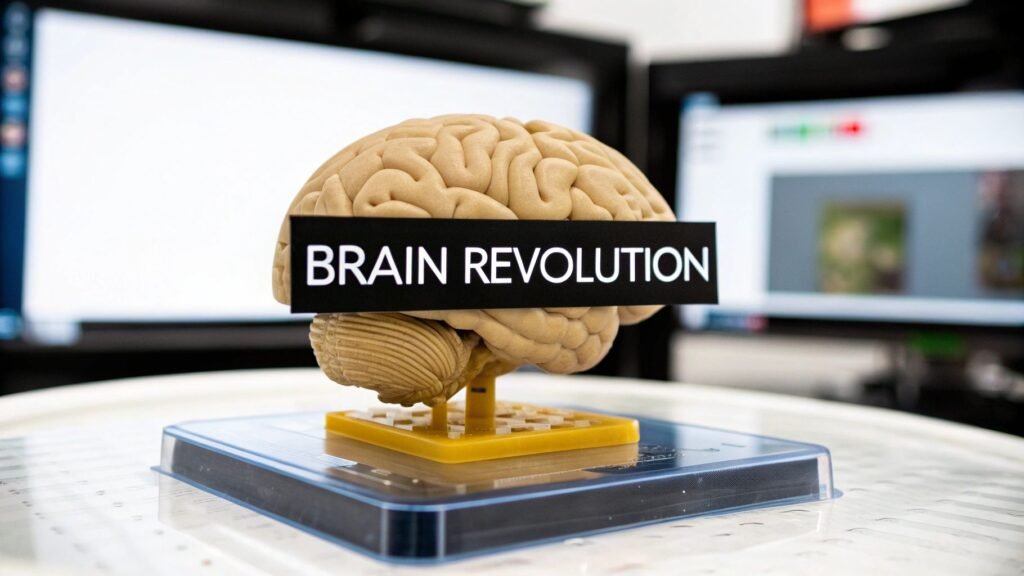
This is a buying page for 3D-printed brain models: commercial printers, software, and services that produce a physical brain you can hold. It is not a scan-to-print tutorial. For that workflow see 3D printing anatomical models. For turning a CT/MRI series into a mesh, see convert DICOM to STL.
Pick from the job, not the brand. Surgical planning wants patient-specific geometry and, in some hospitals, a cleared process. A classroom wants cheap, separable, durable parts. Specs that actually change the buy: resolution, multi-material/color, whether the model is built from that patient’s DICOM, biocompatibility/sterilization if it goes near a sterile field, and the all-in cost (printer + software + labor vs a per-case service).
1. Stratasys J5 MediJet
The J5 MediJet is a PolyJet printer aimed at anatomical models. It can print several colors and materials in one job, so vessels, tumor, and parenchyma can be different hardnesses and colors without painting. Models are built from the patient’s MRI or CT after someone else has segmented and meshed the anatomy.
- Layer resolution on the order of 16 µm.
- Typical model cost in the original product literature sits around $1,000–$5,000 depending on size and materials. Print time is often a day or more.
- Needs a medical-image-to-print software path (DICOM → mesh → print prep). The printer does not ingest raw DICOM.
Use it when you need a multi-material, color brain on the table for planning or teaching and the budget is hospital-capital, not classroom. Weakness: cost and a specialist workflow.
2. Formlabs Form 3B
The Form 3B (and its successors in the Formlabs medical line) is an in-house SLA printer. Biocompatible resins, layer heights about 25–100 µm, and a clear-resin option so you can see internal structures without sectioning. A sectioned print is the other way to look inside.
- Printer in the draft’s price band: about $4,500 plus resin and wash/cure gear.
- A brain-sized part is often 8–12 hours plus wash and UV cure.
- Usually one resin/color per job. Paint or a second print if you need contrast.
Use it when a hospital or lab wants repeatable in-house brains and already has (or will hire) someone who can go DICOM → STL. Weakness: post-processing and single-material prints.
3. Materialise Mimics
Mimics Innovation Suite is the software half, not a printer. It is the common clinical tool for turning DICOM into a printable mesh: region segmentation, optional DTI tracts, vessels, cranial nerves, functional-map overlays. Materialise also prints models as a service if you do not have a shop.
- License in the draft’s band: $15,000+/year, plus a workstation and training.
- Per-model print cost is extra and scales with size and material.
Use it when the hard part is the segmentation (tumor vs white-matter tracts vs vessels), not the printer. Weakness: price and the learning curve.
4. Ultimaker FDM educational brains
Ultimaker FDM printers (and the Cura marketplace / similar public STLs) are how schools print separable, multi-color educational brains. Regions print as parts and click or glue together. Material cost is often under $30 if you already own the printer.
- FDM resolution is coarser than SLA/PolyJet. Fine vessels and thin cortex will look stepped.
- Not patient-specific unless you swap in your own mesh.
- Needs support removal and assembly.
Use it for anatomy class and handling practice. Do not use it as a surgical-planning model. Ultimaker education notes.
5. Anycubic / consumer resin prints
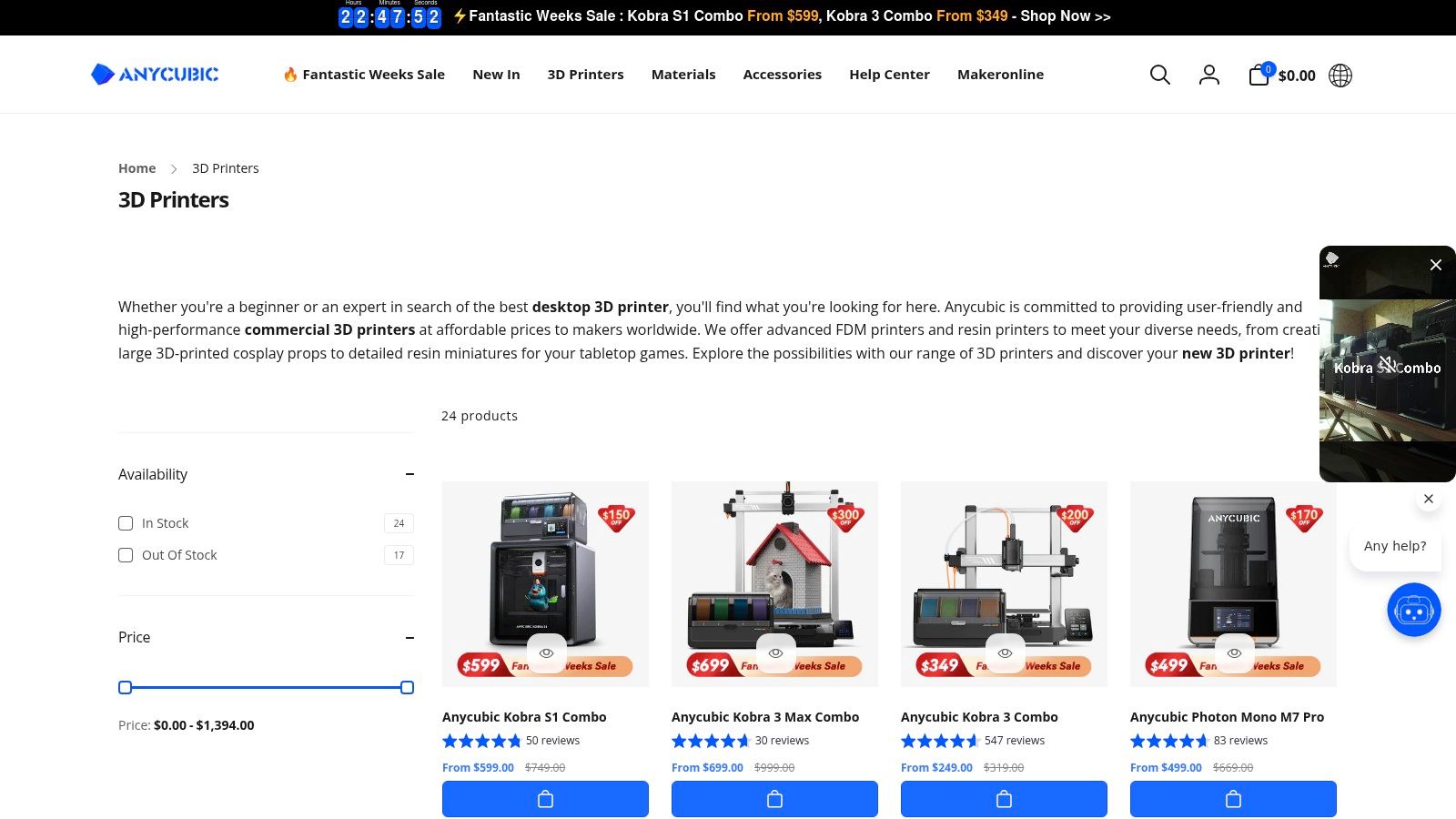
Anycubic (Photon-class and similar) is a consumer resin printer line. The cheap path is: someone converts the MRI/CT to STL, you print it at about 50 µm layers, or a shop prints it for you. Typical shop turnaround in the draft: 1–2 weeks. Color-coding is paint or a multi-part print, not a medical multi-material jet.
- Not an FDA-cleared planning service.
- Detail is good for teaching and a desk model; it is not a hospital VSP part.
- Self-print means you own wash/cure, supports, and resin handling.
Use it when cost matters and the model is for education or a conversation, not a sterile field.
6. 3D Systems VSP
3D Systems Virtual Surgical Planning (VSP) is a per-case service: you send DICOM, their medical team builds the plan and a physical model (and often cutting guides). The draft’s differentiator is FDA clearance for surgical planning. Models can be multi-color, multi-material, and sterilizable.
- Cost in the draft: about $3,000–$10,000 per case.
- Lead time about 2–3 weeks from usable CT/MRI.
- You are buying a service and a regulatory path, not a printer.
Use it for complex tumor, vascular, or craniofacial cases where the hospital wants a cleared planning process. Weakness: price and calendar.
7. Prusa printable brain models
Prusa printers plus designs on Printables (and similar) are the hobby/education FDM kit: separable labeled segments, community revisions, material cost about $15–$50. Tuned for the i3 MK3S+ class; other FDM machines will print them with support tweaks. Total print time is often 20+ hours plus assembly.
Same limits as the Ultimaker path: not patient-specific, not a medical device, lower resolution than SLA/PolyJet. Useful for teaching and a first prototype of a device that has to sit on a generic brain.
Comparison
| Product | What you actually buy | Patient-specific? | Detail | Cost (draft bands) | Best for |
|---|---|---|---|---|---|
| Stratasys J5 MediJet | Multi-material PolyJet printer + print shop time | Yes, from your mesh | Very high (~16 µm) | $1k–$5k / model | Color/material planning models |
| Formlabs Form 3B | In-house SLA printer + resin | Yes, from your mesh | High (25–100 µm) | Printer ~$4.5k; cheap per part after | Repeat in-house brains |
| Materialise Mimics | Segmentation/modeling software (± their print service) | Yes | As good as the scan + printer | $15k+/yr license | Hard segmentations (DTI, vessels) |
| Ultimaker FDM education | Filament + public/educational STLs | No (unless you swap the mesh) | Low–medium | <$30 materials | Classrooms |
| Anycubic / consumer resin | Photon-class printer or a shop print | Optional | Medium (~50 µm) | Low | Cheap teaching / desk models |
| 3D Systems VSP | Per-case planning service + model | Yes | Medical-grade | $3k–$10k / case | Cleared surgical planning |
| Prusa Printables kit | FDM filament + downloadable parts | No | Low–medium | $15–$50 materials | Hobby and teaching assembly |
Rule of thumb: cleared, patient-specific, multi-material → VSP or MediJet + Mimics. In-house repeat SLA → Formlabs. Teaching and budget → Ultimaker or Prusa FDM, or a consumer resin print.
PYCAD builds custom web DICOM viewers and case workflows when the 3D view has to live next to the scan, not only next to a printer. Case studies.