
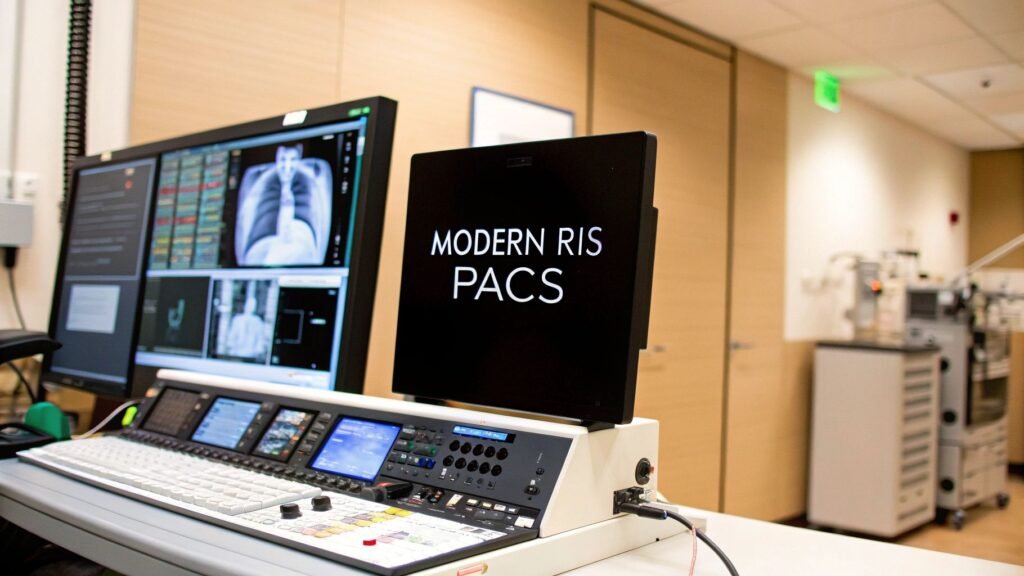
In the world of medical imaging, the terms RIS and PACS represent the digital bedrock of any modern practice. They are the systems that handle everything from the moment a patient is scheduled to the final diagnostic report. Think of a Radiology Information System (RIS) as the administrative and workflow engine, while the Picture Archiving and Communication System (PACS) is all about managing the medical images. When these two work together seamlessly, they create the efficiency and precision that radiology departments depend on.
The Digital Heartbeat of Modern Radiology
Let's use an analogy. Imagine a busy air traffic control tower. The Radiology Information System (RIS) is the control tower operator. It manages all the logistical details—scheduling flights (patient appointments), tracking flight paths (patient workflow), handling communications (billing), and ensuring every plane lands safely and on time (generating reports). The RIS is the operational brain, orchestrating the entire process.
The Picture Archiving and Communication System (PACS), on the other hand, is the sophisticated radar and imaging system. It captures and stores every critical visual—the blips on the screen representing X-rays, MRIs, and CT scans—in a standardized digital format. This system doesn't just hold the data; it presents it clearly to the controllers (radiologists), allowing them to analyze flight patterns and make crucial decisions.
These two systems working in concert are truly the digital heartbeat of modern radiology. They've replaced the old, cumbersome world of film jackets and paper trails with a fluid, connected workflow that saves time, cuts down on errors, and ultimately helps save lives.
From Appointment to Diagnosis: A Connected Journey
This powerful partnership is what shapes the entire patient journey. It all starts in the RIS when an appointment is booked. A digital record is born, ready to follow the patient every step of the way.
Once the scan is done, the images are instantly sent to the PACS. The magic happens when the PACS automatically links these new images to the patient’s existing record in the RIS.
This tight integration means that when a radiologist sits down to read a study, they get the full picture on one screen: the patient's complete history from the RIS right alongside their medical images from the PACS. This isn't just a matter of convenience; it’s about creating a truly holistic environment for diagnosis.
At PYCAD, we take this a step further. We build custom web DICOM viewers and integrate them directly into these platforms, giving clinicians powerful tools to view and interpret medical images securely, from anywhere. We help turn that stored data into life-changing insights. To see what this looks like in practice, you can browse our portfolio.
This guide is designed to move beyond the technical jargon and show you how this incredible synergy truly empowers healthcare providers.
How RIS and PACS Create a Seamless Patient Journey
To really get a feel for how RIS and PACS work together, let's walk through a patient's experience from the moment they book an appointment to the second their doctor receives a diagnosis. This isn't just a technical process; it's a beautifully orchestrated workflow designed for precision, speed, and exceptional care at every single step. It’s where two separate systems truly become one.
It all starts with a phone call or a click. When an appointment is scheduled, the patient’s details and the reason for the scan are logged in the Radiology Information System (RIS). Think of the RIS as the air traffic controller for the entire imaging department—it creates a digital record that manages all the administrative and scheduling details of the visit.
From Check-In to Image Capture
Once the patient walks through the door, the front desk team pulls up their file in the RIS to check them in. That simple action sets everything else in motion. The technologist at the MRI, CT, or X-ray machine gets an instant notification that their next patient is ready.
The imaging machine itself then "talks" to the RIS to verify the patient’s information. This handshake is crucial; it prevents the kind of dangerous mix-ups that can happen with manual data entry. As soon as the scan is finished, the images are bundled into the universal medical imaging format, DICOM (Digital Imaging and Communications in Medicine), and sent directly to the Picture Archiving and Communication System (PACS).
This synchronized flow, from the initial booking in the RIS to the final report, is what a modern imaging department is built on.
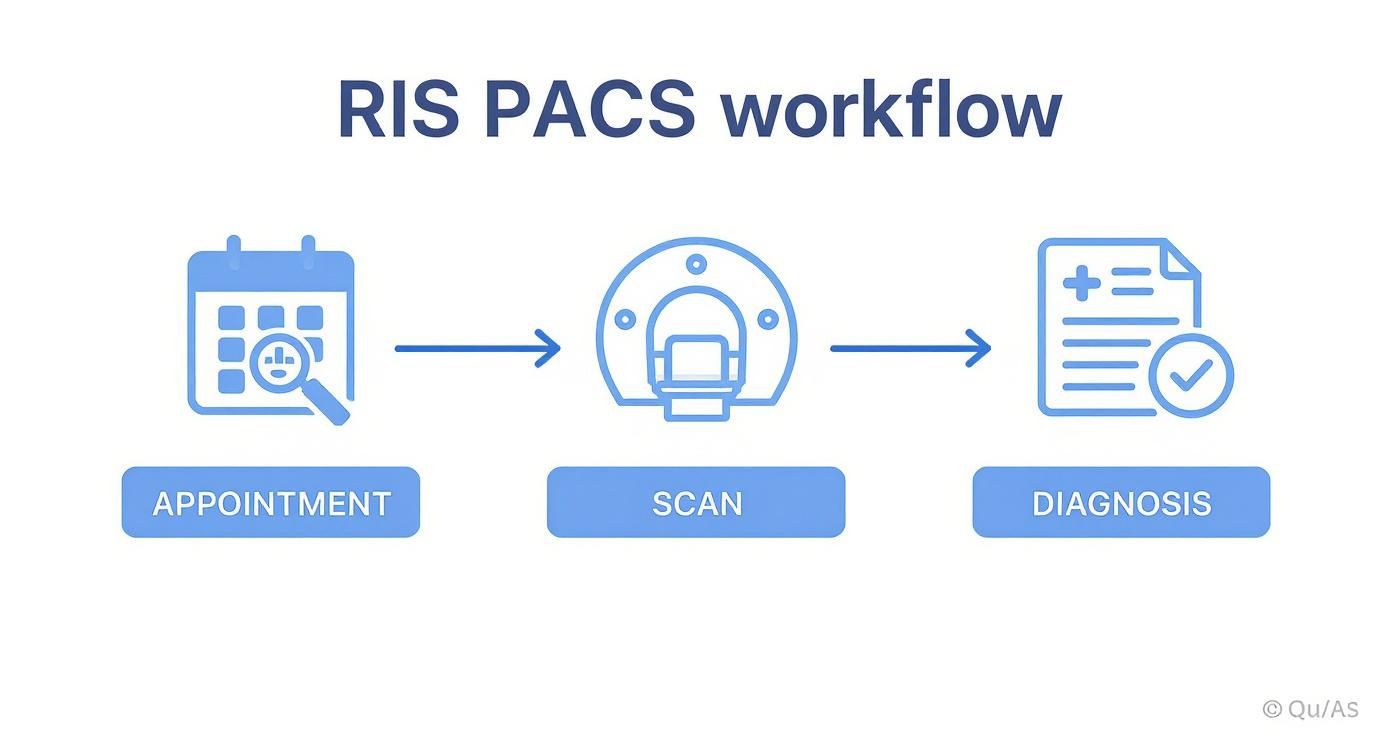
As you can see, the two systems are in constant communication, ensuring data and tasks move smoothly from one stage to the next.
To make the distinction even clearer, let's break down their primary roles. The RIS is all about managing the information surrounding the patient and their appointment, while the PACS is laser-focused on handling the images themselves.
RIS vs PACS Core Functions at a Glance
| Function | Radiology Information System (RIS) | Picture Archiving and Communication System (PACS) |
|---|---|---|
| Primary Role | Manages patient workflow and administrative data. | Manages medical images and related diagnostic data. |
| Key Tasks | Patient scheduling, registration, billing, and reporting. | Image acquisition, storage (VNA), viewing, and sharing. |
| Data Handled | Text-based data: demographics, orders, reports. | Image-based data: DICOM files (MRI, CT, X-ray). |
| User Base | Administrative staff, schedulers, technologists, radiologists. | Radiologists, specialists, referring physicians. |
This table shows how each system owns its domain yet relies completely on the other to function effectively within a hospital or clinic.
The Diagnostic and Reporting Loop
With the images now resting securely in the PACS, they are automatically indexed and linked to the patient's file in the RIS. And this is where the real synergy happens. The RIS sends an alert to the radiologist: a new study is ready for you.
The radiologist opens the images in a PACS viewer. The quality of this viewer can make or break the diagnostic process. At PYCAD, we have deep expertise in building custom web DICOM viewers and integrating them into medical imaging web platforms. This gives specialists the power to analyze crystal-clear images from anywhere, a game-changer for getting diagnoses out fast.
When you bring the patient's story from the RIS together with the clinical evidence from the PACS, you give doctors a complete, 360-degree view. They no longer have to jump between different systems, saving precious minutes that can make all the difference for a patient.
After interpreting the images, the radiologist dictates or types their findings directly into the RIS. The system attaches this final report to the patient's record and links it back to the corresponding images in the PACS. The loop is closed when the report is automatically sent to the referring physician.
This entire dance is choreographed by powerful communication standards like DICOM and HL7 (Health Level Seven). It’s a testament to how well-integrated RIS PACS systems can lift the administrative weight off clinical teams, slash diagnostic turnaround times, and ultimately pave the way for faster, more confident medical decisions.
Choosing Your Medical Imaging Architecture
Deciding how to deploy your RIS PACS systems is one of the most foundational choices you'll make. It's like an architect deciding whether to build on solid rock or reach for the sky. Your selection will define your clinic's agility, security, and room for future growth. The path you take—on-premise, cloud, or a hybrid of both—shapes how you manage, access, and protect your most critical patient data.
This isn't just a technical decision; it's a strategic move that reflects your organization's entire vision. Do you want to build a fortress where you have complete control, or would you rather embrace the boundless potential of an expert-managed infrastructure? Each model comes with its own unique set of opportunities and responsibilities.
The On-Premise Fortress
Think of an on-premise architecture as owning your own home. You have absolute control over every server, every wire, and every security protocol within your physical data center. This hands you unparalleled authority over your data, which is often a non-negotiable for institutions with strict compliance or data sovereignty requirements.
But with great control comes great responsibility. You’re on the hook for everything:
- Upfront Investment: This means significant capital for servers, storage, networking hardware, and the physical space to house it all.
- Ongoing Maintenance: Your IT team is responsible for every update, patch, and hardware replacement.
- Scalability Challenges: Need more storage or computing power? That's a slow and expensive process involving physical upgrades.
This model remains a powerful choice for large, well-resourced organizations that simply must have direct, physical control over their systems.
The Cloud-Based Apartment
A cloud-based system, on the other hand, is like leasing a state-of-the-art apartment in a high-tech skyscraper. You get instant access to world-class infrastructure, security, and amenities without the crushing weight of ownership. The provider handles the hardware, security, and maintenance, freeing you up to focus on what really matters: clinical excellence.
Cloud solutions flip the script, turning a massive capital expenditure into a predictable, manageable operational expense. This shift opens the door for facilities of all sizes to access top-tier technology without needing a massive upfront budget.
The agility this offers is incredible. You can scale your storage and computing resources up or down on a dime, paying only for what you actually use. It’s no wonder the demand for this flexibility is exploding. The global PACS and RIS market was valued at USD 6.58 billion and is projected to nearly double to USD 13.15 billion by 2034. This trend points to a massive industry shift toward more adaptable solutions. You can explore more on these market trends for a deeper dive.
The Best of Both Worlds with a Hybrid Model
For many, the sweet spot lies in a hybrid model. It’s a beautifully balanced solution, combining the ironclad security of on-premise with the nimble flexibility of the cloud. An organization might keep its long-term archive (VNA) on-site for ultimate control while using the cloud for daily operations, disaster recovery, and advanced AI analytics.
This approach lets you tailor your architecture to your exact needs, playing to the strengths of each model. At PYCAD, this is exactly where we shine. We specialize in building custom web DICOM viewers and integrating them seamlessly into medical imaging platforms—whether they live on-premise, in the cloud, or a mix of both.
Our goal is to ensure clinicians have secure, blazing-fast access to images, no matter what the underlying architecture looks like. You can see how we bring this to life in the PYCAD portfolio.
Unlocking the Full Potential of Your Imaging System
A standard RIS and PACS setup is a fantastic starting point, but it's just that—a start. The real magic happens when you push beyond the basics and start building an intelligent, interconnected imaging ecosystem. This is the leap from a simple digital filing cabinet to a dynamic engine that drives faster diagnostics, fuels collaboration, and opens the door to new discoveries.
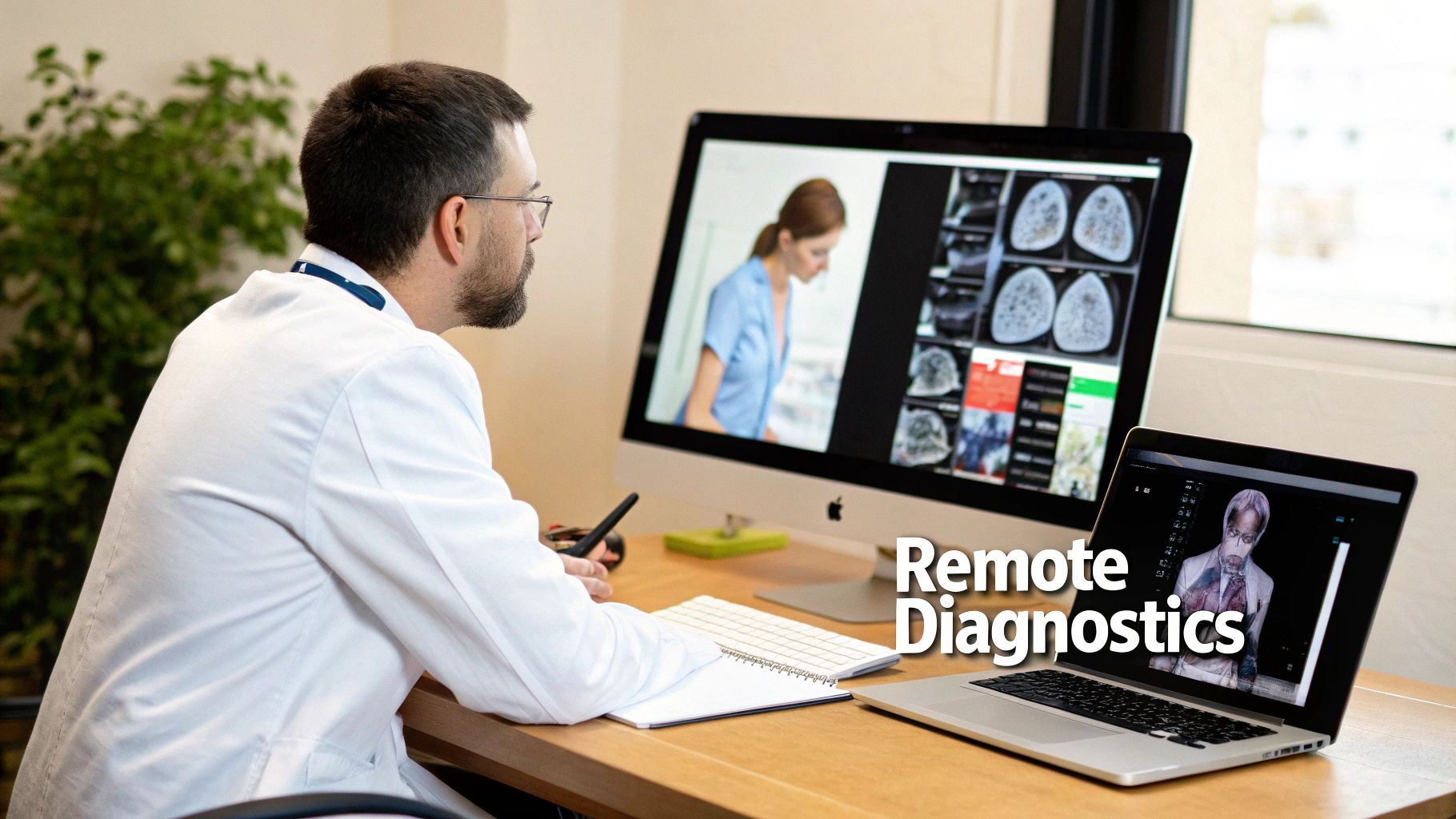
Think about it. What if your top specialists were no longer limited by their physical location? A leading radiologist across the country could instantly pull up a critical scan, offering a second opinion that could change a patient's life. This isn't science fiction; it's the reality made possible by advanced, custom-built web DICOM viewers that grant secure, browser-based access to medical images from anywhere.
Beyond Storage and Retrieval
The future of RIS PACS systems isn't just about storing and retrieving images more efficiently. It’s about smart integrations that create a network far more powerful than the sum of its parts. By weaving your imaging platform into other crucial hospital systems, you create a seamless current of information that boosts efficiency and directly elevates patient care.
This is where true innovation sparks. At PYCAD, we live and breathe this stuff. We specialize in building these custom web DICOM viewers and integrating them into medical imaging web platforms. Our mission is to tear down the walls of the traditional reading room, empowering remote teamwork and slashing the time it takes to get a diagnosis.
A modern imaging system shouldn't just store images; it should generate insights. By integrating with AI for automated analysis or connecting with patient CRM systems, you create a network that actively works to improve care quality and operational efficiency.
This integrated approach paints a complete picture of the patient. When a radiologist can view imaging data alongside clinical notes from a CRM or see AI-flagged areas of concern, their diagnostic confidence skyrockets.
Creating an Intelligent Imaging Network
Building this kind of intelligent network means strategically adding new capabilities to your core RIS PACS systems. Each new connection unlocks another layer of potential, transforming your platform into a central hub for clinical intelligence.
Here are a few of the most impactful integrations:
- Artificial Intelligence (AI): Imagine AI algorithms running an initial pass on images, flagging potential abnormalities for radiologists. This works like a tireless, digital second opinion, helping to improve accuracy and prioritize the most urgent cases.
- Patient CRM Systems: Linking your RIS to a CRM can automate everything from appointment reminders to the secure delivery of results. It’s a simple connection that dramatically improves the patient experience from start to finish.
- Electronic Health Records (EHR): Deep integration with the EHR is non-negotiable. It ensures imaging reports and key images are instantly part of the patient's complete medical record, giving every treating physician the full story.
All of these connections rely on a common language. To build a system that truly works together, you need a solid grasp of these communication frameworks. You can dive into the core principles in our detailed guide on DICOM standards, the essential backbone of all modern medical imaging.
The PYCAD Advantage
This is what we do. Building a future-ready, intelligent imaging ecosystem is our passion. We don’t offer one-size-fits-all boxes; we engineer custom platforms meticulously designed around your unique clinical and operational goals. We firmly believe that technology should bend to your workflow, not the other way around.
By focusing on custom web DICOM viewers and seamless integrations, we help healthcare organizations tap into the incredible power hidden within their imaging data. We help you build a system that delivers faster answers, empowers specialists everywhere, and ultimately raises the standard of patient care. To see what is possible, you can check our work in our PYCAD portfolio.
A Practical Roadmap for Successful Implementation
Bringing a new RIS PACS system into your facility is a huge undertaking. It’s a move that can fundamentally reshape your efficiency and elevate patient care, but its success truly depends on having a smart, well-thought-out plan. A clear roadmap breaks this massive project down into manageable steps, guiding your team from the initial idea all the way to a smooth and successful launch.
The real work starts long before you ever sign a contract with a vendor. First, you need to take a good, hard look at where you are right now. What are the real-world workflow problems holding you back? Where do communication gaps keep cropping up? Answering these questions gives you a clear picture of your needs, which will become the foundation for every decision you make.
This self-assessment is your best asset when you start looking at vendors. Instead of getting distracted by impressive features, you can stay laser-focused on finding a partner whose system solves your specific problems. This is how you make sure you’re investing in a tool that genuinely helps your clinical team and, ultimately, your patients.
Assembling Your Implementation Team
A project of this scale is a team sport, not a solo mission. You absolutely need to build a dedicated team with members from different departments to steer this ship. This group should include people from every corner of your organization who will touch the new RIS PACS systems.
Your dream team should look something like this:
- Clinical Champions: These are the radiologists, technologists, and referring physicians who will live in the system every day. Their insights into the daily grind are priceless.
- IT Specialists: Your tech gurus. They’ll handle the infrastructure, security, data migration, and the critical job of connecting the new system with your existing EMR.
- Administrative Leaders: Think department managers and billing specialists. They see the operational and financial side of things and understand the business impact.
- A Dedicated Project Manager: This person is the glue that holds everything together, keeping the project on track, managing communications, and making sure you hit every deadline.
Getting these key people on board from day one isn't just a good idea—it's essential. When your clinical staff feels like they have a voice in the process, they become champions for the new system instead of roadblocks to its success.
The Go-Live Checklist
As you get closer to the big day, your attention needs to shift to the final, make-or-break steps that ensure a seamless transition. A detailed go-live plan is all about minimizing chaos and setting your team up to win from the moment you flip the switch. It’s about preparing for anything and everything.
A thoughtful implementation strategy anticipates challenges before they arise. This proactive approach transforms a potentially chaotic launch into a controlled, confident rollout that inspires trust across the organization.
Your go-live checklist has to cover three main areas:
- Comprehensive Staff Training: Don't just schedule a one-off webinar. Plan for hands-on, role-specific training sessions where everyone can practice in a safe test environment. Make sure you have extra support on hand for the first few weeks after launch.
- Meticulous Data Migration: Getting years of patient data and images moved over safely and accurately is a massive responsibility. You have to validate everything meticulously to prevent any clinical errors and ensure a seamless continuum of care.
- Robust Integration and Testing: You must confirm that the new RIS PACS systems are talking perfectly to your EMR, billing software, and all your imaging machines. A full, end-to-end workflow test is the only way to catch glitches before they affect a single patient.
And as you bring advanced AI tools into the mix, ensuring GDPR Compliant AI Integration is another critical piece of the puzzle, especially if you handle European patient data.
At PYCAD, we live and breathe these details. We specialize in building custom web DICOM viewers and integrating them into medical imaging web platforms, making sure our solutions fit perfectly into your unique implementation plan. You can see how we bring these integrations to life in our PYCAD portfolio.
The Bigger Picture: Why the Global Medical Imaging Market Matters
Thinking about a RIS/PACS system isn't just about upgrading your facility's tech. It's about tapping into a global standard of care. The worldwide move to digital imaging isn't some far-off trend; it’s a powerful current changing the very fabric of modern medicine. When you see it this way, your investment shifts from a simple operational choice to a strategic imperative.
The momentum is real and it's happening now. Every single day, hospitals and clinics across the globe are ditching their old, clunky workflows for integrated, intelligent platforms. This isn't happening by accident. It's driven by a universal demand for faster diagnoses, smarter data management, and the ability to provide incredible care no matter where the patient or specialist is located.
The Forces Driving This Global Shift
A few key factors are pushing this worldwide migration to modern RIS PACS systems. The biggest one? We're simply creating a staggering amount of complex imaging data. As our diagnostic tools get more powerful, the images they create are richer and more detailed, but also much larger. This flood of data requires truly robust systems to store, share, and analyze it all effectively.
On top of that, the explosion of teleradiology and collaborative care has turned remote image access from a "nice-to-have" into a "must-have." This has opened the door for solutions that completely erase the old physical barriers to getting the right expertise on a case.
Adopting a modern imaging system is really about future-proofing your practice. It's a clear signal that your organization is ready for the challenges and opportunities of a connected healthcare world, keeping you at the leading edge of patient care.
A Look at Regional Growth and Leadership
While digital imaging is catching on everywhere, some regions are definitely setting the pace. North America has long been the dominant market, holding the largest share globally. Not long ago, it accounted for over 42.4% of the entire market, pulling in a massive USD 2.99 billion in revenue. This is largely thanks to high healthcare demand and the early adoption of advanced medical tech. A deeper analysis of these regional dynamics can give you the full picture.
But keep an eye on emerging markets. The Asia-Pacific region, in particular, is growing incredibly fast. This just goes to show that the need for efficient, scalable RIS PACS systems knows no borders. Seeing this global perspective really drives home the importance of picking a solution built for the future—one that can grow and adapt with you.
This is the world we at PYCAD live and breathe. We build custom web DICOM viewers and integrate them into medical imaging web platforms, creating solutions that don't just solve today's problems but are engineered for whatever comes next. We're focused on giving you systems with the flexibility and power to thrive in this constantly changing market. When you work with us, you're not just buying a piece of software; you're investing in a platform designed for long-term growth and clinical excellence. See what's possible by exploring our PYCAD portfolio.
A Few Common Questions About RIS and PACS Systems
Diving into medical imaging technology can feel a little overwhelming, and it's natural to have questions. To help you get your bearings, I've put together answers to some of the most common things people ask about RIS and PACS systems. My goal here is to cut through the jargon and give you a solid, practical understanding of how these two powerhouses work together.
Let’s clear up some of the key concepts so you can see why this technology is so central to modern healthcare.
What’s the Real Difference Between a RIS and a PACS?
Let's use an analogy I find helpful. Think of a busy airport.
The Radiology Information System (RIS) is the air traffic control tower. It's the nerve center for all the logistics. It manages flight schedules (patient appointments), coordinates gate assignments (workflow management), and keeps track of all the flight plans and passenger manifests (billing and reporting). It’s purely focused on the operational data—making sure everyone and everything is in the right place at the right time.
The Picture Archiving and Communication System (PACS), on the other hand, is the secure hangar and the cockpit's dashboard. It’s where the most critical asset—the aircraft itself (the medical image)—is stored safely, maintained, and presented to the pilot (the radiologist) for review. The PACS is all about the visual data. One directs the traffic, the other holds and displays the precious cargo.
Can We Actually Access PACS Images from Outside the Hospital?
Absolutely, and this is one of the biggest game-changers in modern medicine. Today, teleradiology and collaborative care depend on this ability. It’s all made possible by advanced web DICOM viewers that provide secure access to images from anywhere. A clinician can pull up a scan on their laptop at home or on a tablet between appointments, breaking down the physical walls of the hospital.
This remote capability is huge. It means a specialist in a major city can provide a life-saving consultation for a patient in a rural clinic. It allows for faster reads on emergency cases and gives physicians the flexibility they need without ever compromising security or diagnostic quality.
This is exactly what we do at PYCAD. We build custom web DICOM viewers and integrate them into medical imaging web platforms to deliver this kind of on-demand access. We pour our expertise into creating solutions that are not just secure, but also incredibly fast and intuitive to use.
Are Cloud-Based RIS PACS Systems Really Secure?
Yes, they are—when done right. Partnering with a provider that lives and breathes healthcare security makes all the difference. In fact, major cloud platforms often have security infrastructure that’s far more sophisticated than what a single hospital could build and maintain on its own.
Think about it. They have entire teams dedicated to this, employing measures like:
- End-to-end data encryption, protecting information whether it's being sent or just sitting on a server.
- Strict, role-based access controls, ensuring only the right people can see the right data.
- 24/7 threat monitoring and advanced systems designed to stop intruders in their tracks.
- Full compliance with tough regulations like HIPAA.
Moving to the cloud isn't just about storage; it's about investing in world-class security, automatic disaster recovery, and the ability to scale, all handled by experts whose sole job is to keep your data safe.
At PYCAD, we're passionate about building the tools that will define the future of medical imaging. Our deep experience in creating custom, secure web platforms with powerful DICOM viewers is helping healthcare providers unlock new efficiencies and make more confident diagnoses. To see what this looks like in the real world, I invite you to explore our PYCAD portfolio.