Radiology AI is evolving quickly, but most benchmarks still measure only part of what matters. A model may perform well on image classification, visual question answering, or narrow diagnostic tasks and still struggle in a real clinical workflow.
That is why ABRA (Agent Benchmark for Radiology Applications) deserves attention. Published in May 2026, ABRA evaluates whether AI systems can operate as radiology AI agents inside a realistic DICOM workflow rather than simply produce strong scores on static image tasks.
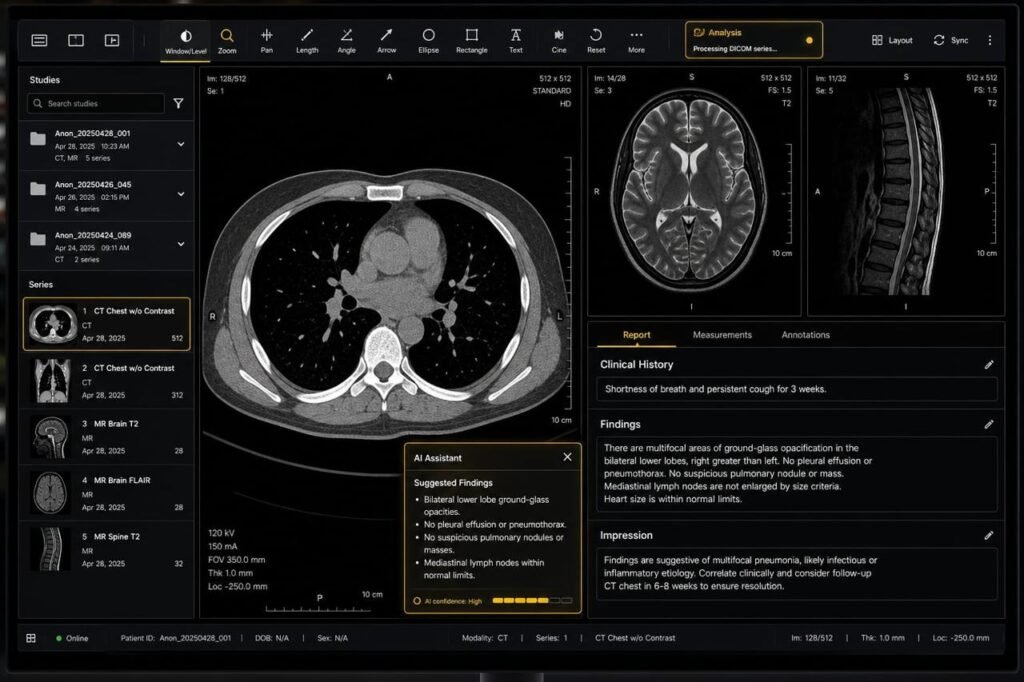
Instead of testing isolated predictions, ABRA examines how models interact with tools such as OHIF, Orthanc, and structured reporting systems. That makes it highly relevant for organizations building modern medical imaging software, custom DICOM viewers, and AI-enabled radiology workflows.
What Is ABRA?
ABRA is a benchmark designed to evaluate how well AI models function inside a practical radiology environment. Rather than focusing only on whether a model can identify a finding on a single image, it asks whether the system can navigate a workflow that resembles real-world imaging practice.
This includes working across:
- DICOM studies and imaging series
- OHIF-based viewer interfaces
- Orthanc-backed image management
- structured reporting tools
That is a significant step forward for radiology AI benchmarking. In actual practice, medical imaging work does not happen in a one-shot prompt-response setting. It happens in software environments where navigation, context, and workflow structure matter.
Why Traditional Radiology AI Benchmarks Are Not Enough
Traditional radiology AI benchmarks have helped the field advance, but they often simplify the work too much.
In a real radiology workflow, a clinician or imaging specialist must do much more than interpret one static image. They often need to:
- open the relevant study
- choose the correct series
- scroll through multiple slices
- compare views across the exam
- gather evidence before reaching a conclusion
- produce a structured output that fits clinical reporting requirements
A model that succeeds on static benchmark images may still fail at these steps. That is why performance on conventional benchmarks does not always translate into deployment success.
ABRA is valuable because it tests the layer that is often missing: whether the model can function inside the workflow.
Why ABRA Matters for Radiology AI Agents
The idea of a radiology AI agent is different from the idea of a standalone imaging model.
A standalone model may recognize patterns well, but an agent has to do more. It must reason across multiple steps, use software tools correctly, maintain context, and generate output in a way that fits the workflow.
This is where ABRA becomes especially important.
It reflects a broader shift in healthcare AI: from asking whether a model can interpret an image to asking whether an AI system can participate in the full imaging process.
That is a more useful question for real-world deployment.
ABRA and Real DICOM Workflow Evaluation
One of the strongest aspects of ABRA is that it is built around a realistic DICOM workflow rather than an abstract benchmark setting.
This matters because medical imaging platforms are operational systems. They are not just datasets. AI performance in those environments depends on more than raw model intelligence. It also depends on workflow design, viewer interaction, data organization, reporting structure, and reliability across multiple steps.
By evaluating AI inside a workflow that includes OHIF and Orthanc, ABRA brings benchmarking closer to the real conditions where imaging software is used.
That makes the benchmark more relevant for:
- radiology software vendors
- healthcare AI startups
- custom DICOM viewer teams
- clinical workflow automation projects
- enterprise imaging platforms
Why This Matters for Custom DICOM Viewers
For companies building imaging tools, ABRA is not just an academic development. It points toward a practical product trend.
At PYCAD, we have already seen how important workflow-specific viewer design can be. In use cases such as dental implant planning and custom neuroimaging DICOM workflows, the imaging interface itself plays a major role in how effectively users can inspect studies, make decisions, and complete reporting tasks.
The same principle applies to AI.
If AI systems are expected to work as agents inside imaging software, then the viewer is no longer just a place where images are displayed. It becomes part of the operational logic of the system. The design of the viewer affects how well an AI agent can navigate, retrieve context, and contribute to the workflow.
This creates an important opportunity for teams building AI-ready DICOM viewers and modern imaging platforms.
A Better Benchmark for Real-World Deployment
One of the persistent challenges in medical AI is the gap between benchmark performance and practical deployment. A system may look highly capable in a research setting but underperform in real use because the benchmark ignored the actual workflow.
ABRA helps reduce that gap.
By focusing on realistic interaction with imaging tools and reporting systems, it encourages a more deployment-oriented view of radiology AI. It highlights capabilities such as:
- workflow navigation
- multi-step reasoning
- tool use
- context retention
- structured report generation
- operational reliability
These are the capabilities that often determine whether an AI product becomes useful in practice.
ABRA in the Broader Medical Imaging AI Trend
ABRA also fits into a larger movement in medical imaging AI.
Recent research is pushing toward more powerful multimodal and vision-language systems. Work such as Merlin, a computed tomography vision-language foundation model and dataset, shows how quickly imaging AI is improving in its ability to connect visual understanding with language reasoning.
But stronger model understanding alone is not enough.
To be useful in deployment, those models also need to operate effectively inside clinical software environments. That is where ABRA adds something important. It evaluates whether model capability can translate into workflow capability.
What Comes Next for Radiology AI Benchmarking?
ABRA may be an early sign of where radiology AI evaluation is heading next.
Future benchmarks will likely go further by testing:
- longitudinal comparison across exams
- multi-study reasoning
- specialty-specific software navigation
- collaboration between human experts and AI systems
- reporting quality and consistency
- reliability in full clinical workflows
That would be a welcome evolution. Medical imaging is inherently complex, and benchmarking should reflect the real conditions under which imaging software and AI systems are deployed.
Final Thoughts
ABRA matters because it asks a more realistic and commercially relevant question than many earlier radiology AI benchmarks.
Not just: Can the model interpret a medical image?
But: Can the model act inside a real DICOM workflow?
That shift from isolated prediction to workflow participation could shape the next stage of radiology AI.
For teams building DICOM infrastructure, custom viewers, and AI-enabled medical imaging platforms, that is a signal worth taking seriously. The future of radiology AI will not be defined by model performance alone. It will also be defined by how effectively those models operate inside the environments built around them.
In that sense, better benchmarks are not just about better evaluation. They are about building better medical imaging products.
Source
ABRA: Agent Benchmark for Radiology Applications
Additional context: Merlin: a computed tomography vision-language foundation model and dataset