
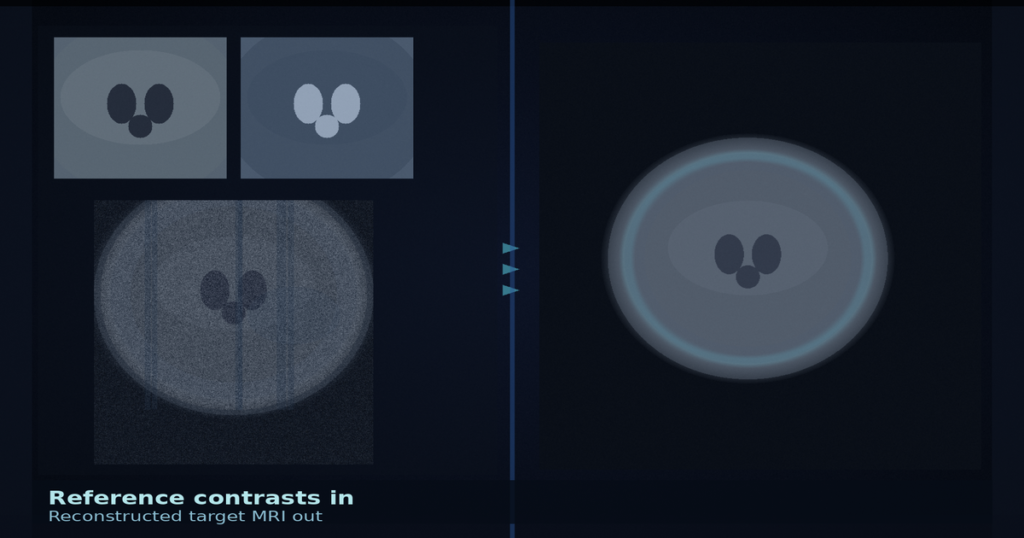
You have a fully sampled reference contrast or two, an undersampled target, and almost no paired raw training data for that scanner. CoSMo-RecNet freezes a reusable multi-contrast content/style prior learned from public unpaired DICOMs, trains a light RecNet on a handful of task-specific raw scans, and returns the reconstructed target. Chinmay Rao, Efe Ilıcak, Matthias J.P. van Osch, Mariya Doneva, Laurens Beljaards, Navid Jabarimani, Nicola Pezzotti, and Marius Staring (LUMC / Philips) posted arXiv:2609.01959 around 2 September 2026. The paper is Data-Efficient Networks for Multi-Contrast MRI Reconstruction based on a Generalized Content/Style Prior. No public code repository is linked in the preprint (checked 5 September 2026).
Guided multi-contrast reconstruction usually wants large paired raw stacks. Low-field and ultra-low-field sites rarely have that. CoSMo-RecNet splits the problem: train CoSMo once on abundant images, then train RecNet on few raw examples so the clinic can hang a cleaned target when references are available.
Public DICOM prior, then a light RecNet
Stage one learns a generalized N-contrast content/style model (CoSMo) on unpaired public DICOMs. Here that is NYU fastMRI brain T1W, T2W, and FLAIR, about 10k subjects at 1.5 T and 3 T. Content encodes shared structure across contrasts. Style encodes what is contrast-specific. No k-space is required for this stage.
Stage two freezes CoSMo and plugs it into a lightweight unrolled RecNet (about 180k learnable parameters). A content-consistency operator injects structure from the fully sampled reference contrast(s) into the undersampled target estimate. RecNet only has to learn a content refiner plus domain adaptors that map the task domain toward the CoSMo domain. One frozen CoSMo can back several RecNets for different contrast mixes, coils, or field strengths.
Evaluation uses low-field 0.3 T M4Raw and an ultra-low-field 47 mT Halbach set (four volunteers), both treated as true low-data and out-of-distribution relative to the high-field DICOM prior.
Where the numbers landed
On M4Raw, with five training subjects or fewer, CoSMo-RecNet reports higher reconstruction quality than a parameter-matched MoDL trained on 100 subjects (the paper cites up to 0.062 higher SSIM). On the 47 mT Halbach data it sits above classical L1-wavelet compressed sensing, zero-shot PnP-CoSMo, and transfer-learned MoDL (examples cited: 0.238, 0.145, and 0.055 higher average SSIM at the stated conditions). Inference is about 1.5 s per case on GPU versus about 14.35 s for PnP-CoSMo on 4-channel 256×256 k-space.
How this lands in a viewer
If you already hang multi-contrast brain MRI in a DICOM viewer, treat CoSMo-RecNet as a reference-guided reconstruction rail before review. Load the fully sampled reference series, run the frozen CoSMo content-consistency step into the undersampled target, let RecNet refine and adapt, then hang the reconstructed target beside the references for reading. Fail closed when no usable reference contrast is present, when references are severely misregistered to the target, or when the target contrast sits outside what CoSMo covers and domain adaptation does not recover. Do not invent a GitHub link; none appears in the preprint.
LoFi RADIO grades acquisition artifacts on portable ultra-low-field neonatal T2. This paper is reference contrasts in, few raw scans to train RecNet, reconstructed target out for low-field and ultra-low-field brain MRI.
Rebuild from arXiv:2609.01959. As of 5 September 2026 the abstract and PDF respond (HTTP 200). No public code link appears in the preprint. The preprint is the source of record until a camera-ready version exists.
Sources
- Rao, C., Ilıcak, E., van Osch, M.J.P., Doneva, M., Beljaards, L., Jabarimani, N., Pezzotti, N., Staring, M. Data-Efficient Networks for Multi-Contrast MRI Reconstruction based on a Generalized Content/Style Prior. arXiv:2609.01959, posted ~2 September 2026. https://arxiv.org/abs/2609.01959 (HTTP 200 on 5 September 2026). PDF: https://arxiv.org/pdf/2609.01959 (HTTP 200 on 5 September 2026). No public code repository linked in the preprint.