
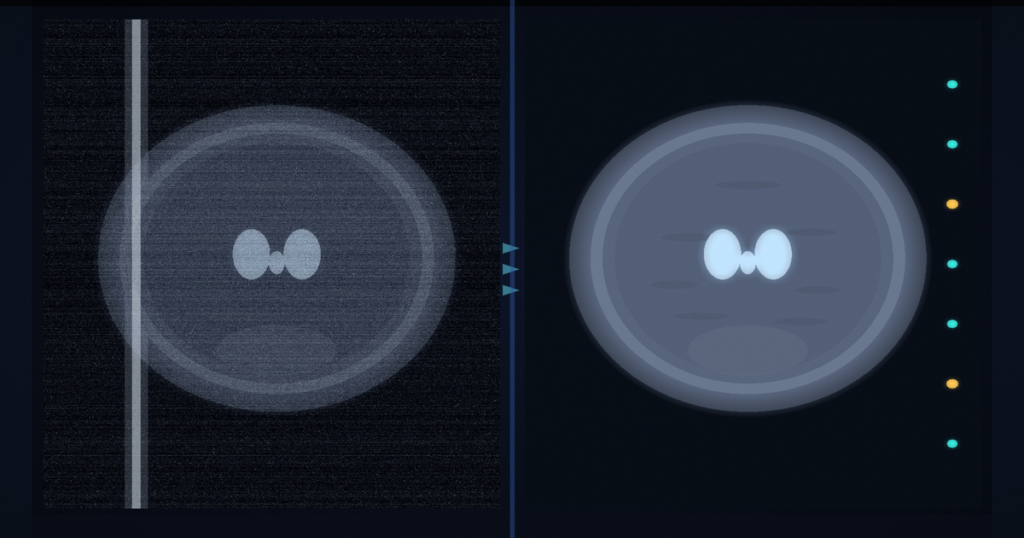
You hang a portable 0.064 T neonatal brain T2 volume and need to know whether noise, zipper, motion, or distortion is bad enough to fail the study before anyone reads it. LoFi RADIO takes that magnitude-only volume, encodes each slice with a distilled ViT-S/14 backbone trained on unlabeled low-field MRI, mean-pools those embeddings into one 384-d descriptor, then an MLP probe returns a 0/1/2 severity grade for each of seven artifacts: Noise, Zipper, Positioning, Banding, Motion, Contrast, Distortion. Jonathan B. Martin, Yashwant Kurmi, and Charlotte R. Sappo (Vanderbilt University Institute of Imaging Science) posted arXiv:2609.02676 around 3 September 2026. The paper is LoFi RADIO: A Distilled In-Domain Backbone Applied for Artifact-Severity Grading of Ultra-Low-Field Neonatal Brain MRI, a MICCAI 2026 satellite. Code is promised at github.com/jonbmartin/LoFi-RADIO-MICCAI upon publication. That repo returned HTTP 404 on 3 September 2026.
Ultra-low-field MRI is cheap and portable enough for neonatal imaging in low-resource settings. It is also noisy, unshielded, and slow, and neonates move. Many of these systems can be run by operators without ARRT MR technologist certification. Automated per-volume QC is the practical gate. The LISA 2026 Task 1a benchmark scores that job on reconstructed T2 volumes from three sites: 531 single-orientation acquisitions from 243 subjects, with axial, coronal, and sagittal labeled independently. The data are magnitude-only, so the phase that would have carried a lot of the motion and zipper signal is already gone.
One distilled backbone instead of four teachers at inference
A frozen foundation-model probe already works on this task. The authors screened DINOv2, SAM, SAM2, BrainIAC, BiomedCLIP, Phikon, MAE, RadioDINO, Triad, and ARNIQA under one protocol: 2.5D slice encoding, mean-pool to a volume descriptor, small MLP head, subject-grouped five-fold. Phikon landed at a composite of 0.8287, DINOv2 at 0.8249, BiomedCLIP at 0.8240. No single backbone won every artifact. Concatenating four teachers (DINOv2, BiomedCLIP, SAM, Phikon) reached 0.8293. A per-artifact softmax gate over those four reached 0.8327. That gate needs all four models sitting in the inference path.
LoFi RADIO distills complementary teachers into one in-domain ViT-S/14 student, initialized from DINOv2, using the AM-RADIO recipe with adaptor heads into each teacher space. Teachers kept for distillation were DINOv2, BiomedCLIP, and Phikon. SAM was dropped because its low-rank features help only through routing, which a single fused student cannot copy. Distillation is unsupervised, so they pooled LISA training images with external low-field brain MRI (M4Raw at 0.3 T plus two 0.064 T adult T2 sets). Leak-free evaluation distilled a separate student per fold so validation images never entered that fold’s distillation corpus.
With DINOv2 plus BiomedCLIP the student composite was 0.8330, matching the four-backbone gate. Adding Phikon moved it to 0.8349. Adding the exact-field OpenNeuro corpus moved it to 0.8374. Gains versus DINOv2 sat mainly in Contrast, Distortion, and Motion, the same classes the gate had helped. On the official withheld LISA validation set the submission scored 0.8322 composite, third of 16 teams (first 0.8356, second 0.8334). Accuracy 0.842, precision 0.833, recall 0.842, F1 0.816, F2 0.828.
How this lands in a viewer
If you already hang portable or ultra-low-field neonatal brain MRI in a DICOM viewer, treat LoFi RADIO as a QC rail, not a segmentation overlay. Load the T2 volume, run the 2.5D encode and mean-pool, then show seven ordinal badges (none / moderate / severe) next to the series. Fail closed when you still have complex k-space and could use phase for motion or zipper (this paper never sees it), when the series is not T2, when you need a native 3D backbone (BrainIAC and Triad underperformed the 2.5D frozen probes here), or when site shift is the real failure mode (three sites, and the authors say generalization across sites limited them more than model capacity). Do not treat a 0.8322 challenge composite as a reject/accept rule on your scanner until you re-validate locally.
PIPG-LDCT cleans a low-dose CT stack without paired normal-dose labels. GazeRefine turns gaze fixations into overlays with a frozen vision backbone. This paper is a 0.064 T neonatal T2 in, seven artifact severity grades out, from one distilled student instead of four foundation models at inference.
Rebuild from arXiv:2609.02676. As of 3 September 2026 the abstract and PDF respond (HTTP 200). The GitHub URL in the paper returned HTTP 404. The authors say code will be posted there upon publication. The preprint is the source of record until a camera-ready version exists.
Sources
- Martin, J. B., Kurmi, Y., Sappo, C. R. LoFi RADIO: A Distilled In-Domain Backbone Applied for Artifact-Severity Grading of Ultra-Low-Field Neonatal Brain MRI. arXiv:2609.02676, posted ~3 September 2026. https://arxiv.org/abs/2609.02676 (HTTP 200 on 3 September 2026). PDF: https://arxiv.org/pdf/2609.02676 (HTTP 200 on 3 September 2026). Code promised at https://github.com/jonbmartin/LoFi-RADIO-MICCAI (HTTP 404 on 3 September 2026).