
Hang one ultrasound stack and ask the viewer for four different product rails at once: a breast lesion mask, a benign or malignant score, a thyroid box, and fetal biometry landmarks. The usual answer is four specialist models. Qing Xu, Yixuan Zhang, Yue Li, Xiangjian He, Qian Zhang, Mainul Haque, Rong Qu, Wenting Duan, Jieyun Bai, and Zhen Chen posted arXiv:2609.20340 around 17 September 2026. The paper is FreqDINO++: A Frequency-Guided Multi-Task Routing Vision Foundation Model for Universal Ultrasound Analysis. Xu, Zhang, and Li share equal contribution. He and Chen are corresponding authors. Code is at github.com/MingLang-FD/FreqDINO-Plus.
FreqDINO++ keeps a frozen DINOv3 backbone and hangs segmentation, classification, detection, and regression through three ultrasound-aware pieces: a Multi-Task Routing Adapter (MR-Adapter), a Frequency-aware Feature Enhancer (F2-Enhancer), and a Task-aligned Collaborative Decoder (TC-Decoder). On the large multi-task FMC-UIA challenge it leads across all four categories at once (about 88.46% DSC, 91.24% AUC / 81.57% F1, 47.75% mAP, 7.74 MRE). External single-task checks land near 81.79% DSC and 97.91% AUC on BUSI, 46.98% mAP on TN5000, and 12.37 MRE on FHC. Unseen BrEaST classification without fine-tuning sits at 84.59% AUC. Inference is about 18.14 ms per image at roughly 205G FLOPs.
What hangs on the viewer
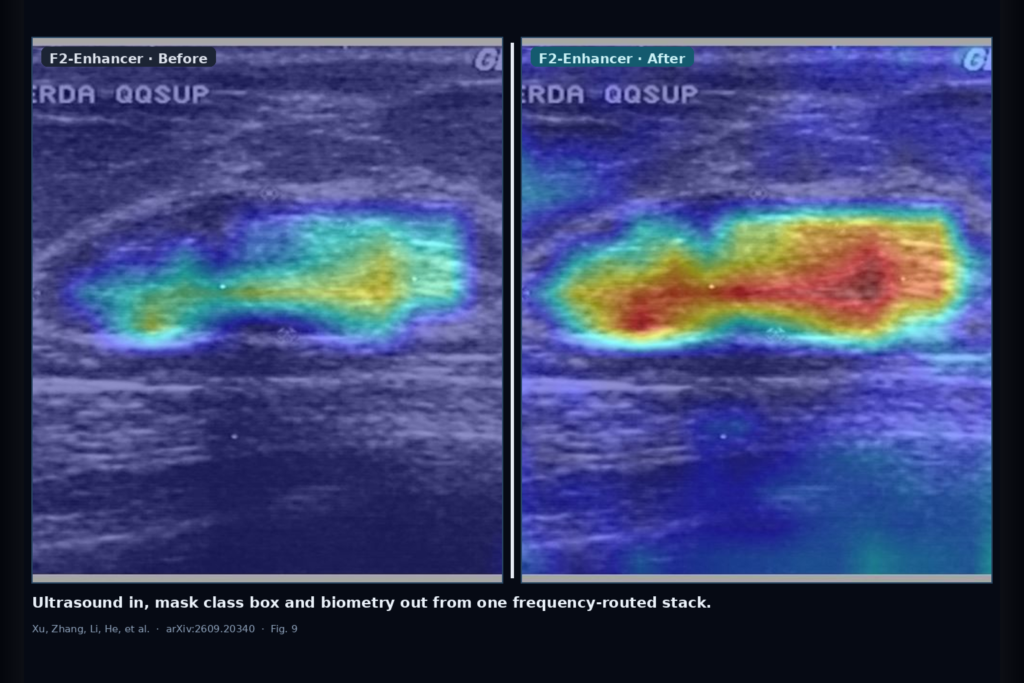
Upstream is a B-mode ultrasound frame. Downstream, one weight stack can return a dense mask, a class score, a detection box, or a biometric regressor output, depending on which task head you arm for that study. For a DICOM shop that means breast lesion overlay plus malignancy score, thyroid nodule boxes, and fetal landmarks such as head circumference or femur length without shipping four separate specialist binaries. Fig. 9 in the paper shows the practical picture: F2-Enhancer attention tightens from a diffuse heatmap to a focused lesion core, then FreqDINO++ mask sits next to ground truth on the same frame.
The point for product is not a leaderboard. It is one rail you can hang beside the study and switch by task id, instead of maintaining a zoo of US-specific nets that never share features.
How the stack is wired
MR-Adapter sits after the feed-forward path in each frozen DINOv3 block. It projects into a small bottleneck, routes through a shared path plus a task-specific expert chosen by the task id, then projects back. That keeps most of DINOv3 frozen while letting breast seg, thyroid det, and fetal reg share common ultrasound features and still specialize where they need to.
F2-Enhancer reads the multi-scale frequency character of ultrasound: low contrast, speckle, and band-dependent texture that natural-image pretraining never saw. It sharpens discriminative bands before decoding. Fig. 9 before versus after is the clinic-facing view of that step.
TC-Decoder then coordinates dense and global heads. Dense work (seg, det) and global work (cls, reg) share the frequency-enhanced tokens through collaborative cross-attention, then branch into FPN-style dense heads or CLS-guided global heads. Training uses task-homogeneous batches so loss scales do not fight each other, with a uniform sampler across the four task families.
Where it still fails
Everything here is ultrasound. Heavy domain shift into CT, MRI, or non-medical RGB is out of scope. A narrow specialist that only does one task can still win that task in isolation; the selling point is simultaneous coverage, not every single metric on every subtask forever. FMC-UIA covers 27 clinical scenarios, but vendor mix, probe settings, and rare anatomies outside those splits need local audit. Unseen BrEaST and TN3K help, but they are still ultrasound benchmarks, not a regulatory clearance. Fail closed when the hanging is not US, when a clinic needs a single-task audit trail with a locked specialist architecture, when latency or FLOPs budgets cannot absorb a ~205G foundation stack, or when the product must refuse outputs outside the trained task ids.
For a viewer or clinic AI shop
Treat FreqDINO++ as a multi-task US foundation rail, not four separate models glued at the API. Hang breast, thyroid, and fetal US studies against one DINOv3-plus-adapter stack. Arm the head you need: mask, class, box, or biometry. Keep a fail-closed path when the study leaves ultrasound or when governance demands a single-task certified model. Rebuild and measure on your own vendor mix before quoting clinic numbers. Latency near 18 ms per image is in the interactive range for many viewers, but still profile on your GPU class.
Rebuild from arXiv:2609.20340. As of 20 September 2026 the abstract and PDF respond. Code: https://github.com/MingLang-FD/FreqDINO-Plus.
Sources
- Xu, Q., Zhang, Y., Li, Y., He, X., Zhang, Q., Haque, M., Qu, R., Duan, W., Bai, J., Chen, Z. FreqDINO++: A Frequency-Guided Multi-Task Routing Vision Foundation Model for Universal Ultrasound Analysis. arXiv:2609.20340, posted ~17 September 2026. https://arxiv.org/abs/2609.20340. PDF: https://arxiv.org/pdf/2609.20340.
- Code: https://github.com/MingLang-FD/FreqDINO-Plus.
- Datasets cited: FMC-UIA 2026 multi-task challenge; BUSI; TN5000; FHC / HC18; BrEaST; TN3K. DINOv3 backbone (cited).