
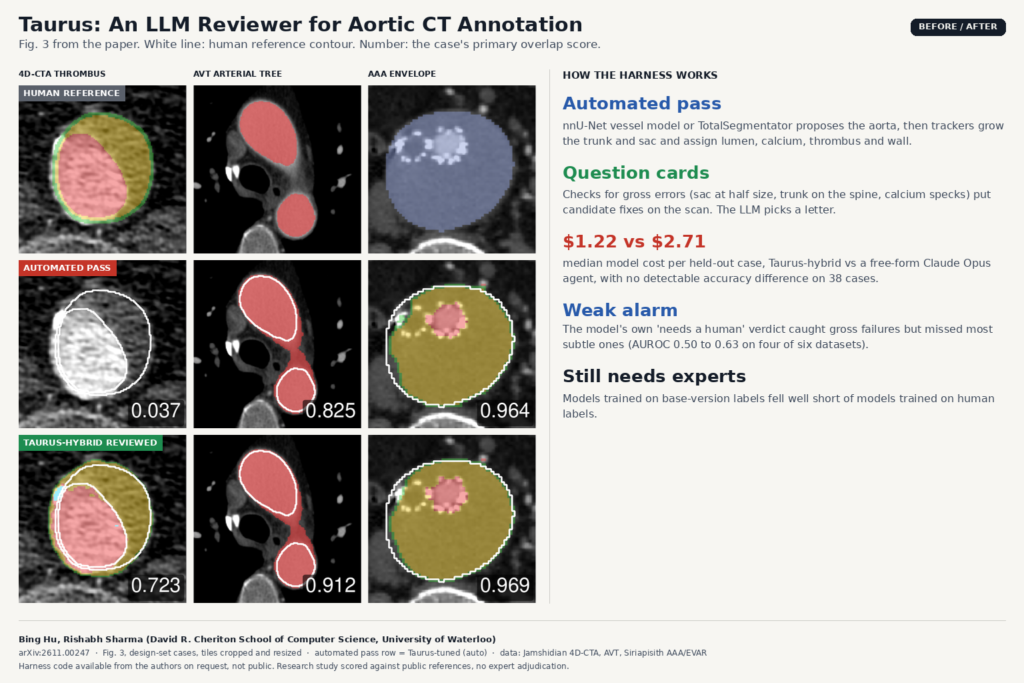
On a vascular CT project, most of the time goes into the label set, not the model. Someone has to draw lumen, thrombus, calcium and wall consistently on hundreds of CT angiograms, with branch names that match the zones a vascular surgeon reports. Public aortic datasets help less than you would hope, because each one labels a different subset under its own rules. In arXiv:2611.00247, Bing Hu and Rishabh Sharma (David R. Cheriton School of Computer Science, University of Waterloo) ask a practical question: if you hand this relabeling job to a large language model, should it write its own segmentation code, or should it review the output of a fixed pipeline? They built Taurus, a review pipeline (the paper calls it a harness) where a deterministic pass draws the labels and the model only makes the judgment calls.
What Taurus does
Taurus has two halves. The automated pass proposes the aorta and branches with an nnU-Net vessel model or TotalSegmentator, grows the trunk and the aneurysm sac with trackers, assigns four tissue classes (lumen, calcium, thrombus and wall) and names 27 vessel labels: the ten aortic zones plus the named branches such as the celiac trunk, renals and iliacs. It also raises quality warnings, for example when the scan header contradicts the anatomy.
The second half is the reviewer, an LLM session (Claude models in the paper) that sees renders of the case and edits the labels only through a fixed set of commands: paint, erase, grow the outer boundary from a click with nnInteractive, lower the lumen threshold, re-track the trunk, add or rename branches, undo. It closes each case with a verdict of ok, fixed or issue, where issue means a human should look.
The piece I like most is the question card. When an automated check finds a likely gross error, Taurus draws two or three candidate corrections on a slice and asks the model to pick one. The paper’s example shows an aneurysm sac with outlines of 121, 114 and 113 mL, and the model answers with a letter. The model chooses between prepared fixes instead of drawing them.
How it got there
The authors built three versions and compared each against free-form agents, meaning a model in a sandbox with the CT and a task description that writes and debugs its own segmentation code. The first version, Taurus-base, used fixed thresholds, and model review barely moved its scores. A free-form Claude Opus agent did better on most datasets.
So they read the free-form transcripts and moved what worked into the automated pass. The agent measured blood attenuation before choosing a threshold, traced the sac out to the surrounding fat and tracked the trunk from a seed. None of that needs a language model. Once those steps ran as fixed rules in Taurus-tuned, they carried most of the held-out gain. The final version, Taurus-hybrid, adds a fixed surface regularization that puts the lumen edge at 0.6 times the measured blood attenuation and smooths the stair-stepped surfaces, then adds checks for the gross errors that remained: a trunk placed on the spine, a sac drawn to half its size, calcium specks on calcium-free scans. Each check that fires becomes a card.
Evaluation used blind label recovery on six public datasets (939 volumes): AortaSeg24, AVT, Siriapisith AAA/EVAR, MosMedData AAA, Jamshidian 4D-CTA and the Vascular Model Repository. Every approach saw only the CT, and each output was converted into the classes of the dataset it was scored against. On 38 held-out cases, the paper found no difference between Taurus-hybrid and the free-form Opus agent in the primary metric, at a median model cost of $1.22 per case against $2.71.
Workflow fit for a viewer or annotation shop
If you run an annotation service or a DICOM viewer with a labeling module, you already have most of this. The automated pass is your existing segmentation stack. The cards are a UI pattern: a slice, a few candidate masks, one choice. That same card works whether the reviewer is a model, a junior annotator or a radiologist doing a final pass, and it produces an audit trail of which candidate was accepted and why.
What hangs on the scan is a tissue label map and a vessel id map under one label contract, plus a verdict and notes about where the model thinks the reference itself is wrong. For a vascular product, those maps feed aneurysm sizing, zone reports for endograft planning and training sets for your own segmenter.
The saving comes from the shape of the work. A reviewer answers a few precise questions, while a free-form agent spends turns writing and debugging a pipeline, so Taurus-hybrid also finished in fewer minutes and fewer turns per case.
Where it fails
The automated pass either works or fails outright. Scans whose header orientation contradicted the anatomy put the proposal on the spine. Two AVT scans without usable contrast for the trunk tools left an almost empty label, and there a cheap free-form Sonnet agent did better because it reads the CT directly.
The model’s own verdict works as a weak alarm. It caught gross failures, such as all 17 header-flipped MosMedData cases, but on four of six datasets it separated failed from acceptable labels barely better than chance. Two reviews of the same case often disagreed. A human who checks only flagged cases would miss most subtle errors.
The labels are not training-ready yet. Segmentation models trained on Taurus-base labels reached 0.699 on Siriapisith AAA/EVAR against 0.975 when trained on human labels, and labels from the later versions were not tested as training data. No expert adjudicated the outputs, expert correction time was not measured, and Taurus-hybrid was designed after its authors had seen held-out results, so it is not a clean blind test. The dollar figures cover model cost only, not the engineering of the pipeline.
Code and license
No public repository. The paper states that the Taurus code, derived labels and result files are available from the authors on reasonable request, subject to dataset licences. Labels derived from MosMedData AAA (CC BY-NC-ND 3.0) and VMR are not released. All six datasets are public under their own licences. The vessel proposal uses nnU-Net and TotalSegmentator, and outer-boundary growth uses nnInteractive, so you can rebuild the automated half from open tools today.
A build order worth copying
Let a strong agent try the task freely, read what it did, turn the deterministic parts into code, and keep the model for the decisions that need judgment, phrased as multiple choice with the options drawn on the image. Then keep an expert in the loop for adjudication, because the authors say the recovered labels still need one before anyone trains a clinical model on them.
Paper: arXiv:2611.00247 · Code: available from the authors on request (no public repo) · Data: six public aortic CT datasets under their own licences