
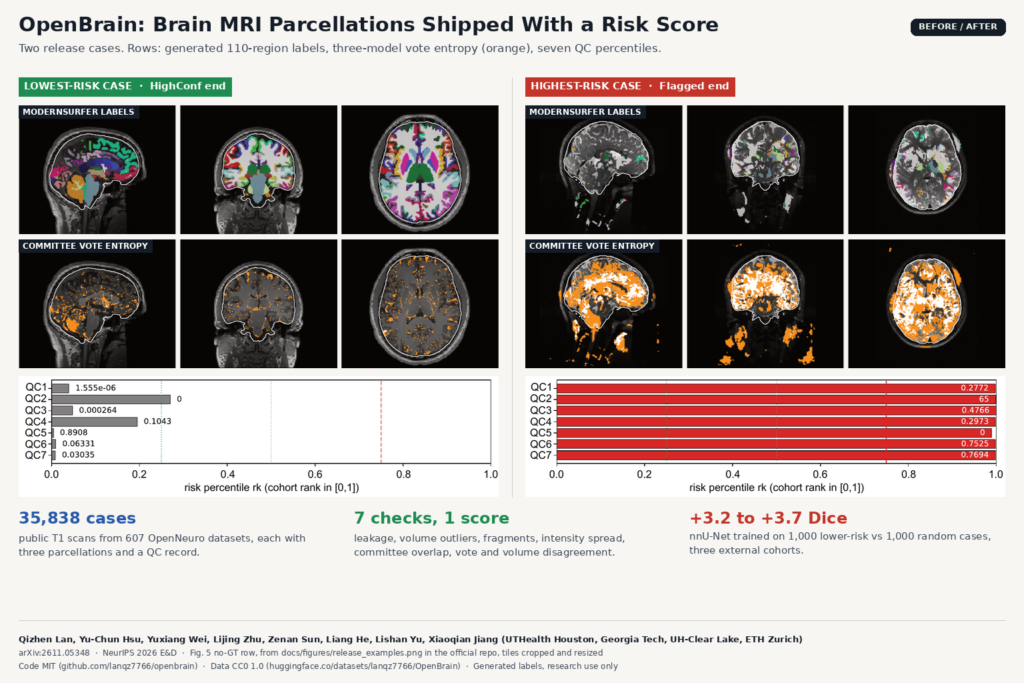
When we train a brain parcellation model on pseudo-labels, we run FastSurfer or SynthSeg over a few thousand public T1 scans and get a folder of label maps. Somewhere in that folder are cases where the cortex leaks into the skull or the hippocampus is a scatter of fragments. Nobody opens all of them. In arXiv:2611.05348, Qizhen Lan, Yu-Chun Hsu, Yuxiang Wei, Lijing Zhu, Zenan Sun, Liang He, Lishan Yu and Xiaoqian Jiang (The University of Texas Health Science Center at Houston, Georgia Institute of Technology, University of Houston-Clear Lake and ETH Zurich) release OpenBrain, a set of generated whole-brain parcellations where every case ships with the evidence you need to decide whether to trust it. It was accepted at the NeurIPS 2026 Evaluations and Datasets track.
What OpenBrain is
OpenBrain covers 35,838 T1-weighted scans drawn from 607 OpenNeuro datasets. Each scan is skull-stripped with SynthStrip, resampled to 1 mm isotropic, and parcellated into 110 regions by ModernSurfer, a 3D residual U-Net trained with nnU-Net v2 on FreeSurfer 7.4.1 labels. That is the primary label. Two more models, SwinUNETR and UNETR, parcellate the same scan, and their outputs are released too. They are there as a committee, so you can see where three different architectures disagree.
The authors describe these as generated labels and say plainly that they are neither manual annotations nor clinical-grade segmentations. The release is organized as case records: each case folder holds the skull-stripped T1, the brain mask, the three parcellations, and a row in a metadata table with the OpenNeuro source, DOI, license, and whatever age, sex and scanner fields the source dataset published.
The seven checks
QC-7 is the piece I would copy. It is a panel of seven reference-free checks run on every case. Three look at label geometry: labels outside the brain mask (Q1), region volumes that are unusual for that source dataset (Q2), and pieces of a region far from its main body (Q3). One checks image-label consistency, meaning how much the T1 intensity varies inside each region (Q4). Three measure committee disagreement: overlap between the primary label and the other two models (Q5), voxel-level vote uncertainty (Q6), and differences in region volumes across the three models (Q7).
Each raw value is turned into a percentile across the release, flipped where needed so that higher always means riskier. The combined risk score R is the plain mean of the seven percentiles. Sort by R and the lowest quarter becomes HighConf, the middle half Standard, and the top quarter Flagged. The raw values are released alongside the tiers, so if you care more about leakage than about committee agreement, you can reweight and re-threshold without rerunning any model.
What it hangs on a scan
Open one case and you get a T1, a 110-label map, two alternative label maps, a voxel-wise disagreement picture you can compute from them, and a bar chart of seven percentiles. In the paper’s figure, the lowest-risk case shows clean labels and only thin entropy along region borders. The highest-risk case has labels scattered across a noisy image, entropy filling the brain, and every bar in the red.
Testing the risk score
The authors froze the checks, the tier cutoffs and the evaluation label set on two development cohorts (IXI and BrainLat) before scoring a manual-label holdout, Mindboggle-101. They then trained nnU-Net on 1,000 lower-risk cases, 1,000 random cases, and 1,000 higher-risk cases. The lower-risk model beat the random one by 3.2 to 3.7 macro Dice points on all three external cohorts. The higher-risk model trailed random by more than 20 points.
Where it falls short
- The labels inherit FreeSurfer conventions. Two of the three validation cohorts use FreeSurfer-derived references, so the largest gains sit inside the same convention the model was trained on. On Mindboggle-101, the only manual-label cohort, keeping the lowest-risk quarter helped less than on BrainLat.
- R is a rank within the release, not a probability of error. A HighConf case can still have a wrong boundary on a small structure, and the gains on 16 subcortical regions are smaller than on the whole brain.
- Lower-risk and random training sets also differ in which OpenNeuro sources they draw from, so part of the training gain may come from source mix rather than label quality.
- There are no disease labels, and age, sex and scanner fields are incomplete, so the authors rule out fairness analyses.
- The committee model weights for SwinUNETR and UNETR are not part of the release. You get their outputs on these 35,838 scans, but if you want Q5 to Q7 on your own data you need to bring your own committee.
What a viewer or clinic shop can take from it
If you build annotation tools or segmentation products, you already live with generated labels. Copy the release format: every auto-generated mask in your pipeline could carry the same kind of record: which model made it, what the source and license were, how two other models voted, and a handful of cheap geometry checks. In a DICOM viewer that becomes a review queue sorted by risk, where an annotator opens the Flagged cases first and skips the HighConf ones, or a training job that drops the top quarter by default. The QC module takes NIfTI folders, and the geometry and intensity checks (Q1 to Q4) run without a committee, so you can try them on your own outputs. Q2 needs more than one scan per source.
For brain work specifically, OpenBrain gives you a large CC0 pretraining or distillation set with the bad tail already marked. The metadata alone is 60 MB, and you can pull one OpenNeuro dataset at a time instead of the full 226 GB.
Code and license
The code is on GitHub at lanqz7766/openbrain under MIT: the seven checks, percentile conversion and tiering, the three training selections, and the evaluation scripts. The data is on Hugging Face at lanqz7766/OpenBrain under CC0 1.0, with a 64-case unpacked sample and one tar per source dataset. Source scans come only from OpenNeuro datasets with CC0-compatible terms. The authors excluded 2,620 audited cases, including those with non-CC0 licenses or unclear redistribution rights. ModernSurfer, the primary labeler, is a separate project under Apache 2.0. The release is for research, not diagnosis or treatment planning.
Paper: arXiv:2611.05348 · Code: github.com/lanqz7766/openbrain (MIT) · Data: huggingface.co/datasets/lanqz7766/OpenBrain (CC0 1.0)