The best healthcare CRM software is so much more than a digital rolodex. It’s a purpose-built platform designed to manage the entire patient journey, from the first point of contact through ongoing care. It needs to speak the language of healthcare—handling complex clinical data, guaranteeing strict HIPAA compliance, and integrating seamlessly with specialized systems like EHRs and medical imaging archives.
Why Your Practice Needs More Than a Standard CRM

In an industry where the patient experience directly shapes health outcomes and organizational trust, a generic CRM just won’t cut it. Standard CRMs are built for sales funnels, not patient care pathways. They simply lack the DNA to manage sensitive health information, navigate the maze of compliance, or connect with the specialized technologies that make up a modern healthcare ecosystem.
When you try to force a square peg into a round hole, you end up with data silos, clunky workflows, and glaring security risks. For everyone from medical device innovators to clinical research teams, the stakes are far too high for a one-size-fits-all solution.
This isn't just a niche opinion; it's a massive market shift. The global healthcare CRM market is on an incredible trajectory, expected to surge from USD 18.76 billion in 2025 to USD 43.40 billion by 2034. That's a compound annual growth rate of nearly 10%, signaling a clear, industry-wide move toward purpose-built platforms.
The Shift to Unified Platforms
The most forward-thinking organizations are no longer just buying software; they're building ecosystems with a specialized CRM at the core. A true healthcare CRM isn’t just a database. It's an intelligent hub that weaves together disparate systems to give clinicians a complete, 360-degree view of the patient.
This philosophy is exactly what drives us at PYCAD. We don't just build tools; we create integrated solutions. At PYCAD, we build custom web DICOM viewers and integrate them into medical imaging web platforms, creating a single source of truth for patient data. Imagine a world where patient communications, appointment histories, and diagnostic images all live in one secure, instantly accessible profile. You can see examples of our work on our portfolio page.
A unified platform transforms a CRM from a simple record-keeping tool into a dynamic clinical asset. It breaks down departmental barriers, enabling seamless collaboration between care teams, researchers, and administrative staff.
Core Differences at a Glance
Getting to grips with the fundamental distinctions between a standard CRM and a healthcare-specific one is the first step toward making a smart investment. The differences go far deeper than a few extra features. You can take a closer look at the role of customer relationship management in a hospital setting to better understand these critical nuances.
| Feature | Standard CRM | Healthcare CRM |
|---|---|---|
| Primary Focus | Sales pipeline, lead conversion, and marketing automation. | Patient journey, care coordination, and outcome improvement. |
| Compliance | General data privacy (e.g., GDPR). | Built-in HIPAA compliance and robust security protocols. |
| Integration | Connects with sales and marketing tools. | Interoperability with EHR, LIS, PACS via HL7, FHIR, and DICOM. |
| Data Types | Manages contacts, deals, and marketing campaigns. | Handles Protected Health Information (PHI) and clinical data. |
Essential Criteria for Evaluating Healthcare CRM Platforms
Choosing the right healthcare CRM isn't just another IT project; it's a foundational move that will define your patient relationships, your operational speed, and your research potential for years to come. To get this right, you have to look past the flashy feature lists. A truly strategic evaluation digs deeper, focusing on the core pillars that matter most in the high-stakes world of medicine and life sciences.
This framework is designed to help you see beyond the sales pitch. It’s about making sure the platform you choose is a resilient, secure, and genuinely intelligent partner in delivering care and driving innovation.
Security and Compliance: The Bedrock of Trust
In healthcare, data security is non-negotiable. It's the absolute bedrock of patient trust and legal survival. A breach isn’t just a PR nightmare; it can trigger devastating regulatory penalties and cause irreparable harm to the very people you’re trying to help. This is why a platform's commitment to compliance is your first and most critical test.
Your evaluation has to confirm the CRM was built from the ground up with security in mind. This means looking for:
- HIPAA Compliance: The system must have built-in safeguards for Protected Health Information (PHI). This includes strict access controls, end-to-end data encryption (both in transit and at rest), and meticulous audit trails.
- GDPR and Global Standards: If you operate internationally, compliance with GDPR and other regional data protection laws isn't optional. It’s a requirement.
- Certifications: Look for independent proof of their security posture, like SOC 2 Type II or ISO 27001 certifications. These aren't just acronyms; they are third-party validations of a vendor's commitment.
Any CRM that treats compliance as an add-on is a massive liability. Demand clear, documented proof of these security measures before you even think about moving forward.
Interoperability: The Key to a Unified View
A healthcare CRM that can't talk to your other critical systems is just a fancy, isolated database. Its real power is unlocked when it can seamlessly exchange information with your entire healthcare IT ecosystem. This is where data interoperability becomes the make-or-break factor for creating a single, accurate view of the patient.
Without it, clinicians are stuck toggling between different applications, a frustrating process that breeds inefficiency and opens the door to critical errors. Think about a radiologist having to log into a separate PACS to view an MRI, then manually type notes back into the CRM. It's a waste of precious time and an invitation for mistakes. To dig deeper, learn more about the critical role of data interoperability in modern healthcare and why it’s so essential.
Key integration standards you absolutely need to see are:
- HL7 (Health Level Seven): This is the long-standing universal standard for exchanging clinical and administrative data between different healthcare software.
- FHIR (Fast Healthcare Interoperability Resources): A more modern, flexible standard that uses web-based APIs to make data sharing between systems—like EHRs and mobile apps—much simpler.
- DICOM (Digital Imaging and Communications in Medicine): For any specialty that relies on imaging, from radiology to medical device research, direct DICOM integration is a must-have.
A truly integrated CRM acts as a central nervous system for patient data. It pulls information from EHRs, labs, and imaging archives, presenting a single, cohesive patient story that empowers better clinical decisions.
At PYCAD, we know this kind of integration is fundamental. That’s why we build custom web DICOM viewers and integrate them into medical imaging web platforms, ensuring that diagnostic-quality images are right there, inside the CRM workflow where they belong. You can see examples of our integrated solutions on our portfolio page.
AI and Automation: From Data Storage to Intelligent Action
The best healthcare CRMs today do more than just hold onto information; they actively help you understand it. Artificial intelligence and automation have moved from buzzwords to essential tools for cutting down on administrative work, uncovering clinical insights, and personalizing patient engagement at scale.
When you're evaluating a platform, look for intelligent features that deliver real-world value. This could be anything from AI-powered risk scoring models that flag high-risk patients for proactive care, to automated workflows that handle appointment reminders and follow-ups, freeing your staff to focus on what matters most.
Deployment and Vendor Support: Your Partner for the Long Haul
Finally, you have to get practical about implementation and long-term support. The deployment model—cloud-based or on-premise—carries huge implications for scalability, cost, and control. This decision has completely reshaped the industry; a stunning 87% of all CRM systems now run on cloud infrastructure, a massive leap from just 12% in 2008. The trend underscores the cloud's clear advantages in flexibility and lower upfront costs, though on-premise solutions still have their place for organizations needing absolute data sovereignty.
But the technology is only half the equation. The quality of vendor support is what separates a good tool from a great partnership. You need a partner who provides thorough training, responsive technical help, and a clear vision for the future. Look for a vendor who acts less like a supplier and more like a strategic ally, truly invested in helping you achieve your long-term goals.
Before making a final decision, it's wise to consolidate these points into a structured checklist. This ensures a consistent and thorough evaluation process across all potential vendors.
Healthcare CRM Evaluation Criteria Checklist
Here’s a summary of the essential criteria to guide your assessment. Use this table to compare platforms side-by-side and ensure you're not missing any critical elements.
| Evaluation Criterion | Key Considerations for Medical & Tech Orgs | Red Flags to Watch For |
|---|---|---|
| Security & Compliance | HIPAA, GDPR, SOC 2, ISO 27001 certifications. End-to-end encryption. Granular access controls and audit trails. | Vague security policies. Lack of third-party certifications. Treating compliance as an "add-on" feature. |
| Interoperability & Integration | Native support for HL7, FHIR, and DICOM. Robust API for custom integrations. Pre-built connectors for common EHRs/PACS. | Proprietary data formats. Limited or no API access. Requiring expensive, custom integration for basic tasks. |
| DICOM & Medical Imaging | Integrated, zero-footprint DICOM viewer. Ability to link images directly to patient records. Support for various imaging modalities. | Requires a separate login for a PACS. Slow image loading times. Inability to handle large imaging datasets. |
| AI & Automation | Predictive analytics for patient risk. Automated communication workflows. AI-driven data analysis for research insights. | "AI" is just a buzzword with no practical features. Automation is rigid and cannot be customized. |
| Deployment Model | Cloud (SaaS) for scalability and lower overhead. On-premise for total data control. Hybrid options. | Inflexible deployment options. Hidden costs associated with cloud hosting or on-premise maintenance. |
| Vendor Support & Partnership | 24/7 technical support. Dedicated implementation team. Clear product roadmap. Strong industry reputation and case studies. | Poor customer reviews. High-pressure sales tactics. No clear plan for future product development. |
Using a structured checklist like this prevents emotional decisions and grounds your choice in the practical, high-stakes realities of modern healthcare. It ensures the platform you select is not just a tool for today, but a foundation for a healthier future.
The Power of an Integrated DICOM Viewer in Your CRM

Imagine a world where diagnostic images aren't locked away in a separate Picture Archiving and Communication System (PACS). What if they lived right inside the patient's profile, ready to view with a single click? That's the profound shift that happens when a web-based DICOM viewer is built directly into a world-class healthcare CRM.
This one change elevates your CRM from a simple database to a dynamic command center for clinical work and research. It shatters the wall between administrative data and critical diagnostic insights, forging a single, unified view of the patient that fuels faster decisions and better collaboration.
For clinicians, the daily frustration of switching between systems or waiting on image transfers disappears. They can view, analyze, and discuss MRIs, CT scans, or X-rays in the very same interface they use for patient communication and history. It’s a completely fluid and efficient way of working.
A Gateway to Advanced Clinical and Research Work
The real magic of an integrated viewer reveals itself when you start exploring the powerful new workflows it enables. This isn’t just about convenience; it's about unlocking entirely new possibilities for patient care, research, and medical device innovation.
When imaging data is woven into the fabric of your patient records, you can:
- Collaborate on Diagnoses from Anywhere: Specialists across the globe can securely access and review patient scans together, in real time, all within the CRM. This makes remote consultations and second opinions not just possible, but practical.
- Simplify Clinical Trial Management: For research organizations and medical device companies, managing imaging data for trials becomes incredibly straightforward. Images can be tagged, annotated, and linked directly to a participant's profile, guaranteeing data integrity and streamlining analysis.
- Deepen Patient Engagement: During a telehealth call or an in-person visit, a clinician can instantly pull up a patient’s scans on-screen. Sharing these visuals helps patients understand their condition and participate more actively in their own care.
By bringing diagnostic imaging into the core workflow, an integrated DICOM viewer transforms a CRM into an active participant in the clinical process. It's the difference between merely storing data and actively using it to drive better outcomes.
The PYCAD Approach to Integrated Imaging
Achieving this level of deep, seamless integration is where genuine expertise makes all the difference. At PYCAD, we don't just advocate for this approach—we live and breathe it. We specialize in building custom web DICOM viewers and integrating them into medical imaging web platforms. Our entire focus is on creating zero-footprint, high-performance viewers that feel like a natural extension of your CRM.
We know that for medical imaging to be truly effective, it has to be immediate, accessible, and diagnostically precise. That’s why our solutions are engineered for speed, security, and accuracy, giving clinicians and researchers the powerful tools they need, exactly where they need them. You can dive deeper into the technical capabilities and see how it all works by exploring the essentials of a modern https://pycad.co/dicom-viewer/.
This dedication to flawless integration turns a standard CRM into a powerful, context-rich hub of innovation. It’s a true game-changer.
Using AI to Predict Patient Needs and Personalize Care
Artificial intelligence isn't some far-off concept anymore; it's a real, practical force that's completely changing how we manage patient care. The best healthcare CRM software today is far from being a simple database. Instead, it’s an intelligent system built to anticipate needs, personalize how you connect with patients, and automate the busywork. This shift lets clinicians get back to what they do best: delivering exceptional care.
This isn't just a minor upgrade. It’s a seismic shift in where healthcare technology dollars are going. AI integration is the fastest-growing part of this market, which was valued at USD 11.04 billion in 2025 and is expected to explode to USD 48.4 billion by 2033. Considering that 82% of healthcare organizations already use CRM software, it’s clear that AI is becoming the new standard. If you want to dive deeper, you can discover more insights about the CRM market and its growth.
Real-World AI Applications That Actually Matter
A truly smart CRM delivers tangible results you can see in both the clinic and your operations. The whole point is to turn all that patient data you're collecting into something you can act on—something that improves patient health and makes your team more efficient.
Here are three areas where AI is making a huge difference right now:
- AI-Powered Image Analysis: When you connect a DICOM viewer to your CRM, AI algorithms can scan medical images to spot anomalies, outline structures, or flag anything that might need a closer look from a radiologist. This doesn't replace the expert, but it makes their diagnostic process faster and more accurate.
- Predictive Risk Modeling: Imagine being able to identify patients at high risk for a specific condition or hospital readmission before it happens. AI models can do just that by analyzing massive amounts of data—patient history, lab results, demographics—and flagging individuals who need proactive intervention.
- Intelligent Workflow Automation: AI is fantastic at handling the routine stuff. It can manage appointment scheduling, send out follow-up reminders, and even gather pre-visit information from patients automatically. This frees up your staff and ensures patients get consistent, timely communication.
Building a Truly Intelligent, Unified Platform
The real magic happens when AI isn't just another standalone tool but is woven directly into a single, unified platform. An isolated AI app just creates another data headache. But an integrated one? It makes your entire system smarter. At PYCAD, this is our specialty. We don’t just bolt on AI features; we build cohesive systems where the CRM, a custom web DICOM viewer, and specialized AI algorithms all work together seamlessly.
A modern healthcare CRM shouldn't just store data; it should provide actionable intelligence. By integrating custom AI solutions, a platform can become the intelligent heart of a clinical and operational strategy, turning patient information into predictive insights.
For example, we can build an AI model that analyzes images from a connected medical device, shows the results right inside our integrated DICOM viewer, and automatically updates that patient’s risk score in the CRM. It’s a single, fluid workflow. This deep integration is what separates a basic CRM from a truly intelligent healthcare ecosystem. You can see what this looks like in practice in our portfolio of completed projects.
Reducing Clinician Burnout While Improving Outcomes
One of the most powerful things a great AI strategy can do is fight clinician burnout. The sheer volume of administrative tasks is a major source of stress for healthcare professionals. By automating all that repetitive work, AI gives clinicians back their time, letting them focus on human connection and the complex decisions that matter most.
It goes beyond just patient care. AI in a CRM makes the entire operation run smoother. When a system intelligently manages paperwork, sorts patient questions, and handles follow-up schedules, the whole team breathes easier. Exploring how AI-powered documentation solutions reduce this burden really highlights the impact. A less stressed, more focused team ultimately delivers better care and achieves better clinical outcomes.
Choosing Your Path: Custom vs. Off-the-Shelf Solutions
Every healthcare organization eventually faces a crucial decision when looking for a CRM: do you bend your workflows to fit a pre-packaged product, or do you build a solution that molds perfectly to your unique needs? This isn't just about comparing features—it’s a choice that will define your team's efficiency, your ability to scale, and your power to innovate for years to come.
An off-the-shelf system, like Salesforce Health Cloud, gets you up and running fast. These platforms come with a solid set of pre-built tools designed for common industry tasks. For a small clinic or a new practice with straightforward processes, it's a quick way to modernize without getting bogged down in development. But that speed often comes at the cost of true flexibility.
On the other hand, a custom-built platform is crafted from the ground up to be a perfect reflection of how you already work. It’s the right move for organizations with one-of-a-kind workflows, specific research needs, or complex integrations that out-of-the-box systems just can't handle. The initial timeline might be longer, but the result is a system that feels like a natural extension of your team, not another tool they have to fight.
Customization and Workflow Alignment
The real difference boils down to how the software aligns with your day-to-day operations. Off-the-shelf systems let you customize, but only within the walls they’ve built. You can add a few fields here and tweak a dashboard there, but you can’t change the fundamental logic. Your team ends up learning to work the vendor's way.
A custom solution puts your workflow at the center of the universe. Imagine a medical device company needing to pull data directly from its proprietary hardware for clinical trials. Or a research institute that requires a specialized data analysis module that simply doesn't exist anywhere else. That’s where custom shines.
A bespoke CRM becomes a strategic asset when your operational model is your competitive advantage. It ensures that your technology empowers your unique processes rather than constraining them.
At PYCAD, this is our bread and butter. We build custom web DICOM viewers and integrate them into medical imaging web platforms, creating a single, fluid environment where your specific clinical or research workflow is the central focus.
This decision path shows how patient data can flow through an intelligent CRM, branching into predictive models and automated workflows to deliver truly personalized care.
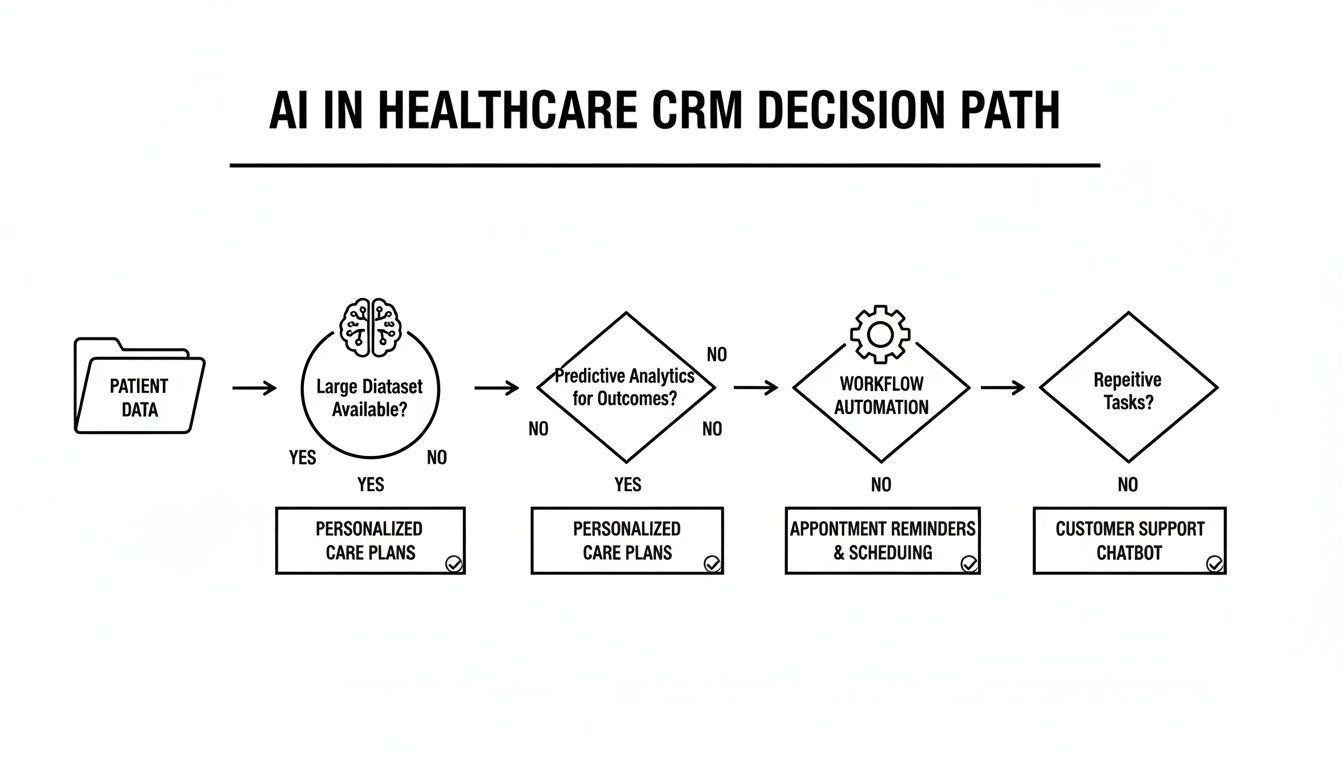
The diagram makes it clear: a modern healthcare CRM shouldn't just be a database. It needs to be an intelligent engine that turns data into meaningful action for both patients and providers.
The table below breaks down the strategic differences between these two approaches, helping you see where your organization's priorities align.
Custom-Built vs. Off-the-Shelf Healthcare CRM Comparison
| Factor | Off-the-Shelf Solution (e.g., Salesforce Health Cloud) | Custom-Built Platform (e.g., PYCAD Solution) |
|---|---|---|
| Workflow Alignment | Standardized; teams adapt to the software's logic. | Built around your exact processes; software adapts to you. |
| Initial Deployment | Fast. Weeks to a few months. | Slower. Several months to a year or more. |
| Flexibility | Limited to vendor-provided configuration options. | Nearly limitless. Can be designed for any unique need. |
| Cost Structure | Lower upfront cost, but high recurring per-user license fees. | Higher upfront investment, but no ongoing license fees. |
| Integration | Relies on pre-built connectors that may not support legacy or proprietary systems. | Can be deeply integrated with any system (EHR, PACS, custom hardware). |
| Competitive Edge | Uses the same tools as competitors. | Creates a proprietary asset that can become a key differentiator. |
| Ownership & Control | You're a tenant on the vendor's platform; subject to their updates and pricing changes. | You own the intellectual property and control the roadmap. |
Ultimately, an off-the-shelf solution can be a fantastic starting point for many. But for those looking to build a true competitive advantage, a custom platform is often the only path forward.
Scalability and Long-Term Return on Investment
Scalability is a huge piece of the puzzle. While pre-built CRMs are made to grow, their cost model is usually tied to per-user licenses. As you add more staff, those recurring fees can skyrocket, turning what was once a budget-friendly tool into a major long-term expense.
A custom platform flips the financial model. Yes, there's a larger investment upfront, but you own the software. That means no more perpetual licensing fees eating into your budget. The real ROI comes from superior efficiency, freedom from user-based costs, and the power to pivot your business without asking a vendor for permission.
The Strategic Imperative for a Custom Platform
For many, the choice becomes obvious when a standard solution starts creating more workarounds than solutions. A custom platform isn't just a preference; it’s a strategic necessity when you face situations like these:
- Proprietary Device Integration: You need to connect your CRM with unique medical devices or diagnostic equipment that standard connectors just don't support.
- Complex Research Workflows: You're a clinical research organization with specialized protocols for data collection, anonymization, and analysis that generic CRMs can't handle.
- Deep EHR/PACS Integration: Your entire operation depends on a flawless, two-way data flow with legacy systems that pre-built integrations can’t fully manage.
- Unique Compliance Needs: You operate in a niche field with specific regulatory or reporting rules that go beyond the basics of HIPAA.
Choosing the right partner is just as important as choosing the right path. Our work, which you can see in our portfolio, shows our dedication to building these highly specialized, integrated platforms that empower the future of medicine. The decision you make today will shape your organization’s agility and potential for years to come.
Building Your Future-Ready Healthcare Ecosystem

The future of medicine won’t be won with siloed tools. It will be built on a single, intelligent, and completely unified ecosystem. Choosing the right healthcare CRM is a great first step, but the real leap forward happens when you architect a platform where every single component works in concert. This isn't just about buying software; it's about building a strategic foundation for whatever tomorrow brings.
Think of it as a secure, scalable web platform with a powerful CRM beating at its heart. This central system does more than just hold data—it connects every thread of the patient journey. It’s about creating total synergy, where information flows without friction between departments, devices, and disciplines.
The Blueprint for a Modern Platform
A truly modern healthcare platform is built on one thing: seamless integration. The best architecture weaves three critical elements into one cohesive unit, finally solving the frustrating problems of data fragmentation and clunky workflows that plague so many practices.
This ideal blueprint looks something like this:
- A Dynamic CRM Core: This is the central nervous system, managing all patient and operational data.
- An Integrated Web DICOM Viewer: This brings diagnostic imaging right into the primary workflow, so you can stop toggling between separate systems.
- Proprietary AI Algorithms: These turn mountains of raw data into predictive insights, guiding clinical decisions and automating routine work.
This integrated approach is exactly what we live and breathe at PYCAD. We specialize in building these kinds of systems from the ground up. At PYCAD, we build custom web DICOM viewers and integrate them into medical imaging web platforms, creating an environment where every piece of information is right where you need it, when you need it. To fully bring a future-ready ecosystem to life, it’s essential to partner with experts who offer comprehensive IT services for the healthcare sector.
We don't just see ourselves as developers. We’re strategic partners, dedicated to building solutions that empower discovery and elevate care. Our job is to construct the technological backbone that lets you focus on what really matters.
This is so much more than just software. It’s a commitment to a smarter way of working. It’s about building a system that anticipates needs, fuels collaboration, and delivers the clarity required to make life-changing decisions.
I invite you to see what’s possible by exploring our portfolio. Let's discover how we can build the future of healthcare, together.
Your Questions, Answered
Choosing the right healthcare CRM is a big decision, and it’s natural to have questions. Let's tackle some of the most common ones that come up when leaders are planning their next big move.
What Really Sets a Healthcare CRM Apart?
Think of it this way: a standard CRM is built to track a sales lead, but a healthcare CRM is engineered to manage a human life. The difference is profound. You absolutely must have built-in HIPAA compliance, not as an afterthought, but as part of its core DNA.
It also needs to speak the language of healthcare—fluently. That means native support for interoperability standards like HL7 and FHIR, allowing it to communicate seamlessly with EHRs and other clinical systems. These aren't just features; they're the essential guardrails for protecting patient data and ensuring care continuity.
How Does an Integrated DICOM Viewer Change the Game?
For a medical device company, a DICOM viewer built right into your CRM is more than a convenience; it's a strategic advantage. Imagine your clinical trial team accessing and managing imaging data directly within their workflow, no more jumping between systems.
This integration also opens up new possibilities for remote support and training, letting your experts guide device users in real-time. It transforms your CRM from a simple data repository into an active, value-adding part of your product ecosystem. At PYCAD, we specialize in building these custom web DICOM viewers and embedding them directly into medical platforms to unlock this potential.
Where Do I Start on a Custom Project?
Embarking on a custom healthcare CRM project feels like a huge undertaking, but it starts with a simple, focused step: a deep-dive needs assessment. You need to map out your specific clinical workflows, identify every integration point with EHRs or devices, and define what success truly looks like for your organization.
Once you have that blueprint, the next step is finding the right partner. Don't just look for developers; look for a team that lives and breathes the complexities of healthcare technology. The right experts won't just build what you ask for—they'll help you build what you need.
At PYCAD, we’re not just code-writers; we are your strategic partners in building the future of healthcare. Take a look at what we've built for others and imagine what we could build for you in our portfolio.