
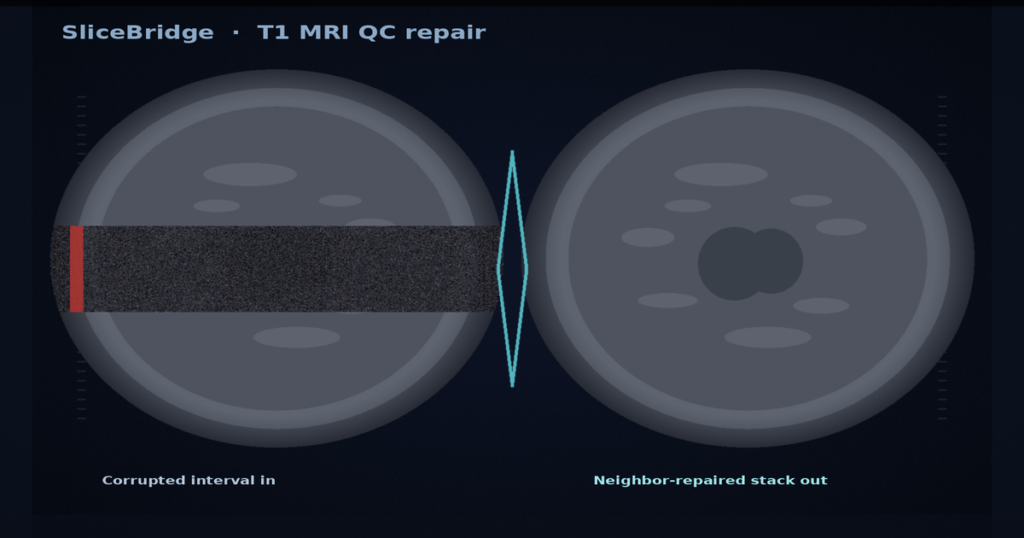
A T1 brain volume often fails on a short contiguous band of axial slices while the rest of the stack is fine. SliceBridge takes that flagged interval, reconstructs each missing axial slice from the intact neighbors and their relative positions with a shared rectified-flow U-Net, then writes the repaired interval back and leaves every other slice untouched. Jiheng Li, Michael E. Kim, Trent Schwartz, Gaurav Rudravaram, Derek B. Archer, Timothy J. Hohman, Lianrui Zuo, Bennett A. Landman, and collaborators at Vanderbilt (with ADNI data) posted arXiv:2609.01827 around 1 September 2026. The paper is SliceBridge: context-consistent repair of corrupted slice intervals in T1-weighted MRI.
Throwing out the whole scan wastes usable anatomy. Whole-volume correction rewrites slices that were already trustworthy. SliceBridge stays local: you already know which interval is bad (manual QC or a slice-level detector), you withhold that content from the model, and you hang only the reconstructed band back into the volume.
Neighbors plus positions, coordinated axial repair
The model is a time-conditioned 2D U-Net trained with rectified flow matching. For each target slice it conditions on up to 16 intact context slices on each side of the interval (skipping any other corrupted slices in the search range), plus context-offset and target-position maps so the shared context stack knows where the current target sits. Through-plane consistency comes from three couplings: interval-correlated initial noise, a shared flow time during training, and synchronized sampling at inference (10 Euler steps, one deterministic candidate per interval).
Development used 9,877 QC-passed T1 volumes from ADNI, AOMIC, NACC, and OASIS-3 (7,901 train / 1,976 val). External evaluation held out IXI (581 subjects). Baselines were linear interpolation between the nearest intact boundaries, coronal EG-GAN row inpainting mapped back to axial, and an Uncoupled flow twin that matches SliceBridge except for the interval-level coupling.
Where the numbers landed
On clean-interval withholding at length 6, SliceBridge reaches foreground SSIM 0.824 versus Uncoupled flow 0.814, EG-GAN 0.755, and linear interpolation 0.706 (similar ordering at lengths 1 and 12). Across intervals of length 2 to 12 it cuts mean internal z-gradient MAE by 32.9% to 41.3% relative to Uncoupled flow, and it is the only learned method that beats linear interpolation on that through-plane metric at every length. Under controlled corruptions, median affected-ROI absolute percentage error from SLANT-TICV volumes falls from 1.95% on corrupted stacks to 1.05% after SliceBridge (lower error in 79.7% of paired cases). Uncoupled flow lands at the same 1.05% median APE, so the coordination gain shows up mainly in slice-to-slice consistency rather than this regional volume endpoint.
How this lands in a viewer
If you already hang T1 stacks in a DICOM viewer, treat SliceBridge as a QC repair rail. Mark the bad axial interval, pull bilateral intact neighbors, run the coupled flow reconstruction, and hang the repaired band back on the same study for morphometry or human review. Fail closed when the bad band sits near the volume ends and you cannot gather 16 eligible context slices on both sides, when the corruption is not axial, when the interval was never flagged (detection is out of scope), or when you need quantified repair uncertainty (the paper samples one deterministic candidate).
PIPG-LDCT cleans a low-dose CT stack without paired normal-dose training. This paper is flagged corrupted axial interval in, neighbor-conditioned repaired T1 slices out.
Rebuild from arXiv:2609.01827. As of 6 September 2026 the abstract and PDF respond (HTTP 200). No public code link is listed in the preprint; the PDF is the source of record until a camera-ready or repo appears.
Sources
- Li, J., Kim, M. E., Schwartz, T., Rudravaram, G., Archer, D. B., Hohman, T. J., for the Alzheimer’s Disease Neuroimaging Initiative, Zuo, L., Landman, B. A. SliceBridge: context-consistent repair of corrupted slice intervals in T1-weighted MRI. arXiv:2609.01827, posted ~1 September 2026. https://arxiv.org/abs/2609.01827 (HTTP 200 on 6 September 2026). PDF: https://arxiv.org/pdf/2609.01827 (HTTP 200 on 6 September 2026).