
TotalSegmentator has become the default way to get more than 100 labelled structures out of a CT scan, and a lot of opportunistic work now rests on it: muscle area for sarcopenia, bone for osteoporosis, organ volumes and attenuation charts built from tens of thousands of exams. The problem shows up when you try to run it on a whole archive. With the reference command-line tool, one exam takes roughly one to four minutes on a high-end consumer GPU, so a hospital backlog can occupy a GPU for weeks.
FlashSegmentator, posted on 24 November 2026 as arXiv:2611.32208, leaves the model alone. Yosuke Yamagishi, Tomohiro Kikuchi, Shouhei Hanaoka, Takeharu Yoshikawa and Osamu Abe (The University of Tokyo, The University of Tokyo Hospital and Jichi Medical University) kept the same TotalSegmentator weights, the same 1.5 mm resolution and the same sliding-window settings, and rewrote only how the work is scheduled on the GPU. You get the same label maps, much faster.
What it changes
The starting point is FastSegmentator, an open reimplementation of the TotalSegmentator inference path that already moved pre- and postprocessing to the GPU. Like the reference tool, it still handles one exam at a time and one 128 by 128 by 128 patch at a time, so most of the GPU sits idle. FlashSegmentator adds six changes on top:
- Each of the five nnU-Net networks is compiled once with
torch.compilefor a fixed input shape; incomplete batches are zero-padded so the graph never has to recompile. - cuDNN autotuning picks the fastest convolution algorithm per layer.
- Exams are processed in groups of four in a three-stage pipeline: CPU threads load and resample the next group and write the previous one while the GPU runs the current group.
- Patches from all exams in a group are pooled and pushed through each network in batches (8 on a GH200, 4 on an A100 or T4).
- Turning network outputs into labels and merging the five part-model label maps happens on the GPU.
- The writer reuses the header read with the input and writes 8-bit labels instead of re-reading the image.
Patch size, step size 0.8, Gaussian weighting, no test-time mirroring and fp16 mixed precision all stay as in the reference. The authors also tried TensorRT, ONNX Runtime, fusing the five networks into one grouped-convolution network and a channels-last layout. None of them beat the compiled PyTorch networks, so none were adopted, and the numbers are in the supplement.
How it was tested
The comparison used public data only: 73 CT exams from the TotalSegmentator v2.0.1 test split, 30 abdominal CTs from BTCV with manual labels, 512 training-split CTs for the concurrency runs, and 55 exams from the TotalSegmentator MRI test split. Three GPUs were used: a GH200 node of the Miyabi-G supercomputer and Azure A100 and T4 virtual machines. Throughput counts wall-clock time from reading the first exam to writing the last one, so input and output are included. Accuracy was checked with paired Dice differences against the reference tool and a two one-sided equivalence test with a margin of plus or minus 0.01.
FlashSegmentator processed 3782, 1810 and 270 exams per hour on the GH200, A100 and T4, which is 57.7, 33.9 and 6.4 times the reference tool on the same GPU. All 117 structures were equivalent on every GPU, and on the GH200 the mean Dice was 0.93765 for the reference and 0.93766 for FlashSegmentator. On the 55 MRI exams the speed-up was 94-fold with all 50 structures equivalent.
Compared with the --fast modes
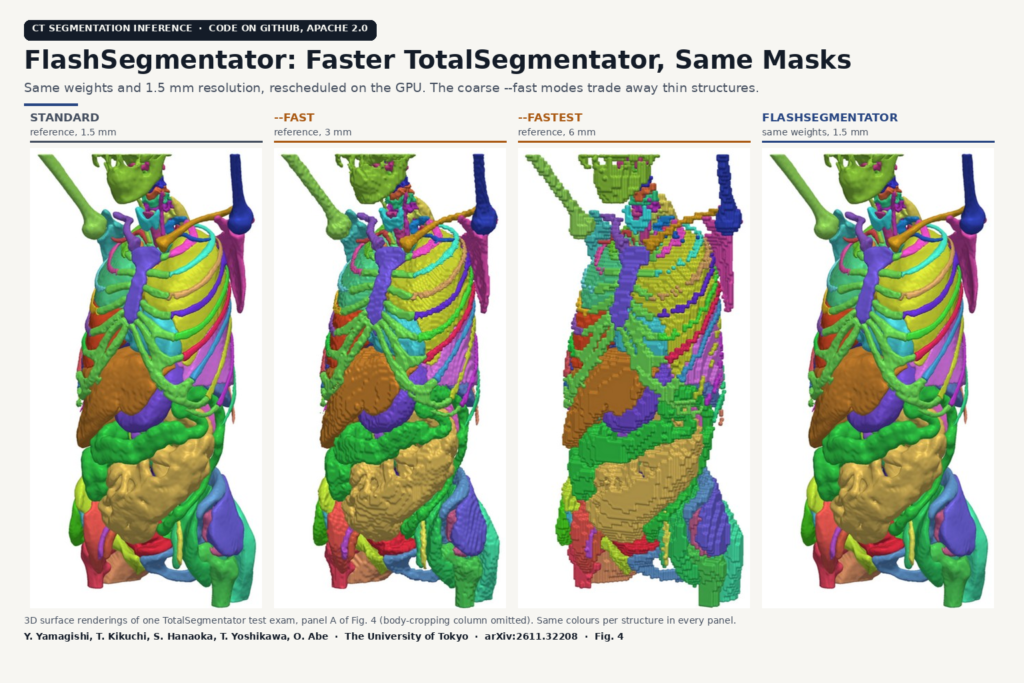
TotalSegmentator already ships lower-resolution modes. On the A100, --fast (3 mm) and --fastest (6 mm) reached 181 and 213 exams per hour, and they cost 0.116 and 0.241 in mean Dice. The loss lands on thin and small structures. The sixth cervical vertebra drops from 0.944 to 0.600 with --fast and to 0.444 with --fastest. Figure 4 of the paper, used as the featured image here, shows what that looks like in 3D: stair-stepped surfaces and broken ribs at --fastest, while the FlashSegmentator output looks the same as the standard mode. FlashSegmentator at full resolution was still about 8 to 10 times faster than those coarse modes.
Where it fits in a viewer or clinical platform
If you run TotalSegmentator behind a PACS-connected service or a DICOM viewer, plan around the single-process design. FlashSegmentator kept the A100 at 93% mean utilisation with one process, against 7% for the reference tool and 48% for compiled FastSegmentator. Extra processes on the same GPU only competed for memory and lowered its throughput. So the scaling rule is one FlashSegmentator process per GPU, and you add GPUs, instead of stacking workers on one card.
On Azure list prices from 18 November 2026, segmenting 10,000 exams on an A100 VM came to about US $997 with the reference tool run one call at a time and US $29 with FlashSegmentator. On a T4 VM it was US $167 against US $26 (US $20 with body cropping). Storage and data transfer are not included.
Messy archives get a bonus. Sixteen test exams had direction cosines in the header that were not exactly orthonormal, and both the reference tool and FastSegmentator failed when writing their output, so they were excluded from the comparison. FlashSegmentator reuses the input header and processed all 16. Header problems like this are common in real hospital exports.
Limits
- It covers only the CT total task and the MRI total_mr task. Organ-specific TotalSegmentator tasks and other segmentation models were not tested.
- The optional body cropping, which crops to the body bounding box before tiling and adds a factor of 1.26 to 1.37 in speed, changes the output. It was noninferior overall but only for 106 of 117 structures, so the authors recommend leaving it off for whole-body work that includes thin structures.
- For images not already at 1.5 mm, resampling can create small differences. On BTCV, 12 of 13 structures were equivalent and the portal and splenic veins narrowly missed the margin.
- Each timing condition was measured once, so run-to-run variation is unknown, and concurrency was only tested on the GH200 and A100.
- The throughput numbers start from NIfTI files. PACS retrieval and DICOM conversion are outside the benchmark, and in a real deployment they may become the bottleneck.
Licence, code and status
The paper is an arXiv preprint (19 pages, CC BY 4.0) and has not been peer reviewed. The code, together with the throughput and agreement scripts, is public at github.com/yamagishi0824/FlashSegmentator under Apache 2.0. It is a fork of FastSegmentator, which is also Apache 2.0, and the README calls it research code and a work in progress. There are no new weights: it downloads and uses the TotalSegmentator weights, which stay under TotalSegmentator’s own licence terms, so check those before commercial use. Input is a folder of NIfTI volumes and output is one multilabel .nii.gz per exam.
Source: Yamagishi, Kikuchi, Hanaoka, Yoshikawa and Abe, “FlashSegmentator: High-Throughput TotalSegmentator Inference without Loss of Accuracy”, arXiv:2611.32208 (CC BY 4.0). Figure reproduced from the preprint with credit to the authors.