
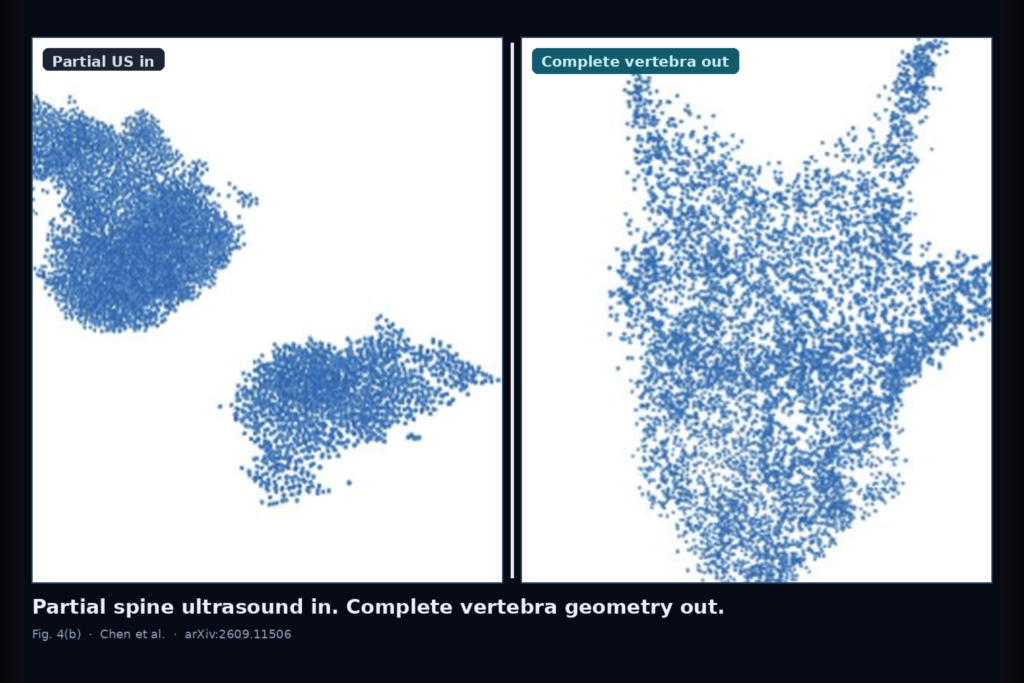
Hang a tracked lumbar or thoracic ultrasound sweep in your stack, segment what the probe can see, and you still get a sparse, artifact-laden point cloud. Spinous processes drop out. Cortical surfaces thicken. Streaks and shadows leave holes that a voxel stack only smears further. UBone3D takes that partial ultrasound point cloud and returns a complete vertebra geometry you can hang beside the B-modes for scoliosis follow-up or ortho planning without another CT. Weiying Chen, Yuchong Gao, Siyuan Li, Marek Reformat, Rui Zheng, and Edmond Lou (University of Alberta and ShanghaiTech) posted arXiv:2609.11506 on 10 September 2026. The paper is UBone3D: Physics-Rectified Conditional Flow Matching for Anatomical 3D Shape Completion from Ultrasound. Project page: https://answerrtx.github.io/UBone3D-Proj/.
Adolescent idiopathic scoliosis patients often need repeated imaging across years. Ultrasound avoids ionizing dose, but recovering a clean 3D bone model from imperfect segmentation-derived US points is the hard part. Pure geometric completers assume clean input. Real Clarius sweeps do not. This work trains an anatomy prior on Spine1K CT vertebrae, then steers completion at test time with a differentiable ultrasound physics proxy so the filled-in bone stays consistent with what the probe actually observed.
What goes in, what comes out
Input is a partial 3D point cloud built from segmented B-mode frames after pose aggregation. Output is a completed vertebra point cloud (anatomically consistent geometry) that fills missing arches and bodies while keeping fidelity on the active ultrasound observation area. The anatomy prior, BoneFM, is a conditional flow-matching model with a PointNet++ velocity network and FiLM conditioning. The physics proxy, USimNet, is a lightweight PointNet++ that maps a complete anatomy cloud into an ultrasound-style observation so gradients can pull the flow back toward physically plausible coverage.
Simulation training uses Spine1K-PC: vertebrae cut from Spine1K CT, then corrupted with field-of-view cuts, body cuts, and acoustic effects (shadowing, attenuation, thick-surface response, axial streaks, anti-grid sampling). In-vivo testing used 5 healthy adult volunteers scanned with a Clarius transducer; 24 thoracic and lumbar vertebrae were extracted for a sim-to-real check. Inference runs Heun integration over 35 steps with classifier-free guidance and a delayed physics-rectification schedule.
How physics rectification steers the completion
BoneFM alone already knows vertebral shape from CT. Without physics, it can still hallucinate geometry that a real probe could never have seen from that pose. USimNet acts as a differentiable stand-in for ultrasound formation. During test-time flow, its observation-consistency gradient clips and reweights the velocity so completed points stay compatible with the partial US cloud. Observation anchoring also re-projects a fixed subset of visible input points onto the flow path each step so local detail does not drift away from the scan.
On simulated full-physics tests, UBone3D reaches L1 Chamfer about 28.2×10⁻³ and F-score@1% about 0.079 when trained on physics-rich observations, with lower Earth Mover’s Distance than most baselines that look competitive on Chamfer alone. Ablations show full USimNet beats both no-proxy and simple-physics variants. On zero-shot in-vivo data, laminae distance error against a VNN reference drops to about 1.3 mm for UBone3D versus roughly 3.4 to 3.9 mm for the adapted baselines in their Table 3. Qualitative Fig. 4 shows sparse input clusters becoming recognizable vertebrae where PoinTr, SVDFormer, and SSM-Net leave noise or collapsed bodies.
Where it still fails
In-vivo evidence is still small: 5 volunteers, 24 vertebrae, healthy adults only. Pathologic deformity, implants, and pediatric curves are out of scope. The pipeline assumes you already have segmented B-modes and poses; it does not replace probe tracking or the US bone segmenter. Completions are per-vertebra point clouds, not a fused full-spine mesh ready for surgical navigation. The authors note real-world visuals still need improvement relative to the clean simulation panels. If your clinic needs millimeter-accurate pedicle corridors on diseased spines tomorrow, this preprint is a research path, not a cleared product.
For a viewer shop
Treat UBone3D as a post-sweep geometry rail: partial US point cloud in, complete vertebra overlay or mesh proxy out, with physics rectification to keep the fill-in honest to the probe. Pair it with your existing Clarius or tracked B-mode pipeline and Spine1K-style priors when you want radiation-free longitudinal bone shape without inventing anatomy the ultrasound never supported. Fail closed when segmentation is missing, when poses are untracked, when the case leaves the healthy thoracic/lumbar volunteer distribution, and when you need whole-spine fusion or implant-aware models this paper never trained.
Rebuild from arXiv:2609.11506 and the project page above. As of 12 September 2026 the abstract, PDF, and project page respond. Check the project page for code and model release status; the preprint is the source of record until a camera-ready version exists.
Sources
- Chen, W., Gao, Y., Li, S., Reformat, M., Zheng, R., Lou, E. UBone3D: Physics-Rectified Conditional Flow Matching for Anatomical 3D Shape Completion from Ultrasound. arXiv:2609.11506, posted 10 September 2026. https://arxiv.org/abs/2609.11506. PDF: https://arxiv.org/pdf/2609.11506. Project: https://answerrtx.github.io/UBone3D-Proj/.
- Spine1K dataset (cited CT anatomy prior for vertebrae).
- Qi, C. R., et al. PointNet++. NeurIPS 2017.
- Yu, X., et al. PoinTr: Diverse Point Cloud Completion with Geometry-Aware Transformers. ICCV 2021.
- Gafencu et al. Shape completion works on ultrasound bone morphology (cited physics-aware vertebral completion baseline).