
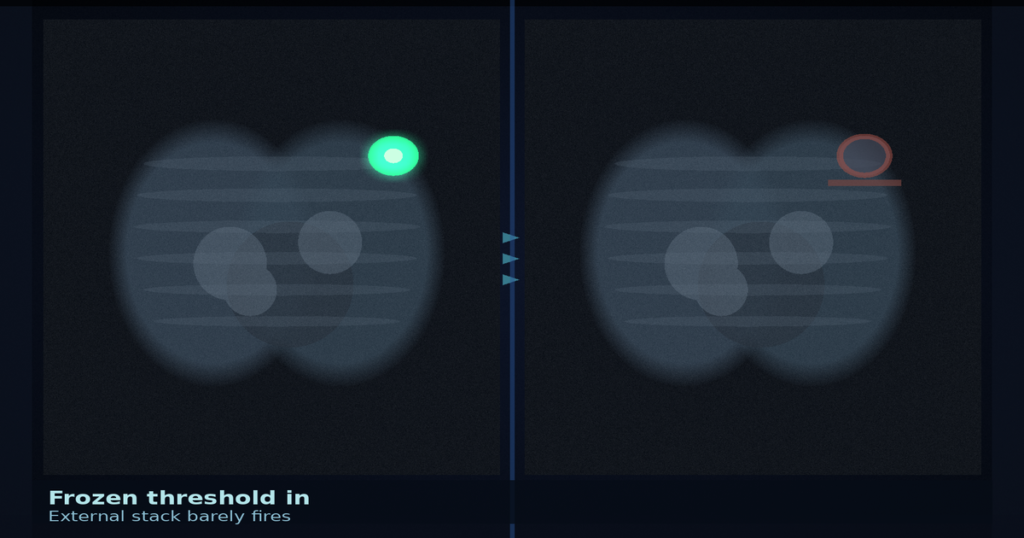
Train a pediatric pneumonia classifier on Guangzhou chest X-rays, lock the operating threshold that hit 95% sensitivity at home, then hang the same model on Bangladesh and Vietnam stacks. Ranking still looks usable. The frozen threshold almost never fires. Nazim-E-Alam (American International University-Bangladesh) posted arXiv:2609.05140 around 4 September 2026. The paper is Cross-dataset transportability of pediatric chest X-ray deep learning across three countries: discrimination, calibration, operating-point failure, and limited-label recovery. Journal target: Computer Methods and Programs in Biomedicine. A curated reproducibility-code archive ships with the submission; raw radiographs stay with the original dataset providers.
External CXR AI reviews often collapse into AUROC. This protocol keeps five lanes separate: discrimination, probability calibration, fixed operating-point transport, shortcut or acquisition-associated signal, and limited-label recoverability. That split matters in a viewer worklist, where the number you hang on a study is a decision threshold, not a ranking curve.
Guangzhou train, Bangladesh and Vietnam freeze-test
After exact-duplicate removal, 5,824 Guangzhou radiographs supported leakage-controlled source development and internal testing. A frozen three-seed DenseNet121 dual-view ensemble (full radiograph plus lung-conditioned view with a learned gate and MixStyle during source training only) was evaluated zero-shot on BDCXR-3257 from Bangladesh (n=3,257) and an untouched harmonized VinDr-PCXR/PediCXR test cohort from Vietnam (n=1,077). Temperature scaling and the primary threshold were fit on Guangzhou tuning only. The primary threshold was the highest-specificity source-tuning ROC point that still reached at least 90% sensitivity (0.9999728). Bangladesh was used for adaptation only after its full-cohort zero-shot result was retained. No Vietnam image or label entered training, calibration, thresholding, or adaptation.
Matched seed-42 variants (full-image DenseNet121, ungated dual-view, gated MixStyle) all showed the same qualitative source-to-Bangladesh drop, so the transport failure is not one architecture quirk.
Where the numbers landed
Internal AUROC was 0.976 with 95.1% sensitivity at the frozen threshold. On Bangladesh, AUROC fell to 0.798 while frozen-threshold sensitivity fell to 6.2% (specificity 99.9%). On Vietnam, AUROC was 0.742 and frozen-threshold sensitivity was 0%. Calibration also drifted (Bangladesh ECE 0.258). A post-hoc liberal source-only threshold recovered Bangladesh sensitivity to 69.0% and Vietnam to 15.9%, so the extreme primary cutoff amplified the failure but did not create the cross-dataset score shift.
With 163 Bangladesh labels (5% of the cohort), Platt recalibration preserved AUROC while lifting held-out sensitivity to 88.3%. Specificity fell to 47.9%, the alert rate hit 78.5%, and false alerts were 14.1 per 100 exams. Two hundred repeated 163-label fits confirmed sensitivity recovery with wide specificity swing. Prespecified last-block fine-tuning at 326 labels did not beat matched Platt on AUROC. Shortcut stress tests left Bangladesh pneumonia AUROC above chance on background-only (0.719) and border-only (0.667) views.
How this lands in a viewer
If you already hang pediatric CXR in a DICOM viewer, treat this paper as a transport checklist rather than a new backbone. Keep the source-locked score, the site-recalibrated score, and the frozen versus local threshold as separate overlays or worklist flags. Fail closed when you ship a source threshold unchanged to a new country or vendor stack, when AUROC alone is used to green-light a deployment, or when recalibration restores sensitivity while the alert rate explodes. The paper also keeps untouched external testing distinct from later target adaptation, which is the right discipline for a multi-site viewer rollout.
InstEditSeg turns a text instruction into a color overlay on polyp or skin frames. This paper is China-trained pediatric CXR in, Bangladesh and Vietnam stacks that still rank but drop the locked decision threshold.
Rebuild from arXiv:2609.05140. As of 7 September 2026 the abstract and PDF respond (HTTP 200). The preprint is the source of record until a camera-ready CMPB version exists.
Sources
- Nazim-E-Alam. Cross-dataset transportability of pediatric chest X-ray deep learning across three countries: discrimination, calibration, operating-point failure, and limited-label recovery. arXiv:2609.05140, posted ~4 September 2026. https://arxiv.org/abs/2609.05140 (HTTP 200 on 7 September 2026). PDF: https://arxiv.org/pdf/2609.05140 (HTTP 200 on 7 September 2026). Reproducibility-code archive supplied with the submission; raw radiographs remain with the original providers.